

Comics News
Tripwire’s 101 Greatest Comic Artists Of All Time: No.34: Burne Hogarth


No.34: Burne Hogarth
One of the unsung pioneers of the four color medium, Burne Hogarth was, like contemporaries Hal Foster and Milton Canniff, a huge influence on many artists that followed in his footsteps, and was one of the cornerstones of the development of the comic form. As an artist, he was one of the first illustrators who understood the possibilities of the comic strip and how its parameters could be expanded – such innovation would of course be the lodestar for legends such as Will Eisner, Frank Frazetta, Wally Wood and Al Williamson. Words: Andrew Colman…
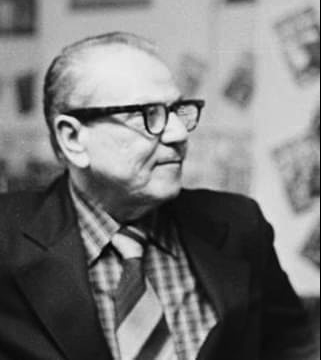
Getting his start early in the still-fledgling industry, Hogarth was studying art at the Art Institute in Chicago at the age of twelve and would continue at other distinguished colleges, studying anthropology, psychology and art history. He entered the business at 15, and by 18, he had drawn his first comic strip, Ivy Hemmanhaw. From 1929 Hogarth was struggling to find work due to the Great Depression, and opted to move to New York in the early 1930s, where his career would take off.
Having served his apprenticeship both as an artist and as an editor, Hogarth was called upon by artist Lyman Young to assist him with Tim Tyler’s Luck as his previous assistant, none other than the legendary Alex Raymond, was about to leave and start his own strips, such as Flash Gordon. He then spent several years in the mid-1930s at King Features Syndicate on odd strips such as Charles Driscoll’s pirate series Pieces of Eight before being offered his career-defining strip, Tarzan.

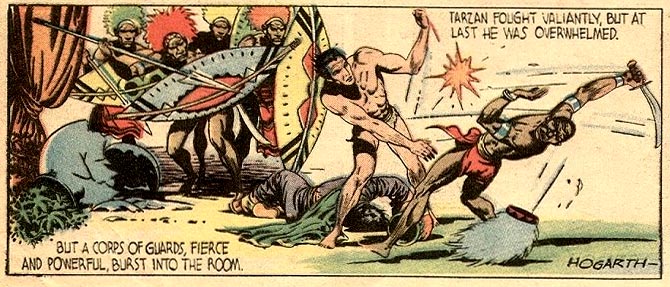
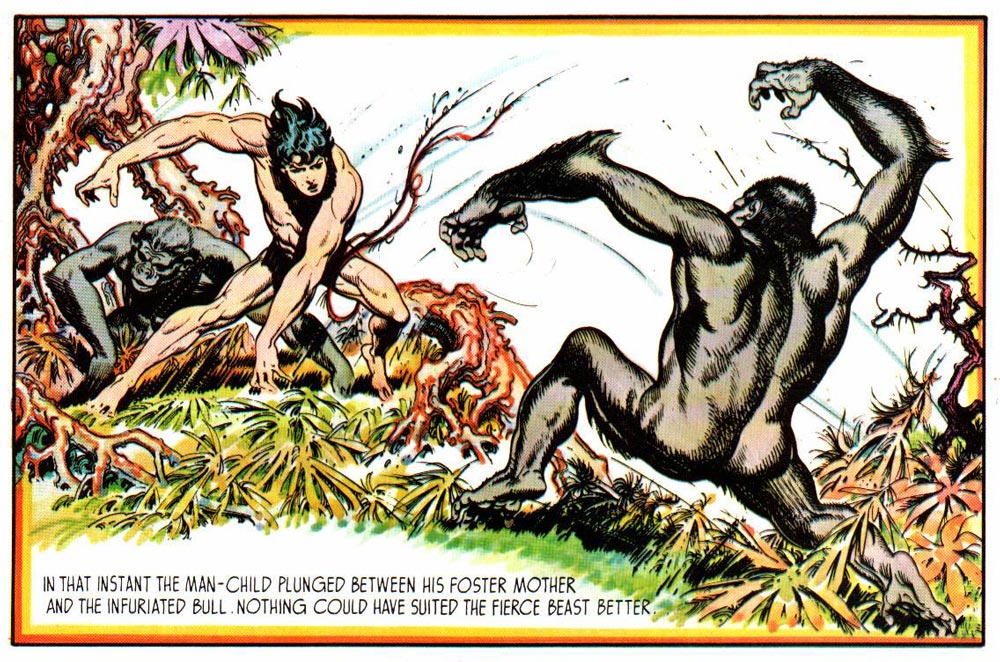
The strip’s then artist, Hal Foster, who Hogarth much admired, had spent a number of years working on the series, yet despite the obvious quality of his art, was keen to move on due to his lack of interest in the character (he could never take it seriously), beginning his classic Prince Valiant strip soon after. Hogarth immediately took Foster’s place and at first found it hard to establish his own artistic footprint on the character and his world, but within a couple of years had made it his own, investing it with detailed, fine line panels and a new type of dynamism in what the artist referred to as “the syntax of the figure”. His work propelled strip art forward, bringing an understanding of the medium’s unique narrative and how to bypass the inflexibility of the form, playing with panel structure and convention. In the late 1940s, in his final years on the strip, Hogarth reached his zenith with his figurative illustration with Tarzan, channelling his interest in Michelangelo’s anatomical drawings.
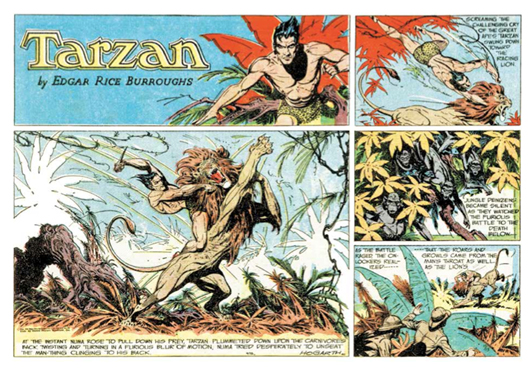

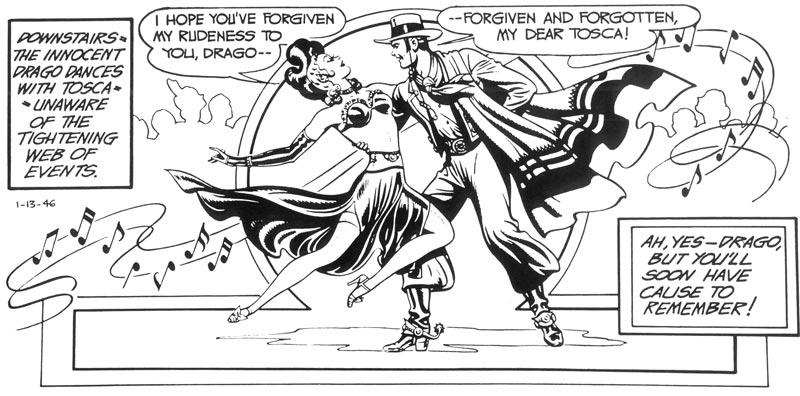
After a dispute with King Features in 1945, Hogarth left the company and moved to the New York Post to draw Drago, a Tarzan manqué who battled Nazis in Argentina, along with the humour strip Miracle Jones. Neither character caught on, and Hogarth moved away from the industry, firstly to casually lecture about his work to returning GIs, before deciding to open a school – The Cartoonists and Illustrators School (changed to The School of Visual Arts in 1956). Hogarth had gone back to doing the Sunday Tarzan in 1947 while teaching (helped by such distinguished students as Al Williamson and Gil Kane), and had reached even greater heights in his work, but another dispute developed over royalties for foreign reprints, so he dropped the strip and devoted himself to the school full-time.
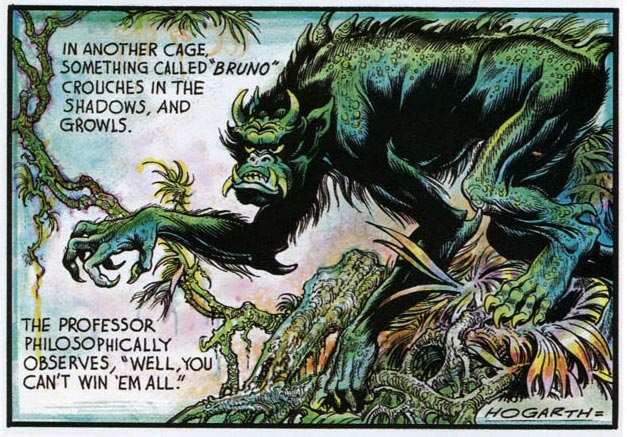
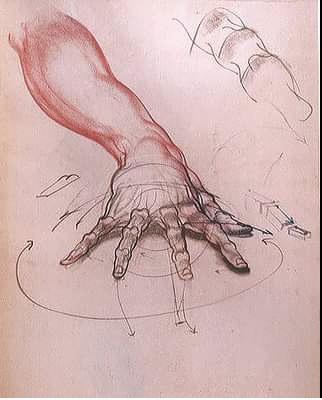
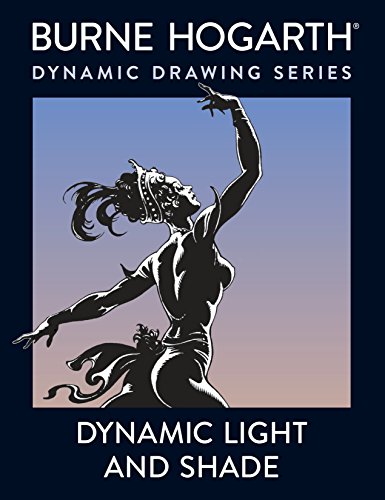
Hogarth taught at the school until 1970, but continued teaching anatomy and illustration at other colleges until the early 1980s. His other major contribution to the medium and industry was his art textbooks about anatomical illustration, that are basically mandatory reading for any budding artist or devotee – Drawing the Human Head, Dynamic Light and Shade, Dynamic Wrinkles and Drapery, Dynamic Anatomy, Drawing Dynamic Hands andDynamic Figure Drawing. By the 1960s his work had been reappraised due to the medium being taken seriously by the media and intelligentsia, primarily in Europe, which led to a number of major exhibitions of comic art (including at the Louvre in 1967), some of which positioned Hogarth as the most significant of all strip artists.

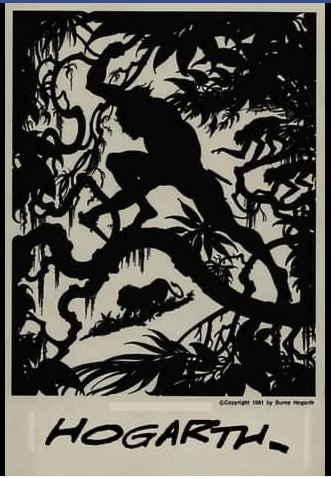
His popularity in this period became so great that in 1972, he drew two new Tarzan books. Tarzan of the Apes and Jungle Tales of Tarzan were beautifully drawn albums, featuring full page drawings that proved that Hogarth had lost none of his genius.
Hogarth’s position in comics’ fandom had been cemented, and he continued to attend conventions for both comics and Edgar Rice Burroughs in both Europe and America. One of the key classicists in the history of the medium, it’s difficult to overestimate his canon.
Here’s links through to the other entries in our 101 Greatest so far as well
Tripwire’s 101 Greatest Comic Artists Of All Time: No.35: LB Cole
Tripwire’s 101 Greatest Comic Artists Of All Time: No.37: Bill Everett
Tripwire’s 101 Greatest Comic Artists Of All Time: No.38: Robert Crumb
Tripwire’s 101 Greatest Comic Artists Of All Time: No.39: Mac Raboy
Tripwire’s 101 Greatest Comic Artists Of All Time: No.41: Jim Starlin
Tripwire’s 101 Greatest Comic Artists Of All Time: No.42: Mike Zeck
Tripwire’s 101 Greatest Comic Artists Of All Time: No.43: Adam Hughes
Tripwire’s 101 Greatest Comic Artists Of All Time: No.44: Daniel Clowes
Tripwire’s 101 Greatest Comic Artists Of All Time: No.45: Gene Colan
Tripwire’s 101 Greatest Comic Artists Of All Time: No.46: George Perez
Tripwire’s 101 Greatest Comic Artists Of All Time: No.47: Michael William Kaluta
Tripwire’s 101 Greatest Comic Artists Of All Time: No.48: Cary Nord
Tripwire’s 101 Greatest Comic Artists Of All Time: No.49: Frank Quitely
Tripwire’s 101 Greatest Comic Artists Of All Time: No.50: Mike Ploog
Tripwire’s 101 Greatest Comic Artists Of All Time: No.51: Johnny Craig
Tripwire’s 101 Greatest Comic Artists Of All Time: No.52: Darwyn Cooke
Tripwire’s 101 Greatest Comic Artists Of All Time: No.53: Steve Dillon
Tripwire’s 101 Greatest Comic Artists Of All Time: No.54: Gil Kane
Tripwire’s 101 Greatest Comic Artists Of All Time: No.55: Michael Zulli
Tripwire’s 101 Greatest Comic Artists Of All Time: No.56: John Romita
Tripwire’s 101 Greatest Comic Artists Of All Time: No.57: Joe Maneely
Tripwire’s 101 Greatest Comic Artists Of All Time: No.58: Marshall Rogers
Tripwire’s 101 Greatest Comic Artists Of All Time: No.59: John Severin
Tripwire’s 101 Greatest Comic Artists Of All Time: No.60: Alex Toth
Tripwire’s 101 Greatest Comic Artists Of All Time: No.61: Brian Bolland
Tripwire’s 101 Greatest Comic Artists Of All Time: No.62: David Mazzuchelli
Tripwire’s 101 Greatest Comic Artists Of All Time: No.63 Reed Crandall
Tripwire’s 101 Greatest Comic Artists Of All Time: No.64 Harry Anderson
Tripwire’s 101 Greatest Comic Artists Of All Time: No.65 Nick Cardy
Tripwire’s 101 Greatest Comic Artists Of All Time: No.66 Matt Wagner
Tripwire’s 101 Greatest Comic Artists Of All Time: No.67 Bryan Hitch
Tripwire’s 101 Greatest Comic Artists Of All Time: No.68 Shawn Martinbrough
Tripwire’s 101 Greatest Comic Artists Of All Time: No.69 Al Feldstein
Tripwire’s 101 Greatest Comic Artists Of All Time: No.70 Nestor Redondo
Tripwire’s 101 Greatest Comic Artists Of All Time: No.71 Tarpe Mills
Tripwire’s 101 Greatest Comic Artists Of All Time: No.72 Eduardo Risso
Tripwire’s 101 Greatest Comic Artists Of All Time: No.73 JH Williams III
Tripwire’s 101 Greatest Comic Artists Of All Time: No.74 Irv Novick
Tripwire’s 101 Greatest Comic Artists Of All Time: No.75 Dan Zolnerowich
Tripwire’s 101 Greatest Comic Artists Of All Time: No.76 Gilbert Shelton
Tripwire’s 101 Greatest Comic Artists Of All Time: No.77 Tommy Lee Edwards
Tripwire’s 101 Greatest Comic Artists Of All Time: No.78: Sean Phillips
Tripwire’s 101 Greatest Comic Artists Of All Time: No.79: Jose Luis Garcia-Lopez
Tripwire’s 101 Greatest Comic Artists Of All Time: No.80: Dan DeCarlo
Tripwire’s 101 Greatest Comic Artists Of All Time: No.81: Marie Severin
Tripwire’s 101 Greatest Comic Artists Of All Time: No.82: John Paul Leon
Tripwire’s 101 Greatest Comic Artists Of All Time: No.83: Jim Lee
Tripwire’s 101 Greatest Comic Artists Of All Time: No.84: Denys Cowan
Tripwire’s 101 Greatest Comic Artists Of All Time: No.85: Ross Andru
Tripwire’s 101 Greatest Comic Artists Of All Time: No.86: Paul Gustavson
Tripwire’s 101 Greatest Comic Artists Of All Time: No.87: George Evans
Tripwire’s 101 Greatest Comic Artists Of All Time: No.88: Michael Golden
Tripwire’s 101 Greatest Comic Artists Of All Time: No.89: Matt Baker
Tripwire’s 101 Greatest Comic Artists Of All Time: No.90: Todd McFarlane
Tripwire’s 101 Greatest Comic Artists Of All Time: No.91: Fiona Staples
Tripwire’s 101 Greatest Comic Artists Of All Time: No.92: Carl Barks
Tripwire’s 101 Greatest Comic Artists Of All Time: No.93: Carmine Infantino
Tripwire’s 101 Greatest Comic Artists Of All Time: No.94: Alan Davis
Tripwire’s 101 Greatest Comic Artists Of All Time: No.95: CC Beck
Tripwire’s 101 Greatest Comic Artists Of All Time: No.96: Syd Shores
Tripwire’s 101 Greatest Comic Artists Of All Time: No.97: Bob Fujitani
Tripwire’s 101 Greatest Comic Artists Of All Time: No.98: Tim Sale
Tripwire’s 101 Greatest Comic Artists Of All Time: No.99: Jim Aparo
https://tripwiremagazine.co.uk/headlines/tripwires-101-greatest-comic-artists-of-all-time-no-100/
https://tripwiremagazine.co.uk/headlines/tripwires-101-greatest-comic-artists-of-all-time-no-101/









You must be logged in to post a comment Login