

Comics News
Tripwire Reviews Marvel’s Todd Mcfarlane’s Spider-man Collection


Todd Man Out
Tripwire’s contributing writer Laurence Boyce reviews Marvel’s Spider-man by Todd McFarlane out in a new collection now…
Spider-Man
Writers: Todd McFarlane (with Rob Liefeld and Fabian Nicieza)
Pencillers: Todd McFarlane with Rob Liefeld
Inkers: Todd McFarlane with Rob Liefeld, Rick Magyar, Scott Williams and Jim Lee
Colours: Bob Sharen, Todd McFarlane, Gregory White and Brian Murray
Letters: Rick Parker, Jim Novak, Chris Eliopoulos with Todd McFarlane and Joe Rosen
Published by Marvel
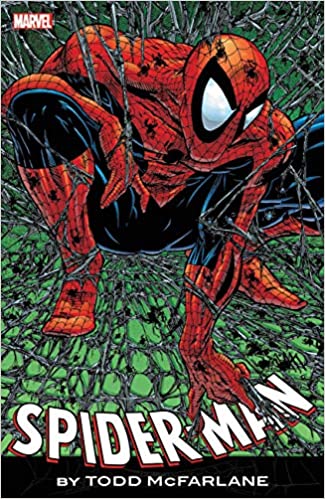
Todd ‘Spawn’ McFarlane’s run on Spider-Man is somewhat infamous. While it was replete with commercial success (Spider-Man # 1 is still one of the best-selling comic books of all time, partly thanks to an inordinate amount of variant covers) it’s also seen as the epitome of the excess and hubris that managed to almost sink the comic-book industry in the early 90s. 30 years on and Marvel has come out the other side (suffice to say they’re doing OK for themselves at the moment). How does McFarlane’s 15 issues stack up three decades since they first appeared?
The first 5 issue arc, Torment, is something of a statement of intent. Happy-go-lucky Peter Parker – who enjoys time with his wife Mary-Jane and bringing down criminals under his web slinging alter ego – suddenly finds things take a dark turn when The Lizard returns with an unusually intense bloodlust. It soon becomes clear that The Lizard is not acting upon his own agency. As Spider-Man becomes drawn deeper into the machinations of his unknown enemy (and the re-appearance of yet another old antagonist) he finds himself faced with almost insurmountable odds.
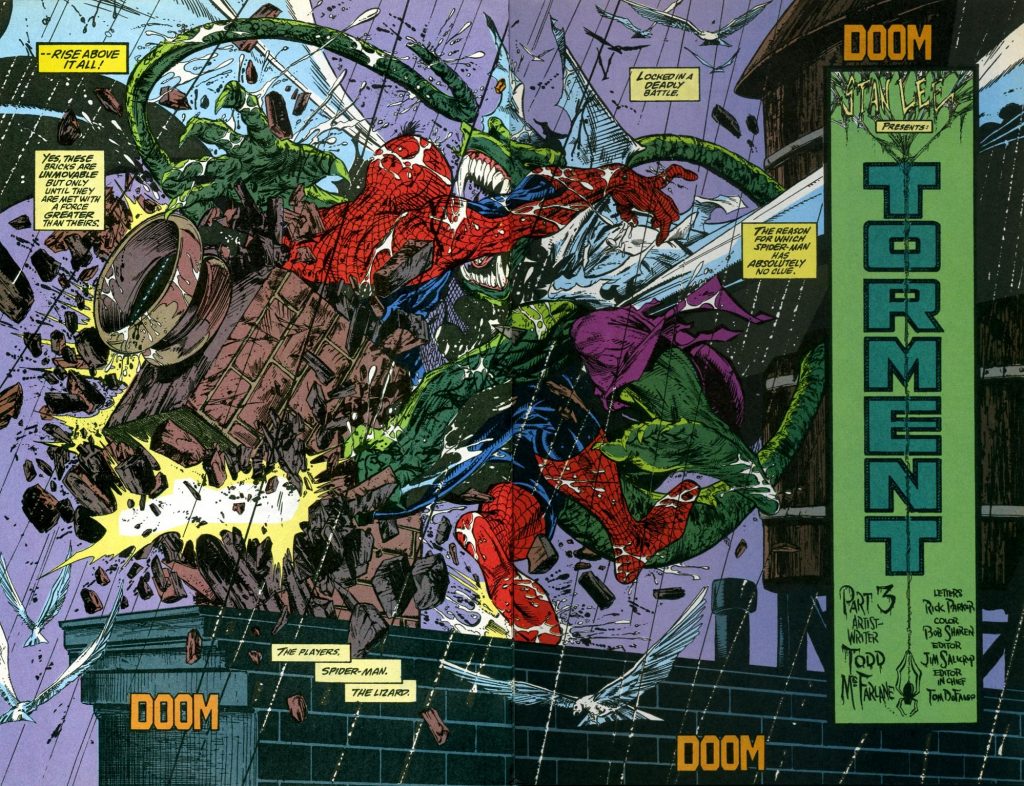
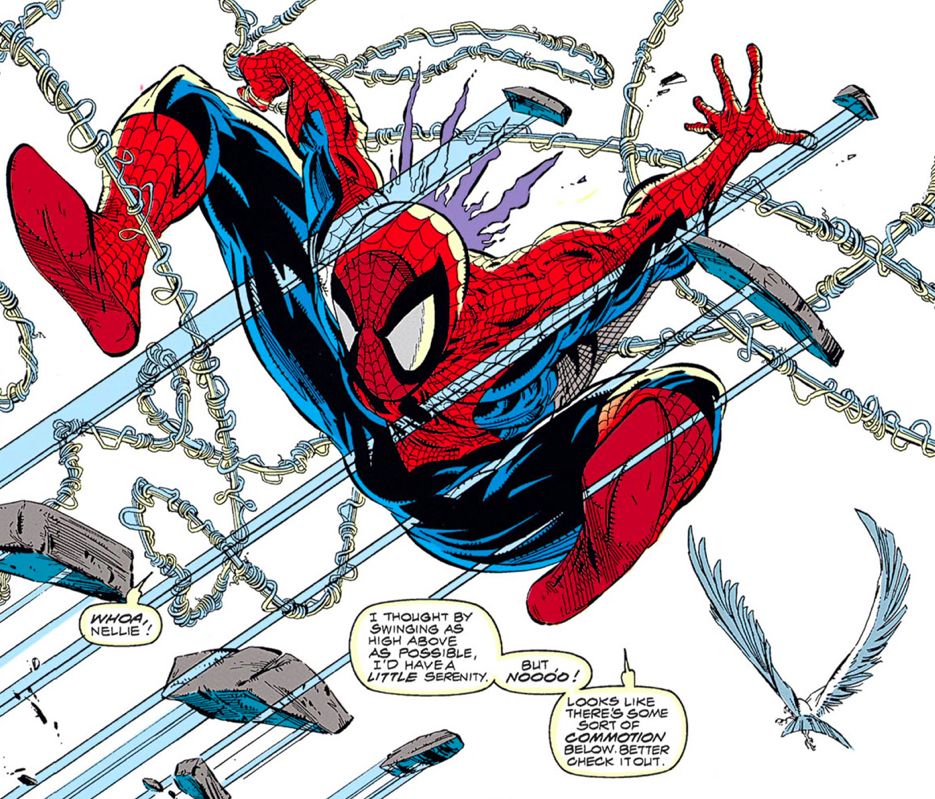
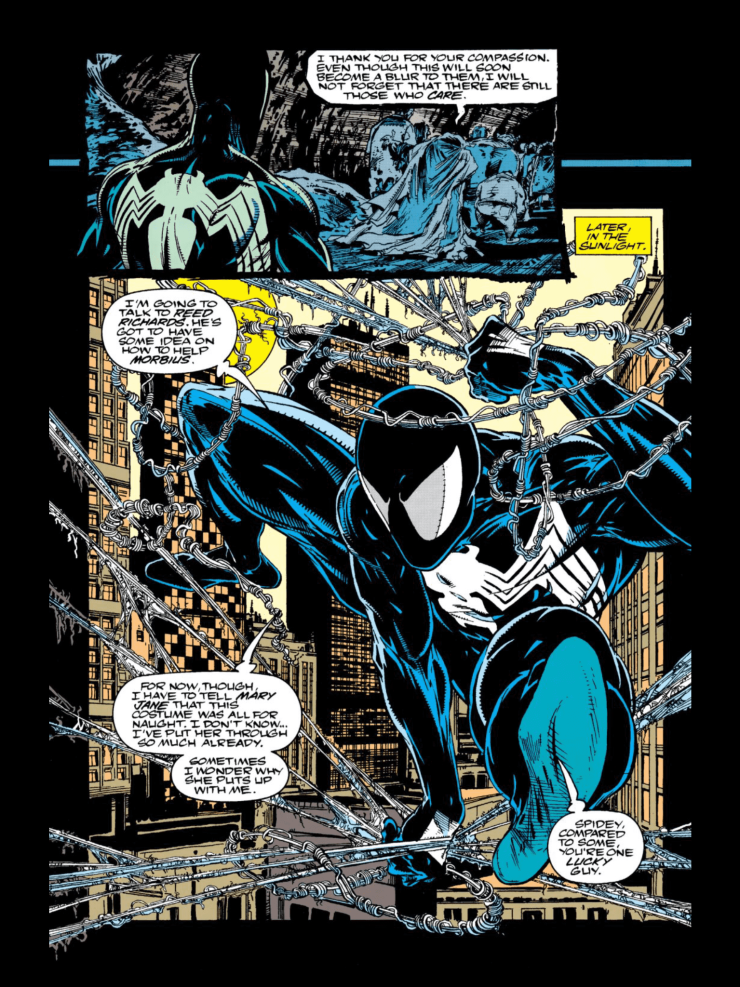
There’s a certain amount of bleakness and portentous doom that hangs over this first story as McFarlane goes all out into trying to psychologically torture the Web Slinger. In some ways it works, bringing the innate heroic nature of Spider-Man into sharp relief as it delves into the past (classic arc Kraven’s Last Hunt becomes a touchstone for the story) while trying to put together a template for the future. It’s all rather full throated and this constant excess has moments of exhilaration. McFarlane’s artwork contributes to said excess as his character models play fast and loose with realism, with angular jaws, and impossible muscles and poses. The frames are constantly filled with shadows and small details (Spider-Man’s webbing is almost impossibly detailed) which make everything busy and excessive. But for all its energy, it sometimes comes across as rather ham-fisted with no real moments to let the characters breathe. Mary-Jane and Parker’s relationship was usually used as a contrast to the superhero action, as a way to humanise our characters. McFarlane juxtaposing Spider-Man battling with Mary-Jane dancing in a nightclub throughout Torment feels a little too arch and obvious while their entire relationship seems underwritten (with a couple of moments that – in the modern era – would see a few eyebrows being raised).
Things are pretty much the same in Masques, in which perennial Spidey villain The Hobgoblin is given more of a supernatural twist and Ghost Rider shows up for the party. There’s more bleakness on offer (with the villain offing a number of innocents at the start) and a number of striking moments (the end of Issue 6, with Hobgoblin’s ‘victim’ revealing himself is still a memorable set-piece). But the constant battles, the never-ending aesthetic excess means that it almost burns itself out and starts feeling like style over substance.
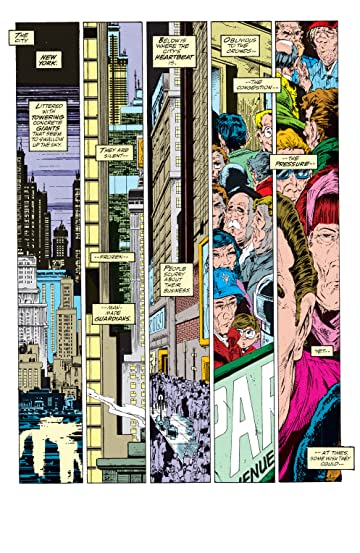
The five part Perceptions has a little more introspection as Parker is dispatched to Canada on a Bugle story concerning a number of child murder’s. There he encounters Wolverine and a mysterious creature known as the Wendigo, as he tries to piece together what really happened. While the constant action is more muted than in previous instalments, this is still an extremely busy piece trying to fit in notions of press responsibility, environmentalism and the nature of humanity. This is perhaps the most coherent and entertaining of McFarlane’s run, with an engaging central mystery and a good use of Wolverine as guest star.
Sub City also provides a little introspection, with the motivations of another returning Spidey villain given some consideration as Spider-Man investigates the disappearance of homeless people. While there’s some interesting philosophical discussion, you can’t help feel the commercialism creep through. The return of Spider-Man’s black suit seems nothing more than a promotional gimmick, and it seems that McFarlane is running out of steam.
We send with the Spider-Man / X-Force ‘Sabotage’ crossover whose chief gimmick was publishing the issues in a ‘Landscape’(or, for people who didn’t know what that was, ‘sideways’) format. There’s plenty of scope for Rob Liefield’s impossible anatomy in a fun 90s story that still feels throwaway.
There’s nothing inherently wrong with McFarlane’s 90s stint on Spider-Man. There’s always a sense of the kinetic and there’s always a grandiose sense of ambition. But the stories sometimes strive for a profundity that they can never quite reach and there’s a nagging feeling that everything is slightly throwaway.
McFarlane would end up falling out with Marvel over editorial interference: amongst many other issues, Marvel editor Jim Salicrup would rein in what he saw as McFarlane’s more excessive tendencies in terms of violence while McFarlane would bristle at not being allowed to utilise the ‘top tier’ of Spider-Man’s enemies. This collection gives no indication of this – in fact, as it publishes the letter pages that went into each issue, McFarlane’s farewell missive places the blame at family commitments.
The excesses of the 90s comic industry would bring it to its knees (don’t worry, a large number of those alternative covers – some suspiciously samey – are here as well) as too many gimmicks and too much grim introspection and excessive violence actively turned off people. While Spider-Man does contain much of this, it serves as a reminder that these elements could sometimes provide much entertainment.














You must be logged in to post a comment Login