

Book News
Throwback Thursday: Cory Doctorow

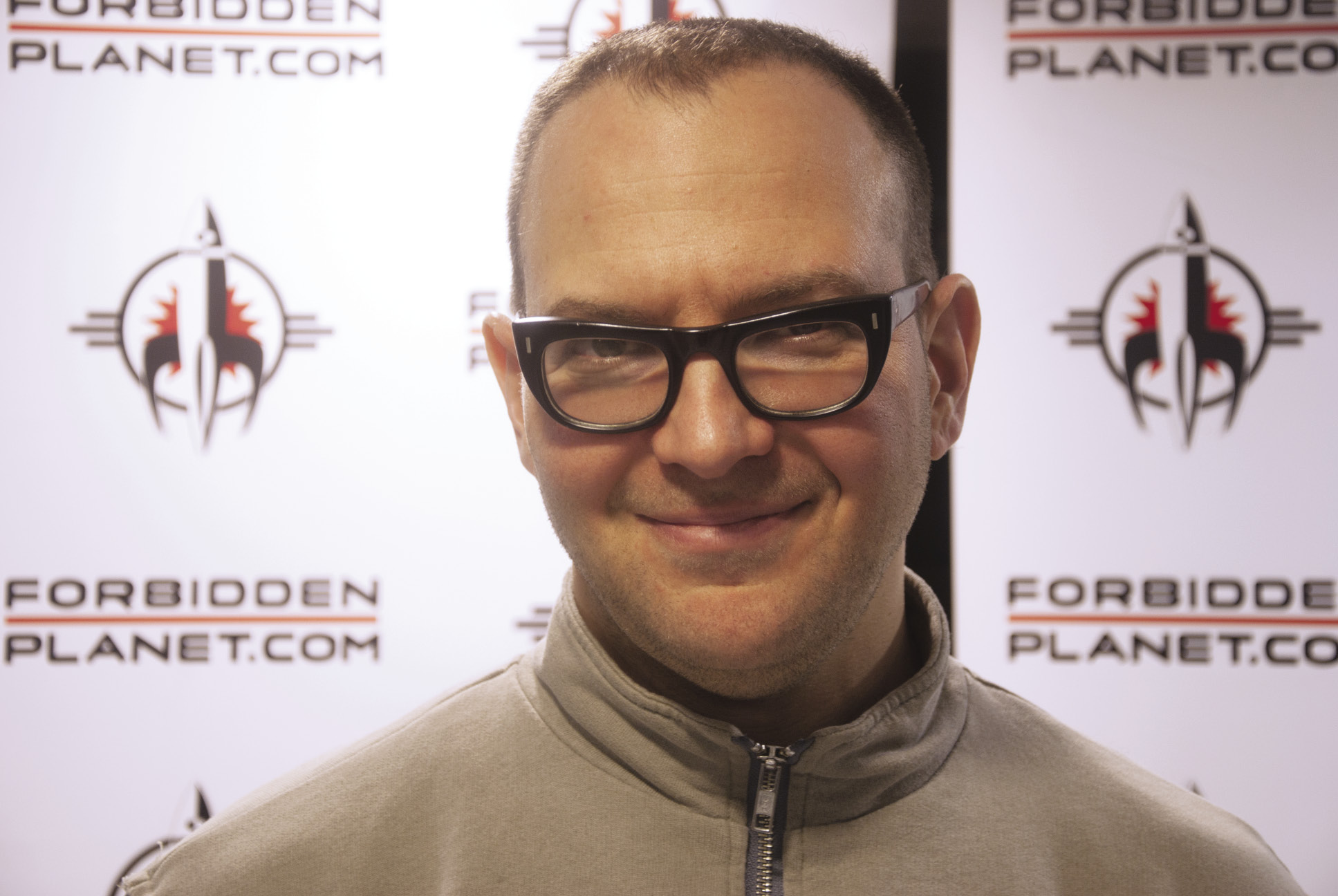
♦Back in October 2013, we published our short-lived Tripwire Digital and the first edition had a long interview with writer and political activist Cory Doctorow. So we thought we would make it this week’s Throwback…
Future Shocks
Writer Cory Doctorow’s CV includes political activism, tech commentary and he is also a highly regarded novelist. 2013 sees the release of his latest novel Pirate Cinema and The Rapture of The Nerds, co-written with fellow author Charles Stross. TRIPWIRE caught up with him to discuss approaches to writing, the pros and cons of technology and juggling different disciplines. INTERVIEW: JOEL MEADOWS
TRIPWIRE: How did you wind up collaborating with Charles Stross?
CORY DOCTOROW: At the time I was living in San Francisco and Charlie was living in Edinburgh. We had corresponded but never met, I’d read his work and he’d read mine and he was a commenter on Boing Boing and he just asked me if I was interested in collaborating and I said sure. So he sent me along something that he’d been working on but he’d gotten stuck with and that was the first bit of Jury Service which we went to just start writing turn wise. I would write 500 words and then he would rewrite those 500 words and then I would rewrite his 500 words and then we would go back and forth, talking about it as little as possible, more exquisite corpse than premeditated murder and it went really well.
After the first novella, Jury Service, got published we took on to do a second one which was actually harder. I think the second time you do something you’re self-conscious about it and that was the one that we rewrote the most for the book and then the third one was incredibly straightforward and business-like, reflecting the fact that we had moved on in our respective careers and become a lot more systematic about writing and we fired the manuscript back and forth.
But for us, because I was living in the UK by then, we could still take advantage of the time zone difference because Charlie’s nocturnal and I’m diurnal so I delivered 5000 words at the end of the business day just as he was sitting there at his keyboard and he would write 1000 words by the time I woke up the next morning.
TW: Was that the first time you had collaborated with another writer?
CD: No, I wrote a book in 2000 , the Complete Idiot’s Guide to Publishing Science Fiction, with Karl Schroeder. Karl wrote the bits on novels and I wrote the bits on short stories, but it was a lot more straightforward because it was non-fiction and because was composed of a series of unique, distinct chapters where it was pretty easy to decide who was going to write what. There weren’t a lot of interdependencies between what I wrote and what he wrote.
TW: You’ve had a fairly odd career, and I mean odd in an interesting way. You’ve got an incredibly diverse CV.
CD: Well I don’t know that there’s a traditional career path for a science fiction writer. It’s fair to say that my CV is pretty diverse though.
TW: You’ve worked for a lot of different organisations, I’m not sure what you’d call them, I’m not sure that lobbying organisation is the right term.
CD: I call them activist organisations. They don’t lobby in the sense of sending lobbyists directly to Washington. They’re actually legally enjoined from doing that as part of their tax status. They’re emphatically not a lobbying organisation in the sense that say the Motion Picture Association is a lobbying organization.
TW: So politics was a major part of your working life for many years. Did you find it good grounding for you as a writer? Was it something you were just interested in or did you just fall into it?
CD: I think the job of a technology activist is to examine where technology is taking the world and try and influence it, and the job of a science fiction writer is to examine where technology is taking the world and try to write about it. So these are clearly intimately related subjects and I certainly did benefit from the fact that they were closely related and I continue to benefit from it. My approach to research or preparation is very serendipitous. I just pursue the things that interest me and the theory is that things will eventually gel out of them that will be larger or more synthetic like books or speeches… I don’t go out to research with the aim of making a novel or a speech but eventually they come together on their own and sometimes things will work as non fiction and others will work as a novel.
TW: So am I right in assuming that you’ve always been interested in technology?
CD: My dad had a teletyper in the house when I was about six and even before then I remember making fake computers out of paper with buttons to push and so on. I benefitted greatly by being able to play with a machine called a CARDIAC which was a teaching tool made by Bell Labs, essentially a cardboard working computer where you were the motivating force of it, so you would say add three plus two and there would be an accumulator and a register and there would be a bit of cardboard that you move into that slot and there would be an output register which would tell you the answer and I found this incredibly fascinating. Though it may be the slowest possible way to discover what three plus two is.
TW: Do you think it’s essential for a science fiction writer to be interested in the impact of technology on society?
CD: I think that’s practically the definition. You don’t have to be in favour of it but you certainly have to be interested in it.
TW: There have been two significant books this year about the way that technology is continuing to change modern society, one was quite negative and the other was a bit more positive. You’re so immersed in the world of tech that I was wondering what your take on it was.
CD: Firstly if we’re both thinking of the same negative book, one that argues that the net is negative for society and that it makes us stupider…
TW: That certainly sounds like the book I’m thinking of.
CD: And that it takes all of our jobs, I think one of the reasons that gets a lot of play is that the message that is fantastically comforting to the entertainment industry and the media industry, to be told the reason your industry is losing enormous amounts of value against a wider industrial picture is because something evil has happened rather than some missed opportunity or obsolescence is incredibly comforting. It’s like being told the reason the rains haven’t come is because of heretics. There’s been no rain but at least you know who to blame, right?
Likewise the positive book which is written by the CEO of Google, so I think that book got a lot of attention because it’s written by the CEO of a gigantic company and had a marketing budget to match, not because of any particular merit. It’s not a great book. There are books critical of the internet and books which are in favour of the internet and there are books which are both which are worth reading and worth writing.
I reviewed a book the other day in the Global Mail, a very good book called Black Code, written by the head of Citizen Lab in Toronto. It’s a really amazing book about the way that states, spies, criminals and companies all want to break the internet in similar ways, and how when they break the internet they make it easier to wiretap and to steal identities and how there is an accidental emerging conspiracy between a whole bunch of different entities. They’re working at cross purposes but they just happen to be working in each others interest. The last chapter, though, is a very hopeful chapter because it’s about a vision for stewardship for the internet. Despite the fact it would be easier in some ways to be a policeman if everything we did on the internet was continuously logged and available without a warrant, I think the state has a duty to defend the citizen’s health and privacy and I think that’s a brilliant way to approach it.
So I am optimistic about the fact that the internet helps us collaborate more cheaply and easily than ever before. The reason that we became social primates, the reason we developed a neocortex for all the social stuff that happens is because by sharing workloads among us, we can do more collectively than any one individual can do on our own. It literally makes you superhuman when you do things with other people because you are transcending the limits of the individual, though we do all have to monitor that time when we’re working with other people so we make sure we’re not working at cross purposes and what the internet has done is rationalize that coordination cost and continues to lower that coordination cost. And embodied in that coordination cost is the cost of doing stuff together which is to say doing everything worthwhile. So I am enormously hopeful. The internet has made it possible for us to build an encyclopedia, which is as complicated as building say a skyscraper. And we can build that encyclopedia with only the level of organization we bring to bear to run say a car boot sale. It means that we have all been given super powers.
Now, I am pessimistic because the internet has been viewed by many law enforcement agencies and governments and corporations as nothing more than a piggy bank or a convenient place to spy on people or some combination of the two. They behave with a depraved indifference to the consequences that breaking or bending the internet to their needs has to wider society. I wrote a column that was in the Guardian this morning that likened this to the NHS deciding that the way to save money on elder care is to make sure that everyone’s a chain smoker so no one lives long enough. All we need to do is compromise every body’s privacy all the time and encourage the private sector to build services that will allow us to have access to their databases. So I am pessimistic but my hope is that this super-charged, superhuman capacity that we gain will allow us to prevent this ubiquitous nightmarish control.
TW: Some people have criticized the net for creating a lower attention span society, but I’m sure television and radio have been accused of the same thing when they first came to prominence.
CD: Not just television and radio. Theroux famously said ‘Oh the telegraph. We’re so anxious to build a wire between Boston and Atlanta but it may be that Boston and Atlanta have nothing to say to each other. We may be keen to build a wire between Boston and London and the first thing that reaches American ears is that Princess Anne has a whooping cough.’ So we have been talking about this for centuries. If you read Socrates, you’ll find him complaining that people aren’t memorizing long enough poetry. But what we gain when we create this sort of technology are two important things:
The first is that we get to work at higher abilities of abstraction, so just like the people who worried that with calculators kids wouldn’t be able to do sums but what calculators do is help kids very quickly move out of the realm of mechanical addition and multiplication into the advanced mathematics where all the interesting stuff happens, where people can discover a lifelong love for maths. So for example, you get higher levels of abstraction, you can outsource remembering phone numbers to your phone. There is no particular virtue in remembering phone numbers. People who bemoan people’s inability to remember phone numbers forget that for about 1900 years after the birth of Christ no one could remember numbers either. If such a figure as Christ ever existed.
The second thing we get from this is the ability to transact the trivial in order to build up the profound. So every profound relationship is made up of a thousand trivial dribbles of relationship water onto the flower of relationship, which grows into something larger. You know the reason you ask your wife “how did you sleep last night” is not because you care how she slept, because if you’re like me and you sleep next to your wife you know how she slept. The content of that message is “I love you, I’m thinking of you”. So one zillion trivialities that we trade on the Internet, all these little bits and pieces that traverse our social networks, that we characterise as irrelevancies, are actually the glue that binds us together, that makes us a society. What is it that makes up a friendship? It’s not a series of profound discussions…
















You must be logged in to post a comment Login