

Comics News
Tripwire Talks To Australian 2000AD Artist Mark Sexton About A Career In Comics And Film

Making His Mark
Tripwire’s contributing writer Paul N Neal just talked to Australian comic artist and film storyboard artist Mark Sexton about a career that encompasses comics and film…
TRIPWIRE: Mark, could you say where your interest in being a professional artist began? Was it comics? What may have been the earliest comics you remember reading?
MARK: I honestly never considered being a professional artist as a career. I always loved drawing as a kid, but it never occurred to me that I’d be able to make a living out of it.
I grew up on Norfolk Island, a tiny place way out between Australia and Noumea in the Pacific, back in the 1970s – 80s. We grew up without television, there was no cinema and there wasn’t exactly a thriving arts scene. The population was only around 2000 people. So, making a living from art wasn’t ever in the mix. But I loved drawing – I remember drawing dinosaurs on butchers’ paper when I was three, and I amused myself by drawing monsters and dinosaurs, inspired by books I read.
The one local newsagent got the occasional small consignment of comics – American titles mostly – the odd Marvel title, Archie, Gold Key comics – but I never read them, though I saw them at other kids’ homes. I might have flicked through an issue of Shang-Chi or Tomb of Dracula. I do remember Turok – I was fascinated by dinosaurs as a kid, and that always caught my eye – but once again, never read anything on a regular basis until my parents gave me and my siblings a box of Asterix and Tintin books for Christmas (I was seven). I would read them over and over – I still have a huge place in my heart for the early Asterix books in particular. Those books inspired me to do my own comics, so I drew my first strip soon after we got the Asterix books. It was a single page story called “Bug Goes Camping” where the eponymous hero (wearing a talking hat that smoked a pipe??) woke up, went camping and shot WW2-era German soldiers out of trees. Very strange. And very bad.
TW: As an artist, would you describe yourself as being self-taught or did you receive a formal education and earn qualifications as an artist?
MS: I’m almost entirely self-taught. I did art at school, of course – but art at Norfolk Island Central School was taught by the woodwork teacher, whose artistic bone was in the shape of a hammer. Not the greatest basis for an artistic educator, so I just did my own stuff outside of school.
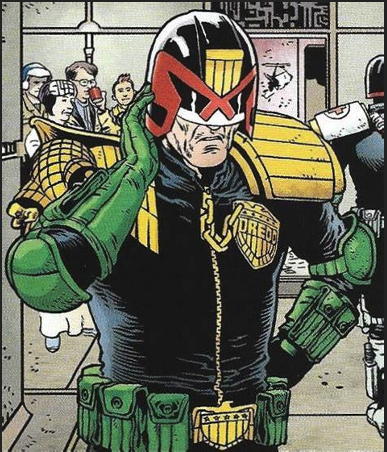
Inspired by the Asterix and Tintin books, I continued to draw Bug comics until about the age of 15 when I attended boarding school in Australia for the last couple of years of school. Now I was on the mainland in a big city – well, Adelaide at least – and being exposed to the joys of television, cinema and the like. I also discovered the Eagle Comic reprints of Judge Dredd – the first comic that I ever read regularly. The first issue I read was the second half of the Block Mania storyline – and it blew my mind! I’d never encountered anything like it. I started drawing my own Dredd pictures – totally intimidated by the complexity of the uniform, plus I was terrible at drawing people – but I kept trying.
I was doing art as a subject in Year 11 at the time – and my art teacher HATED my drawings. She would tell me on a regular basis that they were awful and that comics were rubbish. Why didn’t I try painting still-life of fruit instead? That was Proper Art. I didn’t… and she failed me – and that was as far as my formal art training ever went.
TW: Despite that dreadful advice, you went on to become a published 2000AD and Judge Dredd artist. Who was your first Tharg and how did you come to be published? Was it a thrill (pun intended) for you?
MS: My first and only Tharg was the current incumbent, MATT-1 (Matt Smith), who has been great to work with – a terrific mix of editorial oversight with a keen eye for a story, but with the discipline to let writers and artists do their own thing without being overly controlling.
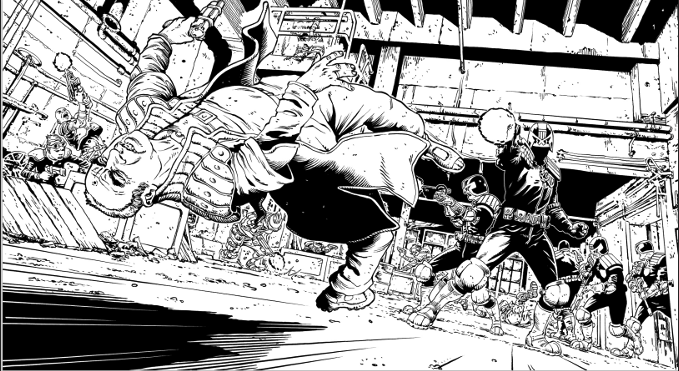
Weirdly I got into 2000AD via a very lateral pathway. I had dreamed of doing a Judge Dredd story ever since discovering the character back in the mid-80s, but I’d never thought I was good enough. However, many years later – after going down a very unexpected career path. I was lucky enough to have been allowed by George Miller, the director of the Mad Max films, to write and draw a series of prequel comics to Mad Max Fury Road back in 2014. When I was wrapping up on those, I was looking around for the next thing, and film work in Australia was pretty thin on the ground at the time, and I needed to look for other opportunities.
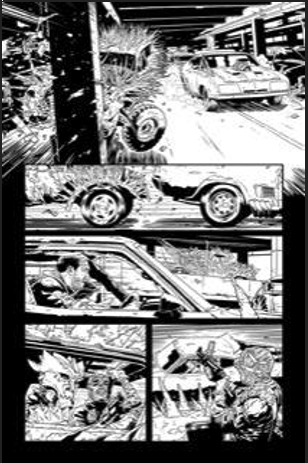
Credit: Mark Sexton, Mad Max Fury Road prequel comic page.
MS: Maybe six months earlier I think, I’d seen Matt Smith’s profile pop up on Facebook – I think he’d only got on it recently – and I’d sent him a friend request which to my pleasant surprise he accepted. He didn’t know me or what I did from a bar of soap – I wasn’t much of a FB user at the time, and didn’t talk much about what I did, so lord knows why he pressed “accept” – but I’m glad he did!
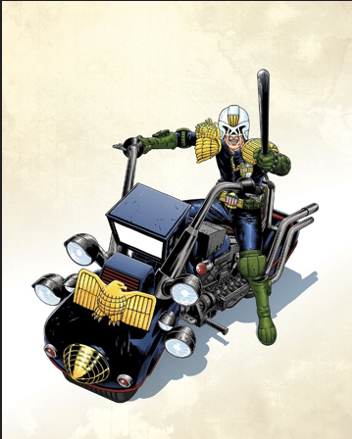
MS: Anyway, something I’d been thinking about for a while was what a Judge Dredd/ Mad Max crossover would be like, and I’d even written up a detailed story outline which I quite enjoyed. Someone on a 2000AD Facebook group had proposed one of those “which character would you like to see Judge Dredd team up with?” questions, and of course I said Mad Max, which got a few likes. But I noticed one of the likes was from Matt Smith – so on a whim I sent him a PM saying that I was actually quite serious about the JD-MM idea, that I had just finished the Fury Road comics and that I was literally sitting just outside George Miller’s office and could pop my head around the door and ask him if he was interested.
Matt’s response was immediate – a direct quote – “Yeah, I’d be well up for a Max/Dredd crossover” – and so I asked George. He mulled it over quite seriously for a bit and then said that we might be able to do it once he’d finished his proposed Fury Road trilogy. So close but yet so far. Anyway, I reported the near miss back to Matt and then said if ever he needed an artist for a Dredd story, I’d love to help out – to which he promptly offered me a six-part Michael Carroll-scripted Dredd. And that’s how it happened. You could’ve knocked me down with a feather.
TW: You’ve gone on to storyboard an impressive number of projects? How did that initially come about?
MS: So – storyboarding. This came directly out of comics…
Once I failed Year 11 art, I found myself unable to continue any formal art education, so I was at a bit of a loss at what to do with myself. I was a reasonable student and finished Year 12 exams with a mark good enough to get me into most university courses – so I chose to do a bachelor of science at Monash University in Melbourne, because I’d remembered enjoying learning about genetics in Year 9 Science at school. From that I’d gone on to do honours and then a PhD in genetics – but truth be told, I was bored shitless!
However, I’d met another student at uni – a fellow called John Petropoulos who also drew his own character, Stump – a short statured but muscular guy with an enormous quiff which coincidentally predated the better-known and extremely similar Johnny Bravo character by several years. I basically bullied John into doing a regular strip for the student newspaper at the uni, teaming Stump up with my resurrected childhood character Bug (minus the talking hat that smoked a pipe). The resulting “Bug & Stump” strip ended up being quite popular and running for two years, and at the end of our run, the strips were collected into a comic book (paid for by the university, which was a bonus!).
We’d seen the appearance of a new Australian anthology comic book in newsagents at the time named Issue One – and I’m afraid that, in our hubris, we’d thought we could do better. Whatever the truth/reality of that, we started our own comic book featuring Bug and Stump, now reimagined as aliens trapped in suburban 1990s Melbourne, which ran for three years on a semi-regular basis. We sold them in newsagents and comic stores all over Australia, and it ended up being quite successful for an Australian comic of the time, which was nice. So much so that when the opportunity arose (and with great glee) I quit my PhD and tried to do the comics full-time.
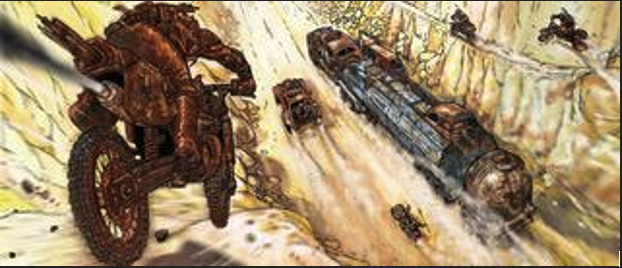
Credit: Fury road storyboard image by Mark Sexton with colour by Brendan McCarthy
MS: While doing that, we got a gig doing a couple of comics for an infamous alternative rock Melbourne band called This Is Serious Mum (TISM for short) who we were great fans of. This was great fun – until it wasn’t. The second issue, written by one of the band’s two vocalists, had a contentious line of dialogue which fell very, very foul of the authorities – and all of a sudden the comic was recalled from shops nationwide a mere 24 hours after it was released. It was banned, so we lost our comics distributor and all of a sudden we had no way of making a living doing our comics. This was before digital printing, so overseas distribution of the comics was prohibitively difficult and very expensive. Things were grim. I found myself with $100 in the bank, enough to pay that week’s rent and then – well, starve.
But swings and roundabouts – because the banned TISM comic had been picked up by a film director up in Sydney by the name of Alex Proyas. He was working on a film called Dark City and had just broken his old storyboard artist, so he needed a new one. Alex had a habit of using comic book artists because, as he put it, “they don’t know the rules of film” and so his producer found my name in the Melbourne phonebook and rang me to ask if I’d be interested in storyboarding a film? $1000 a week?
That was more money than I’d ever seen in my life, and I was about to be completely destitute, so I said yes. I was completely terrified because I didn’t know anything about storyboarding – I didn’t even know such a thing existed! Remember, this is 1996 – pretty much pre-internet. Because of growing up on Norfolk Island without TV nor cinemas, I’d never really got into watching movies regularly, so I wasn’t really steeped in film: I’d probably only watched about 40 – 50 films at that point. I knew nothing really! So, I found a book, The Art of Jurassic Park, which had a small collection of storyboard sequences in the back, and that was my single reference. I drove up to Sydney, where the director pretty much just gave me the script and told me to storyboard it. I spent six months making it up as I went along. I made every mistake an inexperienced storyboard artist can make and learned a bit. I finished, thought “well, that’s that then, what do I do now?” then through word of mouth, I was asked whether I could help out on Babe 2 for George Miller.
If there’s one thing you can say about George, it’s that he loves to share knowledge and understanding of film, and Babe 2 was a hell of a film education. I learnt so, so much from him (I still do, nearly 30 years later!) and from there, I felt confident enough to try storyboarding as a full-time job. I think I did okay.
TW: This is a chance to show off and shamelessly name drop. Just how many movies have you worked on as a storyboard artist? Can you name them all?
MS: It’s not the longest list thankfully, otherwise I’d be here all day. In order of release:
Dark City, Babe: Pig In The City, Komodo, Nowhere To Land (TV film), Mission Impossible 2, Once In The Life, Red Planet, Invincible (TV movie), Cubbyhouse, Star Wars: Episode 2: Attack Of The Clones, Happy Feet, Australia, The Fourth Wise Man (unproduced), Justice League: Mortal (unproduced), Happy Feet 2, Wolf Creek 2, Backtrack, Mad Max Fury Road, The Darkness, The Lego Ninjajo Movie, Black Panther, Ant-man And The Wasp, Peter Rabbit 2, The Falcon and The Winter Soldier (TV Series), 3000 Years Of Longing, Thor: Love and Thunder, Untitled Star Wars Film (unproduced), Furiosa: A Mad Max Saga…and a number of upcoming projects including Mike & Nick & Nick & & Alice, Sinners, Klara and The Sun and Marvel’s Thunderbolts* plus last year’s Monarch (TV series).
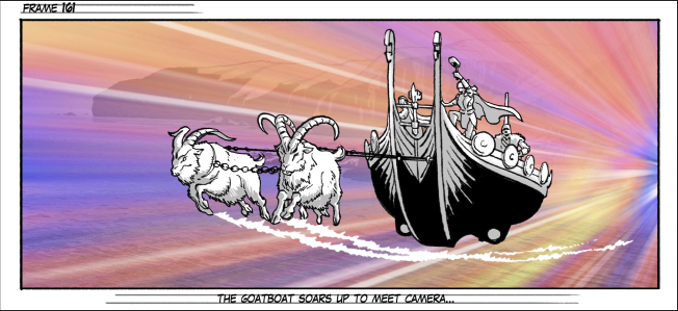
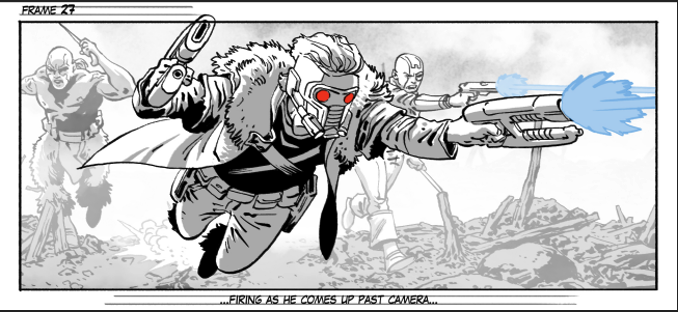
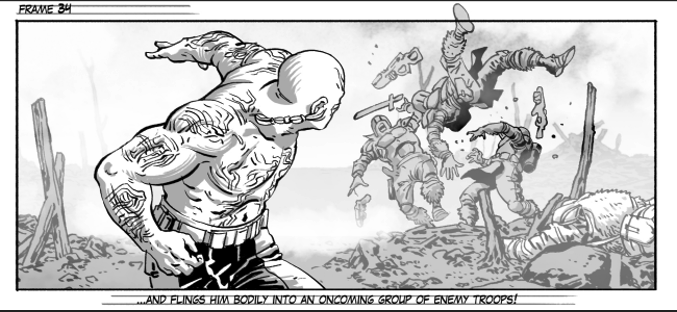
TW: As a storyboard artist, how much time have you spent on movie sets, or is it all spent behind a drawing board? Do you have any fun stories you are allowed to share?
MS: Back in the days of analogue and pencil and paper, I would spend a lot of time on movie sets and location, working wherever the production would take me. These days though, now that digital working methods are so ubiquitous and working remotely is such a standard, I barely set foot on a film set. Got to admit I miss it! But on the other hand, I can now work on films shooting anywhere and not have to leave my office.
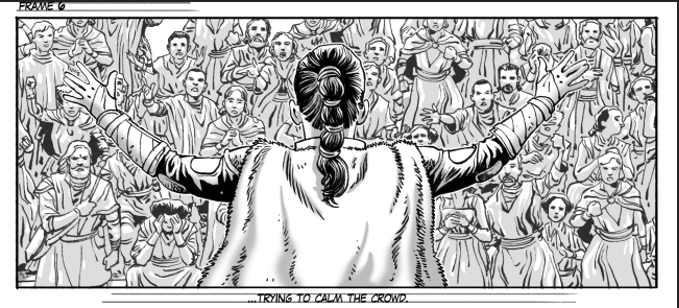
There’s always stories:
Being forced by an orangutan to sit in the lap of the (human) star of Babe 2.
Watching Mickey Rooney walk about aimless shouting “Kevin!” with a clown costume around his ankles, chased by frantic ladies from wardrobe while we were listening to the Dead Kennedys’ “Too Drunk To Fuck”.
Collecting Tom Cruise’s nose in the middle of my chest as I came around a corner one way and he was coming at typical Cruise speed the other way.
Standing in a doorway with John Woo watching my car be destroyed by baseball-sized hail (John found it very funny).
Seeing a gentleman in a very loud Hawaiian shirt yelling into the largest satellite phone I’d ever seen and feeling compelled to talk to him about it, generally blathering at length while he looked utterly bewildered, then only realising as I walked off that I’d just been raving about antenna sizes to Francis Ford Coppola (I was just coming off a 3-day stint of boarding without sleep).
Being told by George Lucas that his future goal was to be able to sit in a room and make a film by himself and put people like storyboard artists out of a job (this was in 2000, maybe he understood more about upcoming AI technology that most at the time).
Watching Hugh Jackman do a penguin impression after finding out I’d worked for 5 years on Happy Feet.
And watching a rough cut of Fury Road about nine months before it was released and being utterly blown away by the movie, even in its rough state. So many other stories but that’ll do.
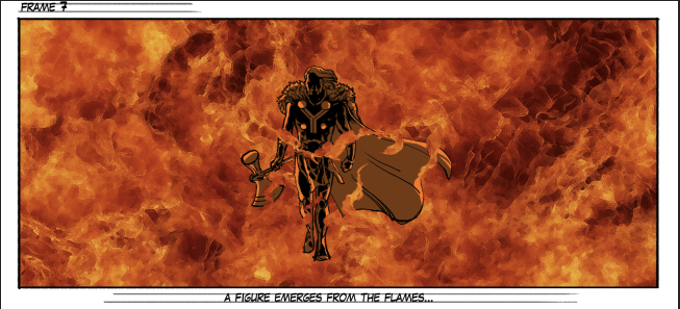
TW: As you mentioned, interestingly one of your latest projects I gather was for the upcoming MCU movie Thunderbolts*. I appreciate you are bound by an NDA, but can you describe the experience please? Did you have a chance to meet any of the cast of Thunderbolts*? Was it a pleasant project to work on? Please feel free to offer any hints of what to expect.
MS: Thunderbolts* was a fairly standard film experience for me – I worked remotely on it for around four months towards the tail end of pre-production (I’d been asked on earlier but already had prior commitments). The film was being shot mainly in Atlanta, but I sat in my office in Sydney doing the occasional Zoom call with the director Jake Schrier and producer Brian Chapek (both of whom were lovely to work with).
Generally, on Marvel films, you’re given a sequence to work on by yourself, figuring everything out from a fairly broad and simple brief – then after you’ve figured a version out, you pitch it back to the director and producer. Sometimes you get notes, but usually they take the sequence, put it together in an animatic and run it past Kevin Feige – he gives feedback and then you go through the process again until everyone’s more or less happy.
It’s both a great experience – you’re directly inventing stuff that can make it up on the big screen – but also very solitary as you’re working remotely. The role of a storyboard artist is a funny one in that we aren’t really part of any department within the crew – so we essentially only answer to the director and producer. That’s a great opportunity for us to markedly shape the film, but it can also be a double-edged sword – there was one Marvel film (not Thunderbolts*) where the production designer and art department were doing all this work on what the film would look like, but the director kept pulling out my boards and telling them that he liked what I had come up with better, and to use those designs instead. Suffice to say that I was not particularly popular with the art department on that film.
Anyway, Thunderbolts* was not like that – it was hard work, and I worked on one particular sequence that was completely reimagined about 4 times as the script changed. But I really did enjoy working with Jake and Brian. Jake is very understated and reserved, very thoughtful – but he had strong ideas. I think he’s going to turn in a very enjoyable film.
Of course, working remotely, I didn’t get to meet any of the cast. I’d love to have though – I always enjoy David Harbour in whatever he does, and I think Florence Pugh is a sensational actor – I’d have cheerfully chatted to all of the cast, they’re all great.
Obviously I can’t say anything about the story of the film, but what was really fun about the script was that it was so character driven, with terrific interplay between all the main players. Fun on the page, and with that cast, I can only imagine how much stronger the end result will be. Very much looking forward to seeing what the final film will be like!









You must be logged in to post a comment.