

Comics News
Tales From The Marvel Bullpen: Michael Higgins


More Marvelous Memories
With the recent news that Marvel Comics is moving its editorial offices from its long-standing home in New York to Los Angeles, Tripwire’s contributing writer Paul N Neal thought this may be a perfect time to reach out to some of our friends.
Marvel Comics veteran Gregory Wright recently shared his recollections of that time. A link to that interview can be found here:
https://tripwiremagazine.co.uk/headlines/tales-from-the-marvel-bullpen-gregory-wright/
Following on from that interview it was Neal’s pleasure to speak to another Marvel Comics creator, Michael Higgins to find out if he had a similar experience working for Marvel Comics in their famous New York offices. The same questions were asked and the replies were fascinating.
TRIPWIRE NOTE: Michael Higgins kindly reached out to his long-time friend and colleague Eliot R Brown for a little assistance with some photographs for this interview. All the images below are provided with his kind permission and shared here with Tripwire’s enormous gratitude…
TRIPWIRE: Michael, you may have answered this question a few times in the past but how did you first have the opportunity to work at Marvel Comics?
MICHAEL HIGGINS: I was a friend of George Pérez so my introduction to Marvel was very casual. I went to the Marvel offices the first few times with him. I sort of became George’s assistant and he suggested I learn to letter so I could do some of his independent projects. With Jo Duffy’s help, that lead to me getting a few short stories to letter. Then Jo told me about an opening for a staff letterer. I was hired for that job and started on staff the first week of March 1978
TW: Can you describe your first morning walking into Marvel Comics offices in New York? How old were you? Who greeted you that very first day? What were your very first impressions of Marvel Comics that day?
MH: I got there way too early the first day. The only person already in the office was John Tartaglione, who did art corrections. So, we talked for a while. I was only 18. These the very first days I can remember, watching John inking some Sal Buscema Captain America pages and a Jack Kirby Machine Man cover. I was always interested in watching all the artists work. That’s what I mostly did at conventions as a fan.
The staff gradually came in, and I got set up at a drawing table… and basically just started working. I wasn’t used to working with so many other people around me and that was an adjustment. I was a bit self-conscious. I think the first significant work I did on staff involved a few balloons in an issue of Thor.
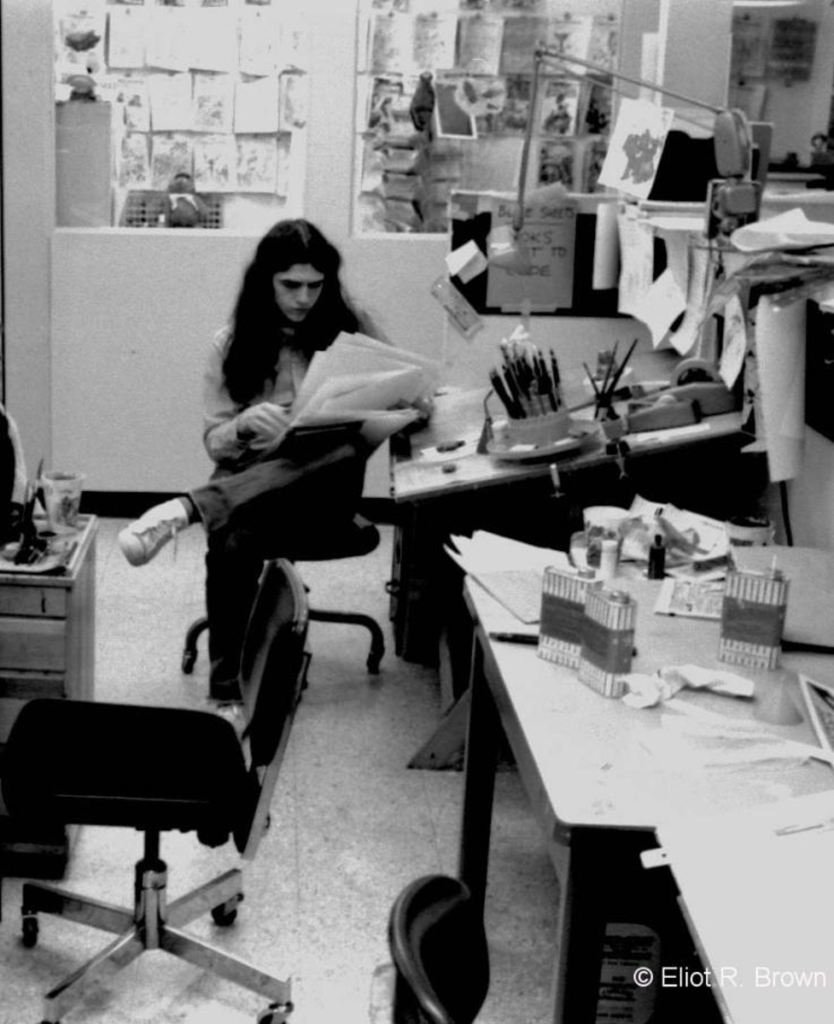
Photo Note: “This is me in the Marvel Bullpen in 1978, with Marie Severin’s office seen in the background. Those are three cans of Snopake on the table in the front. A lot of us never fully recovered when they stopped making Snopake.”
Tripwire Note: Snopake was a well-known brand of correction fluid and office stationery.
TW: For those that may not be aware, can you briefly describe your role or your official titles during your years working for Marvel Comics? What years did you work for Marvel?
MH: I worked in the Bullpen as a staff letterer for 2 1/2 years. A little later I became an assistant editor and then a full editor. Then I had a contract as a quota artist. I worked for Marvel from 1977-1999.
TW: The term “The Marvel Bullpen” has become the stuff of comic book myth and legend. To your knowledge who came up with those three words?
MH: Stan Lee made it up, but at the beginning it was more an illusion than a reality. Y’know, Jack Kirby wasn’t sitting around drawing comics in Marvel’s office, he was working at home in his basement. There was essentially no staff when Marvel Comics started. It became a real thing as time went by.
TW: What was the Marvel Bullpen really like? Many fans may picture an idyllic, perhaps nostalgic image of comic artists beavering away at their art boards to reach deadlines, and editors on the phones, and people running back and forth with parcels of original art almost like The Daily Bugle offices. Is that idea false or was it really like that?
MH: It was a little like that, but I certainly wouldn’t call it idyllic. When I did lettering corrections I worked in the physical area we called The Bullpen. This was the name of the area, but the collective art and lettering staff were also referred to as “The Bullpen.”
Danny Crespi was head letterer and did most of the covers at the time. Rick Parker also did lettering corrections, Morrie Kuramoto pasted up covers and Nel Yomtov pasted up letters pages. We worked in this large, mostly open space with a couple of partitions.
Art director Marie Severin had her own office at one end. The production managers’ office was at the other end and beyond that there were a lot of smaller offices, too.
Tartag (John Tartaglione) and cover colourist George Roussos shared an office. There was a separate office for the magazine line where designer Nora Maclin and B&W art director John Romita, Jr. worked along with a few others.
Dave Cockrum, cover designer and colourist Andy Yanchus had offices of their own or worked in The Bullpen proper at various times. There were other rooms with photostat cameras and one with a typesetting machine.
Unless you go back to the illusion, editors were not considered part of “The Bullpen.” Most of them had been working in one big office but beginning in 1978 the books were assigned to specific editor and Assistant teams. After that each Editorial team had an individual office. The special projects department— Stan Lee, John Romita, Sol Brodsky— had their own row of offices, and the British department had a sort of bullpen of their own near the receptionist.

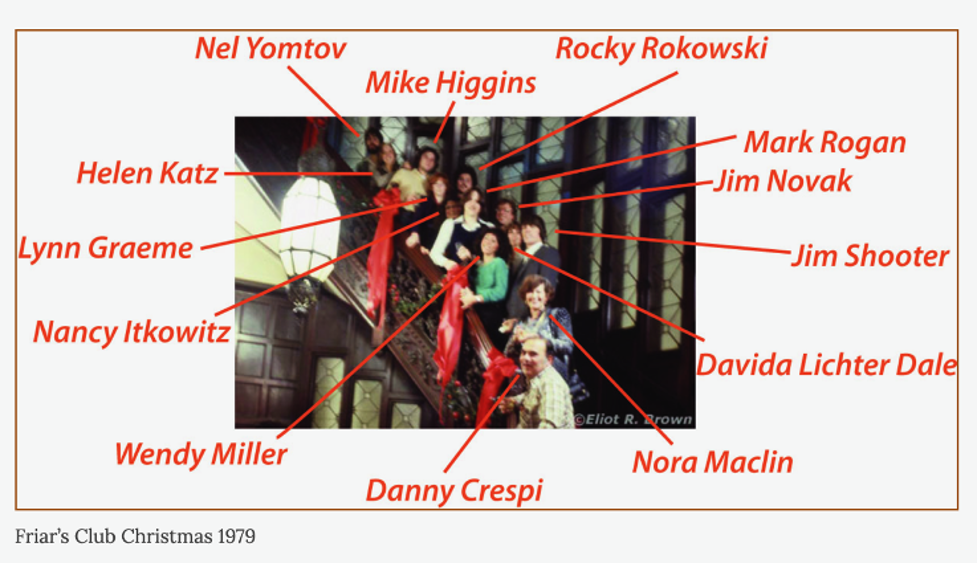
Photo Note: “Marvel held its Christmas Party at the Friars Club in 1979. I think Marvel’s president Jim Galton might have been a member. I remember some of the stodgy old men looking askance since women had invaded their private sanctuary. This is an image showing Jim Shooter in the foreground, with me in the back in the yellow shirt.”
TW: Was J J Jameson based on Stan Lee? Many comic fans have suggested this.
MH: I think a case could be made for that, but I never asked about it.
TW: Can you briefly describe your usual day working in the Marvel Bullpen? Was there ever a typical day at Marvel? What were your day-to-day tasks?
MH: When I worked in the Bullpen, each and every comic passed through twice for corrections. We also pasted top copy and indicias onto splash pages. Corrections could be very simple— just punctuation— or entire pages might be rewritten and pages cut apart with panels shuffled around and reassembled jigsaw style.
The editors decided what they wanted done to the pages, and then “The Bullpen” did it. Later, I was on the editorial side, and in addition to that we assigned work to all the artists, writers, inkers, letterers and colourists. We read through every page of plot and script and approved the art at every stage.
TW: What was the working atmosphere like in the Marvel Bullpen. Did everyone get on well or were creative differences commonplace? Was it a warm and pleasant workplace?
MH: Mostly. I mean, when I started Danny, Morrie and Marie all worked within a few yards of me. That was great. I got along well with the editors, but I knew most of them before I worked in the office. Danny advised me early on that to a certain degree there was a separation between editorial and production, but I hadn’t been aware of that.
There was a quick turnover in the Bullpen. A lot of people came, and a lot of people went. I got along better with some of them than others.
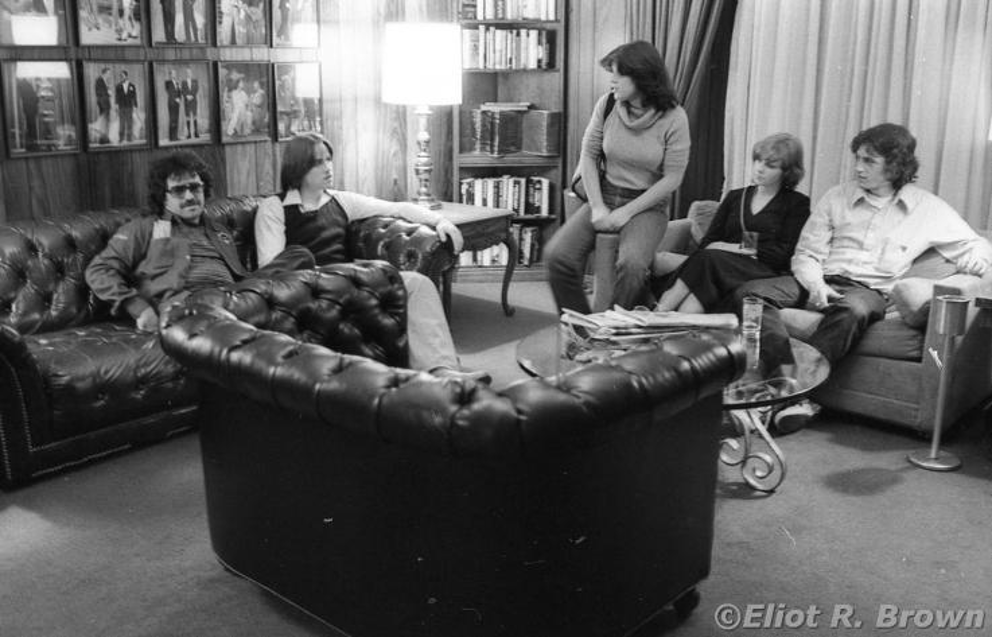
Photo Note: “When we weren’t posing for pictures on the stairway, we were making ourselves at home in the Friar’s Club lounge. Pictured are Statmen Robbie Carosella and Mark Rogan, Cindy Cavanaugh, who was an executive secretary in the Advertising Department, Lynn Graham, editor of Marvel’s Black and White line and me.”
TW: You must have met so many comic book legends in those New York hallways. Can you briefly share just a couple of memories? You must have brushed shoulders with some incredible creators. Or did you have coffee with Jack Kirby every morning and think nothing of it? Surely not?
MH: Well, as I said, George Pérez was a good friend, and before I worked at Marvel I met John Byrne, Dave Cockrum, Marshall Rogers, Len Wein, Marv Wolfman, Roger Stern, Bob Layton—it was a pretty big list. I knew Frank Miller and Bill Sienkiewicz before they had any work published by Marvel. I brushed shoulders with just about all of them and no, I didn’t think too much about most of it, especially as time went by.
I was still in awe of Barry Smith when I first saw him at a convention in 1974… and I only saw Jack Kirby once at a convention in 1975. I regret that.
I was personally introduced to Steve Ditko by Marie Severin outside Archie Goodwin’s office when Steve returned to Marvel, probably late 1978. Marie made a point of introducing us and that was a very big deal for me. I remember the first few times I saw Jim Starlin in the office… that really hit me. I loved Warlock. And even though I’d worked with him long distance, I was too overwhelmed by Craig Russell’s work to be able to get up the nerve to introduce myself to him when I first saw him at Marvel.
I once witnessed a conversation where John Buscema was trying to convince Gene Colan to adopt his method of pencilling so Gene could crank out more pages and make more money. It was fascinating, and to be able to see something like that up close and personal meant a whole lot to me… but I wasn’t really starstruck by most of it. It was just my life.
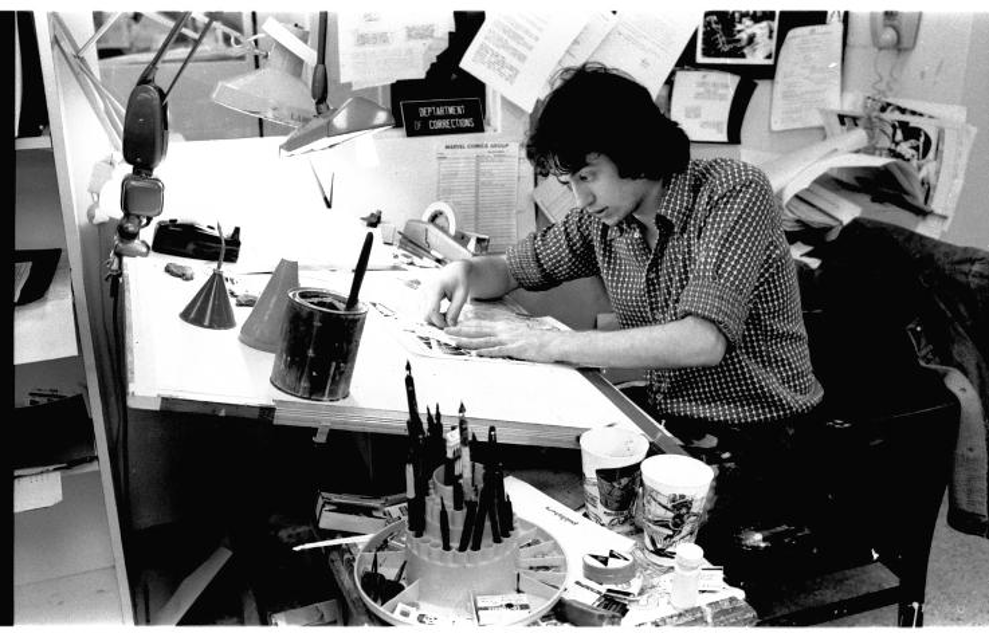
Photo Note: “This is me hard at work in the Bullpen— er… The Department of Corrections— in 1979.”
TW: I ask you to honestly reflect back on your time at Marvel just for a minute. In your era at Marvel, were there a great deal of female or black employees or colleagues. Or would you describe it as an enlightened and friendly working environment that was ahead of its time? It feels worthwhile to ask.
MH: I never noticed it at the time, because I was Jo Duffy’s friend and she was in editorial… but she was the ONLY woman in editorial—the first female editor ever at Marvel I think, and maybe only the second or third in the history of comics. I think one reason the lack of female representation in editorial wasn’t so apparent was that there were quite a few women who worked in the office.
We had Marie Severin, Paty Cockrum worked for Sol’s Special Projects Department, so did Irene Vartanoff. Nora Maclin and Davida Lichter-Dale worked on the B&Ws, Nancy Murphy handled subscriptions, Dorothy Marcus ran personnel, Dickie McKenzie returned artwork, Millie Shuriff had handled the accounting department since the 1950s… and there were numerous secretaries, so there were a lot of women in Marvel’s overall workforce… but not in editorial. On the other hand, I don’t remember that there was even one black woman working at Marvel back then when I started.
Also, in the entire time I worked in at Marvel, I can’t think of a single instance when a white EIC hired a black editor. That definitely became more and more apparent over time. I think over two decades or so, about three editors chose assistants who were black… and I believe Jim Owsley (Christopher Priest), hired by Larry Hama, who is Japanese, not white, was the only one promoted to the position of editor the entire time I worked for Marvel.
What you’ll discover is that comic companies always seem to have been willing to employ black talent as artists— arguably the most difficult task in comic production— but not much else.
TW: This may be stating the obvious but while you worked for Marvel you clearly didn’t have access to the technology most of us enjoy today. Were a lot of tasks completed using a photocopier? Did Marvel solely rely on the postman to receive original art and scripts? How many things were cut and pasted using scissors and glue? Were you working with fax machines?
TW: This may be stating the obvious but while you worked for Marvel you clearly didn’t have access to the technology most of us enjoy today. Were a lot of tasks completed using a photocopier? Did Marvel solely rely on the postman to receive original art and scripts? How many things were cut and pasted using scissors and glue? Were you working with fax machines?
MH: When I started, Marvel had one crappy copier. It was one of those relics with one big roll of paper. All mail was first class. It could take a week or more for a freelancer to get a book sent by US mail. I cut and pasted thousands of things at Marvel using two-coat rubber cement. No scissors. Some people used X-acto blades for cutting, but like a lot of older pros, I preferred single-edge razor blades.
We even used to cut and paste new dates into old indicias. It wasn’t a very sophisticated system.
There were no fax machines till a long time after I started.
TW: If you had photocopiers, who in the office changed the toner? What model computers were you using? I’m honestly just interested.
MH: The copy machine was on the opposite side of the partition from where I sat. Danny Crespi would get mad because it wasn’t my job, but I changed the toner a lot of the time. I also learned to clear the paper jams. We wouldn’t have been able to make copies of a whole lot of books if I hadn’t figured out how to do that. The official policy was to call a repair man who might show up a day or two later, so I usually just took care of it.
Computers were only starting to be used in comic production the last couple of years I was at Marvel, and that changed the game entirely.
TW: What were lunch hours like in the Bullpen? Did someone rush out for fifty sandwiches and hotdogs? Can you share any memories? Did anyone have any specific orders to your knowledge? After long hours, everyone needs to eat at times.
MH: We had an unpaid lunch hour between 12:30 and 1:30. I got into trouble once when I went out to lunch with Jo Duffy from 1-2. That was when Danny first took me aside and clued me in about the perceived rift between production and editorial. I was acting too much like an editor, I guess, instead of one of the Bullpenners.
The Marvel office at 575 Madison Avenue was just a few blocks away from Central Park and it wasn’t long before a group of us started spending our lunch hour there. When I was in editorial, we tended to go to local restaurants in groups of three or four, and we’d often take out a freelancer or use the time for plotting sessions. A favourite place for this was Mexico Lindo, where we especially enjoyed the “chippy chips and slippy grease.”
TW: Did working for Marvel in New York involve many late nights in order to hit a deadline? Were there huge pressures to get projects completed on time? Were the deadlines set in stone and vitally important?
MH: I couldn’t count the number of times I stayed up all night working! Yes, we took deadlines very seriously back then. Missing shipping was considered a major crime— we just didn’t do it! Over time editorial became so sloppy that this was no longer the case. By the late 90s it was a free-for-all. Back then, though, we made our deadlines.
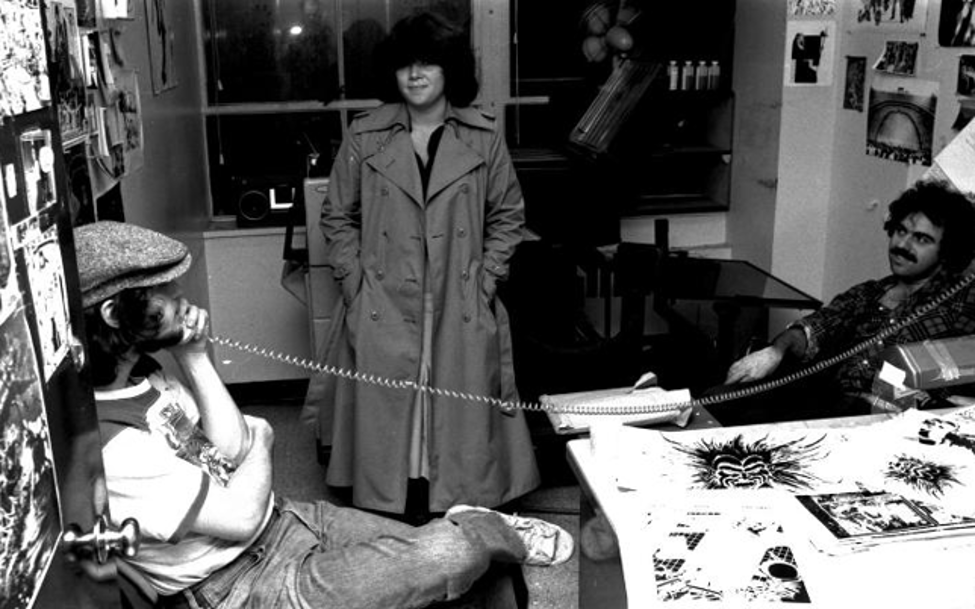
Photo Note: Hanging out in the Marvel Statroom with Robbie and Cindy in 1979.
TW: New York is famous for its sports teams. The New York Knicks especially this year, (I happen to be a fan), but were many of the writers, artists and editors you worked with especially passionate fans of any teams or sports? Was it ever a topic of discussion or debate? In New York I fail to believe it was never mentioned.
MH: Not so much. I can remember running into a couple of guys at a Mets game once… and of course a lot of us went to that Spider-Man wedding thing. Marvel did have a softball team that competed against other NY publishing companies in Central Park.
TW: What was the view like from the windows of Marvel Comics New York offices? What can you see? What floor were you on? Did the elevator always work? Did you ever get a view the Macy’s Thanksgiving Day parade Spider-Man balloon for example?
MH: At 575 Madison what I remember is seemingly incessant construction. The ATT building and Trump Tower were going up, so there were explosions all day long across Madison Avenue for a while.
We were nowhere near the Macy’s Parade route, not even on the same side of Manhattan… but the Pope did pass by on Madison Avenue when he came to NY. Basically, the views from Marvel’s windows at 575 Madison or 387 Park Avenue were just other buildings across the street. At 575 Madison we were on the 6th floor and the business guys were on the 9th. I think we were on the 10th and 11th floor at 387 Park Avenue South. The elevators usually worked.
Even with Marvel so close to Central Park, you couldn’t even see the slightest hint of it from any of Marvel’s windows. I did see the Macy’s Parade once from the DC offices at Mike Carlin and Archie Goodwin’s invitation.
TW: Finally, is it a sad day that Marvel moves away from New York? Was it inevitable or is it a mistake? So many classic stories have been set in New York. Are Spider-man, Daredevil and Luke Cage moving to Los Angeles as well? They are a permanent fixtures to the city surely?
MH: For a long time, most of the work hasn’t been done in the office anyway. I don’t really think it makes any difference except to the people on staff who will either have to move or get other work. I guess it was inevitable. After all, it’s all about the movies these days, isn’t it?
***
Tripwire thanks everyone involved for their help in making this interview possible.
Special thanks to artist John Charles for his assistance with the headline logo. Comments and feedback are very welcome.
Tripwire is ending this interview with a series of photos that simply tell a fascinating story….
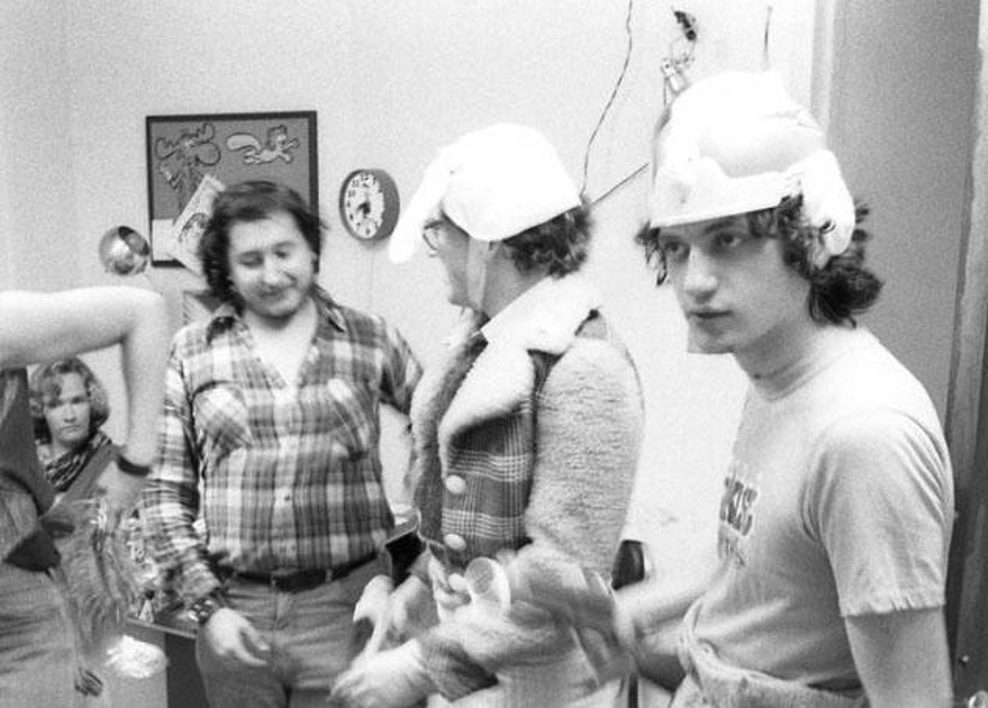
Photo Note: “Marvel Typesetter and colourist Carl Gafford had the idea for a cable TV show called Space Rabbit and he talked a lot of us into participating. A lot of people who agreed to do it dropped out immediately and the show never got any further than this single photo shoot
That’s Carl Gafford, the man in charge, talking to the star of the series, a friend of his named Rick Spinier… with me wondering what the hell I’ve gotten myself into.”
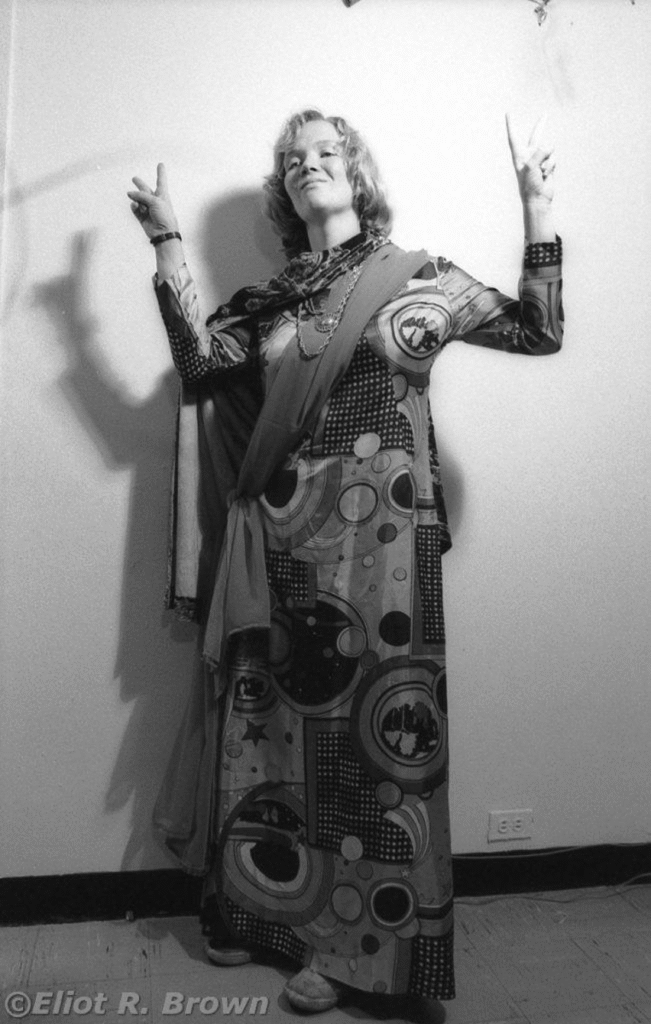
Photo Note: “Jo Duffy played the President of Space.”
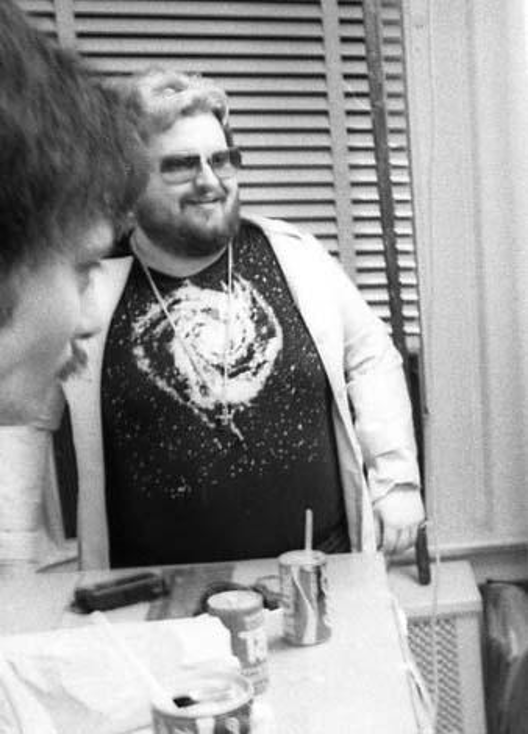
Photo Note: “It was a class act with such high production values that inker Duffy Vohland actually played Space.”
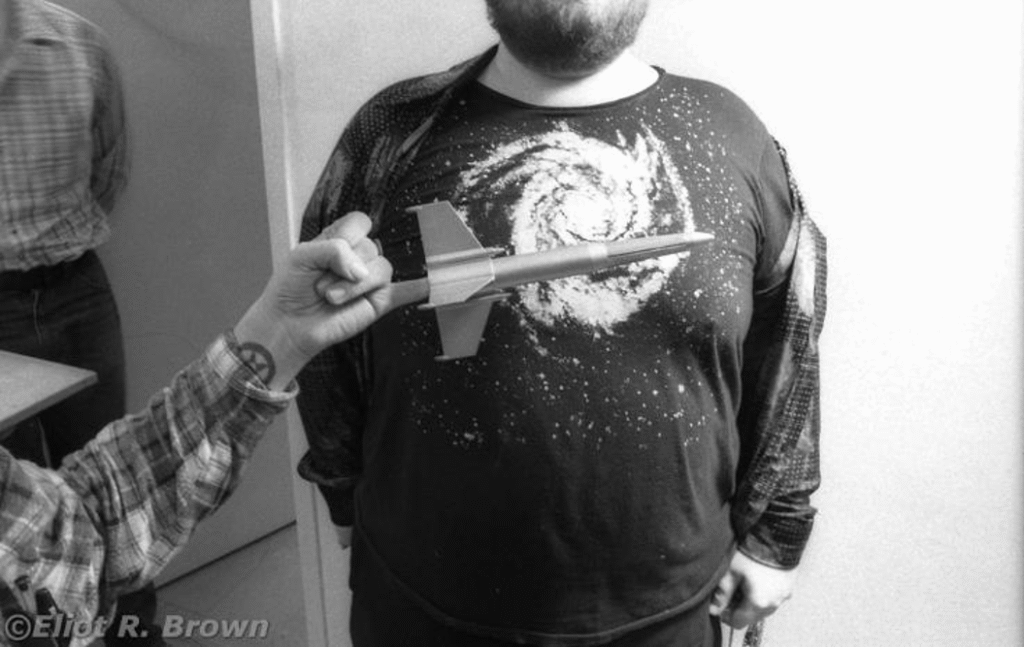
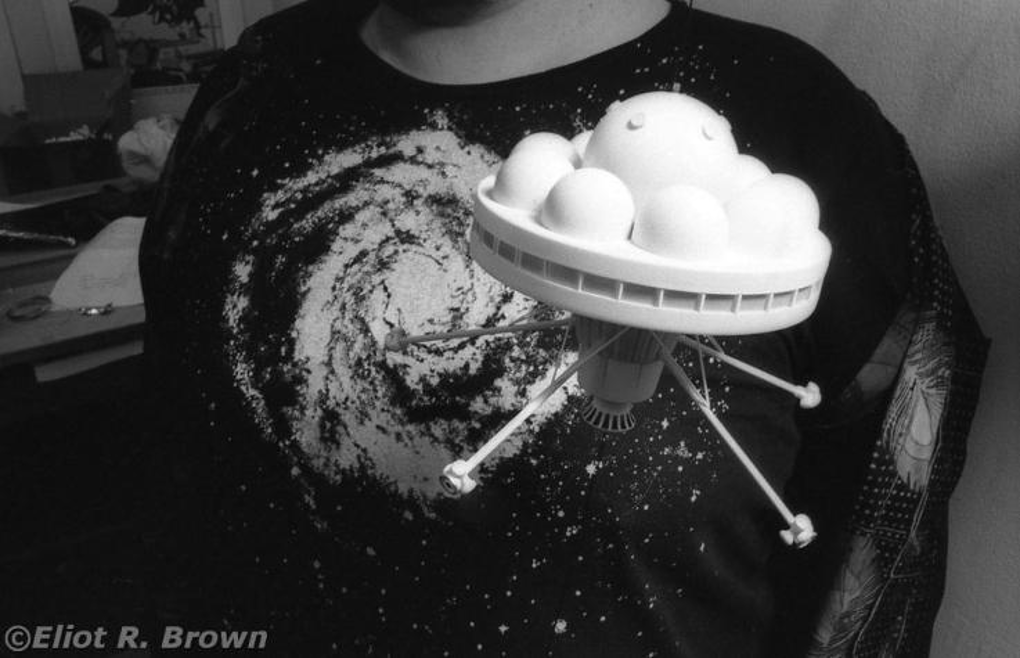
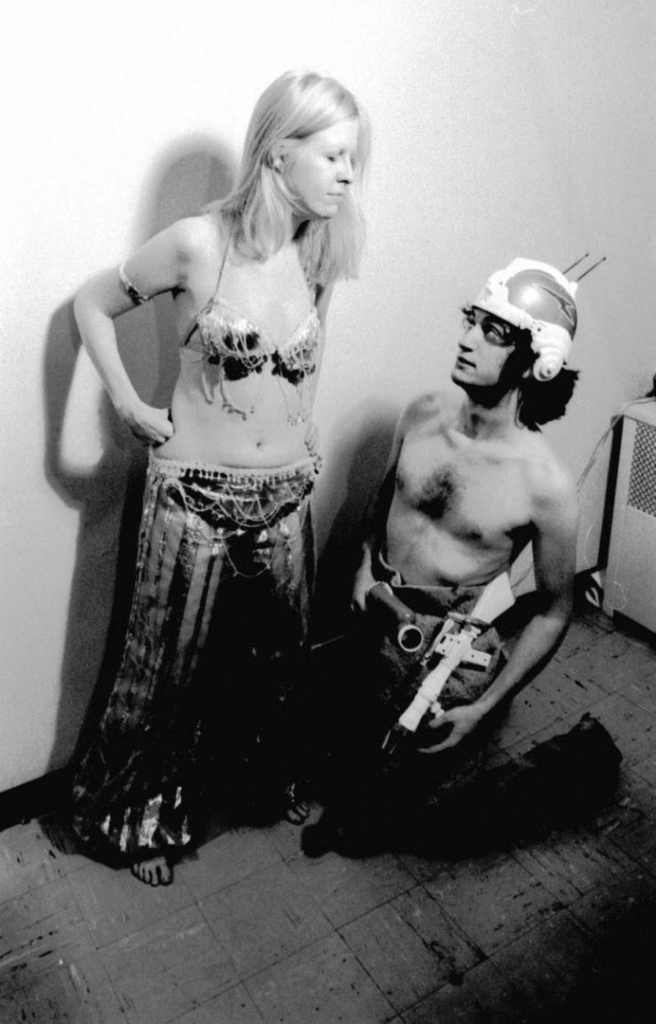
Photo Note: “As for me, I was a mindless minion in the thrall of Dickie McKenzie as an Evil Space Empress.”










You must be logged in to post a comment.