

Comics News
Co-Creator Tom McWeeney Talks To Tripwire About US Indie Roachmill’s 40-year Anniversary

Discussing The Bugs In The System
Roachmill was part of the 1980s black and white comics boom, created by Rich Hedden and Tom McWeeney.
Need an exterminator to handle those rats? Pesky roaches ruining your sleep? Maybe Grandma’s getting on your nerves? Call Roachmill Pest Control and we’ll get the job done!
Roachmill was part Dirty Harry, part 50’s detective novel and part Warner Brothers cartoon set in a future version of New York City.
The title began in late 1986. With the character being forty years old this year, Tripwire’s contributing writer Paul N Neal spoke to co-creator Tom McWeeney about all things Roachmill…
TRIPWIRE: 2026 marks the 40-year anniversary of issue one of Roachmill. I suppose my first question is simply: Does it feel that long ago? I hope it isn’t weird to ask but how old were you at the time?
TOM McWEENEY: Rich and I were both twenty when we started work on Roachmill and it very much feels like 40 years ago.
TW: Can you explain the origins of Roachmill? What were the circumstances that led you and Rich Hedden to create such unique character? Just how did the collaboration work? How did it all happen?
TM: The character Roachmill was completely Rich Hedden’s idea. The supporting cast were mostly mine, but the whole premise was Rich’s baby. We were in our final year at the Kubert School when Rich showed me a drawing of this weird bug-armed guy all in black holding four guns. I asked him who that was and he said “Roachmill. He’s an exterminator in the future. You can hire him to kill your termites or your mother-in-law.” That’s it, I was sold. Such a bizarre concept. Plus, I knew with Rich it would NOT be The Punisher, it would be funny and dark and strange, which it was.

TW: You have had a long career in the comics industry with DC Comics, Wildstorm and even toy company Hasbro. Where does Roachmill feature in that career? How significant has he become to you?
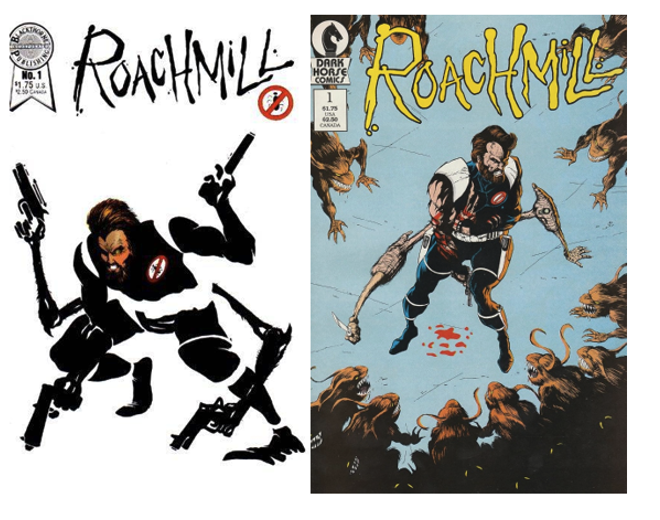
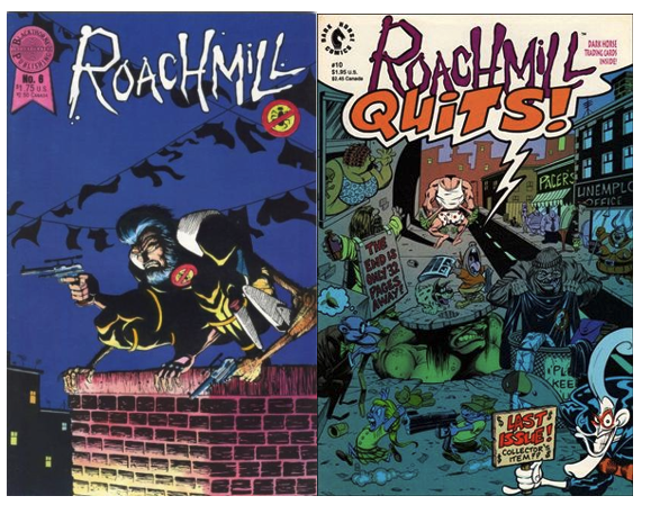
TM: Well, it got me published in a time when comics were still small, so comic people “heard” of Roachmill, especially after we went to Dark Horse. It also was a chance to improve my skills.
I can’t stress how important this was. I was not ready to work on a monthly book for Marvel or DC at that time. I didn’t have the chops or the mental focus. Roachmill was like toiling in the minor leagues for a few years, with long deadlines and low stakes, just having fun and trying to get better. So, I do owe him that.
TW: Roachmill emerged during a boom in the popularity of black and white comics. Was the decision to create a black and white comic a financial choice or a decision that was entirely creative? In your mind would the character have been as popular if the title had been a full-colour project?
TM: We were kind of smart about it in hindsight. Or maybe realistic is a better word. We both knew we weren’t getting hired by Marvel or DC any time soon, and there were all these smaller publishers out there looking for material. I’ve always said that Rich and I were in exactly the right place and time when it came to our careers. A few years earlier and our only choices would have been Marvel and DC and a few years later most of the smaller publishers were gone. We hit a window where everything, for the first time, was wide open. All the new publishers were doing black and white books so by default Roachmill was black and white, which was fine with us.
Our second year at Dark Horse, they gave us the option to go colour. We talked it over and both agreed that colour was not going to make the book any better and it would just become one more thing we would have to concern ourselves with, so we passed.
Also, Dark Horse had a profitable number for black and white books, I believe it was ten thousand copies, so if a black and white book slipped below that number, it would be cancelled. If Roachmill had gone colour, because of the extra printing costs, that number would go up, meaning we’d have to sell more books just to keep from being cancelled. We were selling around thirteen thousand copies at the time, and I was not convinced colour was going to pull in enough new readers to make up for the cost increase.
TW: I am guessing in the last forty years you have attended a handful of comic conventions and comic signings. Do you meet a great deal of Roachmill fans? I believe the title has a pretty dedicated “cult” following, what are the fans like?
TM: I think “cult” following is overstating it. It has a small following of fans who love it, much as I would imagine most small press books from that era have.
Roachmill fans are great because you know right away a bit about their taste. They must like stuff a bit offbeat, that’s not afraid to be funny or to tip over into satire. These are the things Rich and I both like and it’s always good to know some others do as well.
TW: In your experience have you ever seen or heard of any Roachmill cosplay? In theory I would imagine that would be tricky, but some cosplay artists seem to be very creative. Would you agree?
TM: I have not seen any Roachmill cosplay. The character has been out of print, mostly, since cosplay really blew up so I’m not surprised. No one knows who he is.
I did see a woman posting videos of a pair of wings she made that folded up on her back and thought her mechanism would work perfectly for Roachmill’s insect arms, which Rich had always envisioned would fold up on his back when he was relaxed. So, it absolutely could be done.
TW: Tripwire’s Scott Braden spoke to you back in 2019. At the time, we asked how things were potentially progressing with bringing Roachmill to the big screen. Since then, have you received any further interest in a film or television adaptation?
TM: No, but aside from that failed film there was another time a studio was, at least briefly, interested in Roachmill. In late 1997, HBO was looking to expand their animated line up based on the success of the animated Spawn show and Dark Horse told us that they were considering Roachmill along with Jason Pearson’s Body Bags and one other but that’s all I remember.
TW: It may sound silly, but in 2026 and with Clint Eastwood being an unrealistic option now, who would you currently picture playing Roachmill if somehow a movie did occur?
TM: I really want to give you an answer to this, but I honestly can’t come up with a single actor right now who I think would be a good fit. I mean I’m open to suggestions, but it would have to be someone tall and wiry, no stocky guys or muscle actors. And more importantly he has to look kind of grizzled and worn. A bit scary.
Josh Brolin has the face and the voice but he’s just too short. There’s an actor named Harris Dickinson who was in Triangle of Sadness, and he has the Roachmill build, but he’s just too good- looking. The only other actor I ever thought was right for the character was Robert Patrick around the time he was on The X Files. He would have been a killer Roachmill.
TW: This is a difficult question to ask. Roachmill was a pretty tough guy who literally specialised in dealing with illegal ALIENS. Given numerous current global political events, does the character feel in any way more relevant to today’s world?
TM: I would say the opposite is true, the books, such as they are, were satirising something that can no longer be satirised. Roachmill was funny because it was over the top. It was us, in 1986, making fun of comics’ sudden love affair with guns and, to a lesser extent, America’s.
The aliens arriving on Earth was just an inciting incident and a way to make it more “science fiction.” Plus, Rich just wanted to draw “goofy aliens.” The aliens weren’t the targets per se, but eventually the laws get rewritten and became so broad that everyone then becomes a potential target. Factor in all the mass shootings that have occurred in 40 years, and our satire is now a sad reality.
TW: The omnibus book format has been a huge success for both DC and Marvel Comics. Would you imagine a Kickstarter campaign that puts the entire history of Roachmill together could become a success? Would you consider such a thing?
TM: Dark Horse wanted to do an omnibus back around 2007, but it fell through for logistical reasons. I’m 60 years old and I have no desire to get involved with Kickstarter for something that is not going to make me any money. The audience is too old and too small for Roachmill.
I know this because It’s Alive reprinted the first six issues of Roachmill in 2022 and the publisher used Kickstarter to fund printing costs and while it did get fully funded, I would not call it a roaring success. It kind of limped to the finish line. People always say, “just crowdfund it,” like that’s so easy, but it’s still a full-time job to run the campaign, supply incentives and actually get the book produced and shipped. No thanks.
TW: Certainly, in the UK black and white comics tend to still have a dedicated fanbase. Is there a possibility you may ever consider returning to Roachmill for new and fresh stories?
TM: It’s unlikely at this point. Rich and I are really no longer compatible work partners. We’re still friends but our few attempts to do something together since the end of Roachmill have not panned out.
TW: After forty years, what is the legacy of Roachmill for you and his fans?
TM: Roachmill’s legacy? Well, Deadpool is one. He’s essentially Zoo-Lou from Roachmill. A goofy, impossible to kill hitman that’s aware that he’s a character in a comic book. The film District 9 clearly sprung from the pages of Roachmill as well. Too many similar ideas to have been a coincidence.
I wish I could say it had some kind of lasting legacy in comics, but it really didn’t. It was just too much of a mess to have any kind of impact. People just don’t know what to make of it. Rich and I had zero editorial restraint and that was not a good thing for two kids doing their first comic.
When I look at Roachmill now, all I see is what it could have been had we just thought for a second about the audience and not ourselves. There’s some good stuff in the early issues when we were trying to stick to the premise and write stories within that world, but once we switched to Dark Horse the book was killed by our own immaturity and self-indulgence. I tried to steer it back on course with the four-issue Laser Killer storyline, but Rich fought me all the way through and for the first time the book no longer felt fun. That was kind of the end.
TW: Would you have any exclusive or rarely seen Roachmill images Tripwire could share with the world?
TM: Recently Jake Allen did a piece of Roachmill fan art that I loved. In my opinion, it’s the best drawing of Roachmill I’ve ever seen. I captures him perfectly. Also, there were some terrific variant covers commissioned by It’s Alive that I’m not sure many people saw. Richard Pace, Mark Nelson, Nicolas Giacondino along with one of my own and a cover Rich Hedden and I supplied for the trade.

TRIPWIRE NOTE: Artist: Jake Allen.

TRIPWIRE NOTE: Artist: Richard Pace.
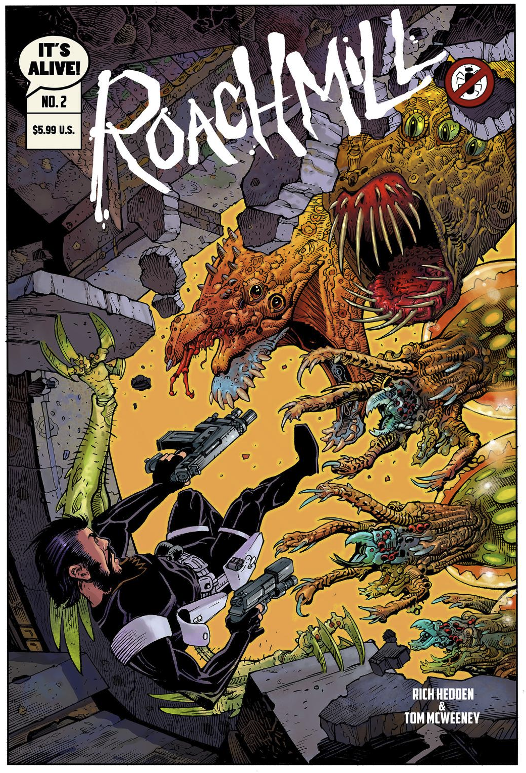
TRIPWIRE NOTE: Artist: Mark Nelson.

TRIPWIRE NOTE: Artist: Nicolas Giacondino.

TRIPWIRE NOTE: Artist: Tom McWeeney.
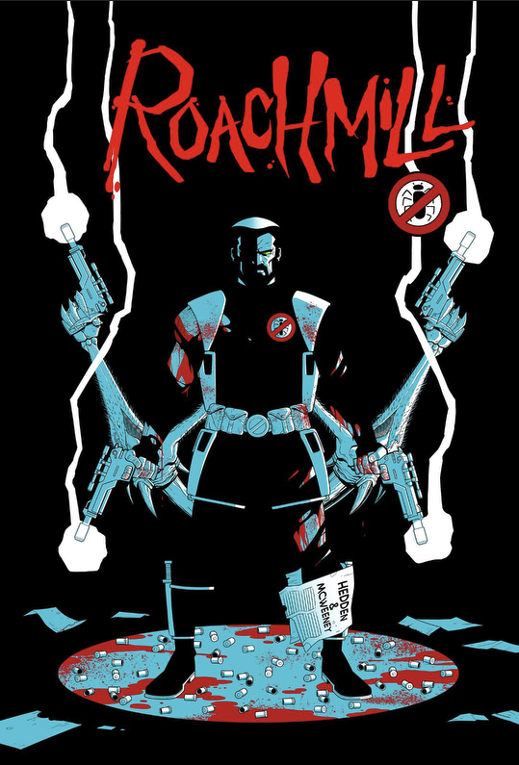
TRIPWIRE NOTE: Rich Hedden and Tom McWeeney
Final Tripwire Note: As Tripwire mentioned our contributing writer, Scott Braden also spoke to Tom McWeeney back in 2019. Here is a link to that excellent interview:
https://tripwiremagazine.co.uk/headlines/scott-bradens-lost-tales-tom-mcweeneys-roachmill-movie/








You must be logged in to post a comment.