

Comics News
Looking Back At DC’s Man Of Steel Celebrating Its 40th Birthday

Remaking Superman For A Modern Age
Tripwire’s contributing writer Scott Braden takes a look back at John Byrne’s Man Of Steel comic which celebrates its 40th birthday this year…
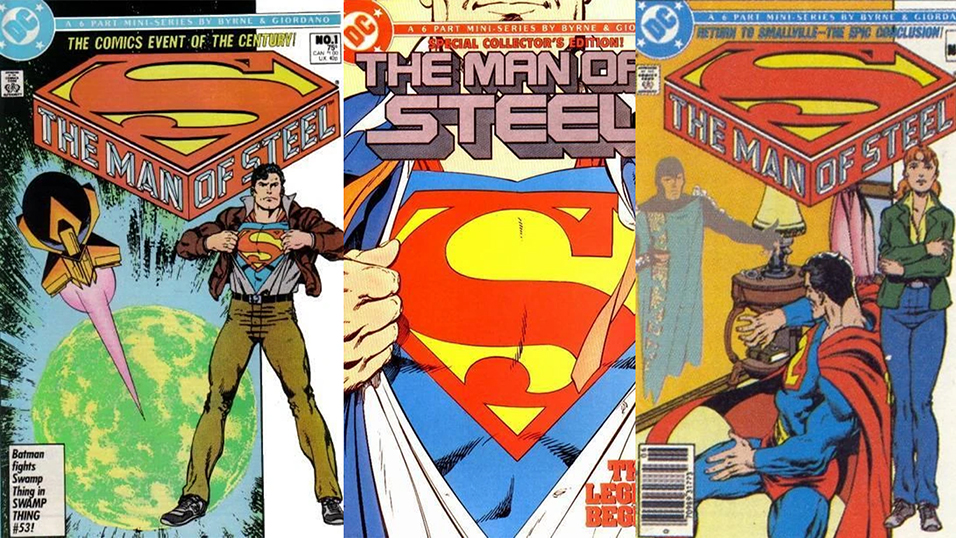
Recently, John Byrne has received massive press and tremendous accolades for his work on Marvel Comics’ X-Men: Elsewhen. But 40 years ago, he received the same for his revamping of DC Comics’ “Man of Tomorrow” with the six-issue limited series he wrote and illustrated himself, The Man of Steel.

A pivotal reintroduction of the “Last Son of Krypton” following the events of Crisis on Infinite Earths, Byrne redefined the origin and supporting cast that made up the mythos of Kal-El or Clark Kent, as he knew himself to be.
During the publication of Crisis on Infinite Earths, executive editor Dick Giordano discovered that Byrne had no longer been under contract with Marvel Comics. In May 1985. Giordano and Byrne began talking about what the acclaimed creator would do with Superman if offered the job. With DC agreeing with 99% of the revision, Byrne was given the go-ahead for what became The Man of Steel. Byrne’s original pitch was to mold Superman through a story arc over six or eight issues which would bring Superman to the point where he wanted him to be, but because DC insisted on a reboot, Byrne used that approach instead.
Among the changes, Byrne got rid of Clark Kent’s teenage career as Superboy; cut down Superman’s powers; and made Superman the only survivor of Krypton, avoiding other Kryptonian characters if necessary. Byrne also made Lex Luthor, Superman’s arch-enemy, a powerful businessman and a white-collar criminal, as opposed to the classic mad scientist moniker.

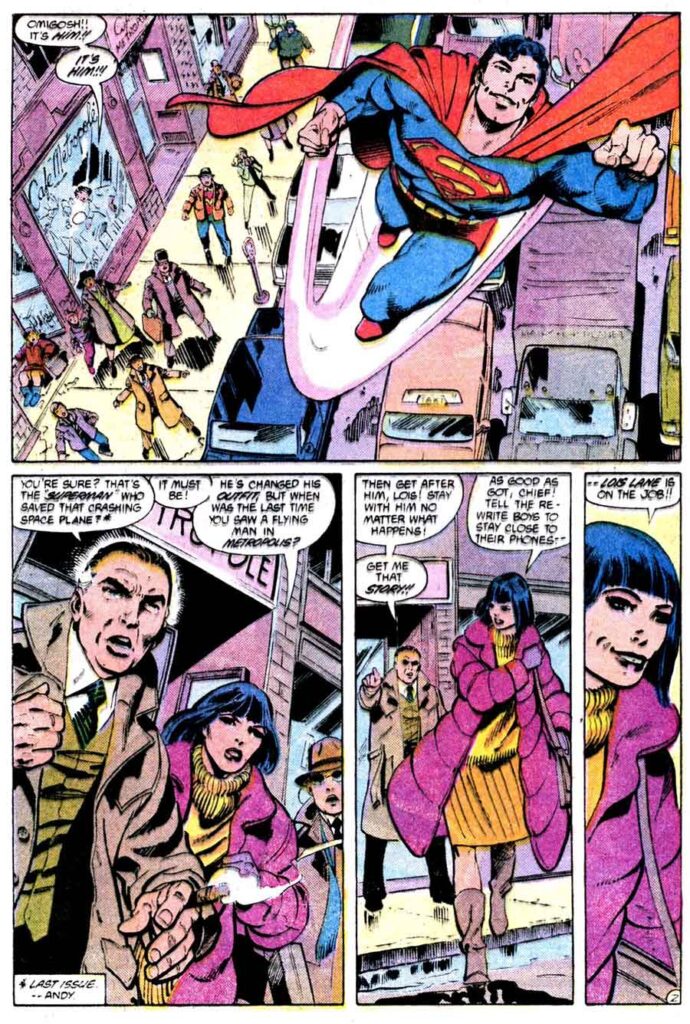
As a teenager, Clark Kent wins a high school football game almost single-handedly, a story idea which would never have been allowed in pre-Crisis times. In The Man of Steel’s premier issue, Clark has also developed many of his powers: stamina, great strength, X-ray vision, and flight. Jonathan reveals to him that he is not Jonathan and Martha’s biological son; they found him in a crashed spaceship. Jonathan explains that Clark needs to use his powers more responsibly, not for his own benefit. Clark decides to anonymously help others, and for the next few years, while studying in university, he secretly saves lives and averts disasters. While in Metropolis, however, he openly prevents the crash of an experimental space plane, revealing his existence to the public. He meets Lois Lane and the two start to connect when a grateful mob of people surrounds them. Clark, unable to deal with the sudden attention, flies away to consult his parents. In order to preserve Clark’s privacy, Jonathan suggests that Clark adopt a secret identity. Martha makes a costume for him, and he decides to use the name he was given by Lois, “Superman”.
Clark’s abilities are shown to have developed gradually in the yellow sun environment of Earth, starting with resistance to injury, with his flying ability emerging last. His powers do not reach their peak until his late teen years; thus, Clark only adopts the Superman identity in adulthood and never was Superboy.
The second issue picks up with the costumed Superman debuts in Metropolis. Daily Planet managing editor Perry White assigns Lois to get the full story on the new hero. In the meantime, Superman is all over Metropolis aiding others, from stopping muggings to foiling bank robberies. After a series of failed attempts to even encounter him again, Lois decides to take a gamble and plunges her car into the harbor to lure Superman into the open. Her plan works, as Superman arrives and takes her back to her apartment. The pair have a quiet talk in which Superman vaguely reveals some details about himself, including confirming the name “Superman” that Lois gave him in her first article about him.
Lois finally has her scoop – the first sit-down interview with Superman – only to find out she’s been beaten to the headline by the Daily Planet’s newest reporter: Clark Kent.
The third issue explores Superman’s relationship with The Batman, which was friendly throughout most of the pre-Crisis period, but became much more strained in later years, as each began disagreeing with the other’s attitudes. This shift is reflected in Man of Steel, as it starts off with Batman and Superman initially at odds over their respective ideologies and approaches before just begin showing signs of developing a partnership, if not friendship. The Dark Knight’s musing at the story’s end is an allusion to their pre-Crisis friendship.
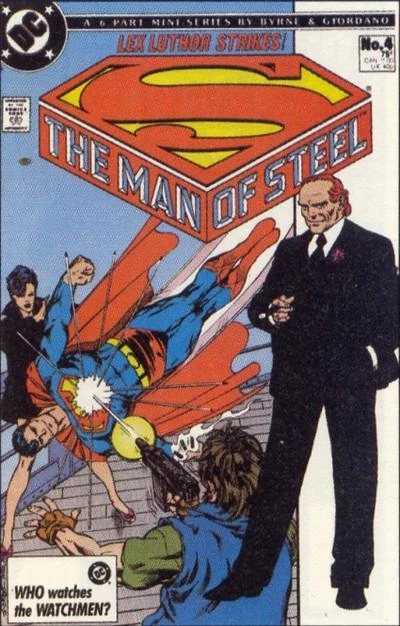
The fourth issue reveals Byrne’s reinvention of Lex Luthor, who, as stated previously, was no longer a mad scientist or costumed super-villain but instead was a power-hungry businessman and “the most powerful man in Metropolis” who resents Superman’s overshadowing presence. Instead of battling Superman directly, Luthor would now use hired minions, employ staff on his payroll, or manipulate others to destroy Superman, while ensuring that no incidents could be conclusively linked to him.
Issue #5 has Superman seemingly capturing Luthor, who is wearing his pre-Crisis power suit, but the next page reveals that it is one of Luthor’s pawns in the suit. Luthor claims that the suit had been stolen and that he had no knowledge of the plot to attack Superman, but the suit’s systems have left the man inside a vegetable, unable to tell the truth of Luthor’s involvement. The reader later learns that Luthor was responsible for all of the above, which Superman suspects. Additionally, through Dr. Teng’s examination, Luthor is among the first to discover that Superman is not human, but an alien. Superman is still, at this point, unaware of his extraterrestrial origins, much as his Golden Age version did not learn the truth about his past until well into his adulthood.
The issue also reintroduces the villain Bizarro, who was established as an imperfect clone of Superman, created from the superhero’s DNA, rather than as a duplicate resulting from an imperfect duplicating ray. Furthermore, Bizarro is no longer an “imperfect opposite” of Superman and as such, has identical rather than opposite powers. Though the duplicate is referred to as “bizarre” in-story, it is never explicitly named “Bizarro”; that name will not be established post-Crisis until years later, when another imperfect duplicate created by the same process runs rampant in Metropolis. Lois mentions that she has been dreaming of kissing Superman for five years now, indicating that he has been active in Metropolis at least that long at this point.
The final issue of the mini-series has Clark reveal his abilities to his old flame Lana Lang, and, while she retains feelings for him, has come to terms with the fact that they will merely be friends, and no longer pursues him as she did pre-Crisis. Clark’s adoptive parents are alive and well into his adulthood, and Clark visits them periodically. Pre-Crisis, they had died shortly after Clark’s high school graduation.
Clark is 28 years old by the time the story ends, indicating that the six issues had taken place over a decade.

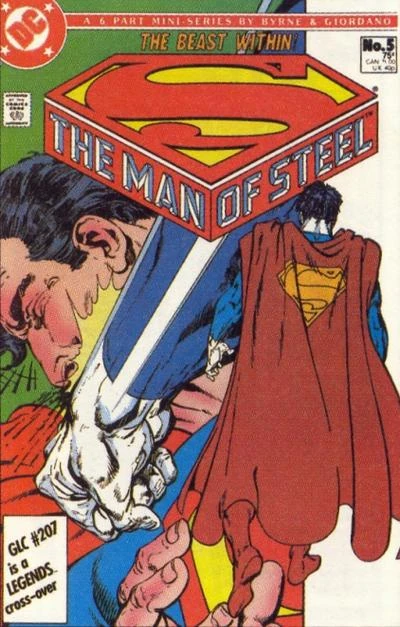
From 1986 until 2003, The Man of Steel was the official Superman origin story. The 1998 limited series, Jeph Loeb & Tim Sale’s Superman for All Seasons added to the story, but did not remove it from continuity.

Byrne followed the story with three four-issue mini-series that retold and explored the new world of Superman: The World of Krypton (December 1987 – March 1988), The World of Smallville (April – July 1988), and The World of Metropolis (August – November 1988).
In addition to these stories, three ongoing monthly comics featuring the new Superman’s adventures were published by DC. Byrne continued his stories in the brand new Superman #1, and continued with Action Comics #584, while celebrated comics scribe Marv Wolfman wrote Adventures of Superman which had been retitled from the original Superman book and began with #424.
Byrne and Wolfman continued the changes presented in The Man of Steel in these ongoing stories. Although most of Superman’s powers remained unchanged, they did become limited to make him more believable. Additionally, he could no longer survive in space indefinitely without an air supply. These changes eliminated intergalactic and time travel stories.
They also wanted to establish Clark Kent as the real person, with Superman being the disguise. Clark was no longer “mild-mannered”, but became more assertive. He worked out to explain his muscular build and had written a “best-selling” novel before becoming a Daily Planet reporter.
Additionally, most stories of other characters trying to find out Superman’s secret identity were eliminated, as it was not believed that he had an alter-ego. Byrne also decided to keep Jonathan and Martha alive and well into Clark’s adulthood to be important support characters for years.
Byrne also limited the use of Superman’s weakness, kryptonite. He removed all other forms besides the green variety, and made it an extremely rare element that came to Earth in one large rock with Superman’s rocket. Lex Luthor believed early on that the radiation emanating from kryptonite was within safe limits for humans, but was proved wrong in later stories.
Two of the biggest changes to Superman was reestablishing him as the sole survivor of the planet Krypton and the removal of his career as Superboy. These alterations in continuity would have a serious effect on the Legion of Super-Heroes. The Legion was formed based on the legends of Superman’s adventures as a boy, and since they were still in continuity this was a problem. Additionally, Supergirl visited and worked with the Legion in many of their stories. Since Supergirl did not exist either, Byrne had to correct this incongruity. He created a storyline in his two books where the Legion travels back in time to confront the post-Crisis Superman to find an explanation on Superboy’s apparent disappearance. It was revealed that the Legion’s enemy, the Time Trapper had created a pocket universe where Superboy existed. Whenever that Superboy would travel to the future or the Legion would travel to the past, the Time Trapper shifted them in and out of the pocket universe. This would also be used to explain the existence of Supergirl in the Legion stories.
One change of the Superman mythos introduced by Byrne was that Kal-El was not an infant sent from Krypton to Earth, rather, his fetus was placed in a “birthing matrix” equipped with a rocket engine and Jor-El’s experimental warp drive, with Kal-El gestating during the trip to Earth. Once the rocket landed, Kal-El was fully “born” on Earth and was officially an American.
Also, the planet Krypton in this series is cold and emotionally sterile, an idea Byrne borrowed from the 1978 film, Superman.
The Man of Steel was highly regarded as an origin story for Superman, with the first issue selling in excess of 200,000 copies. In collected editions, as time went on, the story has sold legions more ever since.











You must be logged in to post a comment.