

Headlines
Throwback Thursday: Dave Gibbons

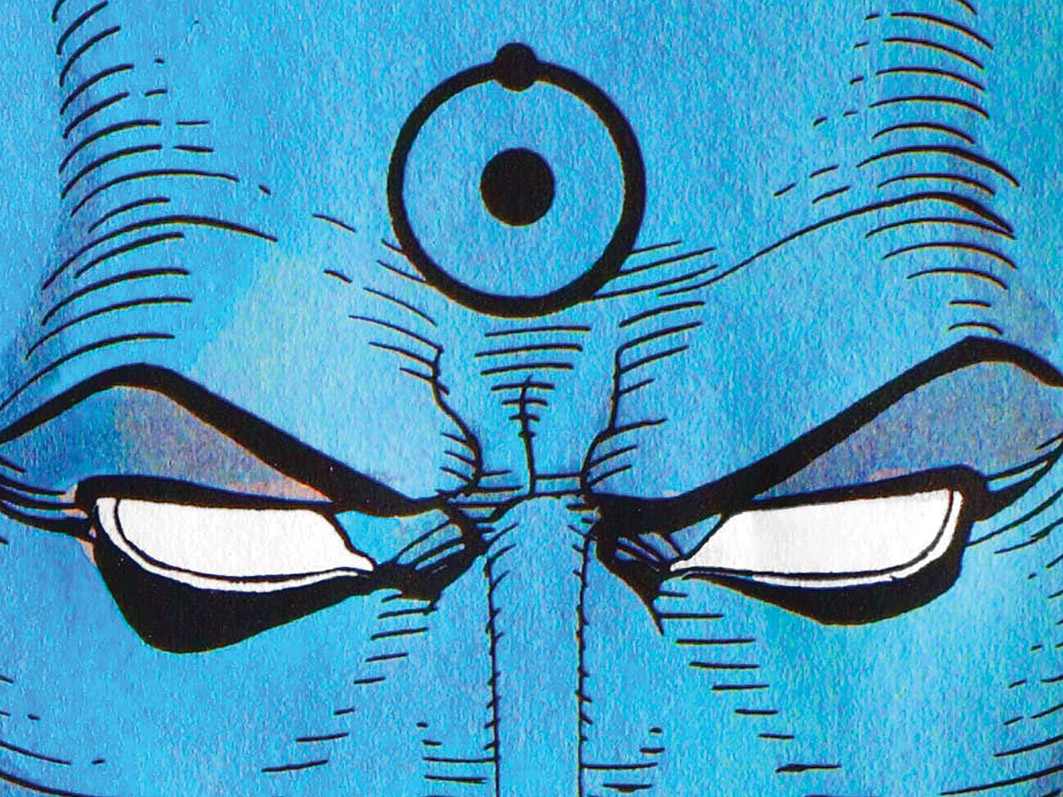
♦Back in Superhero Special 2009, we spoke to Watchmen artist and co-creator Dave Gibbons about how he approached the series when he first drew it in the Eighties. Since 2016 is the 30th anniversary of the series, we thought it would be an appropriate throwback . interview by ANDREW COLMAN
Sketching The Past
TRIPWIRE: Would you regard this book as essentially for Watchmen aficionados? It does detail the creative process, but it does seem like a book for those who are not just familiar with the work, but are completists.
DAVE GIBBONS I think it’s for everybody who’s interested in Watchmen – I think there’ll be more of those once the movie’s here. I think certainly over the years that there’s been such an interest from readers about how we did Watchmen, what was it like working with Alan Moore, how did we plan things out. I think a lot of general readers will be interested in it, I don’t think it’s just for completists, although they do form a reasonable section of the audience.
TW: The book is a lavishly illustrated companion of the graphic novel. It does tie in (obviously) with the release of the film, but would you say its publication was as much to do with distance from the time it was produced?
DG: I first explored the possibility of doing this book when I was meeting Paul Levitz about a movie-related item – I think it was Motion Comics, we talked about those. I know that Paul is a pretty big fan, as big as I am in fact, of comics, and I told him about all these notes and sketches that could be turned into a book, and that I’d seen other books that Chip Kidd had done on Alex Ross and the Batman Animated Series. I really thought that the material in Watchmen could be treated in a similar way. Paul put a note in his book, along with a note that Chip Kidd should design this book because I think he’s got a way of making this archival material come alive and making it very tactile, almost as if when you’re holding the book that it’s like holding the original in your hand. The timing is such that it’s come out at a good time – I couldn’t imagine a better time for it to come out, in fact. This wasn’t calculated, I sat down and started to write the book once we got the go- ahead. I began to inventory everything that was going to go in it and it was put together in an organic way. Yes, it’s coming out at a time when people are becoming more aware of the Watchmen – hopefully they’ll pick up the book, and as far as anyone who’s been a fan, it’ll be a band aid for all the haemorrhaging enthusiasm that must be taking place with the movie coming up. I’ve done it for no other reason than it’s the kind of book that I love – if I hadn’t been involved in it I’d’ve been at Waterstones or Forbidden Planet on the day it came out to buy it. It’s nice to see it in amongst all the those similar type of books that I and fans like myself love to have on their shelves.
TW: Your narrative is most interesting when you discuss fandom’s reaction to the then just-published issues, and the frenzy you experienced at U.S. conventions. San Diego in those days was purely about comics, and the medium’s fanbase seemed more cohesive and progressive. Are you nostalgic for how fandom was back then?
DG: Well, I suppose this comes back to “What was the Golden Age of science-fiction? Fourteen!” One’s own experience is integral to how you think fandom or any sort of enthusiasm should be. Obviously they were very exciting days, very exciting for me – I think people of my generation, me, Alan, Brian, Kevin O’ Neill, Mick McMahon, I think we were on a high and were on the cutting edge of things. And we were the young turks, and for that reason things like San Diego were an incredible experience. I find San Diego today to be rather bloated, it’s like three conventions in one, although whenever I get the chance I love to walk around it and see just how our prviate world of science-fiction and fantasy has turned into this global phenomenon in a number of different media. I guess that one’s always going to be nostalgic for the old days, but you know, I would have to say in many ways, contrary to what I said about the Golden Age, is that this must be the Golden Age today. There are some fantastic writers and artists around, all the best work from the past is readily available in archives and other collections and there are wonderful retrospectives of cartoonist’s careers available, and there are movies now that you could rate very good to excellent that deal with these characters. I think probably back in 1985 we could only have dreamt of the kind of exposure that our media has today. I suppose there was a degree of intimacy that isn’t around now – I particularly think of the London comic marts and the Westminster Arms, the pub next door where anybody who was important in British and American comics seemed to be drinking in on a Saturday lunchtime. Always in British comics there’s been less of a demarcation between fan and professional anyway and although I’ve been lucky to spend my life as a professional doing comics and I’ve had a degree of success, I am at heart very much a fan, and I suppose in some ways I miss those days. (Jokingly) I’ve come over all nostalgic, Andy….
TW: Despite contextualizing everything on an artistic level, there isn’t much emphasis on how the series was influenced by then- current events, even though such topics are self-evident in the story. Is that something you’d prefer to leave to Alan to write about?
DG: Not really – I just wanted to write about the creation of the Watchmen, that’s what all the notes and artifacts I had related to. I kind of leave it to other people, Alan or whoever, to put it in its context. That wasn’t really what I was aiming to do here – I’m sorry if it spoilt your enjoyment of the book, but as you suggest, you’re probably looking for a different book.
TW: Did you feel when re-examining the work and all the outlines that the series was too schematic? When you were in the early stages of illustrating the Watchmen were you completely aware because of this how the characters would finish their respective arcs, or did Alan Moore keep you guessing?
DG: We knew from the very beginning how everything was going to end up – that’s the way Alan likes to work, the way most writers like to work, in fact. You know where you’re heading, although you make take a few detours. When I write a story I like to block things out – I think with comics, where you have a limited number of issues, a limite number of pages, that that’s essential. You can’t add half an issue on, or end half an issue early. So I think you have to do comics in a rather schematic way if you’re trying to do something in a limited number of issues. Having said that, along the way lots of things we thought were secondary became important features of the work, for instance the Pirate comics, which I’d only considered to be a throwaway, background kind of dressing became an ongoing analogy for the whole story. The way we got into storytelling, we never envisaged being quite so clever — things like Fearful Symmetry were never envisaged at the beginning. But I think we knew exactly the story we wanted to tell, but we got a lot of pleasure as we discovered how to tell it.
TW: The book frequently mentions the exhaustive attention to detail that went into the production of the book. Did you feel at the time that that sort of commitment was unsustainable or not feasible on subsequent projects? Was this attention to detail informed by the work methods of artists who had influenced you, such as Hampson or Bellamy?
DG: I think detail was important in Watchmen, I think it was all about that. It was about the detail of people’s lives, about the minutiae of those lives, and what it was like to live in a world where there were costumed heroes. As for it being an unsustainable commitment, I don’t think so — everything I’ve drawn has required that level of detail. I think that detail isn’t a thing that you add in because you feel like it or because you’ve got more time, or you’re being paid more money. Some things require detail, others don’t. Some of my favourite pictures in Watchmen have probably been some of the simplest — I’ve always liked that shot of the Owlship as it descends, about to crash land in Antarctica — it’s virtually a silhouette. I think “details” is one of the weapons in your armoury that you can deploy when appropriate. In many cases in Watchmen it was appropriate, and in other strips, not so much. I think the fact that Alan had put so much thought into the script spurred me on to put an equal proportion of thought into the art — you’re occasionally given scripts, not by Alan but by other writers, where they’ve put very little thought into them and it’s very difficult to put much thought into them yourself. Sometimes that can work the other way, for example when you’re presented with a script so dire you’ve got nothing to do but improve it, and you can use it to experiment with drawing styles or try some tricks that you hadn’t tried before. Certainly artists like Frank Hampson and Frank Bellamy influenced me, and people like Wally Wood as well who also put a tremendous amount of detail into their work. The thing with Hampson is that his studio used to biuld models, so when you read the strip, you had the sense that it had been drawn from life, and in many senses it had been. I wasn’t able to do that with Watchmen and it wouldn’t have been appropriate because that required a more stylized approach. But certainly all the stuff I did did add to that, and although subliminal it did add to that feeling of consistency of the whole piece.
TW: On a related note, did such a creative process develop your writing skills or your desire to be a writer as well as an artist?
DG: For as long as I’d been into comics, I’d always wanted to write AND draw them. It was just happenstance that I was getting work as an artist – it’s always easier to get work as an artist than a writer because you can tell in a couple of glances whether someone can draw, but trying to establish whether they can write is a longer thing, and most people who came into writing had worked editorially for comics. I’d always wanted to write, and certainly with Watchmen my name accrued a certain “box office” value, and so I was given the chance to write things I very much enjoyed, and train and flex those muscles. But it wasn’t the creative process of Watchmen that fuelled that desire.
TW: The book has been designed to emphasise the strong brand that the graphic novel has — were you aware at the time just how potent the motifs and imagery were to your readership and pop culture in general? Did poring over the source material remind you of the initial impact of these images?
I did design the book to have iconic aspects to it. From the nine panel grid, to make each page unmistakably Watchmen, to having the logo sideways, which made sense when the book was racked on a shelf in a direct sale comic store rather than in a high street bookstore or newsagent when it would’ve been in a spinner rack where only the top of the cover was visible. And the yellow smiley which had started as a mere detail but then passed into something symbolic to show the Comedian was dead and had evolved into the trademark of the series. That combination of black and yellow was very, very strong and it’s no accident that they make warning signs black and yellow. It is very powerful. We didn’t want anyone to miss Watching The Watchmen and it so much refers to the book and at the same time being such an eye-grabbing design combination we would’ve been foolish not to use it on it.
TW: Do you feel the book demythologizes the graphic novel in any way, or is such an enigmatic work impossible to break down?
DG: I don’t know what kind of mythology there is within the book — it deals with a kind of mythology, a kind of fantasy, and everyone knows that Alan wrote it, I drew it and John Higgins coloured it. I think people are interested in seeing how we came up with something so complex and mythological in its scope. I don’t think it gives anything away in the sense of a magician showing you where all the wires and trap doors are which spoils the trick. I suppose to some degree any complex work will always be enigmatic. People are always pointing out things to me in relationships that I’m not aware of, if I ever was aware of them, so I suppose there’s always something to be said for leaving things mysterious – the J.D. Salinger route where you never explain, you never complain, you never appear, you never do anything…but then as a fan whenever I’ve read the inside story of anything I’ve loved such books generally enrich the experience rather than diminish it.
TW: The book touches on the mindset that you and Alan had at the time, as two “young Turks” not just breaking into the American market but taking it by storm. Did you feel like standard-bearers for a more European style of storytelling? What’s interesting is that there was no resistance to this in the U.S. Was it at least partly about timing?
DG: A lot of it was about timing. I mean, we were at the stage in our careers where we knew what we were doing, we knew what we wanted technically, we were young enough, hungry enough to do something that took an unfeasible amount of time. I suppose growing up in England you’d inevitably be a fan of American and European comics. Even if you weren’t aware of it at the time, you’d be reading British comics a lot of which had been drawn by European artists. So I suppose that would’ve been incorporated in our work. I think that also because we were a step away from the U.S.A. meant that America had an exotic feel to it. I’ve said this before but the first time I went to New York the first thing I wanted to see were the steaming manhole covers, the fire hydrants in the street and the cylindrical water towers on the downtown roofs that Ditko had drawn in Spider-Man. So I think we had that perspective. I don’t think we felt anything worthy like being standard-bearers. It was just wonderful that we were getting the chance to do stuff for DC Comics, and wonderful as well because essentially, like any big publishers, they don’t quite know what’s going on – like they say in Hollywood, “Nobody knows anything” – I think there’s a certain amount of truth in that. Clearly they knew by the time Watchmen started that Alan could write exceedingly well, and that I could draw to a professional standard so they weren’t taking that huge a risk, plus you know, Alan and I obviously had a huge love for these characters and even though we were going to break a few rules, there wasn’t going to be anything incomprehensible to a super-hero reader.
TW: The book details the primitive tools one had for graphic storytelling and production, as well as networking and supplying the finished product. Do you ever wonder how different the finished product might’ve been if you’d had all the technology that is available now at your disposal?
DG: I never wondered that. It is very much a product of its time, and it was written and drawn in a certain way, deliberately. We were going a bit retro even then — there were minor technological advances available in comics then, such as the colour hold which is where you print the key line of the drawing in black but in another colour — that was being used quite widely, but we decided we didn’t want to do that as that wasn’t a traditional comics effect. And when it came to the Absolute edition, we resisted doing anything to it then. And with the colouring, we still kept it looking as if it could’ve been done at any point from the ‘40s onwards, to give it that classic comic-book look. There are certain production things where I had to have photographic prints made for repeated panels, and you know, reduce and resize things in a rather laborious way that on a computer would’ve been very easy – I could’ve printed out the page grids on a computer, I could’ve done the lettering on the computer..it would’ve lost a bit of character I think, because the lettering is variable and I think that’s essential to the look of the story. Certainly from Alan’s point of view, not having to spend hundreds of pounds sending pages of typescript via a taxi to me – that would’ve been very advantageous. And certainly John would’ve found the colouring a lot easier, technically. I think it would’ve been a different world, and I think one of the downsides of modern technology is how distracting it can be when you read a comment on your work the day after it comes out, when you’re drawing the next issue but one. That can be slightly, slightly distracting, or worrying, or encouraging. Distorting to the experience anyway. It was a product of its time, and I’m happy to see it as such. I think that as more time goes by it has a classic rather than a contemporary look, and I think that’s part of its charm. I think it’s also part of the charm of the movie that it’s set in period but maybe that’s something for a different conversation.
ANDREW COLMAN











You must be logged in to post a comment Login