

Book News
Throwback Thursday: Christopher Fowler


♦Back in Tripwire#55, published in summer 2011, we chatted to author Christopher Fowler (Bryant & May, Paperboy). With a new Bryant & May novel out this March, we thought it would be a perfect time to represent it, so here it is…
London Made Him
Tripwire talks to writer Christopher Fowler about Bryant & May, the Big Smoke and working in the film business. Words and Photos: JOEL MEADOWS…
It ‘s February in London. Not the nicest time of the year in the Big Smoke with rain and inclement
temperatures. Christopher Fowler lives in King’s Cross in London, a part of the city that is undergoing billions of pounds of regeneration. His flat overlooks the canal, appropriate really for a writer who embodies London in what he does.
I make my way to his flat, which is tucked away behind a security gate. The wait is short before I am buzzed in and directed to the writer’s flat. It is an open-plan white affair at the top of a block perched next to the Grand Union canal. But, as is unsurprising, his flat is also packed, albeit neatly away, with piles of books. From his writing, it is evident that he is a lover of reading.
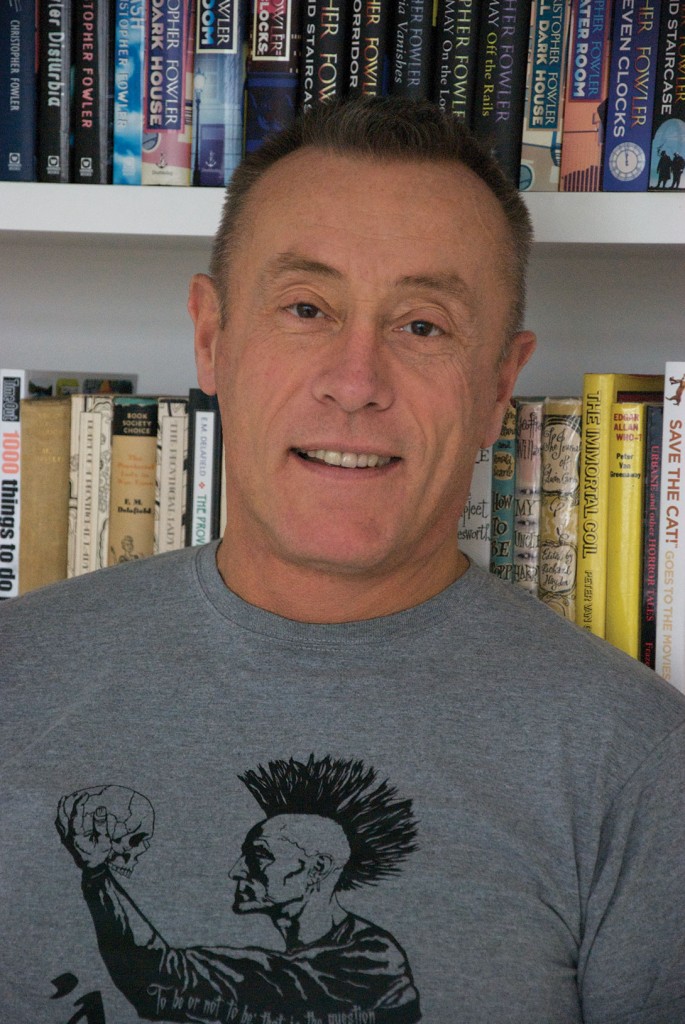 He has built up a reputation as a writer of crime fiction, modern British horror and some of the territory in between. His work is shot through with nods to popular culture.
We get settled in his kitchen, where it is possible to almost literally watch the area transform around us, and get started.
Currently, what is exciting Fowler is not his prose but a graphic novel project that he is working on. He has written over 21 novels or so since 1990 but his love of comics is well-known and so at last he is able to translate this into a graphic novel featuring creations who are arguably his best-known, detectives Bryant & May. It all began when he was contacted by artist Keith Page, he explains to me over a cup of tea.
“He sent me a piece of artwork out of the blue. He took a scene from one of my Bryant and May books and then followed it up with another. Graphic artists do get in touch from time to time. So I asked him: ‘If we ever get the chance to work together, what would this look like in colour?’ And so he sent me another piece, this time in colour.”
This isn’t the first time that Fowler has dabbled in comics: back in 1997, Vertigo published Mens Insana, a oneshot drawn by British artist John Bolton. It was an experience that wasn’t the worst of his career but he admits that working with Bolton was a little bit tricky.
“DC was alright but the hardest part was John Bolton,” he tells me, laughing slightly nervously. “John’s a good friend and a brilliant artist, but had a fairly specific list of things he didn’t want to draw. It turned out this was a good thing, because the tight brief of illustrating very few complex backgrounds meant the story had to be clever and involving. I kind of turned it to my advantage and it was great fun but it was one of the hardest briefs I’ve ever had. But DC were getting very proscriptive and difficult after we did that and we must have pitched a dozen ideas. There were a lot of things that John didn’t want to do and things that DC didn’t want. So I just backburnered the idea of doing another comic project and forgot about it. It was only when Keith contacted me that I thought ‘This could work.’”
As an established writer with a body of work, Fowler could have fallen back on adapting an existing book. But never one to do things the easy way, he didn’t want to just translate a Bryant & May book to the comics page, he informed me.
“Keith asked me if I wanted to simply adapt a work of mine. So I said: ‘No I absolutely want to write something specific for a graphic novel. I’m not a big fan of just adapting things from one medium to another unless it really works. I thought it would be much nicer to use the graphic medium.”
Giving me the pitch for the graphic novel, to be published at some point in the future, the writer seems genuinely excited.
“What I thought was ‘‘Wouldn’t it be nice in a graphic novel to do something we can’t do in the books rather than just extend the books.’ What’s clearly in the books is a nostalgic feeling for London. So what if it took place in a London we kind of wish existed. So it’s like the London of Ealing comedies and yet it’s also recognisably the modern London. So it’s a modern London where Irene Handl and Sid James are still around, as the landlady and the spiv. So Keith said ‘I would love to draw that.’ So that’s what I did. The idea is that it’s like the early days of Batman. I started an alternative timeline. I took a jumping off point which was an investigation in one of the non-canonical books, Soho Black. There’s a story about a man who’s murdered in a telephone box full of butterflies. Then I put a kind of gang in with characters like Benny the Spiv. Having got that, I then introduced some fantastical elements the way I did in Roofworld. The gang is picked off by this thing called the Soho Devil which appears in the sky, swoops down and takes them out. There’s a nice reveal and a logical explanation at the end. We’re going to call it the Casebook of Bryant & May No.1 Soho Devil and if we can get them up and running, we’re going to do a whole series. I’ve just been signed for two more Bryant & May books.”
Fowler’s ageing detectives seem perfect fodder for film or particularly television but nothing has ever happened to bring them to either of these media.
“The rights are still all sold. It’s expensive to shoot in London. One of the problems is that we keep picking people who die. I think you pick younger people and age them up. Somebody suggested Timothy Dalton and I thought he was too young. But he’s actually 63. He’d be a great John May. So Clerkenwell Films still have the rights and they did Wallander and some other
good things. But they’re still producing scripts and they’ve had the rights for five or six years now. All these projects take years and years to percolate and either weirdly come together or they don’t. And one of my problems over the years is I’m the guy who so nearly made so many films.”
The writer’s working background is a little unusual. He used to run a film marketing company in London. But that came to a little bit of an unnatural end as he told me over another cup of tea.
“My business partner at the company died. It was called the Creative Partnership and it was founded on the two of us and everything reflected his and my ethos,” he said slightly regretfully.
“My partner was Arthur Bryant and he really was the other half of my head. So without him it wasn’t the same company. And also the business was changing. It had become very churn and burn, get it in and chuck it out.”
Fowler had worked in film for a number of years as he came up with a niche that wasn’t being already catered for in the UK, he tells me.
“When I set this up, I was very young. My partner was nine years older than me. I set it up in 1979 because I spotted a gap in the market. I had my commercial hat on and no-one was marketing films. Two guys were doing all the film posters in Britain, one was doing the Carry Ons and one was doing Hammer. That was pretty much it.”
For him, the marketing end of the film industry in the UK doesn’t offer the same sort of appeal that it held a few years ago.
“I was on a five year buyout and I sold it to people I’d groomed in the company. There was a whole succession thing and [my partner] Jim had lung cancer and he was ill for three years. So we had plenty of time to plan the whole thing out. So we finally sold the company to them and I will
come out of our indentures in June this year. I go in there once a week to say hi to people. But I wouldn’t want to be involved these days because all of the campaigns are done from straight out of the US and all they do in the UK is top and tail everything.”
The art of the film poster seems to be lost and he feels that a particular popular genre
should shoulder most of the blame.
“It’s the curse of the romcom. A girl standing with one leg bent up and if you’re really really stuck on a movie poster, put a dog wearing sunglasses. It’s because so many people are involved and it’s also because the agents are letting the stars have approval of the photography. I have the
original poster in the cupboard here of You Only Live Twice. Artists can go on working
until they drop, like Robert McGinnis.”
He admits that working at the marketing company and doing something other than just writing was an activity that he saw as healthy for him as a writer.
“I was reluctant to go. Partly because I have this issue with writers who just write. They just do one thing and often they become very introspective and you end up like Stephen King, a writer who writes about a writer writing about writing. They turn in on themselves. You end up losing
the plot, which is why I live very closely connected to town because I’m in and out every day. But also I really enjoyed the film industry and while it was still fun it was okay.”
The recent changes in marketing in the British film industry were just too much for him to take, he reveals.
“The last few years I really started hating it because I was taking meetings with kids which was fine but they didn’t know anything. Two of us were employed by Fox to go and tell Fox what the Fantastic Four was, what their own project was. So they had a huge marketing team of under 25
year olds who had never heard of Fantastic Four, which is fine. So we did this whole thing and told them: ‘Look this is why Fantastic Four is the motherlode. You’ve had Spider-man.’ What’s really funny is that I was also talking to the Fox people and one of them said that they’d just come back from a seminar called ‘Understanding the 50 year old mindset’ because there were no 50 year olds in their marketing team. Everyone is 25. And it was a bit tragic actually. I thought ‘man, this is becoming undignified.’”
He does still keep in touch with one of his regular collaborators from those days.
“I still work with an artist called Graham Humphries. I am going back to my horror roots a bit this year. I’m doing a novel and a collection of short stories which I need a title for. So Graham did the cover for Hell Train. The idea of Hell Train is that, in 1966 this guy gets commissioned
to write a movie for Hammer between Frankenstein Created Woman and The Mummy’s Shroud called Hell Train. So you see the commissioning process and you realise that it’s structured like an anarchists’ anthology and the actual story is in the main body of it.”
Fowler is a writer who seems to enjoy creating a lot of different sorts of writing and, as well as his fiction, he also regularly contributes journalism to newspapers and magazines.
“I do a crime review for the Financial Times and I do a column on forgotten authors for The Independent. I do the column for the Indy every week. Outside of that there’s a lot of specialist stuff I write for. They don’t pay.”
His love of comics dates back to his childhood and it’s a love that he embraces openly.
“One of the reasons why my books read as very visual is because I’ve always been graphically orientated. This is my dark secret. I own every issue of Lois Lane; why, I have no idea. I’ve had them since childhood. I wrote this book called Paperboy and there’s a whole chapter in it on my Lois Lane obsession which is kind of disturbing. When I was a kid I drew comics as well which they printed on the inside in the hardback of Paperboy. So I was comic obsessed and often when I’m designing a book or when I’m planning a book, I actually draw it out. I plan out all the locations.”
Being a writer these days doesn’t just entail writing the books but also promoting them through talks, events and even readings. This is something that doesn’t seem to bother the soft-spoken Londoner.
“Reading should be like a performance. I did halloween this year at the London Metropolitan archive. I got up there and I assumed it was going to be like a 10 or 15 minute thing. When I got there, there was a big armchair on stage and they wanted an hour from me. I hadn’t brought enough material. I had just written a story and so I downloaded it very quickly and printed it out. And I read it but I did it as a performance piece. Because I wrote it as a monologue and I did it as a little performance. And everyone afterwards said ‘We really love the second bit you did.’ So with Paperboy, it was very standalone chapters, weird things about childhood. There’s a whole chapter about DC comics versus Marvel. It’s funny because whenever it’s reviewed by really straight laced reviewers they go ‘We love the book except that weird boring bit about comics’ and everyone else goes ‘We love that bit.’ So that was the first bit I wrote for that book and when it went down so well I ended up expanding it. So I am now doing this on the Southbank and I’m writing a sequel to Paperboy called Film Freak. So we’re going to try a piece from that, see how it plays and if it plays well aloud then I’ll carry on doing it.”
The cult of personality that some writers build up is something that’s far more prevalent than it was years ago but with the well-adjusted Fowler, there is no pretence.
“The thing is I am myself. I am naturally very outgoing and not a socially inept shut in at all. What’s really funny is an interviewer was interviewing Bret Easton Ellis and before they went on, apparently he was very very charming and affable and then he said ‘Forgive me for the way I am going to be on stage.’ So when he was on stage, he was an absolute arse and rarely spoke to her. And then when he got off again, he was really nice again. But I think that’s much more common in America.”
Using technology and being able to represent yourself in places like Facebook and Twitter has become increasingly more significant. This has been no problem for Fowler but he does feel that it has created a division between those writers who feel comfortable tweeting and those for who the whole experience is alien to them.
“It makes it easier for some writers and harder for others,” he tells me putting his mug of tea down onto his immaculate workspace.
“One of the problems is that now writers are now being left behind because if you look at say the crime writing, the median age is quite senior. Particularly with women as there are quite a lot of crime writing older women in their fifties, sixties and seventies, much more than you’d think.
I was talking to one of them recently and she was saying ‘Oh I suppose you’re one of these people who do the Twitter’ as if it were something out of Great Expectations.
I also went to this awards thing and they said ‘we’re going to be doing the voting online and one of them said ‘I think that’s dreadful because not all of us have access to computers’ and I said ‘Actually 98% of us do’. And she said’ Well I live in a tiny village’ but I said ‘You’ve probably got a McDonalds that has wi-fi.’ And she said ‘Do you mind? I’m a vegetarian.’ And I thought ‘I’m going mad here.’ So you do get this.”
He is one of the most technologically savvy writers currently working in fiction.
For him, the net is a key part of promoting yourself.
“I’ve just set one up which is more for the Americans, a Peculiar Crimes Unit website
[the police unit that Bryant & May work for]. So this is going to be the Bryant & May website and it’s got maps of where everything takes place in the books. So the idea is that I don’t want to have to run this one. On it are all the books that are mentioned on all of Bryant and May’s shelves. I didn’t put this together: this is some nutcase. But luckily I have some obsessed readers. The other site is more like a cross between a regular site and a punch up in a bar. I put my reviews up or if I’m walking around London and put whatever I want on it, whereas the Peculiar Crimes Unit will just be a literary resource. And that takes care of that. But if you don’t do that now, you’re in trouble. In America all the book clubs are very, very tied to online sales especially with the publishers. And they sign up with publishing book clubs so they get the first six books free. So if you don’t do that, you’re limiting distribution of your books immensely.”
Fowler has written nine Bryant & May novels to date but even though he has gotten into a rhythm with them, he doesn’t exactly dash them off, he informs me.
“I do them one at a time because they’re internally quite complex. Each one usually hinges around one big subject so I really want to stay in that subject. The next one’s going to be about class and that’s going to be quite a complicated thing to set up. I’m slightly dreading doing the research. It’s about class and codes. And this one that I’ve just done was largely about Punch and Judy. I’ve got a big collection of Punch & Judy books so that was relatively straightforward to write.”
He is able to move from prose to comics to journalism and then onto plays within the space of the same day without too much of an adjustment. He replies almost surprised that I have asked the question about whether this is part of his working routine .
“I’m a jobbing writer and I follow the long traditional line of jobbing writers. And when I do this Forgotten Authors thing in the Indy I am always amazed to find forgotten authors who wrote upwards of 100 books who now only have one book in print. That’s really not uncommon at all.
I think Kim Newman and I always trawl around that area. What really bugs me is that we’re available at short notice to provide tip top work. Perhaps it’s really bad being a good all-rounder because it would be better to be a Bret Easton Ellis, a sulky difficult person who produces one book every five years and people love you more. I don’t think the work really is better but if you make yourself less available, you become more exclusive.”
As well as the full-length novels, Fowler has also penned a number of short stories over the years including for Solaris’s The End of The Line collection (pictured), which came out last year. He is even willing to try material that is seemingly outside of his regular comfort zone. He told me about a short he has contributed to a collection of Western or cowboy stories and its genesis.
“The process is very, very subconscious. You’ll read something entirely unconnected and you’ll put two together. I’ll give you a really good example recently. Conrad Williams is putting together a book of cowboy stories called Gutshot. And he asked me to do one. I’m the guy who wrote a football story and I’ve never been to a football match in my life. So I said ‘Yeah I’ll do a Western story.’ I kind of had an idea. But I couldn’t make it work. And then two things happened. I was reading Cormac McCarthy’s Blood Meridian and I went on holiday to Delhi. And believe it or not, it was the Delhi thing. I had read Mike Dash’s book on the Thug sect and Thugees. Then I was talking to some Indian people who said ‘You have to understand Indian culture. We’ll never tell you no, we’ll fudge it because we’re salesmen and because we’re very polite as well. If we can’t do it or we haven’t got it, we’ll fudge around it and make you think that we probably have got it. Or we’ll give you something else.’ And suddenly when I put all those bits together, I had this story called ‘The Thug Boy’. And now it’s going to be the lead in the anthology because everybody likes it. It wasn’t there right up until the week before it was due. And then it just clicked.”
He also enjoys the challenges that writing short stories throw up.
“You can’t wing it because there’s an awful lot of bad anthologies and there’s a very select handful of wonderful anthologies. When you’ve somebody like Kirby McCauley as an editor and you pick up one of those books, you realise every single bloody story is perfect. And then you pick up some other shit and they’re unreadable. I also think a good anthology pulls your own socks up because you realise that you’re going to be in really good company.”
His first novel, Roofworld, was written about twenty years ago and it taught him some valuable lessons about writing, especially as a debutant author.
“One of the things I tell first-time writers is to stop worrying you’re copying other people because you can’t avoid it. When I did the first novel, Roofworld, I’d been reading Stephen King and JG Ballard. So I’d been planning it since my early twenties and I was in my mid-twenties. I was never a Stephen King fan but I loved Ballard. When the first review came out, it said ‘A major new writer takes the throne halfway between Stephen King and JG Ballard’.
Well, yeah because it was littered with stuff which wasn’t lifted but was very much in the style of them and I couldn’t help it.
Then one day my agent told me that she read a piece that didn’t have my byline on it, so she said ‘I knew it was you. It was your style.’ And I said ‘I haven’t got a style.’ And she said ‘You really have.’ So I said ‘Fuck, okay.’ It takes you a while to shake it off but you can’t help it.”
Roofworld has become a success in retrospect but at the time, it was a disaster as he tells me slightly sanguinely.
“I didn’t know what I was doing and one of the problems was neither did the publisher. It did disastrously. It did incredibly well as a book in the longterm. But immediately they overprinted the hardbacks and then they did a huge cinema campaign with a commercial that went out.”
Fowler also hit the usual pigeonholing problems after Roofworld came out, he recalls as we begin to wrap our chat up.
“I had been planning this retro detective novel and that threw them because they said ‘You’re a fantasy writer’. And I said ‘I’m not really an anything writer.’ And then I did a crime novel and then a series of zeitgeisty books and then I wrote horror books. One of the problems with writing a lot of different material is that you’re all over the place.”
With his detective novels, because there is a mystery at their heart and it’s a mystery that has to work with a pay-off that is satisfying enough for the reader. As we complete our conversation, Fowler gives me a glimpse into his approach to crafting mysteries.
“You have a resolution, you play fair and you don’t spring deus ex machina in at the end. But you do want people to slap their foreheads and there’s this great quote from Barnes Wallis who said ‘There is nothing more satisfying than to show that something is utterly impossible and then show how it can be done.’ And that’s a wonderful thing to be able to do.”
Christopher Fowler is a uniquely British writer who uses his home of London to great effect in his work and he has been able to create a niche for himself almost as the spirit of the Big Smoke, using all of the city’s oddities and foibles to give all of his work a distinctive voice.
As an interview subject, he was refreshingly down-to-earth and accessible. It is heartening to meet a writer who doesn’t feel the need to create a different persona for himself. Genre fiction would be a poorer and less colourful place without Christopher Fowler in it.
JOEL MEADOWS
Bryant & May – Strange Tide: (Bryant & May Book 13) Full Dark House: (Bryant & May Book 1)
 Bryant & May – The Burning Man
 Bryant & May – The Bleeding Heart: (Bryant & May Book 11)













You must be logged in to post a comment Login