

Comics News
Tripwire Talks To Pat Mills’ Ragtime Soldier Art Team


Drawing On History
Tripwire’s contributing writer Paul N Neal recently spoke to writer Pat Mills about his upcoming successor to his classic strip Charley’s War.
Pat Mills Talks About His Successor To Charley’s War, Ragtime Soldier, To Tripwire
As a follow-up Paul also took the opportunity to talk to the art team behind Ragtime Soldier, penciller Gary Welsh and inker and letterer Phillip Vaughan.
TRIPWIRE: Can you say at all when you first became interested in becoming comic artists? Did you enjoy comics from a young age? If so, were there any particular titles you enjoyed?
GARY WELSH: I grew up on the Beano and Dandy weekly comics, Christmas annuals and The Broons and Oor Wullie annuals and the odd Commando comic. That was my introduction to the medium. I also drew a lot when I was younger. I did well in art classes at school but that was unrelated to comics. I just liked to draw. I think I started drawing my own comics when I was at secondary school. A friend introduced me to superhero comics. I copied bits of the art and tried to make my own at home. I would walk down to John Menzies/WH Smith every month to buy the new issues. At that time, it was reprints of Spider-man in a magazine called Exploits of Spider-man which had a mix of the early Stan Lee/Steve Ditko work and the more modern 90’s run. The first issue was Part One of the Maximum Carnage story which was quite a long story that ran for months over the different Spider-man books in the States. 14 issues of Exploits later, I was a Spider-man addict.
I started buying the X-Men books after that and not long after I discovered Forbidden Planet in Glasgow and was in heaven. I didn’t read much 2000AD until later. I remember reading and re-reading an Indigo Prime trade paperback about Jack the Ripper, by John Smith and Chris Weston, and Rogue Trooper The War Machine by Dave Gibbons and Will Simpson, but I wasn’t a regular reader of the prog until recent years.
I gave up on the drawing for a while and picked it up again a decade later when I went back into education to study film and animation. I don’t think I really considered being a comic artist viable for me at that point. I didn’t see a path to it. After doing my animation degree, I had a realisation that I didn’t really want to do anything else other than draw comics.
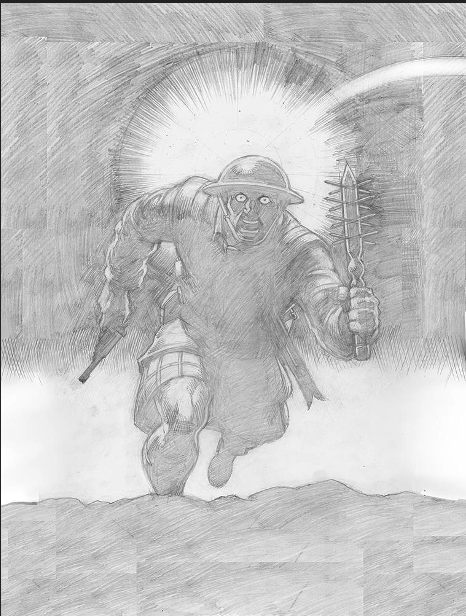
Note: Pencils for original RT Page 2.

PHILLIP VAUGHAN: Comics were a big part of my childhood. Being born in Dundee, you could not escape them! I remember being particularly intrigued by the indicia on the Beano. On the back page, there was a DC Thomson address on Fleet Street in London. However, the Dennis the Menace Fan Club had an address of Albert Square in Dundee. This messed with my young mind to be honest! I was astounded to realise that the comic I read every week originated in Dundee!
But the real game changer for me was in 1982 when IPC launched the New Eagle. I can’t say I particularly enjoyed all the photo stories (except Doomlord), but I was really into the new Dan Dare. Or should I say the Great Great Grandson of the original Dan? Anyway, the stories and art really grabbed me. Pat and initially John Wagner wrote it, and Gerry Embleton illustrated it in full colour. But it was when Ian Kennedy took over the art of Dan Dare in issue 19 that it really came alive. Pat’s very well-researched scripts, and Ian’s fully painted centre spreads were amazing. Plus, I could not believe that Ian hailed from Dundee as well! It truly was the centre of the comics universe as far as I was concerned!
I soon graduated to reading 2000AD around 1984. I was blown away by Judge Dredd et al. And I pretty much have been getting it weekly ever since: that’s over 40 years now! I absolutely loved Pat’s Nemesis work, along with Kev O’Neill and Bryan Talbot’s art.
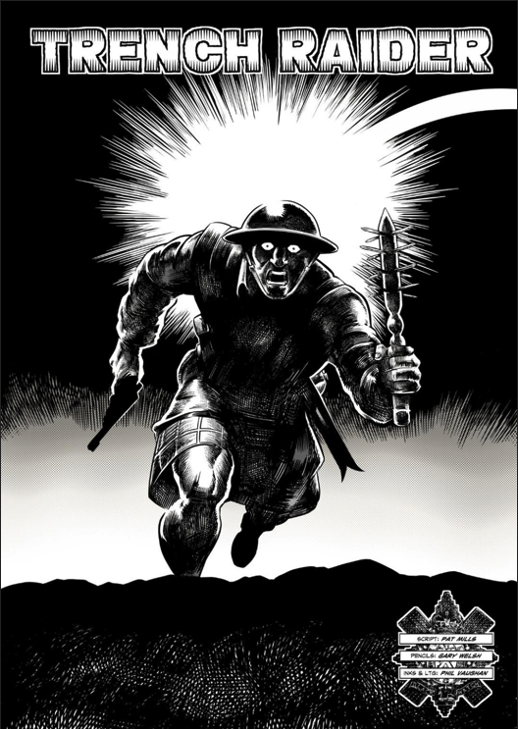
Note: Below, Ragtime Soldier piece from Gary Welsh’s pencils, then with Phillip Vaughan’s inks.
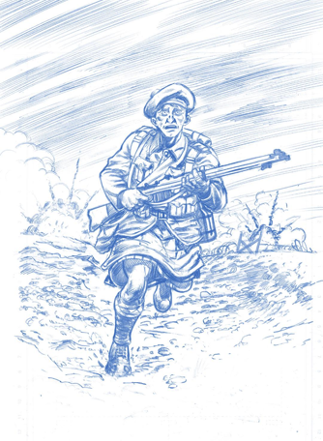
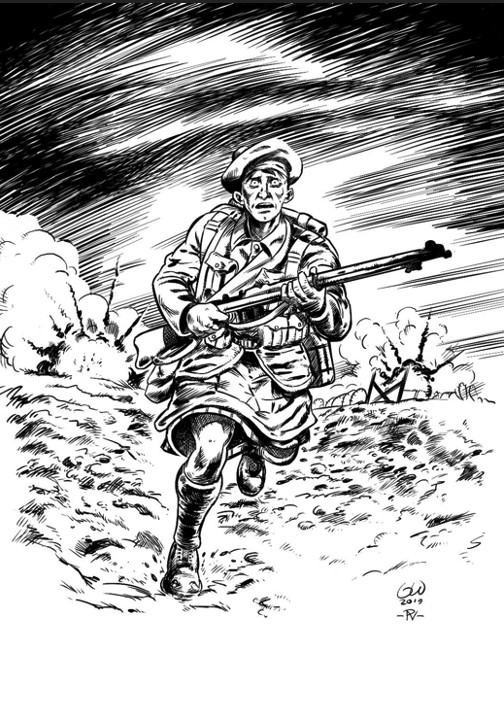
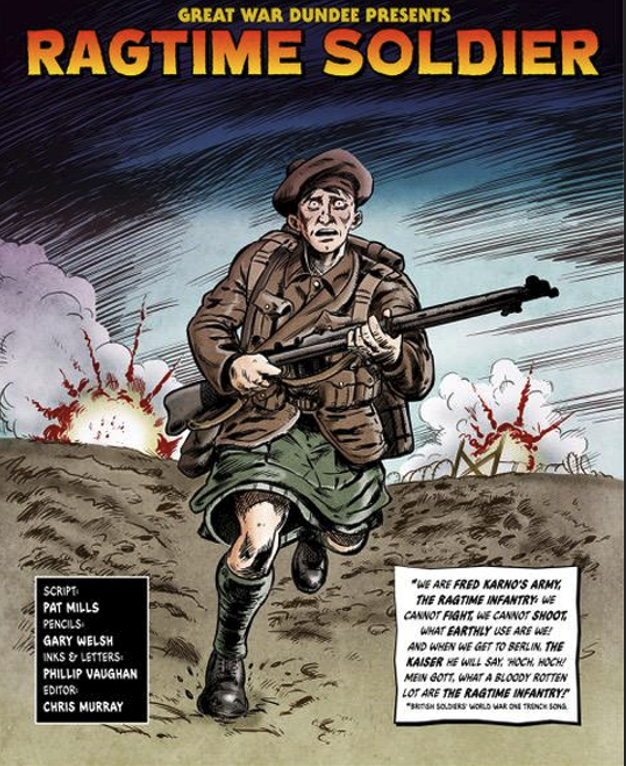
TW: For Ragtime Soldier, Pat Mills has assembled a wonderful art team in both of you. Can you describe how you became artists please? To what extent would you say you are self taught? Can you describe any formal education you’ve received?
GW: I had drawn a bit and did my own comic pages when I was younger and gave it up for a few years. I started reading comics again and drawing again years later then decided to do a film and animation HND at the local college for two years thinking I wanted to try and do something related to storytelling and visual narrative. I didn’t expect to end up in Dundee doing an Honours Animation degree after that but that’s what happened. In the Dundee course, I gravitated towards storyboarding and directing.
I wrote and directed a short film for the final year. It was a role that I found myself in, rather than specifically setting out to do, but it was a really rewarding experience personally, turning something that was an idea that I was able to translate into visuals for other people to experience. Not on my own, mind you, I owe a lot to a team of really talented classmates- everyone worked really hard on the film, and I’ll be forever grateful to them. Audiences of people watched it at our degree show. I overheard people talking about how much they enjoyed it when they came out of the screenings. I think something about that moment has stuck with me.
A year or so later, I did a master’s degree in comics and graphic novels again at Dundee University. Part of the master’s degree was practical, including producing your own comics which I thoroughly enjoyed but what I really loved about the course was the study of comics as literature. I enjoyed thinking in depth about what some of the comics I was focusing on were about.
I had been starting to think about that when working on my own stories and looking at these other works in that respect was eye opening. I was trying to understand what stories were about, and how the creators were conveying that. I think that’s what I love about stories in general: they are expressing something real and can make you feel something. I got a lot out of the degrees, I did, but I don’t think it’s a case of self-taught or structured education. Some people can do entirely self-taught and some benefit from a structured learning approach like I did but ultimately you get out of these things what you put in.
PV: Well, I used to copy Ian Kennedy’s artwork from Dan Dare! Also, I went to early Saturday morning art classes at Duncan of Jordanstone College of Art & Design, in Dundee. The tutor, Jonny Johnstone, saw some early potential and encouraged me to do comic art in the class. Here’s an Interesting fact: Jonny was a friend of Cam Kennedy, and in the 70’s suggested that Cam sent in his art to DC Thomson, which is how he ended up getting Commando work.
Anyway, fast-forward to 1989, and I was at the Duncan of Jordanstone open day, and I saw some comic art on the wall. It was by Colin MacNeil, who had just started working for 2000AD. I thought, ‘this must be the place to learn comic art.’
Eventually, after completing an HND in Graphic Design at Dundee College I got into DoJ (as it was affectionately known back then). Colin was long gone, and so was any love of comics. I ended up doing a BDes (Hons) in Graphic Design, with animation as a support study.
When I graduated in 1996, I was lucky to get snapped up by a Glasgow company called Digital Animations and I quickly picked up 3D animation skills, as most of my work at DoJ had been 2D.
Here is where it gets truly bizarre. My boss, Mike Antliff comes in one day and says, ‘Phil, you are into comics? Do you want to join a meeting with John Wagner, Alan Grant and Cam Kennedy?’. I couldn’t believe it! My first job and I ended working with my comics heroes! It was mostly with Cam: I worked on colouring his black and white concept art for various abortive projects. It taught me a lot about comic art and colouring.
So really, it was a fairly formal art college training, followed by a lot of ‘on the job’ learning, especially on the 3D side of things.
TW: What was your first published work?
GW: Technically, it was an indie comic called Book of Nemus around 2008/2009 which was a sci-fi story that was never completed. I think we got an issue of itself published. I did that when I was working in a boring office job before I went back into education, and it was probably the start of me thinking ‘I want to take a shot at doing something creative’.
PV: In animation, it was a cutscene for the video game version of Deathtrap Dungeon by Ian Livingstone. Again, another weird coincidence as I was a massive fan of the Fighting Fantasy books. My favourite fact about that cutscene is that I tried to get Tom Baker to do the voice over, but his agent said, ‘Tom doesn’t do computer games!’, which was a shame. But we did get Paul Avon Darrow to do it instead and he did an incredible one take performance. You can still watch that cutscene online if you search for it. It almost holds up (it was 1997 to be fair).
Comic wise, it took a bit longer, due to the day job! I did work on a Superman game in 2011, which was for DC Comics/Warner Bros, and it was very comic related in the art style which we used.
Around the same time, I did some uncredited colour assists on a Judge Dredd story by Chris Weston. By this time, I was teaching so I had to squeeze in what I could around that. I did some colouring work on Commando’s first graphic novel in 2018 for Gordon Tait, who was the then editor. In fact, I recommended Gary Welsh to him back then after I saw his Ragtime pencils, and he has now worked for Commando, as well as The Broons and Oor Wullie, and also 2000AD/Judge Dredd Megazine, most recently illustrating the Still Game comic book, again for Gordon Tait at Scunnered Ink.
Note: Below the pencilled and inked title page of Trench Raider.
TW: How did you come to be involved with Pat Mills and Ragtime Soldier?
GW: Phil and Chris Murray recommended me for the Great War Dundee project after I had done the degree course in Dundee.
PV: Well, I initially met Pat at an event hosted by comics Professor Chris Murray at Dundee Uni, back in 2011. I was lucky enough to end up sitting in front of him at the evening meal. Then when I started a comics module at Duncan of Jordanstone the same year, I asked Pat to do a guest slot. Fact fans, the front cover to the first graphic novel produced by my students at the art college was done by Colin MacNeil. It was a moment of redemption after all those years.
Anyway, a number of years later, once myself and Chris Murray had set up the joint comics and graphic novels masters at the University of Dundee, we ended up working on a research project called Great War Dundee. Me and Chris thought that Pat would be ideal to write the main story as we were both massive fans of Charley’s War. Luckily we had a direct line to Pat, and he said yes. After a few Skype calls, we set about thinking about the art.
Note: A pencil to inks fade image.
TW: Pat is famously a touch fussy about the artists he works with, so one would imagine even more so on such an important project as a successor to a legendary title like Charley’s War. Did you feel any pressure going into the story?
GW: I didn’t know that. Yeah I felt pressure because I was aware of Pat’s career and status and because Joe’s work on Charley’s War is incredible. When we did Great War Dundee back in 2019, I was a bit stunned to be involved but to be honest I feel pressure to deliver on every job. I don’t like sending pages in to editors if I am unhappy with any parts of them. I could work on some forever and still be unsatisfied, but you have to draw the line at some point and get on to the next page. I’ll be doing my best to convey the intentions of the script clearly and make the pages visually exciting and hope Pat and the readers are happy with the results.
PV: Huge pressure! But luckily, I had some insider knowledge on up-and-coming comics artists, as I had many talented comics illustrators on my course. Gary Welsh had first come on my radar when he illustrated Saltire, Scotland’s first Superhero! He eventually enrolled on the MDes in comics & graphic novels which I was running. His final masters work was outstanding and me and Chris started to feed him some freelance work.
I suggested Gary to Pat, as I knew Gary could turn his hand to any art style, as he had done on my course. Then I threw my hat into the ring, as I really fancied getting my hands dirty and inking Gary’s pencils. Pat looked at Gary’s samples, then my inks on them, and he liked what he saw. We were definitely both channeling Joe Colquhoun, which was a very high bar. I think we came somewhere close to capturing his amazing render in the final artwork. I am still in awe of Joe’s art after all these years.
TW: The subject matter of Ragtime Soldier can be very personal for many readers. Was this the case for you both? Did you find yourselves connecting with the characters in the script?
GW: It’s not personal for me in any sense that I have a connection to military or the Great War or that I think, “That character is like me! ” But it is in the sense that I am animating the characters. It’s me doing the acting and staging in the drawings, and I’m directing Pat’s script on the page. I’m trying to get into the heads of the characters and make them emote clearly and appropriately for the scenes to work together.
Working from Pat’s script is great because I think he writes very human characters. They are flawed and act and react in believable ways. I feel like they are real. That makes the job a bit easier because it’s more obvious to me from the script how things would play out consistently. I feel like Pat has given everything a lot of consideration. It does feel different on Ragtime Soldier than some other projects because I am establishing these characters for the first time. I don’t think I am explaining myself well here. Yes, it’s personal but not in an obvious or literal way. I feel like I have a responsibility towards the characters and story.
PV: There was a Dundee connection with the Black Watch which made it all seem very close to home. That and the dialogue. The characters all spoke in Dundonian, which can be fairly difficult to pick up, even for locals like myself. It also resonated with the anti-war messaging. Just like Charley’s War before, Ragtime Soldier has plenty of subtext and really hits home the brutality and de-humanising elements of warfare. Pat is a master of taking the historical research and adding that human element to it. So, it really resonated.
TW: Ragtime Soldier must have involved a considerable level of accuracy in the art. Does your work involve a great of research?
GW: I have reference books and will search on the internet for specific things, but I find it time consuming and frustrating to find the right information at times, and if I am doing it to a deadline, it’s stressful. It can be a real pain in the neck, for example, trying to find the right visual references and knowing whether that’s the right thing, or if there’s a different version of that specific thing that would have been used at this time, or if you find a reference from that time of that thing but you need to see it from a different angle or to see how it operates mechanically. All the while, you are supposed to be drawing the page because the next page awaits, the deadline is approaching, and another project is due to start. There are a few things about Great War Dundee story and some of the Commando strips I’ve worked on that I look at now and think “I got that wrong” and wish I could do differently. It’s painful and embarrassing.
PV: I was lucky as we had Pat’s great verbal and written research (pages of it in fact), and Gary’s fantastic interpretation of this, so I just had to make sure I did it all justice in the inking and toning. But we must have done something right, as in the original 11 pager, I remember only a few art changes requested by Pat. I mostly looked at the Charley’s War collections, to make sure we were respectful to the original series.
TW: Is there anything else you’d like to say about Ragtime Soldier? What do you have planned for the future?
GW: I will just say that it will be a good read and anyone that has an interest in the Great War era or, in general, good stories will enjoy it. Pat’s script for the Great War Dundee project was masterful and the historical elements he is planning to weave into this story are in some respects quite harrowing. It’s an intriguing concept for a war comic in my opinion. I don’t think I can be specific here because of spoilers.
As for me, I feel ready to do my part of the artwork for it. For the future, I have more work coming up in 2000AD soon as well as work in the second “Still Game” book later this year and if we are funded, possibly more Ragtime Soldier stories next year.
PV: Hopefully, if successfully funded, we would like to continue the story in other volumes and make it a semi-regular publication! It has been an absolute joy working with Pat and Gary again, along with original editor Chris Murray and Tony Foster at ComicScene. Bear in mind we have had over 5 years in between drawing the original, and now! I hope we don’t have to wait as long for the next one.
find the Kickstarter here
https://www.kickstarter.com/projects/comicscene/pat-mills-ragtime-soldier








You must be logged in to post a comment.