

Comics News
Pat Mills Talks About Spacewarp And More

A Bold Experiment
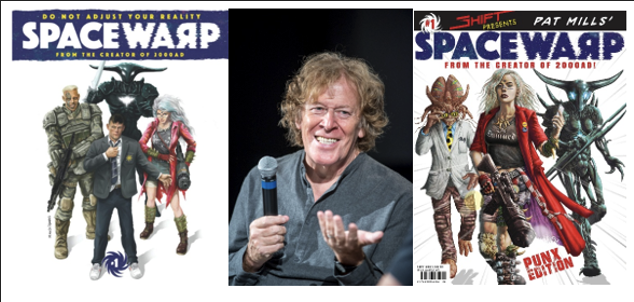
Just before Covid occupied the world, one of the pioneers of UK comic industry created a brand new anthology title. It has been a little while since any updates have been forthcoming about the future of Spacewarp. Tripwire’s contributing writer Paul Neal thought it was a good time to reach out to creator Pat Mills to ask for an update…
TRIPWIRE: Pat Mills, you are a British comic book legend. For many fans yourself alongside John Wagner and Alan Grant, the three of you (with the help of some astonishing artists) defined what British comics were for a generation and what they could become in the future. Would you consider that is a fair statement?
PAT MILLS: Yes, I think that’s true.
TW: I believe you have said in the past that there is a gaping hole in the UK Comics industry and that maybe a whole generation of boys and girls that could be reading comic are being short changed. You intimated that the industry hasn’t quite found a way to capture their collective imagination? Do you still think that is a true assessment?
PM: Absolutely. It’s become an industry for middle-aged fans, neglecting the original source: kids. As that’s my prime motivation, it’s a big deal for me.
TW: The internet would have us all believe Spacewarp was created in 2020 but do the roots or the origins of the title stretch back a little further. Just how long have you been planning a project like Spacewarp?
PM: I’m driven by the need to subvert and there’s no point in trying to subvert middle-aged readers. This meant a lot of hostility from my peers who tried to excuse the loss of young readers with the idea of video games replacing them.
TW: Artistically, did the first issue of Spacewarp have a mission statement or a particular objective? If so did it achieve its objective?
PM: That was my mission statement. It worked, no thanks to the industry – so fuck ‘em.
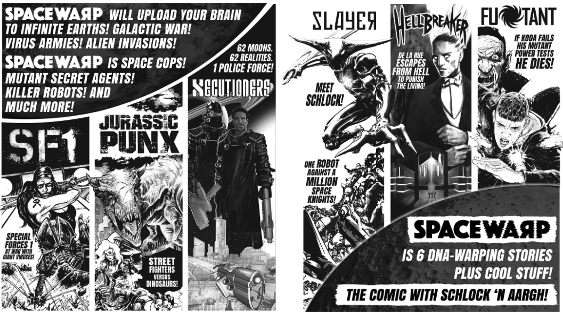
TW: I get the impression the first issue of Spacewarp was never intended to be an ongoing concern. Was it simply rather intended to act as a “launch pad” of sorts for all the stories inside?
PM: It could be a launch pad for solo stories or an anthology. Commercially it worked as an anthology despite Covid, poor distributor and, eventually the loss of WH Smiths.
TW: To what extent did Covid alter you plans? Or delay what you had planned?
PM: Covid probably screwed things and delayed it by about a year.
TW: Did you find it difficult to find the right artists for the six stories in Spacewarp issue one?
PM: Yes it was difficult. But that was also true for 2000AD which fans and historians have conveniently forgotten. It was a nightmare finding artists that liked 1984, French comics, Kaluta etc. So at least we had a starting point.
There’s a certain look that 2000AD had. It could be described as counterculture/alternative/cool. Not a boring tiresome typical comic look.
So many artist’s work can look tired as they lose their sparkle.
I searched for the sparkle in today’s artists and found it. Tired artists from yesteryear didn’t always agree and I recall some of them trashing me in on social media egged on by a shitbag writer from 2000AD, doubtless they were annoyed I didn’t ask them to work for SW – but funds made that impossible and I also wanted new energy.
I wanted to see if it was possible to start again – just as I did with 2000AD. And the answer was yes. Annoyingly, ’new’ artists have to go through a long period of acceptance by fans. McMahon did, for example – whereas now he’s a comic god. Exactly the same thing happened on Toxic. It pisses me off that there is no sense of vision, encouraging future talent – it’s part of the deeply and crushingly conservative nature of British comics.
In that sense the comic revolution was a failed revolution. Not enough old farts went to the guillotine. Notably on the girls comics side which was destroyed and I’m still angry about that.
TW: You mentioned 1984. Is it a book that speaks to your sensibilities? Is it something that has influenced specific strips you have created? ABC Warriors? Third World War Perhaps.
PM: 1984 is counterculture, anti-authority, even though Orwell came from an establishment background. So, there is kinship there, although not specifically 1984. The book Catch-22 is more relevant and doubtless there are others.
TW: You referenced Kaluta? Is it a reasonably safe assumption this is a reference to the artist Michael Kaluta? If so, while I have an opportunity to ask, what make his art special for you? Does his art capture a tone or an era you are especially fond of in comic book history?
PM: Mike Kaluta is an American artist with a European style. He did an illustration for the 10th anniversary Requiem. The publisher and I flew to the States and met him in New York to talk through a story proposal. It was an attempt to bring a European style into US and UK comics. I don’t know why we bothered.
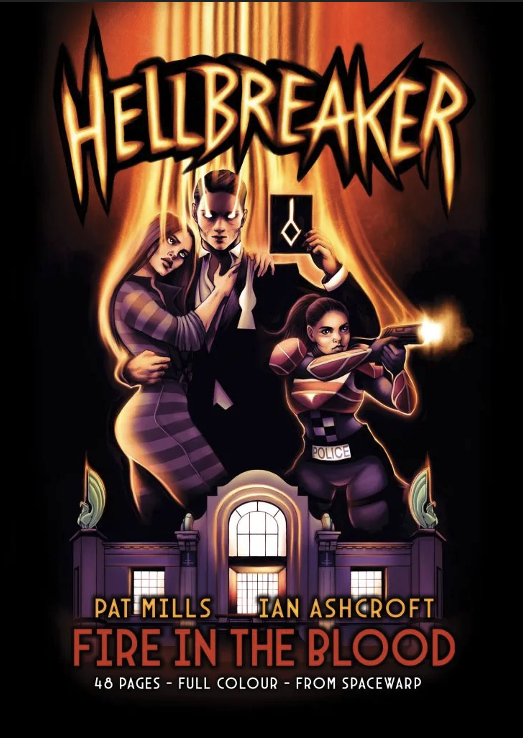
TW: Returning to Spacewarp, I gather thus far Hellbreaker has been the first story to spin off directly into its own title. Could you tell me about it? Has it been a success?
PM: The Kickstarter was a success – yes. It hasn’t gone on regular sale yet. A film company has expressed interest, but it’s all too often bs, so I’m not holding my breath.
TW: So, at this stage are you planning a second issue of Spacewarp? Will that ever happen?
PM: Hellbreaker is a second issue, because it was either an anthology or a launch pad for individual stories. As I explained, several factors made an anthology impossible at this stage. There are marketing realities – like WH Smith – that I can’t magically resolve.
TW: Can you say what The Warp is in regard to Spacewarp?
PM: I wanted a uniform principle that could affect all stories for 2000AD, so characters could interact. You’ll doubtless see how that worked. But there wasn’t time to develop it properly. With SW, I wanted an SF threat which warped all the stories. See Hellbreaker.
TW: What are the future plans for the remaining 5 stories from that initial first issue?
PM: Let’s see how Hellbreaker works.
TW: To your mind, what makes the French comic industry better or distinct from the UK industry?
PM: They give proper rights and they have a love of art and storytelling which is often missing in UK/US comics. They produce beautiful books and are not obsessed with effing superheroes
TW: What makes their system work better?
PM: Rights. Money. TAKING THEIR TIME. British comics can be fast food. French comics are like their cuisine – so memorable.
TW: Would a concerted effort to translate the box office hits (for lack of a better expression) of the French or European comics industry always be doomed to failure?
PM: Requiem and Sha – both French comic books – actually sell very well in the UK and the USA.
TW: Is the UK comic industry too set in its ways to appreciate the cream of European comics?
PM: It sometimes appears that way.
TW: You’d think a publisher with a bit of vision would see an opportunity here, or is the audience not sophisticated or broad enough to justify the effort? Where is the problem in such an idea?
PM: Hellbreaker from SW is very European influenced. Ditto forthcoming Ragtime Soldier. There is no problem – just getting it past the leotard lovers who often control the industry to its detriment.
TW: You have been in the comic industry for long enough to answer this question, simply put, what makes so many Manga titles so popular in recent years? There must be a storytelling or artistic reason why they sell so well? To your mind, why is that?
PM: I’m no expert, but I can see why they appeal to young adults. Possibly why they’re not loved by Brit fans. But French fans love them which emphasises the open-minded quality of the latter
TW: You have clearly fallen out of love of with a great deal of British and I am guessing American comics. Do you personally read ANY American or British comics at all these days?
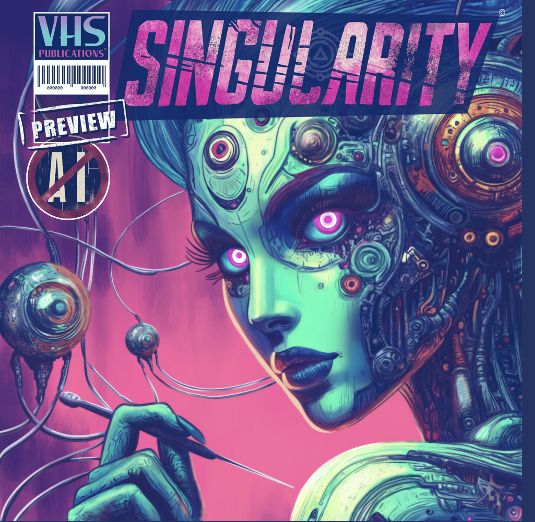
PM: Yes. Singularity. I notice no Brit fans, as far as I know, supported their Kickstarter. That bears out my negative feelings about the conservative nature of UK industry. When I started 2000AD, it was sneered at by old Eagle readers, Gerry Anderson readers and so on. Now it’s the benchmark by which other comics are measured. That is so typical and predictable.
TW: Your answers suggest you have given up on getting your writing out to a UK audience? Is that true?
PM: No.
TW: So, do you still have hope?
PM: Hope’s already fulfilled. I just fiercely object to being drawn into some limited world or team which is going nowhere. This is because I saw such an old world of comics disappearing when I started and I can recognise the same thing is happening today.
Hellbreaker is aimed at a UK market. So, too, is Ragtime Soldier – the successor to Charley’s War. Due out this summer, Sha and Requiem are aimed at a UK/US audience.
TW: What is your opinion of crowdfunding and Kickstarter fundraising. Is it the solution to reaching an audience for creators the established comic industry might ignore?
PM: It’s a solution, I’m a part of it. The question suggests that the established comic industry is something to look up to and admire. I would disagree.
TW: what else does the future hold for Pat Mill for the rest of 2026 and beyond into 2027?
PM: I’m primarily working for France and self-publishing. Every so often I suggest ways to reach younger readers – like Manga adaptions of my characters. But I can see I’m wasting my time. So, it’s time to move on.







You must be logged in to post a comment.