

Comics News
Pat Mills Talks About His Successor To Charley’s War, Ragtime Soldier, To Tripwire

Returning To The Great War
Tripwire’s contributing writer Paul N Neal recently had the opportunity to ask legendary comic writer Pat Mills about what to expect from Ragtime Soldier, a Kickstarter project that offers fans the opportunity to support a very special comic that sees Mills return to the themes of the war he also chronicled so effectively in Charley’s War…
TRIPWIRE: Talk us through your general thoughts on Charley’s War and Ragtime Soldier.
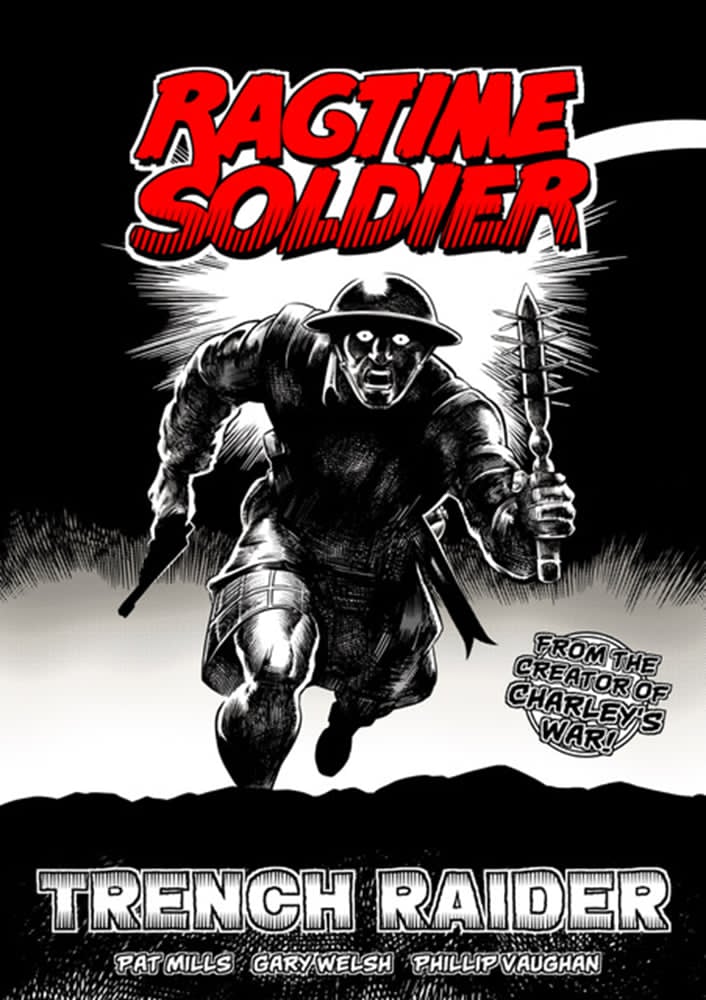
PAT MILLS: There’s a unique post-apocalypse science fiction feeling about the Great War. Thus, the title page of Trench Raider, where our hero is clutching a medieval spiked war club, could be a scene from Mad Max. And we can see it also in the gas masks, the chain mail masks, the German plate armour, the tanks, the Armageddon landscape, living and fighting in holes in the ground and, above all, fighting over the same few miles of Hell for four years. Charley’s War featured all these elements, and I take it further in Ragtime Soldier by relating just how ordinary soldiers were turned into crazed monsters like out of a horror movie. Indeed, it’s symbolised by our hero playing piano after the war for the silent 1920 movie Doctor Jekyll and Mr Hyde.
TW: You have a Kickstarter project for Ragtime Soldier in the works. It is described as a successor to Charley’s War. Can you please say a little more about what promises to be a rather unique comic for many fans?
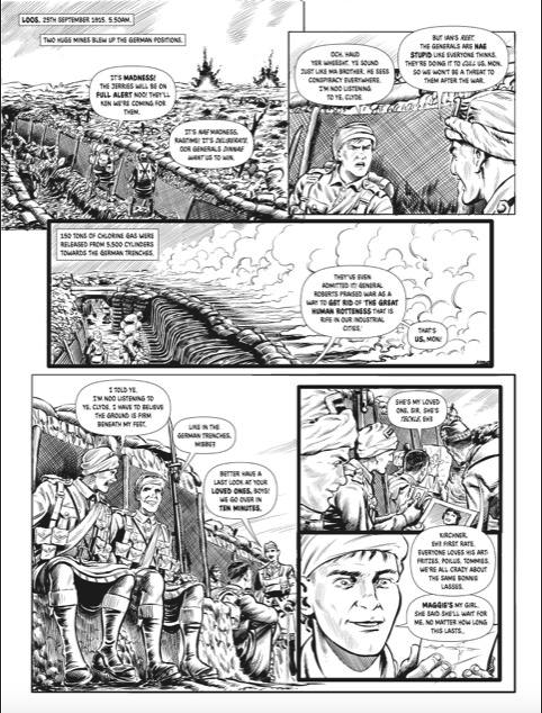
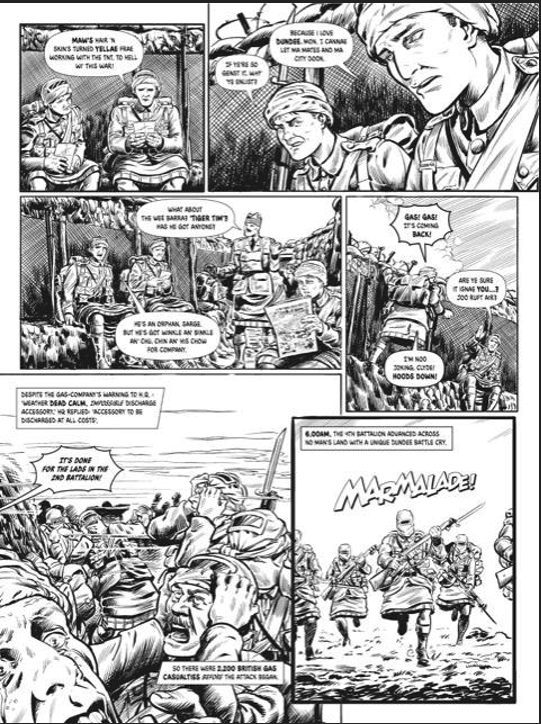
PM: Ragtime Soldier is a 48-page graphic novel illustrated by Gary Welsh and Philip Vaughan. The biggest challenge on Ragtime Soldier was to find an artist who could follow the great Joe Colquhoun, the artist-creator of Charley’s War. Finally, I hit gold with Gary Welsh and Phillip Vaughan. Gary’s work you may know from 2000AD. Their art has the same affection, drama and, above all, emotion that we all remember from Joe. Our book features an 11-page prologue introduction comic strip about the disastrous and tragic Battle of Loos which hit Scotland very, very hard. And then how the war resistance movement defeated Winston Churchill in the Dundee election after the conflict. Churchill had always been MP for Dundee, but he was thrown out by the people after the war, and he never forgave Dundee. It’s an astonishing story with aspects of Peaky Blinders. And then we have a 37-page story about a Trench Raid and the raiders’ terrifying discovery just before the Battle of the Somme.
The Ragtime Soldiers are Dundee’s Fighting Fourth Battalion of Scotland’s Black Watch. They went into battle to their war cry of ‘Marmalade’! Because Dundee was famous for it.
Our creative and production team are Scottish. I started my comics career in Dundee, and I have Scottish blood, myself so it’s a powerful, authentic and personal project for all of us.
My main story source are two brilliant Scottish historians Gerry Docherty and Jim Macgregor who wrote the controversial Hidden History and Prolonging the Agony about the Great War. They’ve been tremendously supportive – Jim even sent me many of his personal research books.
So, it’s a very Scottish project! Even down to getting the Dundee accent absolutely right in the speech balloons. It’s been scrutinised by experts, including the late Ian Kennedy, a Dundonian and the legendary Commando artist.
The name Ragtime Soldier comes from how the British soldiers sang, ‘We are Fred Karno’s Army, The Ragtime Infantry, we cannot fight, we cannot shoot, what earthly use are we?’ They sang it to the hymn The Church’s One Foundation! That’s so Monty Python! Fred Karno was the king of slapstick and promoter of Charlie Chaplin.
So, our forefathers were not the patriotic, dutiful cannon fodder modern historians and politicians want us to believe. They were teenagers, many crazy about Ragtime because it was the rock and roll music of its day. They loved it because it was hot black music, and their parents hated it! And they had the same dark sense of humour many of us have today. They need remembering as these real people, not ciphers.
Our hero Robbie McTaggart tries to escape the horrors of the trenches by playing Ragtime music in his head, but he finally has to confront the truth that this is not a war for freedom, but a war for profit and power as Siegfried Sassoon had declared. But Sassoon escaped court martial for speaking out because he came from a mega-rich upper-class family. Robbie is just an ordinary soldier, and he has to find a way of revealing the truth, which he successfully does. I would describe the way he does it as not just Scottish, but very Dundee!

Note: Original RT coloured.
TW: You have described Ragtime Soldier as a successor to Charley’s War. Have you chosen the word “successor” rather carefully? Given the subject matter, did returning to the era make the word “sequel” feel entirely inappropriate?
PM: Definitely. It couldn’t be a sequel as the characters are not connected. It has new, darker stories that could never have appeared in Charley. Stories that no one has dared to tell before and will never be dramatised anywhere else, in comics or in any other media.
TW: Arguably Charley’s War is considered one of the finest examples of comic strip storytelling. Many say it is an essential educational text that chronicles the horrors of a truly terrible war. What inspired you to return to the subject in 2025?
PM: I had no choice. Historians started rewriting the history of the Great War with the most outrageous lies. So, the Battle of the Somme is now described as a ‘great victory’ by historians! So, the value of Charley’s War to kids and adults was potentially diluted by revisionist historians from around the millennium. Ragtime Soldier should have happened long ago. But there was a media black-out on anything anti-war during the WW1 centenary years.
Publishers excuses to me why they couldn’t publish an anti-war comic series were amusing and pathetic. The real reason was there was an embargo on anything anti-war, but they could hardly admit that. The one exception was Dundee University who commissioned me to write the Battle of Loos, the introduction to RT in 2019. This was published in a magazine, Great War Dundee with a cover by the late Ian Kennedy, also a Dundonian.
Everyone remembers that last tragic episode of Blackadder Goes Fourth. But anything so anti-war was unlikely to be seen in the centenary years. Even comics were affected! Charley’s War was deliberately excluded from the British Library exhibition of ‘radical’ British comics. I was gob-smacked! Charley’s War is easily more radical than my Slaine, Misty and other stories on display. Ragtime Soldier makes up for lost time. It is VERY radical!
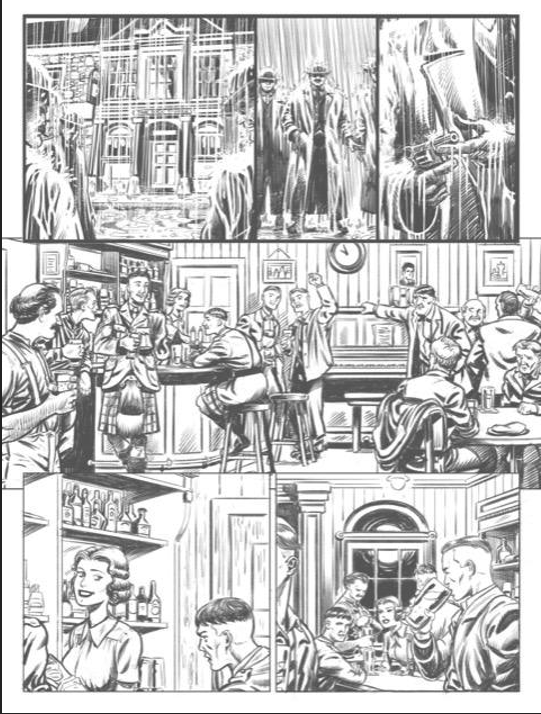
Note: Pencils for original RT Page 2.
TW: You have mentioned the artists, but can you elaborate? How did you approach finding an artist to follow the likes of Joe Colquhoun?
PM: Philip Vaughan was a senior lecturer and programme director at the University of Dundee while Chris Murray is Chair of Comic Studies at the University. Between them they have mentored many great comic talents. Phil and I had previously worked on a possible comic series about the great Scottish anti-war hero John S. Clarke, but that didn’t quite come together. Then Phil and Chris planned the comic magazine Great War Dundee, commemorating the Battle of Loos. Phil introduced me to one of his top students Gary Welsh who would draw our Ragtime Soldier story set at the Battle of Loos. Phil inks Gary’s pencils.
I was delighted because I could see he had the comic passion I was looking for. And I am very picky! Thus, Rebellion had approached me to write a Charley’s War story for the Battle 50th anniversary. I duly worked out a story for them. But then I turned down their suggestion for the artist – because I needed more passion. I heard no more from them since.
TW: Given the obvious connection, can you say to your mind what do you feel is the ongoing legacy of Charley’s War? It is a piece of work you must look back upon with enormous pride.
PM: Absolutely. It sells across Europe. There’s even a Finnish edition! In fact, I think Charley probably sold better in France than it did in the UK. There was a major national exhibition of Joe’s art at the Museum of the Great War in Meaux. That’s the equivalent of the Imperial War Museum. By contrast the Imperial was not interested, yet another example of the blackout on anything anti-war. I see Charley very much in the tradition of Tardi’s work, who I’ve met and interviewed, as well as Joe Sacco. Joe Sacco did an amazing poster book on the Battle of the Somme which was displayed on the Paris Metro. He told me how he was very influenced by Joe’s art growing up in Malta, I believe. For me, it’s important that Charley continues to be recognised in that anti-war category rather than subsumed into ‘war is hell’ comics which are often well done, but really a separate genre.
I thought I could rest on my laurels with Charley. It seemed like the last word on the subject. I was taken aback when historians started provably lying about the Great War. Then I learnt some astonishing new truths about the Great War which were concealed from the public – notably how it was deliberately extended for several years for power and profit – so I felt I had to get back to work. Ragtime Soldier is the result.
TW: Storywise, what can readers expect from Ragtime Soldier? I am sure given your history with the subject matter this will be a carefully researched project. How long has this been in the works?
PM: Because Ragtime Soldier is featuring a real-life Dundee-based regiment, I’m having to be more authentic than ever.
It will have a similar tone of drama and comedy to Charley. But there are important differences: it won’t be so compressed which will give the artist more space. So, we will have a double page spread of the Battle of the Somme. Just one or two big images as the Tommies go over the top. By comparison Joe had to draw six pictures on the page in a comparable scene. Also, we spend more space on the Home Front and what happened ‘when the boys came home’. Only Peaky Blinders and Monocled Mutineer has shown that side of things before.
Ragtime Soldier has been in the works since 2019 with the publication of Great War Dundee magazine. Then Covid and other things got in the way and slowed everything down.
TW: Can you provide more details about the Kickstarter? When does it begin and for those that contribute what should they expect?
PM: The Kickstarter begins on February 14th and lasts till the end of March.
here is the pre launch page https://www.kickstarter.com/projects/comicscene/pat-mills-ragtime-soldier
Here are some of the rewards:
- Ragtime Soldier Print
- Signed Bookplate
- Cover Print
- Original Sketch
- Pat Mills Zoom Talk
- Pat Mills Masterclass
- Gary Welsh Masterclass
- Numbered pencils print
- Ragtime Sketch Book
We found on our recent successful Sha Kickstarter, that a one-to-one Masterclass went down well with pledgers. So, I’d look over a prospective writer/artist’s initial idea and then talk to them by Skype on how to develop it and address any challenges or problems they might have.
I hope these questions and the interview will help promote a project I personally look forward to reading. Thanks so much, Paul. I do appreciate your interest and support!
Sign up for the prelaunch here of the campaign











You must be logged in to post a comment.