

Comics News
Tripwire Asks Just What Makes A Good Comic Editor Part One

Keeping It All Together
In the past Tripwire’s contributing writer Paul N Neal has delved into the details of how comics are made. He has asked about how to approach icons such as Judge Dredd, Batman, and Superman. He has even asked many creators about the best Christmas comics, or simply what goes into producing a wonderful comic cover…
This time Neal decided to consider a deceptively simple question, he asked “What Makes A Good Comic Book Editor?” To address this question, he asked a number of experienced artists, writers and indeed comic editors for their thoughts. Here are the results…
Erik Larsen
(Writer, Artist and Comic Creator. Spider-man and Savage Dragon)

That’s a pretty broad question but I’ll give it a go.
Generally, it comes down to communication. They know what they want. They have an idea of who might be able to do the job. They hire that person (or those people as the case might be) and see if their visions align. If they’re on the same page, they make helpful suggestions along the way. If changes need to be made (some corporations can be prickly about certain characters) they communicate with the creators, make suggestions for fixes, but let the creators make those changes so that the final book is in a single voice.
Presumably, if I’m being hired to do a job it’s because you like my work. But even as an artist drawing a cover I would ideally be shown the proper costume details and provided with a logo so that I could compose a drawing where all the components fit together. If you ever see a cover of mine where the logo doesn’t fit properly, you can bet that I wasn’t given the logo beforehand.
If I’m hired as a penciller – I’d like a say in who’s inking the job.
If I’m hired as a writer, I’d like to know who the artist is and what their strengths and weaknesses are.
I’d like to know their preferred working method. Herb Trimpe wanted a loose plot and hated the modern paint-by-numbers approach where the writer described every panel in vivid detail and gave him every line of dialogue. He felt that he wasn’t able to express his creativity. Jim Aparo wanted a full script. He’d worked from full scripts his entire professional career and he wasn’t going to learn a whole new approach this late in the game. Some artists need layouts or thumbnails. Not everybody wants or needs the same thing.
But largely it’s about communication. If an artist is drawing thumbnails before they draw a story that I wrote – those thumbnails should be shared early on so that any problems could be resolved.
The last thing any creator wants to see is a published book with their name in the credits with changes made behind their backs. Ultimately, it’s the creators getting the blame for anything that was clumsily inserted, well intended or not.
***
Steve Bull
(Writer, Editor and Publisher, The ’77)

I’ve got lots of stories but I’m not sure I can share many as the people involved may recognise themselves🤪
I would say the biggest skill an editor can have in my opinion is the desire and ability to have difficult conversations with people who think their opinion is far more important than the editors.
There’s often a major disconnect between an artistic vision and the cold commercial decisions required to make projects as successful as they can be. A good editor in my opinion makes decisions that satisfy the majority and is prepared to fight that corner in a way that doesn’t destroy their relationship with the minority. I do hope that’s not too cryptic.
You should also speak to a legend like Steve MacManus who is a master of the above.
***
Steve MacManus
(Writer and editor, 2000AD, Battle, Valiant, Blazer and more)

What Makes A Good Comic Book Editor? (From Barbie to Judge Dredd and Back!)
Scenario 1: The Editor of a Licensed Toy (E.G. Barbie)
There is a maxim that says the production of a licensed toy title needs to be: “On Time. On Budget. On Brand.” As such, the editor must deliver each issue to the printer on time. They will commission each issue within its editorial budget (as set by the publisher). And lastly, the editor will ensure that the editorial feature content is in keeping with the spirit and values of the toy itself. By this, I mean the editor and their in-house editorial team will adhere strictly to the accompanying style guide, provided by the toy company’s licensing agent, who themselves need to be kept onside at all times. If the editor can achieve these three targets, then they can be said to be a good editor.
Scenario 2: The Editor of a Licensed Title who has the authority to commission sequential art featuring the title’s hero (eg. Sonic).
The maxim “On Time. On Budget. On Brand” still applies here, as does the need to keep the licensing agent onside. But now there is the added responsibility of recruiting freelance writers and artists to create the title’s picture strips, within the parameters set by the style guide. These strips will put an additional spotlight on the editor’s skill in creating an entertaining, profitable title. Of prime importance is choosing creators who actually have a keen interest in the brand, rather than a creator just “phoning their work in” as it was once described to me by a harassed colleague.
Scenario 3: The Editor of an own brand title, such as Green Lantern or Judge Dredd Megazine.
In this scenario, the editor has the opportunity to involve themself in the stories featuring the character. And before that, in theory, they have the divine right to choose who writes those stories in the first place, not to mention who draws them! This is an entirely different scenario from the ones previously examined and it contains many potential pitfalls. Probably the most dangerous of these is where the editor selects themself as the writer. Another pitfall is the editor allowing their ‘inner fan’ to influence the unwritten rules of the character’s world.
For example, instructing a writer to write a story where Green Lantern becomes King of England, taking Kylie Minogue as his Queen while imprisoning the cast of EastEnders in the Tower of London…. “Because it would be funny.”
Assuming these and other pitfalls can be avoided, then what will define a good editor in this scenario is someone who can support their writers with helpful suggestions, shower their artists with encouraging feedback on their work, not to mention paying both on time while still finding the wherewithal to get the title to press on time and on budget. The last two requirements, since you ask, were ones I was never able to achieve in my eight years as an editor!
Conclusion
Regardless of which of the above scenarios, one final skill unites all editors and that is ‘managing upwards’ as well as downwards. By ‘upwards’ I mean senior figures floating above the editor, such as a managing editor, an editorial director and God himself, the publisher. Each of these will have a stake in the title’s success or failure and therefore a view on the editor’s performance.
***
Pat Mills
(Writer, Slaine, ABC Warriors and many more. Editor 2000AD etc)
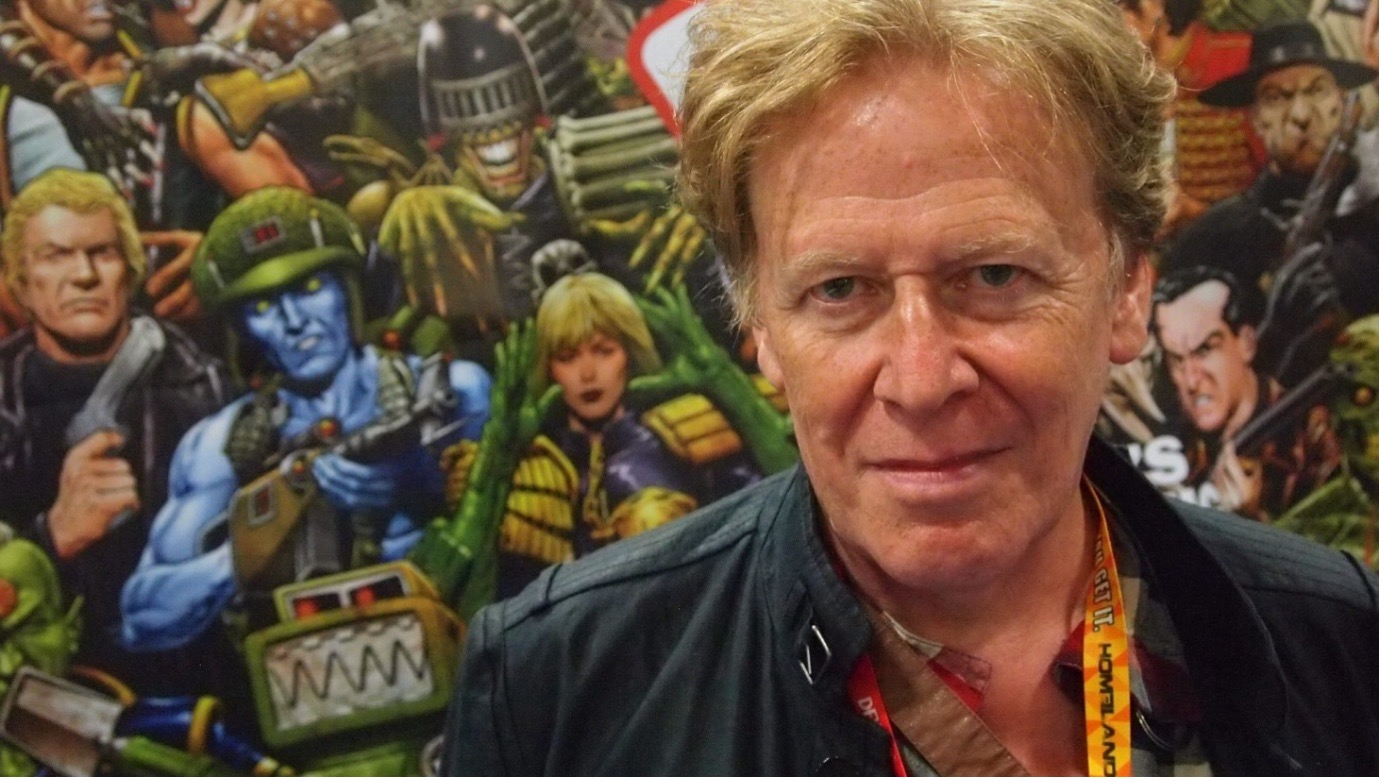
Photo Credit: Michael Molcher
Do quote me on this.
Everyone is going to ignore this advice, but I can assure you this is the most profound advice you will ever receive. The best UK comic editors are freelance NOT staff. Obviously there’s my example and doubtless others. Being a freelance comic editor is incredibly fucking hard work.
But no one looks at this REASON. Worse, no one gives a shit, preferring stereotypical fanboy views which ignore the problem.
If you are STAFF, then your job is secure. If a comic is a failure, you’re still financially secure. I could give endless examples – such as staff launched Look Alive, Tornado and Starlord. But as a freelance, your comic HAS to succeed.
I fully expect this insight to be ignored like every other I’ve given because we are hidebound by made-up bs, largely constructed by rabid professional fanboys with a history of failures behind them.
My book Pageturners elaborates on it.
To fanboy critics of my premise I would respond: Don’t shoot the messenger for telling the unpalatable and toxic truth.
***
Gregory Wright
(Writer, Artist, Colourist and Editor, Marvel Comics)

Tripwire Black and White Photo Note: Mark Gruenwald (Top.) Left to Right: “Me in the striped shirt, Howard Mackie with the tie and Mike Carlin, dark jacket.”
Being a good editor….
First and foremost a good editor must fully understand the MEDIUM of comics and how story and art combine to create the final story as read by the reader. Simply understanding what makes a good story and what makes good looking art is not enough. One must understand how visual storytelling works WITH the story being told.
The next important aspect is understanding that as an editor, YOU are not the creator. Your job is to bring the best work out of the creators you are working with and make certain that each creator is helping to tell the story equally, or hopefully better at each stage. As Archie Goodwin said…and I’m paraphrasing…” Hire the best people for the job and let them do it”. This does not mean you don’t offer feedback when needed, but rather that hiring the right people will mean less need for feedback. Your job is to be sure the creators are telling the story they were hired to tell, in the best way possible. If you have to hold their hand and have them rework material often, you have the wrong team.
A good editor must be able to show credibility to their creators and develop trust. When a creator realises you DON’T understand story or art, or composition or storytelling, or colour or how important the lettering and it’s position and style on the page are…they cease to listen to anything you say and will just do what they want and bully you into allowing it. And an editor should NEVER be a bully to their creators.
That is another way to destroy trust. Editors frequently have to walk the razor’s edge of being a friend, a supervisor and a psychologist in order to get the best work from creators. Creators frequently work at home, alone and may lack certain social “office skills” that make them unreliable or stubborn. Understanding this is crucial to how you relate to the very diverse creators that you will work with over a career.
Tripwire note: Gregory Wright complimented Howard Mackie. He suggested to Tripwire he was an excellent editor:
***
Howard Mackie
(Writer, Ghost Rider. Editor “New Universe” Marvel Comics)
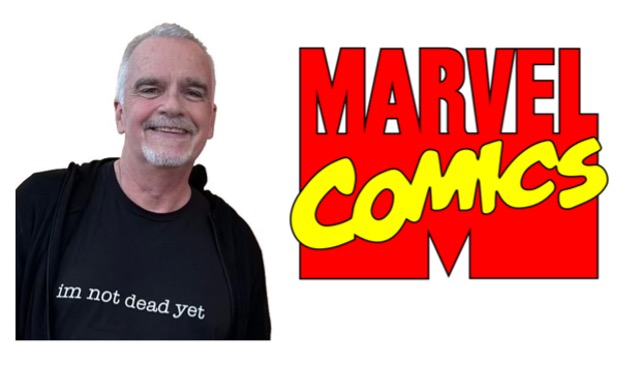
Greg is delusional. I was an adequate editor, at best, but I worked alongside and with many GREAT EDITORS — and one or two subpar editors.
I started my editorial time at Marvel Comics in 1984– and worked on staff for exactly seven years. I was very fortunate to work alongside some of the top editors in the business… from Mark Gruenwald (my friend and mentor) to Tom DeFalco (who is better than a kick in the ass) … and more editors than I can name. I learned by observation and osmosis.
As an editor, I quickly learned that the hardest part of the job was choosing the best team (writer, penciller, inker, colourist and letterer) for the book and then getting out of the way while offering guidance when needed and protecting the integrity of the characters at all times.
As a writer, I got to work with some of the best editors… from Bobbie Chase to Ralph Macchio. I learned from them– and many others in between– to NOT take credit for editorial contributions to a story. Always give the credit to the creators.
And then… I learned from one or two editors what NOT to do. One day– at the very beginning of my career as a writer (and still on staff as an editor) – I had two appointments with editors to go over a couple of pieces I’d submitted.
Editor #1 was going over a plot for a story I’d written. He went through the whole thing and essentially told me it could have been much better. It was a long and plodding criticism of my work with zero positive statements. Editor #1 then proceeded to accept the story as written. I left his office thinking I should pack up any dreams of continuing along the path of a comic book writer.
I then went to Editor #2– a seasoned vet in publishing– to whom I had submitted a pitch for an assignment. He proceeded to tear my pitch apart piece by piece, BUT… he then showed me HOW to put it back together… and made it very clear that he had every confidence in my abilities in doing so. I left his office KNOWING that I could be a writer and that HIS was the editorial style I wanted to emulate.
Overall, I think being a good editor is conveying to the creators that they are working WITH you and not FOR you.
***
Mike Carlin
(DC Comics. Editor of numerous Superman titles for decades)
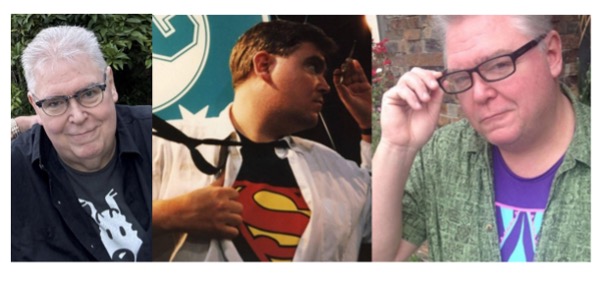
My simple answer to this is that a good editor knows when to stick his nose in on a project— and when not to.
If the creatives are firing on all cylinders, the editor should lay back. If they’re struggling, the editor’s there to help.
And my advice to writers, artists AND editors is not to take any decisions personally, because a million factors go into every judgment-call.
Of course, an editor should always be thinking of SELLING the stories and how best to do that.
In fact, back when I was editing, it was the editor who put together the house ads that would run in DC’s other titles if a series was short a page or a letter column.
And as far as advertising/marketing goes… the editor was always involved with the cover art and cover copy. Sometimes I’d even do the sketches.

My favourite part of the job was writing cover copy. The cover is the most important selling tool.
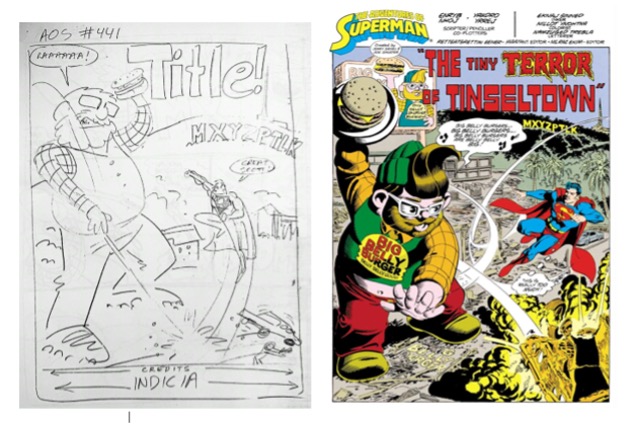
And while not the job per se, I’d sometimes break down the story for an artist in my cartoony style, to save time… because keeping the trains running on time WAS a part of the editor’s job.
***
Ed Doyle
(Art editor /indie creative for Falcon and Shrieeek)
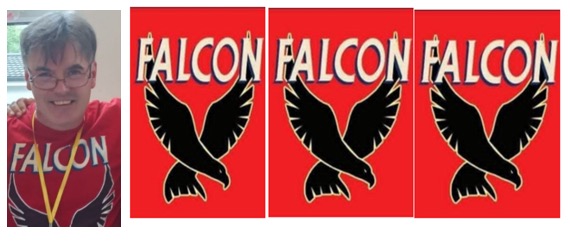
What makes a great comic book editor? Someone that can bring together a great mix of strips to suit everyone’s tastes and interests. That’s why I love anthology comics. You might not like some of the strips but there’s bound to be one or two that takes your fancy.
What can I say? Regarding Falcon, I just mixed up the art styles so that each individual strip is different from the next. I love having different art techniques in the issue. Some are cartoony, some are more realistic. It’s good to have a mix regarding art. Don’t want everything looking the same. As they say, variety is the spice of life.
When I was in my early 20s, I had a portfolio review by John McCrea. He gave me a few pointers regarding varying my work, character poses and so forth. Very helpful. That was at the Rathdrum Cartoon Festival in County Wicklow back in the early 1990s.
***
Alan Holloway
(Writer and Editor Falcon)
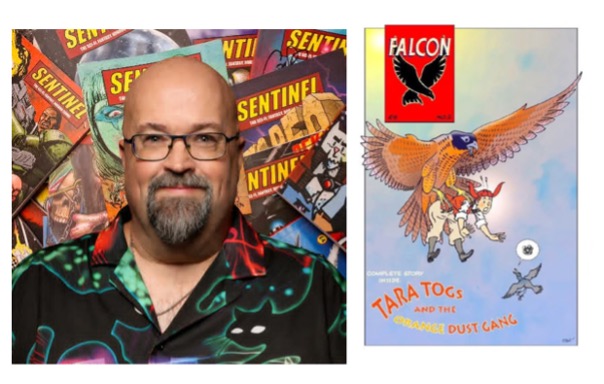
I’m an editor and that surprises me. As a writer, I am fine with sending editors my stuff and getting their feedback, but then I just sort of fell into being one myself when I started Falcon with Ed Doyle and suddenly there were twenty to thirty creatives to look after.
My experience of a good editor started with the late Dave Evans, AKA Bolt 01, erstwhile boss droid at the 2000AD fanzine, Zarjaz. I hadn’t written much when I started to send him scripts, and so was unused to someone sending something back and telling me to, usually, make it shorter.
Whilst he never rejected anything I wrote, he would give clear and very helpful suggestions to make what I had done tighter and therefore better. “This could be a one pager” was always a fun one, meaning I had to take a four- or five-page script and basically boil it down to the gag at the end. I did it, though, and ever since I’ve tried not to ramble on. It was good training for Falcon, where a story has to be told, usually, within twelve to fifteen panels. Dave never rewrote anything, never insisted on putting his own spin on my scripts, he simply encouraged and improved, and in doing so made me a better writer. That, to me, is a good editor.
I try to do the same as Dave, in a limited way as most of the scripts I get work fine as they are. I like a strip to have a good pay off, not be too crowded, and occasionally I’ll suggest a final panel or a line of dialogue. Never too heavy-handed, though, and I’ve heard some nightmare stories about an editor demanding several rewrites and shoehorning their own ideas into a script. Not for me – it’s not my job or right to impose my own vision onto yours. I’ll stick with Dave’s way, and he is greatly missed for good reason.
***
Andrew J Lewis
(Editor, Zarjaz)
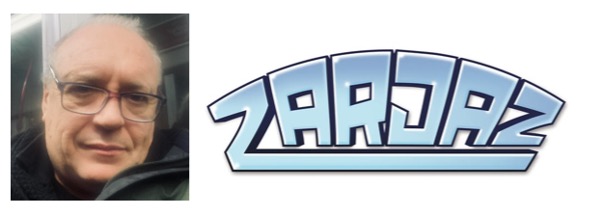
A good editor will have a knack for knowing what will work and what won’t work on a comic page.
Writers might be very attached to their initial ideas, but the editor looks at them as a reader would and therefore with a very different emotional reaction.
The editor is not afraid to highlight areas for improvement or even to gently let down a creator who may not be quite ready for what they’re wanting to do. As editor of Zarjaz I have a responsibility to treat the characters and ideas we are privileged to be using not only with respect for the original creators, but also to a standard which does not reflect negatively on 2000AD in any way. With this in mind my role is to help my team shape stories that could potentially pass for stories in the Prog itself!
But being editor is also about being positive with creators, encouraging them to think beyond their original first thoughts and showing enthusiasm for their talents and ingenuity.
Perhaps the best way for me to explore this question is to share with you my own practice. A lot of the writers and artists I work with on Zarjaz respond positively to my approach and readers’ feedback suggests that it works.
I like to have a brief story outline to start with from writers. Pitching a story is an important step in the process that can’t really be bypassed. The concept of the ‘elevator pitch’ might seem reductive but it’s a great way to pinpoint the key plot elements and characters. Sometimes an outline will have some great ideas, but I might suggest changes to increase the story’s impact. Once the writer and I have agreed on the outline they will send me a script. Sometimes we go for a page-by-page breakdown first, to make sure that the visuals are on in place. The script itself is likely to go through several drafts before we’re both happy with it, but even then there might still be changes ahead.
Once an artist has been assigned to a script I ask that they share with me their work in progress, again so that we can discuss areas where the impact might be heightened by moving things around, changing panel sizes, etc. With lots of artists working digitally some of them will share alternative versions of pages so that we can compare side by side how they work. Often the writers are invited to be part of this process.
At the lettering stage we are finally seeing how the story will unfold to a reader and there is a lot of toing and froing between the writer, the artist and myself in conjunction with the letterer to ensure it works exactly how we all want it to. Sometimes that means adding additional captions or lines of dialogue if an idea isn’t quite clear in the reading, or sometimes there’s the opportunity to add in additional one-liners or to layer in a textual detail to add resonance.
For me the key to all of this is collaboration. Zarjaz is very much a group project, I am fortunate to work with a great team of creative talents, all of whom love comic book storytelling and want to improve their output however possible. I try to keep in touch with the writers, artists, colourists and letterers as much as possible throughout the process and really enjoy being at the helm of this very lovely enterprise.
***
Dan Abnett
(Writer 2000AD, Marvel Comics, Warhammer.
Editor, Toxic and Strip.)
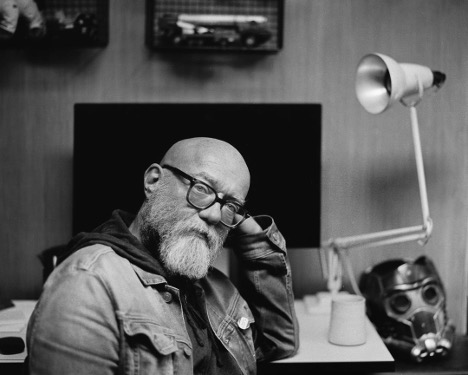
At the risk of sounding old and cranky, it feels like the concept of the ‘editor’ has been diminished somewhat, in comics and in publishing generally. It seems that the general consensus is that an editor is an optional extra, provided you’ve got a clear vision and a spell-checker. At the bare minimum, an editor operates as a traffic manager to keep everything in motion while the creator(s) gets on with it.
But that’s the bare minimum. I started out in editing at Marvel UK (I don’t think I was terribly good at it, as anyone who has read Strip or Toxic can attest), but it was a vital education in terms of understanding how a comic (or novel) “happens”, and how the process works. And also, how storytelling works. We should be championing editors rather than regarding them as superfluous or a dying breed. Rant over.
In prose, which I write a good deal of, I would be nowhere without my editors, operating as they do as anything from sounding board to mentor to therapist.
In comics, which is after all a team sport, an editor is crucial and not just from a production management point of view. The editor is there to keep a project on course, and to make sure it doesn’t drift too far from the original remit (unless there’s a good reason for it to do so, in which case the editor is vital in re-aligning what’s going on).
A good editor has the oversight and impartiality to see things that the writer (or artist) is far too close to and too feverish about. A good editor is the wise and calm voice. And a good editor gives clear, precise and “positive” feedback, guiding you to fix and adjust things as economically as possible.
Not all editors are created equal. I’ve been fortunate enough to work with some great ones and less fortunate on other occasions. The good and great ones understand what the creative team is trying to do (not just because they briefed them in the first place) and can stand slightly apart with a more general view to make sure everything is working in harmony. They can also suggest those sensible fixes and tweaks, because they are all-in on the purpose of the story too.
Some editors just guide things along and then make odd and puzzling suggestions because they’re… well, usually, they’re too busy to be completely in the mix, and have forgotten why something was being done in a particular way, and that conversation happened months ago anyway.
The worst I’ve ever experienced shall remain nameless. It was a long time ago, at one of the Big Two, and he made me re-write a seventy-five-page graphic novel SEVEN times because he wasn’t satisfied…. except at no point could he explain WHY he wasn’t satisfied, or what specific things I needed to adjust to allay his fears. That’s not good editing. A general overview and feedback remarks are fine but you also need some specific notes to understand how they can be applied.
On the other hand, I will always hold up Matt Smith (“Tharg”) at 2000AD, as a superb example of fine editorial delivery. His comments are delightfully minimal. Nine times out of ten, I send in a script and get a “That’s great, Dan, thanks”. But on that tenth time, there’ll be just a simple note suggesting I alter some dialogue or reorder a panel sequence. It’s always a very specific suggestion. It’s almost always a pretty small change, and it’s always transformative. That’s a remarkable knack.
I have never once been pissed off by his feedback (which is saying something, because even good editorial feedback can sometimes grind your gears, simply because you’ve got to go back to work and revise).
Every single time Matt’s sent me notes, I have gone “oh my God! Why didn’t I think of that!” and eagerly made the change, for the better. That’s because he could see what I was too close to see it and he understood the story intimately enough to suggest a fix without breaking other parts of the script.
I guess that’s what makes a good editor, in my opinion. Not someone saying, “this is wrong” but saying “wouldn’t it be right-er if you did this instead?”
***
Steve Rude.
(Writer, Penciller and Inker, Co-creator of Nexus, Eisner, Harvey and Inkpot award winner.)
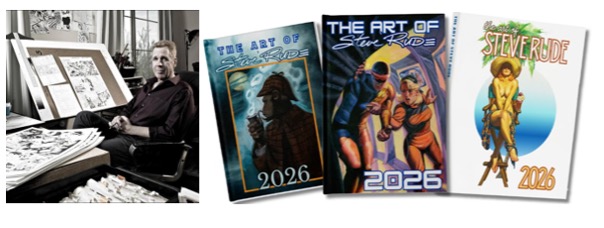
Photo top left by Greg Preston.
I’m not an “officially designated editor”, but in a sense we all are. Like everything else, “Editor” is just a name, a word meant to describe a task.
The first thing to know about editors is that they have a point of view. They only want work to come in on time and done well. If a particular editor is better than most, they will suggest things that the artist or writer may have missed that could change for the better.
Perhaps some “angle” of the given story or the rendered art that would really boost the story to higher levels. To me, a “non-editor”, it’s not as hard as some might think. It just needs time to gestate and become greater than say, a ‘first draft’, might deliver.
Great ideas can come from anyone. You just have be of a mind that is studied and shrewd enough to add to the overall performance. In a sense, every area of art has some manner of performance connected to it. The better you perform, the higher the enjoyment content.
***
Jim Salicrup.
Editor Marvel Comics, Fantastic Four, various Spider-man titles. Editor, Topps Comics, Bram Stoker’s Dracula, X-Files etc)

A simple question? Answer in a few words?
For me, that’s virtually impossible. I’ve spent most of my professional career attempting to answer that question. My thoughts on the subject could fill a book. Too bad Stan Lee, Archie Goodwin, Harvey Kurtzman, Mark Gruenwald and Jim Shooter aren’t around to answer that question.
What I will say is the answer is different for everyone, as I’m sure you’ll discover. It also depends on what exactly one thinks a comic book editor’s job is. For me, I tried to create an environment conducive to creativity. I tried to work with the best people available to do the best work we could in the time available.
It also helps to have great assistant editors, which I was blessed with. Just like the writers and artists, comic book editors had their strengths and weaknesses. While we were all racing to get our books out on time, there’s a lot we could’ve learned from each other. I’m lucky that I’ve had a long career in comics, and I’m still at it, but I’m still learning more every day.
In fact, when I said I could write a book on this subject, I wasn’t kidding! I’m working on a book right now that addresses much of this.
When I took over as editor of the Spider-Man titles, I had to think about how I would handle the character from where the previous editor left off. To buy myself time, I originally used a lot of the inventory material that the bookkeeping department was eager to get off their books. Generally, I approached Spider-Man as I approached most successful properties. I tried to be true to the concept that made the character a success to begin with.
When I took over, Spider-Man had a black and white costume, which was very popular with the fans, but I thought it was jumping on the then current fad of making superheroes darker, in this case, literally.
The last thing I wanted was for Spider-Man to be a second-rate version of Daredevil or the Dark Knight. I thought the black and white costume made Spider-Man look like a villain, which ultimately lead to my suggesting that the costume literally become a villain, which lead to David Michelinie and Todd McFarlane developing Venom. Of course, there’s much, much more to this story, but the main goal I had was to make Spider-Man as much like Spider-Man as possible.
The challenge was to do so without the stories seeming like the same old stories being recycled, but fresh and new. A very real challenge for all serialized fiction.
***
Howard Victor Chaykin
(Comics writer-artist, American Flagg, The Shadow, Black Kiss and more)
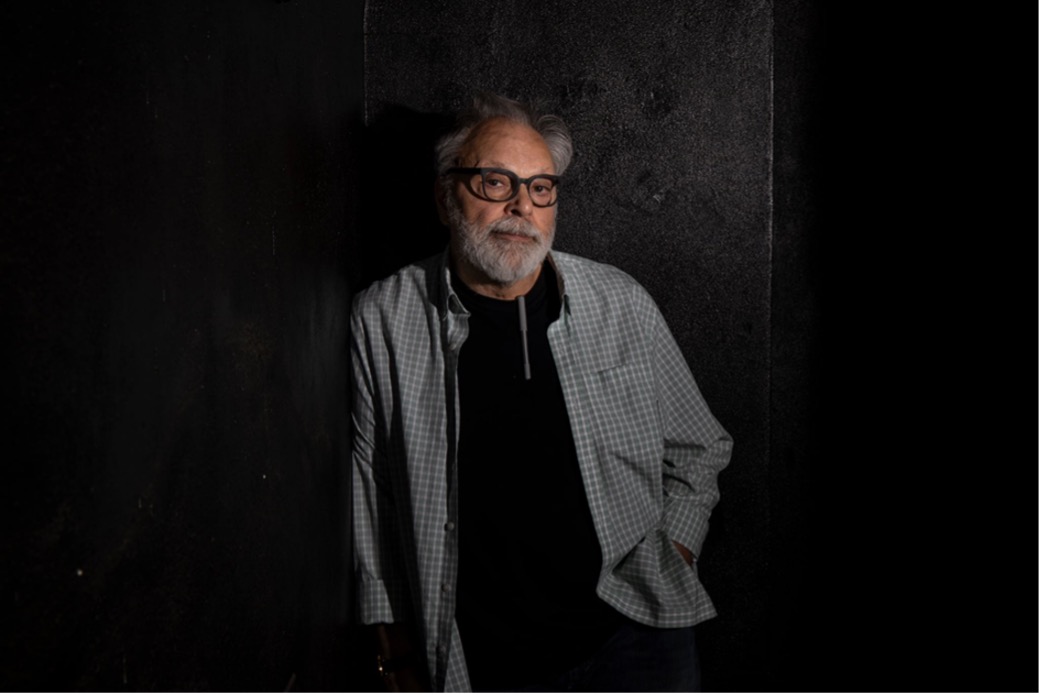
Paul has asked me to answer what appears to be a very simple and straightforward question—
“What makes a good (comic book) editor?”
This immediately presumes that an editor is needed. I share this presumption, with a series of caveats.
My experience, which dates back to what feels like the newsstand in Bedrock where Fred and Barney bought their comics, has been, to put it simply, that the best comic book editors are those who understand, intellectually and instinctually, that we work in a visual medium, despite the unfortunate and ongoing domination of the field by writers.
As I have frequently noted, the average comic book enthusiast has no real idea of what “writing” in comics actually means. It is, to be clear, a collaboration between writer and artist, the latter of whom does the heavy lifting of transliterating a literary idea, often vague, obscure or downright non-visual, into images of explicit and implicit narrative elements.
To a sad extent, this ignorance is often all too present in the editorial offices, where editors, who share at least the rudimentary skillsets of writers—using a keyboard to create text—are often ill equipped to grasp and understand the basic core principle of comics as a medium, specifically panels and pages designed and endowed with narrative value.
As subjective as this might sound, it is precisely what a good, or great, editor brings to comics. It is, to put it bluntly, their job.
I have been lucky enough to work with four great editors. Old-school cherry pickers will note the absence of Archie Goodwin from this quartet. Perhaps curiously, I never worked for him; rather, we collaborated, and I learned a great deal from this relationship.
Those editors are Lou Stathis, Joey Cavalieri, Axel Alonso and Thomas K. Four very different men, four very different mindsets. But all four were and are committed to comics as a visual, not literary medium. I don’t need shaping, per se. I will often call on an editor to help me choose a narrative fork in a road.
I can honestly say that ideas and input from all four of these men cost me time; and 98% of those ideas, that input improved my work for them.
***
Dez Skinn.
(Writer, journalist, editor and publisher, Marvel UK, Starburst, Warrior, Comics International and more.)

Being a comic book editor in America would appear to be totally different to being a comics editor in the UK. It would appear that in the States a managing editor is below an editor and being an editor is merely a springboard to becoming a writer. Infact you often find writers edit their own work. To my mind that’s pretty ridiculous – it’s like having Russell T Davies without Steven Moffat. A disaster.
Traditionally in the UK you begin as a trainee sub editor where you learn your craft working for an editor. After a few years, the trainee aspect ends, and you become a qualified sub editor. If you’re lucky or extremely talented you may come up with an idea for a title which your bosses – the publishers – believe worthy of backing and that will give you editor status.
But like any other industry you will have good editors and bad editors. Generally good editing will be invisible to the readers – if you don’t make any mistakes there’s nothing for them to notice. A bad editor you can spot easily – spelling errors, pages out of order, awful colour schemes on the covers, title logos that are unreadable… lots and lots of things.
I always think being an editor is like being a captain of a ship. The creatives are your crew, and the readers are paying passengers. As captain, it is your job to know what your passengers want and where they want to go. Your crew may not be aware of this. They just want to draw cowboy comics or science fiction whether the market is looking for that or not. This is why so many titles fail because as good as the script and art may be if nobody is interested in the subject matter-destination nobody’s going to buy it – you won’t have any passengers.
The captain should have an awareness of what the market wants, of where the passengers want to travel. He or she can then instruct the crew to aim at the destination and once that is all firmly plotted in, if the crew is any good the captain then can step back and let them do what they are paid for, to handle all of the day-to-day responsibilities because the writer is good at writing the artist is hopefully good at drawing but the editor isn’t necessarily good at either of those things but is good at assembling his or her crew and then leaving them to it.
That’s really only the tip of the iceberg – although that may be taking this metaphor too far. There is much more to editing, a skill it takes years to acquire – five in my case – but I don’t want to fill this entire article with my rambling. Perhaps somebody needs to edit me.
***
This is only Part One of a two-part article. A second part that asks another 15 fifteen writers, artists and editors will be published on the Tripwire website in a few short weeks.






You must be logged in to post a comment.