

Book News
Tom Hanks, Time Travel, and Typewrlters

Uncommon Type
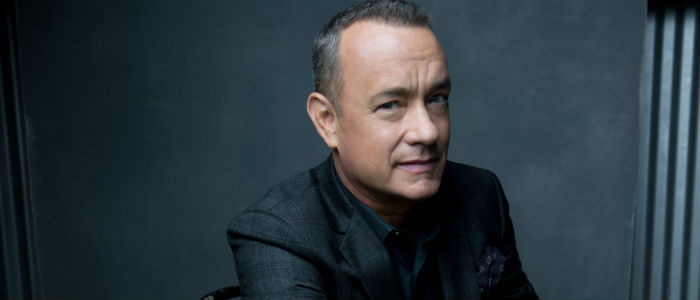
♦ Popular actor Tom Hanks has made the leap into popular writer Tom Hanks, and all through his belief in the life-affirming power of typewriters. He’s been doing a tour to support the book, Uncommon Type, a set of 17 stories written over many years in the downtime between movies, and has had some interesting stuff to say on his way through the media.
“Look, I get it,” he says, talking to The Guardian, “I’m a famous guy and I wrote a book and all that, but the reality is, how much does a collection of short stories really warrant attention?”
The collection deals, with varied subjects: time travel, a World War II veteran on Christmas Eve in 1953, a California surfer kid who ![Uncommon Type: Some Stories by [Hanks, Tom]](https://images-eu.ssl-images-amazon.com/images/I/41ZdAngJK3L.jpg) makes an unsettling discovery. But in every story, there’s a typewriter.
makes an unsettling discovery. But in every story, there’s a typewriter.
“I have too many typewriters,” Hanks says, talking to David Greene at NPR “You want one? I should have brought one for you and the staff, just to help out, man. I don’t want these to be a burden to my children when I kick the bucket. I don’t want them to say, ‘What are we gonna do with dad’s typewriters?'” The book is called, perhaps unsurprisingly, Uncommon Type.
“There’s something about – I don’t know, it’s a hex in my brain – there is something I find reassuring, comforting, dazzling in that here is a very specific apparatus that is meant to do one thing, and it does it perfectly,” Hanks says. “And that one thing is to translate the thoughts in your head down to paper. Now that means everything from a shopping list to James Joyce’s Ulysses. Short of carving words into stone with a hammer and chisel, not much is more permanent than a paragraph or a sentence or a love letter or a story typed on paper.”
Talking about the story These Are The Meditations Of My Heart Hanks says, “That’s actually the story of how I got my first typewriter. A friend of my had gotten a new Olivetti electric that was gorgeous – state-of-the-art typewriter for 1973. … He gave me his old typewriter. But I used it for about a year-and-a-half or so, and I just wanted to get my typewriter serviced, just like the girl [in the story] did. What happens to her in the shop is almost verbatim the conversation I had with the old man.
“That guy altered my concept of the place a typewriter can hold in your life. It is equal to a wooden chest that your great-grandfather carved, or the perfect set of doilies that your grandmother hand-stitched themselves, or a quilt that your mom passed down to you, that she made for you when you were 5 years old. A typewriter is — you can carry it around, it can go with you anywhere in the world. Even the biggest one you can put in a box and lug if you’re dumb enough to try to get through airport security with something like that.”
“I just kept asking questions. Like, ‘Well, how long should they be?’ My editor would say, ‘Well, however long they are.’ ‘OK, how many do you want?’ ‘Well, you know, 15 would be good.’” It turns out Hanks has almost no vanity as a writer. “Look,” he says, “in my day job I provide the raw material and someone else makes all the decisions; the order, the editing, the lighting. So I don’t have any problems with someone coming in saying, ‘I think it should be like this.’ About six stories in, my editor said, ‘You’re always writing about people who are stumbling upon somebody, that becomes part of their world.’ I thought, I guess I am. Son of a gun.”
Hanks is modest in his assessment of his success:
“As an actor, I think your job is to show up on time. Crazy important to show up on time. Huge. It’s the first lesson I learned as a professional actor. You must. Show up. On time. Because, if you don’t, you don’t have the time. It’s as simple as that. Before the sun goes down, or just to get it right; to get everybody on the same page, momentum-wise. If you’re late, momentum can be lost.”
Asked about the Harvey Weinstein allegations by the New York Times he says: “It all just sort of fits, doesn’t it?… You can’t buy, ‘Oh, well, I grew up in the 60s and 70s and so therefore…’ I did, too.” Hanks cites Nora Ephron: “She refused to buy into that shit.” Ephron worked with Hanks on Sleepless In Seattle and You’ve Got Mail. They were great friends, and Hanks dedicates Uncommon Type to her.
“Nora was not a soft woman,” he says, smiling. “You did not want to cross her. Nora said, ‘Never turn down a front row seat for human folly.’ And I have turned down a lot of those front row seats, but human behaviour is constantly entertaining. Watching humans behave in one way results in a comedy, and in another way a tragedy, but it ends up being a constant fascination. Why in the world do we do what we do, and how does someone get to that place where they think that’s important? The people that are dicks in showbiz, I always say to them: ‘Why are you in this?’ I’m in it because there’s nothing more fun than doing this. This is like going to high school and finding out you can take a drama class instead of calculus. Sign me up!”
For Hanks fans, there’s a great interview with him that can be listened to at the excellent NPR Books site!













You must be logged in to post a comment Login