

Doctor Who
Mike Collins Tells Tripwire All About Being A Doctor Who Storyboard Artist For Over A Decade. …and Shares Daleks And A Regeneration


An Integral Part Of The Crew Of The TARDIS
Mike Collins is an accomplished English comic book writer and artist, who has also worked extensively as a storyboard on the long running science fiction series Doctor Who. Tripwire’s contributing writer Paul Neal recently spoke to Mike about some of his experiences working on the iconic series…
TRIPWIRE: Can you remember please, what would have been your very earliest exposure to Doctor Who?
MIKE COLLINS: My very first memory of TV? I had this mental image of a gigantic cabinet with a little TV screen on top of it. On screen was a giant head asleep, with little people walking past. It wasn’t until decades later I found I’d kept a snapshot memory of The Planet of the Giants serial from William Hartnell’s time. As a kid, I was aware of Who, but whatever I saw always terrified me. I didn’t really start watching it until Jon Pertwee took over when I was 9 (so grown up!)
TW: I appreciate this is a slightly fannish question, but do you have a favourite Doctor?
MC: Pertwee was ‘my’ Doctor, so I always had a soft spot for him, but each regeneration has some special spark. I love all the Doctors though Matt Smith cornered the market in smiling with everything but your eyes, which I find fascinating and chilling at the same time. Ncuti Gatwa is excellent and blimey, the camera loves him!
TW: How did the opportunity to become a Doctor Who storyboard artist come about? I understand you’ve now been doing it for a few years, is that correct?
MC: A phone call off Andrew Wildman, my fellow Transformers artist in years gone by, he’d been storyboarding the Matt Smith stories and had been asked back to work on Capaldi’s episodes. However, he’d also been offered a movie with Charlize Theron, so he’d been ringing to see if I’d be happy with him putting my name forward for Who (well, obviously…)
At the time I’d been mostly working in animation (Igam Ogam, Horrid Henry among others) though luckily, the previous week I’d storyboarded a Lifebuoy Soap ad for Indian TV so I was able to show the BBC I could draw something other than cute cavegirls or sociopathic schoolkids. I’ve boarded at least one or two episodes or more each series since, just over a decade of Doctor Who.


TW: As a fan of Doctor Who, do you still enjoy watching new episodes when they are broadcast? Or has peeking behind the curtain, and being part of what I assume must be a rather large crew, taken away some of the magic of just being a fan?
MC: My rule is: if I’m not needed to board an episode I don’t read the script, so I can enjoy it as a fan. I always have to watch any episode I have worked on several times, as the first viewing is very much spotting if they’ve used my boards in the set ups.
Being on set is a lot of sitting around as they shoot the same 8 seconds from five different angles. If you’re not actively involved it can be a bit repetitive. That said, I did get my daughters a set visit and they were dazzled by it all (and Peter Capaldi took them on a tour of the TARDIS set between takes, so Bonus Dad Points there.)

TW: Can you name a few of the episodes you have worked on? Do you have any favourites?
MC: There’s been a LOT, but Death in Heaven was the first of my many opportunities working with Rachel Talalay and still remains a highpoint (even if I did spend way too much time asking her about John Waters.) Also, Heaven Sent/Hell Bent, also for Rachel- I think they are just exceptional episodes of TV not just Doctor Who.
One episode that is very special to me despite the fan distain for it, is Space Babies, as one of the background babies is my granddaughter, Annie!
TW: As a perk of working on the series, do you often have the opportunity to go on set to meet the cast and crew? Or is storyboarding an element of the production that is largely done in isolation from the filming process?
MC: I don’t get to interact much as I’m preproduction- I generally work with the director and DoP. Occasionally I get to go on set – Daniel O’Hara who directed the two-parter Under The Lake invited me on to see filming and I got to spend time with Peter Capaldi discussing storyboards- he loves the Ridley Scott boards for Blade Runner so we enthusiastically bonded over that.
TW: Can I ask a little about the process? Do you receive a full script? Or just the parts you are expected to work on? Are there terribly tight deadlines on Doctor Who? After all, surely it takes a long time between your part of the process to anything appearing on screen.
MC: I get a script, or just scenes if that’s all that’s needed. As opposed to animation, only key scenes get boarded in live action. Every so often my boards might lead to changes (costs, practicality, the sheer horror of what the writer is asking for laid bare in the drawing.) Storyboarding is a cheap way of realising what is expected of the actors and the sets before you do a single frame of filming.
On timescale: I’ve always been ahead of the shooting schedule but more recently with the budgets for FX having been expanded, I’m working further and further ahead. For example, I finished boarding Lux 18 months before it aired.
TW: Can you share any amusing or interesting anecdotes from working on the series? For example, have you ever found yourself particularly starstruck meeting anyone during your association with the series?
MC: On Empress of Mars, I needed reference of the Ice Warrior. Production told me Richard Ashton (who played Friday) was on set and would be happy to pose for me. I went down to the Mars set, met with Richard who happily struck action stances I could draw from. I heard “Positions!” and suddenly realised I was stuck in the middle of this vast set. I ducked behind a large rock as the tea party scene played out.
As soon as they called “Cut” I scarpered out, hearing someone yell “Oi! Who the bloody hell was that?!” So next time you watch the episode, take pity on the lowly storyboard artist holding his breath just behind the dinner table.
TW: Would it be fair to say there is a high level of secrecy involved working on Doctor Who? Just how seriously are such things taken?
MC: Very.
TW: From your social media I understand you worked on Lux, an episode from the latest season. It was a rather unique story because it featured live action and fully animated elements. Can you talk about your experiences on this episode? Did it present any unique challenges?
MC: Lux was a great one where I got to mix my two disciplines of live action and animation for the first time and Amanda Brotchie was enthusiastically committed to make such an outrageous story work so well. The heavy lifting for the episode was done by the animation house, while I provided what were essentially key frames where animation and live action combined.
TW: Will you continue to work on Doctor Who for as long as the opportunities present themselves?
MC: I assume every time the Doctor changes, I’m out of a job but thankfully each time I’ve been asked back. And if I’m asked back, I’m always going to say yes, and thank you. I love the scope of Doctor Who- that you can tell any kind of story- weird, terrifying, funny or bleak. And those stories can happen on any world, in any time. Being part of that has been an utter joy for over the last ten years.
TW: Can you talk about your involvement with Wish World and The Reality War the two-part finale of the latest season?
MC: Ask me again in three or four weeks 🙂
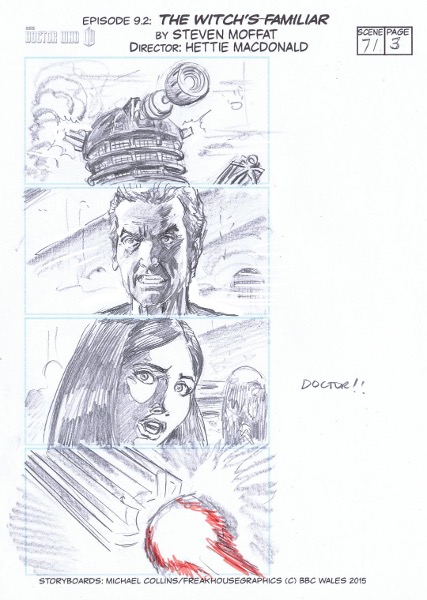
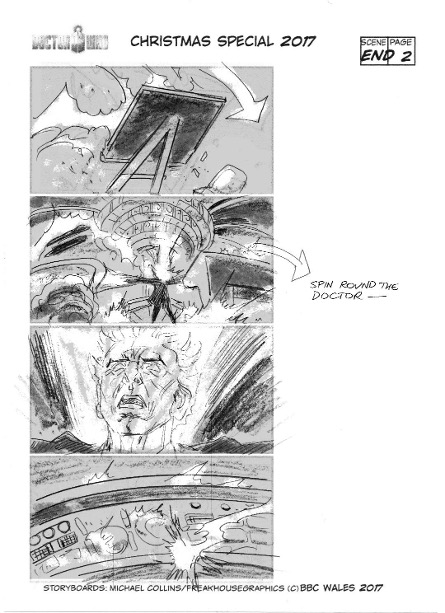
Tripwire Note: Tripwire certainly plans to get back in contact with Mike as suggested. For the time being here are some more images he kindly shared with us. Including Daleks and a Regeneration.











You must be logged in to post a comment.