

Comics News
Marvel and 2000AD Veteran Writer Dan Abnett Talks About His Memories of Editing Marvel UK’s Anthology Title, Strip!


Stripped Down To The Basics
Strip! is a fondly remembered Marvel UK comics anthology from 1990. While it may have been a short-lived title it still has its place in British comic book history.
With this in mind our contributing writer Paul N Neal contacted the title’s original and only editor Dan Abnett to ask if he could share a few memories of his time working on Strip! Here’s what he had to say…
TRIPWIRE: Strip! began in 1990, before diving in can I just ask, before Strip at what stage were you in your writing career?
DAN ABNETT: I’d been on staff, editorial, at Marvel UK since 1987, and I’d been writing from that point – mainly junior licensed strips like Ghostbusters, Action Force and Thundercats. Editorial trainees like me were expected to write stories for the range of titles so we could learn how stories and scripting worked hands-on before we edited other people. I’d done quite a lot by 1990, as “freelance overtime”, and really enjoyed it. I think I was already wanting to do it full time, though I really enjoyed editing and the collegiate atmosphere of the Marvel offices. It was about that time we began work on Knights of Pendragon.
TW: How did you come to be the Editor of Strip!. Was it the type of job a person applies for or were you, for the lack of a better word, headhunted for the role?
DA: It was assigned to me, as I remember. I’d been assistant editor on Ghostbusters, editor on things like Galaxy Rangers, and there was a general eagerness at a senior level to maybe produce something for the older end of the market, teenage-plus. Fleetway was doing, as ever, very well in that area, but almost everything Marvel UK was doing was for the nursery and junior end of the news-stand.
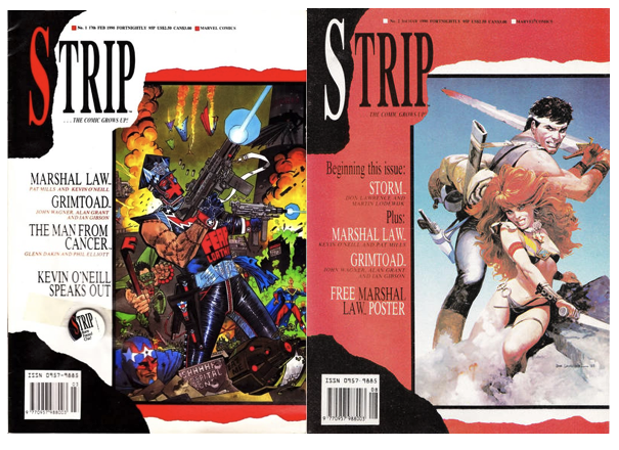
Kev O’Neill (issue 1.) Don Lawrence (issue 2.)
TW: What was your initial brief on Strip!? Did you and the title have a specific mission statement to fulfil?
DA: It was basically to do something older and I suppose something edgier and “cool”. Those definitions were very fluid and I don’t think were ever properly realised. Something that wasn’t for younger kids. Something Marvel UK wasn’t doing. Perhaps also something a little classier and more “mature” — again definitions that are very hard to pin down or pull off, though that was the period when “mature” comics were becoming really big, thanks to Vertigo, Revolver, Crisis etc. Doing comics as legitimate reading matter for grown-ups was suddenly hot.
TW: Strip! contained an eclectic mixture of creators and characters. We’re you in full control of what was published or did you occasionally have to follow instructions from other staff members in Marvel UK?
DA: I got to choose things as the series progressed, but the driving force was the managing director, the late Robert Sutherland. He wanted to try something in that market area, and he’d landed the British rights to Marshal Law, and struck a deal for Ghengis Grimtoad and secured deals with European publishers to reprint material like Storm.
Robert was lovely, though I think he had spent such a long time very successfully mastering the junior and nursery end of the market (Marvel UK was really doing well in that area at the time) that he wasn’t massively well-versed in what might make a “mature” comic. I don’t mean that rudely or unkindly: his support and enthusiasm was amazing, but he wasn’t especially discerning. If a property had classy, illustrative artwork or controversial content, or violence… then it was fair game.
He’d buy up rights to reprint all sorts of things and urge me to run it, and obviously, at that point, it was too late to question a purchase or point out that it might be an odd fit. I suppose what I’m saying is that there wasn’t much opportunity to curate tonally (not that I’m pretending I’d have had the skill to do that either). So, I just leaned into the idea that it was an anthology in the purest sense. The unlikely clash of content material became a feature not a bug.
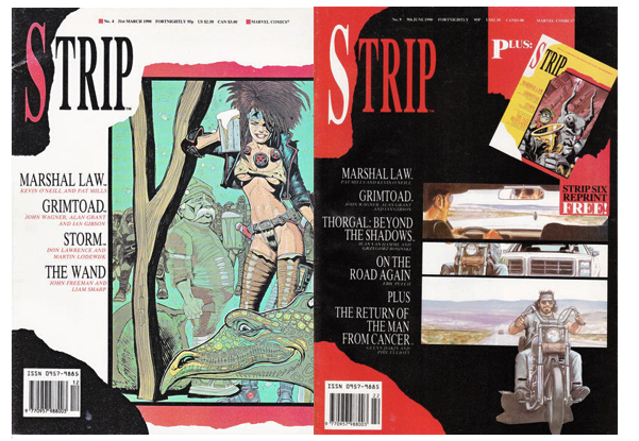
Liam Sharp (issue 4.) Eric Puech (issue 9.)
TW: It has been several years so I appreciate it may be tricky to recall, but roughly speaking as the editor, how much of the material for Strip! did you manage to commission and how much as you said you clearly inherited from other projects or even as cheaper reprint material?
DA: I think there were eight or ten fully originated pages per issue, plus Grimtoad. The rest was reprint. I went looking for stuff and was offered a lot too. As a result, I commissioned and ran all sorts of very unlikely stories. Some worked, some didn’t. Again, I think I had really just accepted that there was no way to achieve a curated tone, so I stopped worrying about it and commissioned things that I liked, even if they were seen as whimsical oddities. It was rather liberating, actually, and as a result we gave a home to some stories, and to some creators, who otherwise would not have easily found a newsstand home.
TW: There were some great stories in Strip!. I would highlight The Chronicles of Ghengis Grimtoad as being a standout strip. Would you agree or were there other stories that really stood out for you?
DA: Grimtoad was certainly great, and a real pleasure to work on. I am also (still) very fond of Phil Elilott’s stories with Glenn Dakin. They were very much NOT Marvel or Marvel UK and would earn me side-eyes from other members of staff. But I was simply embracing the sheer “what the hell” natural of Strip!’s default setting. And, one way or another, I relished every story, even the reprint series. I mean, just because Storm made no sense being anthologised alongside, say, Marshal Law, it didn’t mean they weren’t both great series in their own rights. In terms of commissioning, getting covers from Kev O’Neill was a real highlight. And working with him, and reprinting Marshal Law, brought me to the attention of Pat Mills, which is why he and Kev then head-hunted me to edit Toxic! (which mercilessly took the piss out of Strip!).
TW: Issue 9 of Strip! came bagged with a reprinted edition of issue six. Can you recall or explain why this happened? I can’t recall of another time this happening. There must be a story to be told or retold here? If nothing else, it sounds like an expensive thing to do.
DA: My honest answer is I can’t now recall. I only remembered it even happened at all because you asked. The details now escape me, but I imagine it must have been a page order error, probably a printer’s mistake, and must’ve involved some of the original (commissioned) interior because we’d have made a particular effort to get pages presented correctly if it was a first printing of the work. Beyond that, it’s lost in the mists of time.
TW: I just did a little more online research. It suggested it was because issue 6 was printed on substandard paper. I just wondered does that rang a bell?
DA: It sounds plausible. And would explain why we went to the effort/expense.
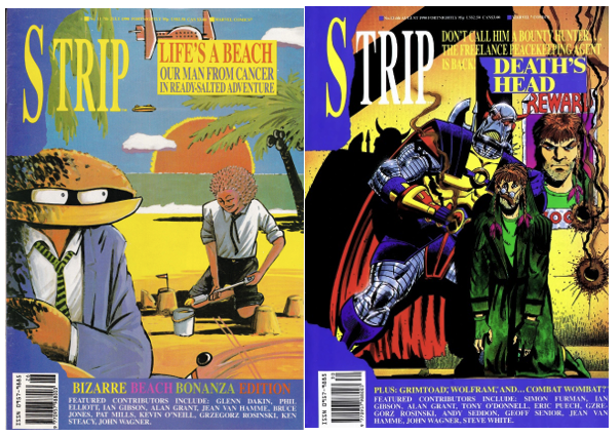
Phil Elliot (issue 11) Geoff Senior (issue 13)
TW: The twenty issues of Strip! had some great cover images. They all seemed pretty eye-catching. I ask simply looking back now do you have a cover that you think was especially eye-catching and effective. Basically, do you have a favourite?
DA: It’s hard to pick a favourite, actually. Commissioning covers was a real highlight, because I got to approach and work with some really big talents. Whatever else, Strip looked good. The covers were really striking and John Tomlinson’s wonderful graphic design for the series “look” was outstanding.
TW: Please forgive me but I heard a rumour once about the fact you may have experienced a rather unique problem with a Simon Bisley Punisher cover. The story suggests that the artist used too much blue paint and gave his original art such a shiny sheen it broke the copy machines of the era that were meant to scan his art. Is this an urban myth? Is there is any truth to that story?
DA: You know, I can’t remember precise details, but that is basically true. I seem to remember another cover that caused problems because it had basically been done on a card stock that was as thick and heavy as Lino.
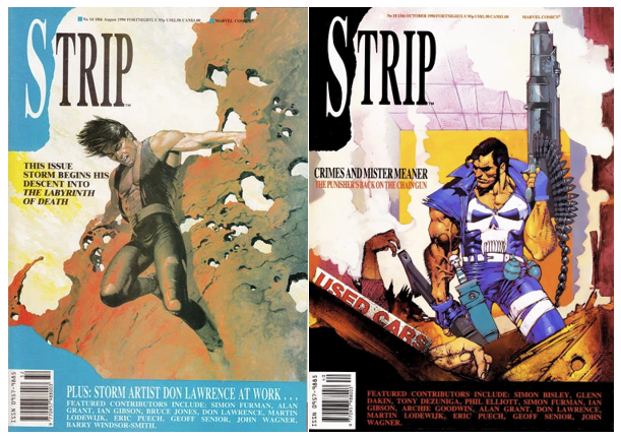
Don Lawrence (issue 14) Simon Bisley (issue 18)
TW: Strip! ultimately only lasted twenty issues. To this day it is fondly remembered. Was it a failed experiment? In your opinion, why did it not go on to be greater or longer lasting success? What factors lead to cancellation?
DA: I think it was a happy failure. If we’d had the budget to commission more of the content, and thus create a more deliberate and cohesive tone, it may have lasted longer. But in hindsight, I appreciate it for what it was – it was fun to produce and, I hope, fun to read. And the nonsensically eclectic nature of the content, though that wasn’t deliberate, gave it a really unique feel, and allowed me to showcase things that would have never otherwise seen the light of day. Looking back, I love its sheer idiosyncratic oddness.
TW: Did you personally enjoy your time editing Strip!? Did you learn any creative lessons from the experience?
DA: Yes, I did, and I learned a lot. Both on Strip! itself, and editing for Marvel UK generally, taught me so much about the way comics worked and about how they were put together. I learned about story and about handling licences. You have to realise that this was all done “old school”. All Marvel UK titles were put together mechanically and by hand… desktop publishing was only really coming in around the time I left staff. So, I learned “the crafts”. I think the body of knowledge I gathered in that time, at all levels of production and story, has stood me in immensely good stead ever since. I’m very grateful for that. And, as I mentioned, it led directly to me working as “editor” on Toxic! which was both an amazing and also horrible experience. Nevertheless, if I could go back, I would still do it, because of how much I also learned about the biz working on Toxic! (even if it was a very rough ride).
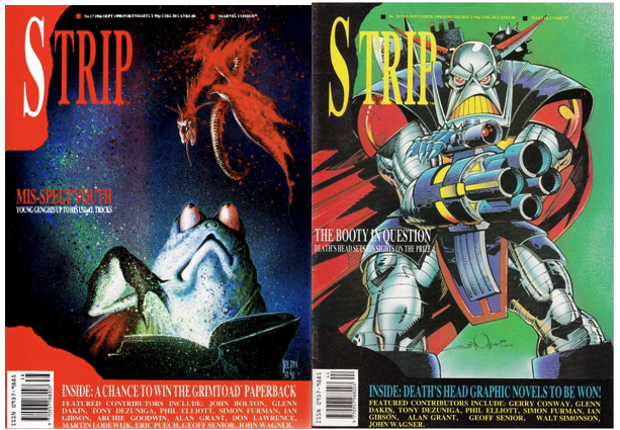
John Bolton (issue 17) Walter Simonson (issue 20)
TW: Would you ever consider editing a British anthology title ever again? Or are you happier working solely as a writer these days?
DA: The idea’s appealing, but I don’t know. As an idea, sure. But I understand how difficult it is, and how hard the market is… harder than it was even back then. Writing is my real passion, and I’ve got fairly good at it, so I’m happy where I am. Next year will be my fortieth year in the comic industry, and the vast majority of that time has been as a writer. So, I’ll probably stick with that.








You must be logged in to post a comment.