

Book News
A Geek’s Guide To Storytelling

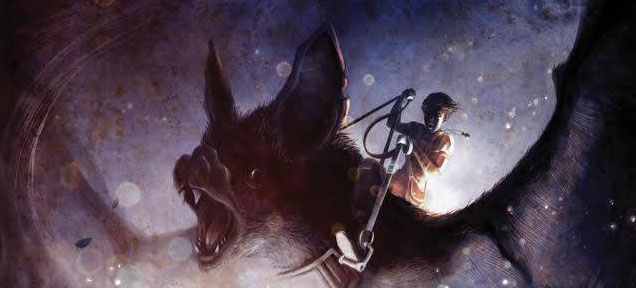
D&D Makes You A Better Writer
Tripwire’s new columnist, author Joshua Khan, writer of the forthcoming fantasy book series Shadow Magic, kicks off his occasional column arguing that playing Dungeons & Dragons makes you a better writer.

©2015 Joel Meadows
What do Vin Diesel, Jon Favreau, Stephen Colbert have in common with writers Patrick Rothfuss, Saladin Ahmed and Conn Iggulden?
Dungeons and Dragons, that’s what.
We live in the Age of the Geek, yet old school table-top roleplaying is still seen, somewhat, as a hobby for the utterly socially maladjusted.
Yeah, as if you bagged, hermetically-sealed Sandman collection ever got you laid*.
Dungeons and Dragons is the grand-daddy of role-playing games. It’s the one where you sit round the table with your mates and pretend to be dwarves, elves, heroic warriors and cunning pointy-hatted wizards, killing orcs by the hundreds, the odd dragon and stealing treasure. It’s had some bad press, back before Harry Potter when it was accused of leading kids into devil-worshipping and suicide.
This isn’t a history lesson. This is actually a writing lesson.
Role-playing games make you a better storyteller. As simple as.
If you ignore the funny-shaped dice and little toy figures it’s only one step removed from sitting around a fire, deep in some cave, keeping your tribe entranced with tales of the beasts and monsters that are out there, just beyond the light.
There are two components to a typical role-playing game. The player, and the gamesmaster.
The player creates a single hero. This hero is his proxy in the world (usually fantasy, but could be of any genre) of the game. He has a profession and a set of skills. Professions range (again, focusing on the fantasy genre) from rogue, wizard, fighter or cleric. Each have their strengths and weaknesses which is why the adventures are based on the party, i.e a group ranging from 4-6 adventurers.
Next is the gamesmaster. He runs the world. He manages the adventure the heroes go on. You have miss a player and the game continues. But there is no game without the gamesmaster.
And being a gamesmaster is the best training in becoming a storyteller.
You learn world-building. As the game expands you weave in more components. First, the heroes might be hired to clear a den of goblins that have been pillaging local villages. Their success brings them to the attention of the local baron. He hires them to act as guards to a banquet he’s hosting with a rival noble. That draws them into the intrigues between these two powerful rulers, and perhaps misadventures with a nobleman’s daughter who has a thing for a guy with a shiny wand.
The gamesmaster must make this world cohesive. He plays the baron, his rival, and even the daughter (mad old witches is my personal favourite, and speciality). He arbitrates on the rules (there can be many) and when the dice rolls fail, judges on what’s right, what’s wrong, and (most importantly) keeps the story going.
It’s hard work. You need to keep on your toes as the players can get wise to your overused tropes. You can see their reactions in real time, good or bad. It’s a live audience to your skills as a storyteller.
But it pays off. It can land you book deals and trips to Hollywood.
With Assassin’s Creed and Warcraft (which is the Dungeons and Dragons movie in all but name) due out this year and all those others than have preceded them, Dungeons and Dragons is the unacknowledged father of modern immersive gaming, and Hollywood’s desire to play catch-up. While the superhero genre continues to grow and grow with depressing monotony, the gaming adaptations have all failed. Why is that? The worlds are just as cool. The heroes just as ripped.
I think there is a fundamental difference in the two fields. With superheores we, the audience, have taken in tales told by others. We know we’re not Spiderman, or Batman or indeed Deadpool. We accept our passive role in their stories.
But as gamers WE are the heroes. We are writing our own tales. As Altair in Assassin’s Creed we are leaping from the rooftops and dispatching Templars to the left and right, we don’t need, or want, to view is passively via the cinema screen, even in the highly-attractive form of Michael Fassbender.
So, it’s game on and give it a try. Gather a group of mates and dig up one of those starter boxes. If you’re serious about storytelling, this is as good a place as any to start.
And if it’s good enough for Vin Diesel…
*Unless you’re Neil Gaiman, of course.
Joshua Khan’s Shadow Magic is out in April. Follow him on Twitter @WriterJoshKhan















You must be logged in to post a comment Login