

Comics News
Ed Hillyer Talks Romo The Wolf Boy From SelfMade Hero


Go Under The Big Top
Ed Hillyer’s Romo The Wolf Boy had a very successful kickstarter last year and now it’s being published through SelfMade Hero, launching today and here’s a brand new interview with Hillyer about the book…
TRIPWIRE: What was the genesis of Romo The Wolf Boy?
ED HILLYER: Crazily enough, it came to me in a dream – the name along with the character concept. Most likely in those lucid moments just before properly waking, a half-sleep. That happens with me quite often and I tend to trust to the unconscious, or semi-conscious (and who doesn’t love waking with a semi). Er. I made a sheet of sketches in our then-studio probably that same day, and seeing those also immediately excited at least one of my co-workers (the illustrator, JAKe, a Star Wars fanatic who’s since done a lot of high-profile commissions for Lucasfilm) into re-drawing ROMO his way, which indeed suggested I might be onto something: the first fan-art, straight out of the gate.
I think I arrived at the setting, the late-19th Century milieu and all the rest of it largely by narrative instinct. That’s just the way it smelt. But story upon story upon story kept on occurring to me, until I had filled notebooks and sketchbooks with it all. Unfortunately it then took 20 years and more than a few attempts to have to come to fruition, at least in terms of a printed artefact that could then make its way out into the world.
Would you believe me if I told you that character portrait or ‘cameo’ image central to the front cover design of the first volume is my very first ever sketch drawing of ROMO? No matter if you don’t, as it’s TRUE! I can say hand on heart I gave birth to my handsome hairy baby boy fully formed!

TW: How did you approach drawing the project as it’s quite different to your other work?
EH: I approach every single project that I commit to as its own thing: in other words, as a storyteller born I work to serve the story – show it in the way that works best for What it is, Where and How it should appear, and just a little bit (so far as that is calculable or controllable, which, despite the worst efforts of marketing, it really is NOT) Who it might be for, in terms of audience or readership.
One trouble I do have – and it has proven to be troublesome – is that I am facile, which is to say I can easily turn my hand to almost anything. My work doesn’t have any set style or medium or genre, and now in these latter days I realise just how much that has actually set me back: my advice to anyone starting out in the field is to stick with a signature approach, make your name and hopefully some kind of living from that, and THEN diversify and experiment, once your rep is established. The only problem is, as with any arena of artistic expression, it’s easy to become typecast and trapped. The marketplace wants a one-trick pony and breeds them, saying the audience wants that too. Repeated often enough it probably becomes true. But me, I love a surprise.
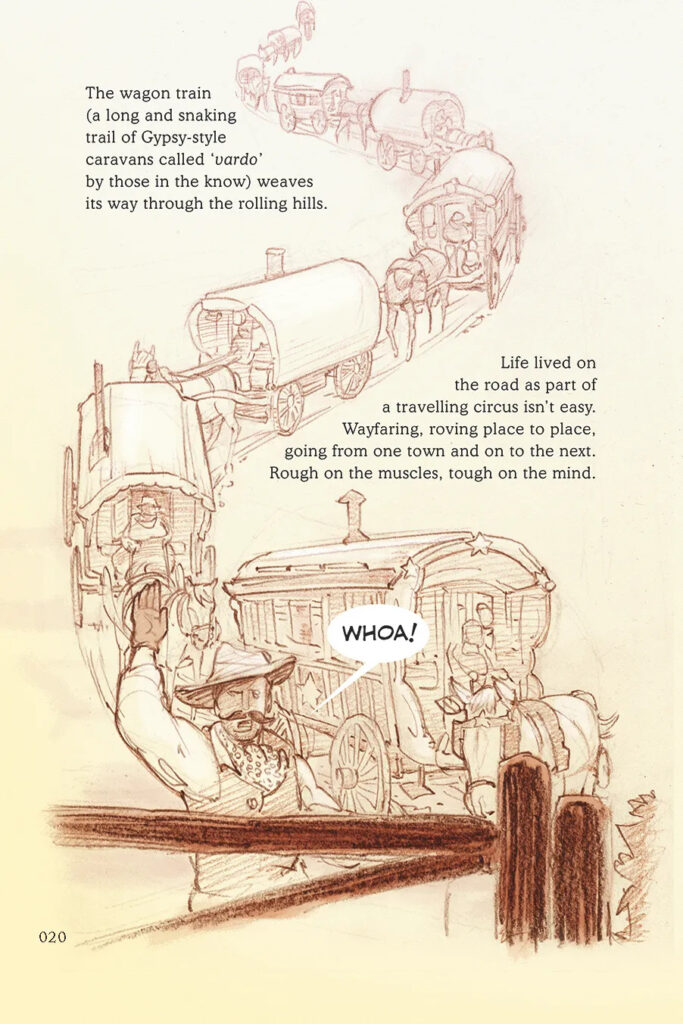
ROMO might only look different if you haven’t tracked other similar-looking pieces of my work that came before it. And honestly, in these atomised days, besides myself, who could? But I can point at Time Traveller, a booklet I co-created on the lesser-known origins of cinema with Professor Ian Christie, for one: another collaboration, this time with a ranting poetess, modernising Dickens for his centenary: and also a pitch for City Reads where the plan was adapt Oliver Twist in the Evening Standard for a month (back when it was a daily). That last one was fully prepped but never came off. But all share a similar period setting: so I guess the shot-direct-from-pencils look that typifies ROMO is my ‘Dickensian’ default, felt suitable to the mid to late Victorian era.

TW: How much visual research did you do before you started drawing it?
EH: I filled sketchbooks with it. I was building my narrative engines at the same time, so lots of words and dialogue clips, inventing characters, storylines as well as images, a whole universe (‘My Universe!’). I picked up dozens of reference books mostly from charity shops – enough by now to fill a library. The shelves at my back and stacks at my feet attest to that.
Sadly, after more than a few moves and the dissolution of my shared studio back in 2016, I can no longer find the biggest and best of these sketchbooks, my ‘Look Book’ or pitch bible which I took early meetings with. I rather suspect I may have unwisely lent it out to somebody, and never got it back. I think I know who this was, as they later lodged a strip in a children’s weekly that was markedly similar to at least one of the threads I was pursuing, and I know for a fact I’d shown them it. But my memory is too blitzed and faulty (always has been) to outright accuse. There’s also a concept of Ideas-space that I believe exists (alongside cyberspace, and fibrespace), a sort of ethereal belt that orbits the planet or the zeitgeist above all of our heads, that any creative can and often does access and draw down from – so it could have been just that, if I’m feeling generous. My work is my own and not so easily replicated. AI too can do one. The direction I’m going in is very much Home Made and Hand Mad™.

TW: Did you look at specific work from other artists for visual inspiration?
EH: I will have done, as I do so on a daily basis simply as part and parcel of my artistic practice. Anybody who’s any good proceeds with their eyes and their ears and their mind permanently open to inspiration and influence: I gather a lot that way.
There’s about a dozen ‘Yellow Pages’ at the back of ROMO Book One that are transparent about this, and tally and show much of the stuff that I drew from, sometimes literally. I mean, it’s OK to take inspiration from elsewhere. But if you do then you should really credit your sources. So I do. I plan to do the same backmatter for every volume of ROMO (intended to become a full series). Some people have already told me these behind-the-scenes/process/‘DVD extras’ are their favourite part.
TW: You have worked as an indie comics creator for quite a while now. How has the independent comics scene changed and evolved since you began working in that space?
EH: It’s been forty years from next year (!), so that’s fart oo big (sic) a question!
There have been a great many surface changes, and some fundamental ones beneath: the popular rise of manga not least, bringing with it more equality among the sexes when it comes to both creators and readership (and I fully support that, with my practice, my words and my actions and energies, as it helps normalise things). The advent of the intersnot – hard to believe even into the early 2000s I only had access online via a housemate’s computer. And look at us now! Everyone a slave to their own Motherbox… The technology evolves so fast and becomes so smothering that the distraction now becomes a danger to every part of life. Obviously it is in my process too but it begins to get in the way MORE than it facilitates. Tech is so HUNGRY! Ugh.
There’s an irony in that I think there are more independent creators now than there have ever been, and the quality too has grown by leaps and bounds – yet, not only is there very little awareness of and therefore building on What Has Come Before (things have always been, by definition, small press), the audience is yet to grow with us and properly find us too. There’s no promotional budget. So it is just as difficult as it has ever been to make a living wage and survive doing what we do. I do this full time, and have done for decades, and it has been my livelihood, such as that is. It has, in so many ways, risked and at times ruined my life – and yet I couldn’t, wouldn’t and probably shouldn’t do anything else. I’m not qualified for anything else! This here is what I’m good at, and what I believe I was made for. Comics is my language. I’ve been working all this time toward the day more people speak it. And that day IS coming – just way, way too slow for my liking. Subsistence and survival gets boring.
You can fill a hall with small press publishers but so much of the time, even now, we are mostly selling to and thrilling each other rather than any ‘general public’ (a nebulous notion at the best of times). Them’s who I have always aimed to speak to, my most ideal audience, the person on the street. Yet I’m hugely concerned at how backwards the outside culture has become – people aren’t even reading any more.
TW: You decided to publish it initially through kickstarter rather than traditional means. What motivated you to do that?
EH: Quite frankly after decades and three previous majorly committed attempts at it, this being my fourth and final, I was simply out of options. This is my last gambit, and I don’t necessarily say that in any desperate or doomed tone. These days self-publishing (or, now, co-publishing) is AS valid if not MORE valid than any other means, at least at this level of circulation. That’s where I came from and I am OK to go back to it now.
And has the crowdfunding model acted to democratise independent comic publishing?
That’s more of a question for the likes of Kickstarter themselves. I’ve certainly backed enough on there and indeed thereby found a few talents I wasn’t previously aware of. But it is also becoming a collection-house for archival or hallmark publishing, hugely ambitious luxury items featuring the legacy work of relative household names, and those do tend to suck up an awful lot of the available milkshake. They coin in thousands! Ultimately though, people will and do vote with their feet – as in, where and for who they choose to open their wallets. I suppose that is democratic!
So, yes and no. If you are an independent and an unknown with little to no track record, even more than most you will REALLY have to put the work in. I’ve worked hard and have plenty of previous. People do run hugely successful campaigns, but as Eddie Campbell has famously phrased it, ‘It’s the squeaky wheel that gets the grease’. And that by itself doesn’t always or even often guarantee the best work being recognised or supported. This is such a hard road to hold that a lot of genius tends to languish, ignored or unrealised. Those who do it, do it because they are driven by compulsion. ‘By The Work of Our Hands, We Live.’ That’s an artistic expression!
Cross-pollination seems the wisest and safest option. Try everything. Online. Print. Print on demand. Self-publishing. Co-publishing. Transmedia. EVERYTHING. Everywhere. All at once.
TW: What are the pros and cons of funding a comic or graphic novel using crowdfunding?
EH: Oof. I’ve only done it this once so far, and that was with Kickstarter. I can’t speak for the rest. I would say that their interface proved refreshingly intuitive. Even so, I completely mucked up trying to set out my Pledge levels for further Rewards, ending up with a right dog’s dinner that took a lot to unravel: not ideal. Aiming to pay myself a little something extra into the bargain (having worked without income for about 14 months, crafting the 223 story pages), my initial goal was to raise £16K, based on a print quote of £10K for 1000 hardback copies and also taking into account the 10% or so that the platform itself takes for hosting any fundraising campaign. At the eleventh hour I took this figure down to £10,800, just enough to cover the print bill. And I think it’s a good job that I did, as I scraped it with just over £11,300 pledged then paid. A pair of large orders from two comic shops got me over the final line, and with one of them since partially rescinded.
If you don’t reach your goal amount no one is charged and the project gets abandoned. So while it sounds impressive, that was a bit too close for comfort. And while the printing got paid for and the book now exists, I’ve still yet to see any earnings myself for all of my hard labour. All the monies that came in and more have gone out again to get this far. Such success is a double-edged sword, as that meant I had to spend most of last two months up until Christmas stuffing envelopes when I should be drawing. There’s still some hangover pledges yet to fill even now. So there’s that.
Even so, I think I would do it again. But the more you succeed, the more necessary it becomes to call in – and in many instances have to budget and then pay for – outside help. It was daunting and scary and caused much anxiety and many a sleepless night, but was ultimately, yes, worth it in the end as the book came to exist.
Now, by way of contrast, there’s the attendant publicity campaign to take care, to draw attention to your fundraiser and then stoke the fires of it through until completion. Most run for a month. You tend to get a healthy set of subscribers to kick off with if you are some brand of known quantity, or a capable showoff, with support coming especially from friends and family. It helps to have a big family! Then another rush comes in at the end, even into the final nerve-wracking hours.
In between however it’s a wasteland, hard to get through for most people who don’t make their fundraising goal amount straight out of the gate. This means the pre-launch publicity campaign is just as important, if not more so. And I found all of that marketing type of activity totally spiritually mentally and morally exhausting. I honestly hated just about every minute of it. Tooting one’s own horn (fun as that sounds) doesn’t suit most folks of an artistic and some might say delicate or sensitive disposition like mine.
Everybody’s nowadays obliged to market themselves in pretty much almost all walks of life and it is a modern-day curse and an evil. Fie! To compound this, I was obliged to join and feed more ‘social media’ outlets for the duration than my comfort zone can take – Twitter X etc. TikTok I shied away from. It just seemed insane. Micro attention-spans needing 20-second hits twelve times a day are not going to read a book. Any book. The worst of it was the Meta suite of Facebook and Instagram, much of which has mutated far beyond what I thought it was – not simply showing off your pretty pictures – instead, into a mess of requisite sound and moving images, short films and soundbites, Threads and Stories and all sorts of extra bushwah that I hadn’t been prior aware of, but apparently what Ver Kids want. On top, Meta’s business interface is entirely run by bots and is a living nightmare to understand, let alone negociate. There’s no humanity behind it at all.
I had to give up and call in assistance to get me through a month and a half of that and wouldn’t have made it without. Most of it was thankfully free but the rest I had to fund as well – including spending a grand on an admittedly-excellent animated short, in an attempt to draw greater attention: only to find that even 1 minute 18 seconds is mostly considered too long to bother with. It didn’t rack up many views that I can track so I don’t know how much that helped me in the end. I sound disenchanted there because I am. I never want to have to engage with anything like that level of self-marketing again. It’s so not for me – even though, ironically, it IS for me and my books. What to do? Phew, phew, Barney McGrue.
TW: How would you describe the story in one pithy sentence?
EH: Boy meets Wolf. Boy may not be boy. Wolf is WolfBoy.
(Actually looks at and refers to old pitch documents):
<ahem> “Romo the Wolf Boy and his partner and guardian Francis X will become criminologists and investigators of the paranormal. But not yet, for this is only their first adventure: the story of how they met.
“An action-adventure serial with strong elements of character-comedy and undertones of mild spooky horror.
Not pithy enough? Then pith off!

TW: What made you decide to make it a mix of traditional comics and an illustrated tale?
EH: Instinct. There’s so many factors: primarily though as a mode of delivery suited to the period, one deliberately harking back to the earliest ‘wild west/frontier’ days of comics, where words combined with images could appear in a dazzling variety of ways, and for a vast popular audience in American newspapers. By going back to the days before there were any rules of comicbook narrative, whether written or unspoken, I’m actually out to Experiment and Explore and see what else might Yet be Possible. Some of it still has the potential to be very innovatory, while at the same time as reverting to a sense of the classic. Bear in mind that this artform is still very young, barely a couple of hundred years old compared to centuries or millennia for most other media.
I want More Readers, which means New Readers, and of All Ages and all capabilities. There’s a crisis in Literacy so I also mean to cater to Reluctant Readers – by raising the bar rather than lowering expectations and therefore standards. My material has always been designed to work at various levels all at once. It is layered in that way. What sails over the head of one reader tucks under the chin of another. Comics is my language, as I’ve said, so I My Aim is to introduce and teach new speakers to it, new eyes, new ears, by any and all means possible and perhaps necessary. If we don’t find for ourselves new readers and encourage, entertain and enlighten them then we are ALL sunk.
Obviously perhaps I dig and admire the work of Posy Simmonds, limited as it can be by a middle-class milieu meant for the so-called ‘chattering classes’ – much leavened by her uncanny ability as a natural mimic, as well as being a great and universal storyteller. Check out her kids’ books also, such as Fred. She had a regular spot in Sunday newspapers and magazines (sometimes full-colour) for years and I can only wish and pine for such a showcase – imagine it, availability in every newsagents, and comics at the table with your Sunday lunch! That’s a nirvana and how it should be.
After the campaign, it was picked up by SelfMade Hero. What are the advantages of Romo being published by them?
More than a few: I get an ISBN and so a copy in each of the 5 national libraries, forever. That gets me into the shops. It gets me the potential for national distribution. It gets me a second, paperback edition (due September 1st): notionally mass-market (if only), but also, in collaboration with American publishing partner Abrams, international distribution. Once contracts are signed it hopefully means I get to do a Book Two (I’m working on that already!). Down the line I hope this all makes it easier for me to get foreign language editions as well (my stuff has tended to do better outside of the English language when it can get there, simply because our own comics culture is poor – relatively slow, small and less literate – by comparison with the global scene).
You know how very little publishing there is in this country, full stop – even less when it comes to comics. It makes NO SENSE at all. Which is why we now need a National Year of Reading declared. Publication with SelfMadeHero allows me access to all of this and more, even if it is little more just now than potential. I wish everything was bigger and better. And yet at the same time I fully appreciate how lucky I am, because there are so few chances like this.
TW: You have started work on a follow-up. How far along are you with that?
EH: Not as far along as I’d like to be. Launching and promoting this first book is almost a full-time job in itself! But realistically, now that this first in a series is out, if I am to catch a wave and build my readership for it, I have to follow through within a year with another, second volume. That’s both daunting and thrilling in the same breath. One thing on my side? That year begins when the second edition of Book One comes out this September. So I have about a year to complete a NEW ONE from next month or so.
The first took me 14 months – 223 story pages in a 256 page book. It’s… feasible! Erk.
TW: You have spent most of your comics career creating your own work. What for you is the greatest appeal of working this way?
EH: The obvious one: independence. Or as close to that as I can possibly get. I do believe the best work done in this medium is solo, and original vision: Hergé, Kirby, Eisner, Miller in his day, Clowes, Burns – all of the usual suspects. We have more masters at work among us now – Julie Delporte, Adam Ellis, the Tamakis, Michaël Sanlaville, Jordan Crane, Adrian Tomine, Craig Thompson – too many to name, which is a happy circumstance. I’ll have left out folks I shouldn’t have. There’s some titanic talents on the production line in US monthlies – Javier Rodriguez, Dan Mora – but their expression is slightly hog-tied, even as they are born to their medium. New Image title Assorted Crisis Events is really something, operating at the limits of formal experimentation. I just last week stumbled across that one.
Unlucky 13, and OUT! Thank you for this opportunity and your inquisition, Joel. ILYA
Romo The Wolf Boy is available from today from SelfMade Hero
https://www.selfmadehero.com/books/romo-the-wolfboy







You must be logged in to post a comment.