

Feature
Throwback Thursday: Hellblazer

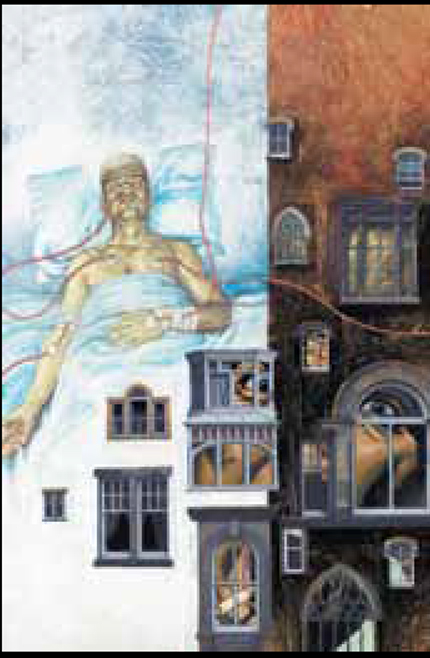
In Tripwire Annual 2007, our contributing writer Robert Cave wrote a celebration of 20 years of John Constantine: Hellblazer so here it is as today’s Throwback Thursday
The 9 Ages of John Constantine
Raising a glass and lighting a fag, Robert Cave celebrates 20 years of Vertigo/DC’s most loveable rogue…
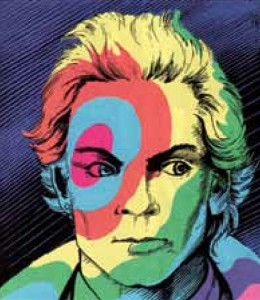 Twenty years. We’re all getting old. Not as old as John Constantine though, well, I’m not anyway. He was nearly thirty-five when he got his own title way back in 1987 and, as he himself observed back then, he was already shot to Hell. A little over five years later, he celebrated his fortieth birthday and in the process he became something of a rarity in the world of comics: a character who appeared to be ageing in real time. By my reckoning that makes John about 55 now and the man has certainly lived an eventful life.
If I were to even attempt to write the seven deadly sins of John Constantine, I’d have set myself a truly Herculean task. Wrath, Lust, Sloth, Pride, Gluttony, Greed, Envy, they’re all constant fixtures in the conman’s life.
Twenty. Same number of fags you get in a packet of Constantine’s trademark Silk Cut, unless you get ‘em from one of those rip-off vending machines you find in pubs and clubs. England’s going non-smoking this summer. Who would have imagined that sci-fi scenario two decades back? Not me, nor Constantine neither.
Twenty years ago. Back then, there was what seemed to be a perennial Tory government that bred disaffection, dissatisfaction and all manner of social ills. Today, New Labour has supplanted the Tories in the political sphere as new perennial party of power while nothing much else has changed. The same is not true for comics. Back in 1987, the whole landscape of the comics’ industry was very different. Comic shops had yet to transform the market places as they did in the 90s, and the majority of DC’s output revolved around muscular men in tights who had colourful adventures within a shared universe.
Created by Northampton habitué and comics legend Alan Moore, during his run on Swamp Thing, the title that helped establish his reputation in the US, Constantine was a seemingly all-knowing foil for the rather slow-witted and unprepossessing swamp monster. As a nod towards his artistic collaborators, John Totleben and Stephen Bissette, apparently fans of the early ‘80s British pop band the Police envisioned him as looking like Sting, the group’s lead singer. More specifically Constantine took on the look of the sharp-suited character Sting played in the seminal British 1979 youth culture film, Quadrophenia.
I never read Swamp Thing when Alan Moore was writing it. My first introduction to the man was through Ennis’s run and Delano’s work. I got the Original Sins collection when I was around sixteen, the age you can start smoking Silk Cut legally. It was also round 1993, the time the Vertigo imprint came into being. So it wasn’t until I was older that I came to Moore’s creation. What struck me most about these tales was how different they were from the later Vertigo tales. For starters it has Constantine in the thick of DC universe continuity, explaining the intricacies of Crisis on Infinite Earths to Swamp Thing. One wonders how the master mage would handle an explanation of Infinite Crisis these days.
As it happens, Constantine was not Moore’s first attempt at a magical horror strip. Before making his way across the pond, Moore was creating the infamous Marvelman (later known as Miracleman) and V for Vendetta strips for the UK anthology comic, Warrior. It was for Warrior that Moore, together with the influential British comics auteur Bryan Talbot, began developing a strip called Nightjar. It was to have been a horror strip, Moore’s first attempt at the genre, and would feature urban magicians. Unfortunately, while the strip was
still gestating Moore and Warrior’s editor/publisher fell out. Without a home, Nightjar was shelved, Moore was headhunted by DC and given Swamp Thing to play with
and it was here that Moore revisited his urban magician concept. The rest, as they say is history.
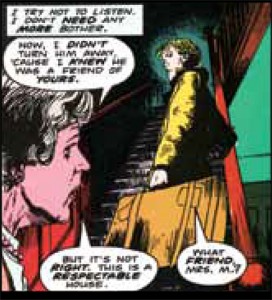 In these modern times, more than a decade on from the establishment of the Vertigo imprint, it seems almost incredible that there was a time when Hellblazer was part of the DC universe. Things changed somewhat when Constantine got his own comic in 1987, penned this time by Jamie Delano, another Northamptonian, hand-picked by Alan Moore to continue writing the incorrigible rogue. Delano’s tenure undoubtedly shaped Constantine’s transformation into a more recognizable shape. Like Moore before him, Delano was an alumnus of the British comics scene, working for Marvel’s UK branch. He was also a leading light of what would later be seen as the post-Moore British invasion of American comics.
Delano moved Constantine to London and fleshed him out, revealing the character to be far less sure of himself than his previous appearances, all bluster and bravado, would have us believe. Using a fog of cigarettes and alcohol to dull his self-created emotional torments, as Papa Midnight observes, “For a man of power, [Constantine] leaves [himself] very vulnerable.”
Delano also fleshed out some of the key formative moments in Constantine’s life – his disastrous attempted exorcism in Newcastle was first chronicled by Delano, as well as the proceeding periods of mental illness and the tainting of John’s blood with that of the demon Nergal. A recurring motif throughout is Constantine’s existence as being only half-magician and the other half conman. Like the old British comedian Tommy Cooper, Constantine is a magician who has made a career of magic tricks that often went wrong, but where Cooper played it for laughs, Constantine is consumed by the horror. Or rather, his friends are. It certainly doesn’t pay to be Constantine’s mate. A growing cast of friends, as well as his lover Emma, have paid the price of John’s recklessness and continue to haunt him as silent reproachful ghosts.
Another key trend of Delano’s, often picked up on by subsequent writers, was a more overtly political slant, tackling the various ills of British society; from racism, football hooliganism and the policies, economic and otherwise, of the Thatcher government.
Following on from Delano, a number of writers, including Neil Gaiman and Grant Morrison, both of whose work would also form part of the bedrock from which the Vertigo imprint was eventually carved, delivered their own interpretations of
the character, but none stayed for a substantial run.
Delano was followed by Northern Irish comics creator, Garth Ennis. Along with Moore and Delano, Ennis has probably had one of the most significant contributions to the Constantine mythos. Ennis established the fall of the archangel Gabriel, a civil war in Hell, and much of the antagonism between Constantine and the First of the Fallen, the most powerful lord of Hell. Ennis’s run saw a notable rise in the visceral violence and horror, men tortured to death, prostitutes viciously beaten and maimed, more torture and a scene that gives new meaning to the phrase, ‘rifle butt’. But perhaps the most lasting legacy of Ennis’s run was in the Dangerous Habits storyline where Constantine’s smoking begins to catch up with him. This storyline went on to provide some plot elements for the 2005 Francis Lawrence film Constantine. The film was poorly received by fans, but that has not prevented talk of a sequel…
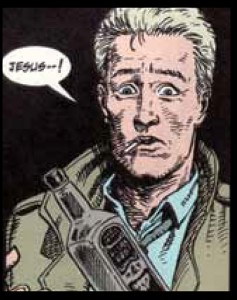
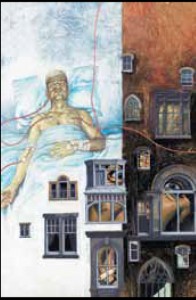 Back to the comic, while Constantine had to face up to the cost of his nicotine addiction, he won’t be dying of cancer anytime soon, but one of the satisfying things about Constantine in general and Ennis’s run in particular is that there is always a price to be paid. Tricking the First of the Fallen into curing him was only ever going to store up troubles for the future. In many ways Ennis’s Constantine was an inveterate gambler in way over his head and whose only way to keep the ever-baying wolves from the door is from an ever-escalating circle of schemes and debts.
After such a successful run, and an impressively nasty encore by Delano, it was time for something completely different: the Scottish-born comics creator Eddie Campbell. Although touted as a regular writer for the title, Campbell’s brief run lasted just four issues of round-the-world trips in the company of a cat demon and the ghost of Sir Francis Dashwood, founder of the original Hellfire club. By his own admission, as a writer Campbell never really felt in synch with his character or the nastiness that plays such a large part in Constantine’s world.
Paul Jenkins, an ex-patriot Yorkshireman, who worked for Mirage Studios, followed Campbell. Jenkins continued the trend for Hellblazer writers to introduce a cast of hitherto unmentioned friends for John to interact with for a span before they are ultimately killed off, though, mercifully, Jenkin’s horror tales tended to feature less visceral violence than some of his predecessors. Did I mention how dangerous it is to be Constantine’s friend? It’s worth saying again.
Jenkins played up Constantine’s past as a punk musician, his relationship with his father and other mythologies, but saw a steady drop in sales throughout his tenure, a situation that is underlined by the fact that, despite its substantial length, none of his run is currently in print.
Warren Ellis was the next major writer to tackle Hellblazer, a job for which he was well suited and, in many fan quarters, much anticipated. Sales increased as soon as he took the helm. Bloody horror and man’s petty inhumanities to man were already a key component in Ellis’s contemporary creator-owned Transmetropolitan, and he soon had Constantine taking a good kicking while on the trail of the killers of another ex-girlfriend.
Ellis’s run on Hellblazer came to a premature end after a little under a year as a result of the controversy surrounding a single issue story dealing with student-on-student shootings in American schools. In the wake of the, then-recent, Colombine massacre there had been an understandable reassessment of editorial policy. There was much discussion on what to do and ultimately Ellis realised that he would be unable to have the creative freedom on Hellblazer that he could enjoy in other areas of his already well-established career and elected to leave the title. The closest thing he got to a parting shot was to create his own loving analogue of Constantine in an issue of Planetary who appears to transform into Ellis’s infamous creation Spider Jerusalem.
After a two issue interlude by the Croatian comic creator, Darko Macan, Brian Azzarello, by then well established for his work on 100 Bullets, became the first American writer to take on Constantine. How would the new writer handle a comic that had become so quintessentially British? Simple, he placed Constantine back in the milieu that Alan Moore had first established him in; he returned Constantine to America and, initially at least, dumped him in prison.
Fan reaction was mixed, while most agreed that he could weave engaging tales of bleak and visceral horror, some felt that Azzarello’s tales were missing something. They just don’t quite agree on what that something might have been.
After Azzarello, Constantine was returned both to the shores of Britain and to the hands of a British writer, Mike Carey, a graduate of Oxford University and former teacher. Where Azzarello’s run somewhat shied away from the use of magic in favour of straighter, more mundane horrors, Carey took the opposite approach, bringing a stronger magical element to his tales, but welding that to some of the cons and violent horror of Ennis and Ellis’s run. He picked up all kinds of dangling plot threads and characters left by previous writers, exploiting them to weave all manner of nastiness of his own design. Throughout his three-year spell at the helm, Carey seldom gave Constantine a moment’s peace, he even managed to spin a single day into three lifetimes.
After Carey, Denise Mina became the first woman to chronicle the life of Constantine. A crime novelist by trade, both of her storylines, Empathy is the Enemy and The Red Right Hand focused on the dangers of empathy and the darkness that lurks in the human heart. They worked for me probably because I was two-thirds the way to the punch-line when I reached the big payoff moment of her final issue, allowing me to feel both flattered for having guessed at least part of what was going to happen and also gratified by an ending that cleverly defeated expectation but remained equally satisfying. For me this is the key to good writing.
Diggle’s run on Hellblazer has just started, but as far as Constantine goes, he’s got form in the shape of the 2002 Lady Constantine series which was well received and led to other writing opportunities, including retooling the obscure DC series The Losers for a new generation. As his run on Hellblazer commenced, Constantine was already getting himself into some deep, cold water and it seems certain that Diggle will have some more nastiness in store.
While the circulation figures on the title remain stable, Hellblazer is not currently setting any sales records. However, it should probably be remembered that Hellblazer, like Constantine himself is a survivor. It alone is the sole title to have been continuously published since the advent of the Vertigo. It has outlasted the other pre-Vertigo Berger books and even Swamp Thing, the comic that gave us the character in the first place. If history has taught us anything about Constantine, and with so many talented creators keen to take a stab at the old bastard, it’s that it is as unwise to bet against him as it is to be his friend. Twenty years has gone by, but he looks set to be with us for some time to come.
ROBERT CAVE
Hellblazer TP Vol 01 Original Sins New Ed (John Constantine, Hellblazer) Hellblazer TP Vol 02 The Devil You Know New Ed (Hellblazer (Graphic Novels))
 Hellblazer TP Vol 03 The Fear Machine New Ed (John Constantine, Hellblazer)










You must be logged in to post a comment Login