

Feature
Are Superhero Comics Dead?

And Are You Digging Their Grave?
♦ Peter Mann wonders about economic viability and the long-term dive into irrelevance…

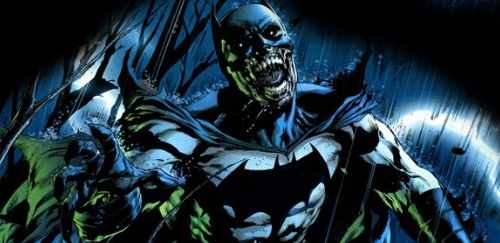
Remember this guy?
Yes, you read that right. Not “will they soon be dead?” But are they dead already for all intents and purposes?
So, what’s brought me to this conclusion? I think it was either DC Comics Rebirth or Marvel’s Civil War II. I had an inkling during Secret Wars II, about the time the final issue took forever to come out, and I decided I didn’t really give a f***. Now, I don’t want us to get off to a bad start, so I’m gonna make this simple: I’m not a man it’s difficult to entertain. I like lots of dumb stuff. But there’s a point where people are slapping you in the face and laughing at you with the dumb stuff that they do. And I realised, about the time I read Rebirth, that that was what was happening to me. I was being rooked and mocked at the same time. That’s an uncomfortable feeling for anyone.
Okay, a bit of history. In the 1960s Superman was selling the thick end of 1 million copies – around 800,000 actually. There was a decline through the 1970s, and the steepness of the decline is almost exactly the reverse of the growth of the direct market. In simple terms, as comics disappeared off newsstands and from newsagents, their sales declined and their price increased. This is what is known as a zero-sum game – a situation in which each participant’s gain (or loss) of utility is exactly balanced by the losses (or gains) of the utility of the other participant(s). Thanks, Wikipedia! As comics became less available, they became more expensive, and therefore less and less attractive to their original audience. The new audience for comics was older than the original audience. The original assumption of comics publishers was that their audience replaced themselves every so many years. In other words, the Janets and Johns read comics until they were about 12, and then they started to read books, or girlie magazines, or the backs of milk cartons. What they didn’t do was carry on reading comics forever. This led to a distinct split in the audience for comic books. Some of the audience for comic books were people like Mike Barrier, or Bill Spicer, or Gary Groth. These people admired comics from the point of view of popular culture, and could see the value in the imagination of people like George Herriman, Jack Kirby, and Milt Caniff, as well as the artisanship, sometimes extending into the realms of fine art, from people like Winsor McKay. They also saw the possibilities in comics for adults, often from looking at European and underground comics. What they did not foresee, was the possibility that superhero comics, generally understood to be wish fulfilment for small children, would be perverted by the needs of an ageing audience who wanted to overlay their adult interests on these childish fantasy figures.
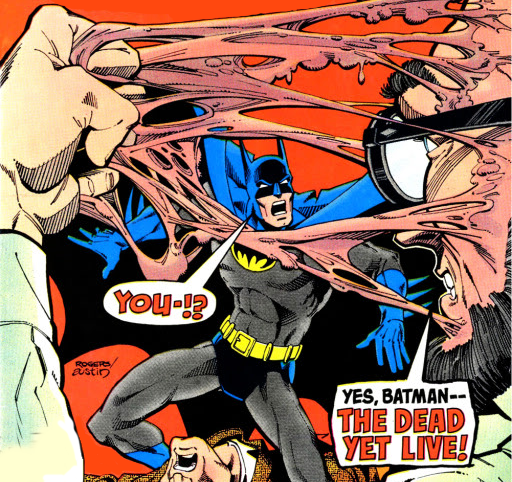
This guy used to be a detective. Now he’s very sad and fights serial killers.
The point at which this actually happened was the 1980s. The two mammoth events are the publication of The Dark Knight Returns, and Watchmen. Neither of these, I believe, were intended to create the revolution they did. Dark Knight Returns gives us a non-canon future Batman, and I would be really spinning my wheels if I described the content, as it’s familiar to nearly every comic fan in the world. What’s less well understood, I believe, is that it was meant to be a satire. The primary influence on Dark Knight Returns, an influence that can be seen on every page from the lettering, to the constant commentary on events from televised pundits, is American Flagg, Howard Chaykin’s dystopian vision of the future, published by First Comics from 1983 onwards. Dark Knight Returns is like Chaykin’s work, a dystopian vision of the future: unfortunately, this time, it’s DC Comics future. Ronin, Miller’s first work for DC comics, had not sold as well as perhaps they believed it would, based on his work on Daredevil. In that context, Batman by Miller is an easy sale. To be fair to Miller, he did better than anyone could have reasonably expected, making millions for DC comics, and set the tone for Batman material for the next 30 years. From now on Batman would have no quirky aspects, little detection would take place, villains would not be amusing, but frightening. And so they started the process of turning children’s characters into a parade of monsters and serial killers.
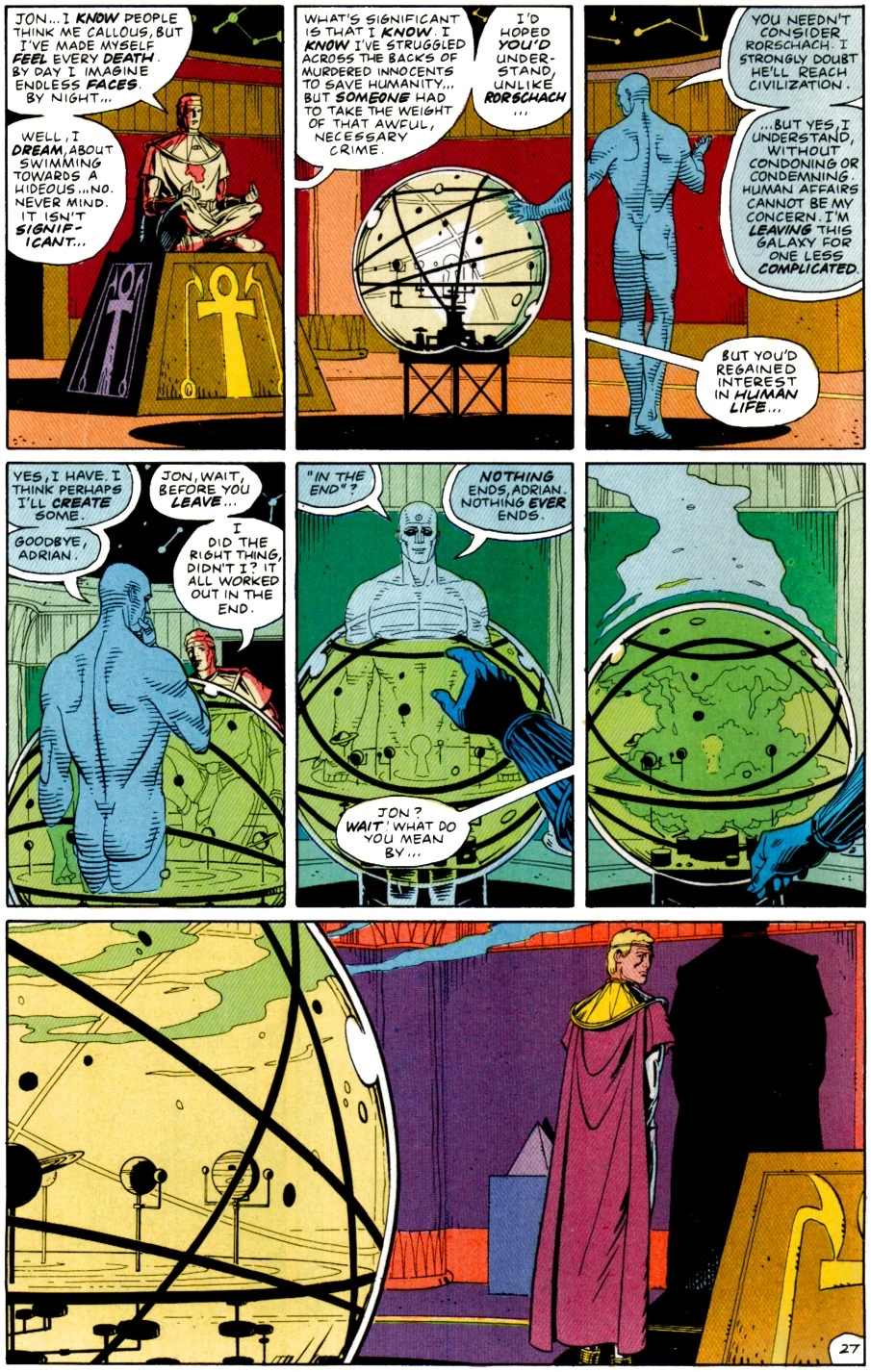
Watchmen – before
Watchmen was also a dystopian reality, but in this case, it was a reality parallel to our own. In the world of Watchmen, something like our own reality had unfolded, but this time with superheroes. Based on a proposal by Alan Moore to DC Comics featuring superhero characters that the company had acquired from Charlton Comics – characters such as Captain Atom, Blue Beetle, and The Question. DC refused Moore’s request – there was still valuable intellectual property in the characters, and Moore’s proposal would have left them unusable. Thus Moore and Dave Gibbons created analogues of each of the characters – Captain Atom became Doctor Manhattan, The Blue Beetle, Nite Owl, and The Question became Rorschach. Again, I’m not going to rehearse again either the plot, or the many, many, arguments about ownership of the Watchmen characters. Moore’s approach on Watchmen dovetailed unfortunately with Miller’s on The Dark Knight. Moore’s central conceit had always been to apply the maxim “what if this was real” to the comics he wrote. As a thought experiment, this becomes tedious very quickly. In Watchmen, through a fusion of ideas borrowed from Kurt Vonnegut Junior, EC Comics, The Outer Limits, and Ayn Rand, among others, he created a graphic novel that “adults” took seriously. Very seriously. Part of the reason this worked so well is the incredible artwork by Dave Gibbons, and colouring by John Higgins. For the first time in a long time an American comic rivalled European comics in storytelling, and in graphic sophistication and minimalism. The book had a massive impact on American comics, with many of Moore’s ideas being picked up by writers who were lazier, less well read, and in the last analysis, less talented than him.
The problem with both of these books is that they did not draw a new audience to comics in the long-term. Anyone who wandered into comics on the back of The Dark Knight, or Watchmen, would have soon been put off by the generally abysmal level of writing and art in comics at the time. Remember it’s not long after this that Todd McFarlane’s Spider-man sold around 3 million copies, ushering in the use of promotional gimmicks to draw in those who had been excited by the investment opportunities. In fact in the late 1980s and 1990s most mainstream superhero comics were comprehensively awful, most of the 90s being down to the same people who now occupy positions of power in DC Comics. To put it in context, by 1987 Superman was selling 162,000 copies. And that was after a decade of fairly successful films based on the character.
So, what’s happened since?
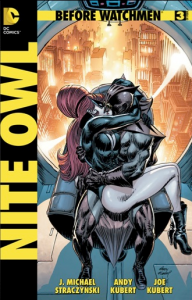
…and after (although Before, if you see what I mean)?
Well, the independent market expanded quite considerably and sells around 30% of the comics out there, but few superheroes. Marvel and DC split the rest of a continually declining market. Digital comics may have provided some hope, but they seem to sell to the people who generally bought the floppies. And now we have the 90s back again.
At this point, we have superhero comic books that are selling for between $2.99 and $4.99, with the occasional upwards peak for special editions. A comic takes you about five minutes to read. 10 minutes if you’re challenged. And on TV you can get Flash, Green Arrow, Supergirl, Daredevil… Well, you get the picture. The value proposition that comics once had – 10 or 12 cents for a reasonable amount of entertainment has gone. Not only that, comics are in the hands of people like Dan Didio:
Paul Pope: “[my] Batman did pretty well, so I sat down with the head of DC Comics. I really wanted to do ‘Kamandi [The Last Boy on Earth]’, this Jack Kirby character. I had this great pitch… and he said ‘You think this is gonna be for kids? Stop, stop. We don’t publish comics for kids. We publish comics for 45-year olds. If you want to do comics for kids, you can do Scooby-Doo. And I thought, ‘I guess we just broke up.’”
To be blunt, if either of my children brought home some of the comics that I see now from the major two publishers, I’d be disturbed. And I’m a very liberal parent. So now we bring ourselves right up-to-date. Superman sells around 40,000 copies maximum except for special events, and over 10 years sales have declined by 48%. Most of the superhero comics being published today would have been cancelled in the 1970s or 80s. This leaves comics as an incubator for Hollywood and TV. But the problem is: what are they incubating? Most of the movies and TV shows are from comics published long, long ago. And the ones that aren’t, are a) not superhero based and b) from independent publishers. Talents such as Matt Fraction have taken their bat and ball away to independents who follow a more traditional publishing model – where the creators get a share of the profits, and participation in movie and TV deals. A lot of the movies that are making money owe their existence to creators such as Bob Kane and Jack Kirby, who are now dead. If you had to mention a superhero of note who was invented in the last 20 years, you’d probably come up with Deadpool.
So here we are. The people who trashed DC comics legacy in the New 52, the high point of which was Geoff Johns paean to necrophilia, Blackest Night, based on an idea by Alan Moore, the most startling element of which was to bring us other coloured Lanterns, are now going to restore that legacy. From examining the first issues they appear to be doing it by a) restoring many of their titles to the same poor quality they were in the 1980s and b) flogging the nearly-dead and whimpering corpse of Frank Miller’s Dark Knight.
Meanwhile, at Marvel, a corporately inspired attempt to replace beloved characters such as the Fantastic Four and the X-Men with the Inhumans, a group who have literally no public recognition at all at the moment, has led us to Civil War II, and the forthcoming Divided We Fall. Marvel now does not have gaps between events – it’s all just one big ongoing event of supreme crappiness. I’m not going to comment on the storyline, suffice it to say it reaches a risible level, that shows that Marvel still has the power to surprise you, but not in a good way. My conclusion is the only people buying this stuff are Dan Didio’s 45-year-olds, along with a few older people, and a vanishingly small number of younger people who have somehow been hooked into this nonsense. Like young trainspotters, if you know what I mean. At both companies everything is about market share, whether it’s DC looting Watchmen badly for the second time, or Marvel giving us die-cut covers and a regular diet of death, it doesn’t matter. Star Wars tie-ins, whatever. I talked about this to a friend recently, and they suggested to me that I was criticising comics simply because I’ve gotten older, and comics hadn’t. In fact, it seems to be the opposite: I find it easy to enjoy comics from the independent publishers, from European publishers, I even like the Adventure Time type kids comics that are around. What I can’t stand is comics that want to have it both ways. They want to be grittily realistic but have a man dressed as a bat at the same time. If you want a violent thriller, pick up a book, goddamnit. There’s lots of them. They’re smaller and thicker than comics and have fewer pictures. Imagine doing this in any other field of endeavour. I have no doubt that there are people out there who would like it. But the problem is that it would drive away the original audience. And that is what has happened with superhero comics. The audience has dwindled, the prices have gone up, and the product is dreadful.
The prognosis is not good. I think they’re dead, Jim.











TR
June 16, 2019 at 1:20 pm
Hard to argue with any of this, except to say that Watchmen was written and drawn by two Europeans.