


Graphic Novel Review
The ‘Clear Line’ of Blake & Mortimer: Plutarch’s Staff


Plutarch’s Staff written by Yves Sente, drawn by André Juillard and Étienne Schréder, colour by Madeleine de Mille, Cinebook £8.99/$15.95
Peter Mann reviews a prequel to the long-running Blake & Mortimer series from Cinebook, and provides a little history for the newcomer.
 Plutarch’s Staff (Le Bâton de Plutarque) is the 23rd adventure in the Blake and Mortimer series, originally published daily in Le Soir (a French language daily newspaper in Belgium), and the French newspaper Le Télégramme. Blake and Mortimer, for those of you don’t know, is a series created by Belgian writer and artist Edgar P Jacobs, centring on Captain Francis Blake of the British Intelligence Service, and his physicist friend Professor Philip Mortimer. Blake and Mortimer combines detection and science fiction in equal measures varying from time travel to espionage with equal ease.
The series started in 1946 and continues on to the present day. Jacobs died in 1987 and his final story, (Professor Sató’s Three Formulae, Volume 2: Mortimer vs. Mortimer) was finished by Bob de Moor, and finally published in 1990. Since the demise of Jacobs Blake and Mortimer has had a somewhat rocky publication history. Jacobs “clear line” style and combination of action/adventure and science fiction seemed to be more difficult to duplicate than perhaps might have been thought. The first post-Jacobs Blake and Mortimer, The Frances Blake Affair (1996), by Jean Van Hamme and “clear line” specialist draughtsman Ted Benoit, aroused the ire of purists due to both Van Hamme’s plotting and the dearth of science fiction elements in the story. The book was a success overall, but by the time publisher Dargaud decided to continue the series Van Hamme and Benoit were tied up elsewhere. This led to writer Yves Sente and artist André Juillard being bought in for The Voronov Plot (1998). Since then the two teams, with occasional substitutions, have been principally responsible for Blake and Mortimer.
Yves Sente and artist André Juillard are behind the current book, with the plot set in 1944, England still struggling against the Nazi threat. This is a continuity insert into Blake and Mortimer’s story so far, as to be fair, are many of the books. The previous book but one (The Oath of the Five Lords) was set in 1919 and 1954, and the previous book (The Septimus Wave) was a direct sequel to Edgar Jacobs’ The Yellow M, first published in 1956. Equally oddly, the book that follows this is The Secret of the Swordfish, the first Blake and Mortimer book. “When we reread [The Secret of the Swordfish], we noticed some strange things,” Sente told Agence France-Presse. “For example, when Blake and Mortimer and Olrik see each other for the first time, they know each other. How is that possible if they have never seen each other before. But there is no explanation anywhere. “So we had fun, as much in creating a story which we hope is exciting, and asking all the questions left hanging.”
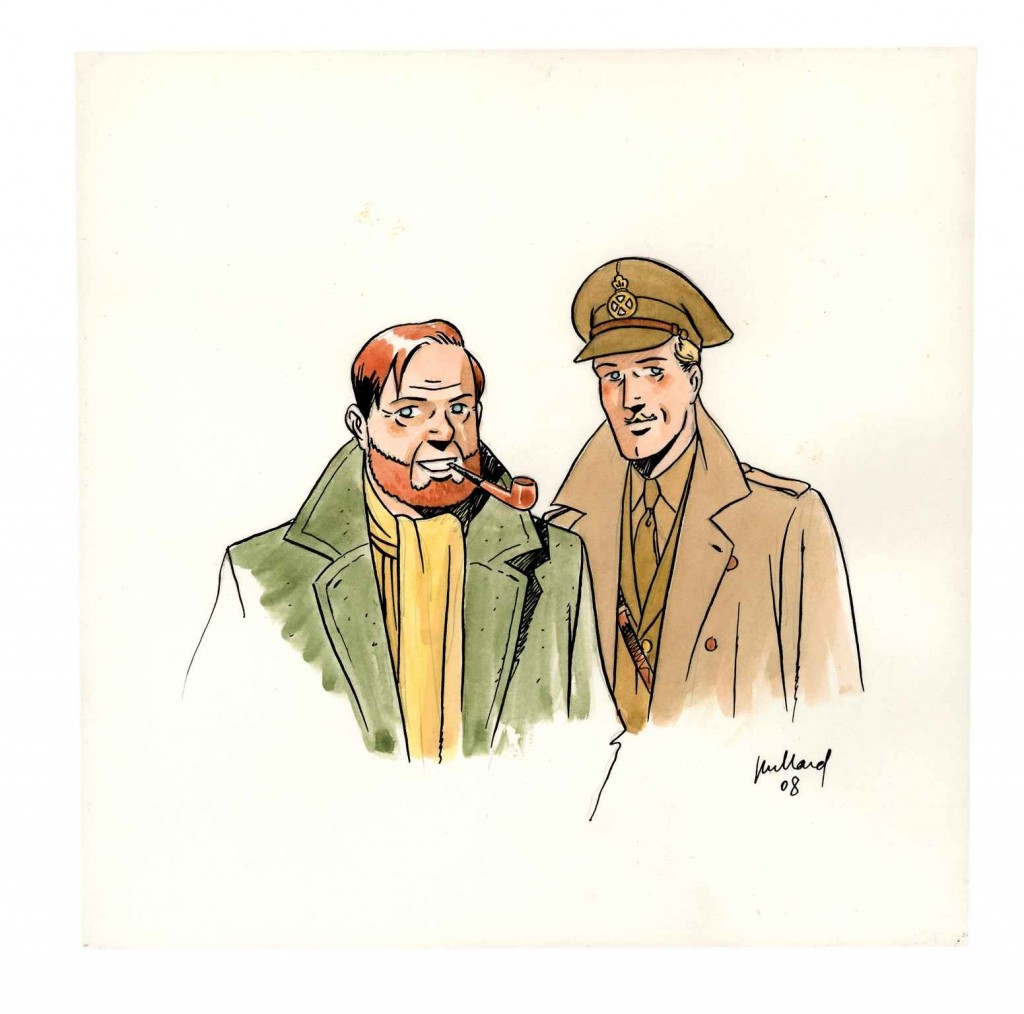 “We weren’t going to change their personalities, we did everything we could to keep them the same,” added Juillard. When seeking inspiration for the prequel Sente and Juillard went back to the mini-biographies of the main characters, written by Jacobs himself. A chance visit to Winston Churchill’s War Rooms in London decided them on setting the adventure in spring 1944, just before the D-Day
The plot is typical Blake and Mortimer material: England’s struggle against the Nazis masks a new threat from the East that brings Squadron Leader Blake, fresh from saving London, to a top secret mission. Blake meets an old friend he hasn’t seen since India, Philip Mortimer, and together they work to defeat the threat. The staff of the title is a Scytale, an ancient encryption device that works to perform a transposition cipher, used by the Greeks of antiquity to communicate during military campaigns. Colonel Olrik, Blake and Mortimer’s eternal antagonist is here an officer working for Allied intelligence. Blake and Mortimer do not yet know Olrik, so the story acts to introduce our heroes to their perpetual enemy (as a “Slavic languages expert,” no less) as well as explaining how they can afford their Park Lane apartment.
The writing is difficult to judge: the dialogue seems to be a little wooden, even for Englishmen of the 1940s, but it’s hard to know whether this is due to Sente’s original dialogue, or the vagaries of translation. I will say that a lack of  convincing colloquial English dialogue is a feature of Cinebook publications, and having a native English speaker edit the translation might result in a smoother transition.
To my eyes artist André Juillard is a little antiseptic for the series. He certainly captures the “clear line” quality of Jacobs’ work, but what he doesn’t capture is Jacobs’ sense of movement, something that is especially lacking in the action sequences. Having said that, Juilliard’s drawing style captures the aesthetic and mood of the series perfectly. I’d just like it to be a little livelier.
To sum up then, if you like Blake and Mortimer already you’ll probably love this. If you’ve never read any Blake and Mortimer before, Plutarch’s Staff, having effectively appointed itself the first in the series, might well be a very good place to start. Also, compare and contrast: Plutarch’s Staff is £8.99 or $15.95 for 62 pages of oversized, beautifully coloured, distinctly compressed storytelling, in a beautiful trade paperback package. I don’t know what that will buy you in American comic books these days, but if you haven’t tried European comics I think the exchange rate isn’t too terrible.
Peter Mann
The Clear Line School
Ligne claire (French for “clear line”) is a style of drawing pioneered by Hergé, the Belgian creator of The Adventures of Tintin. The style uses clear strong lines of the same width with no cross-hatching. Contrast is downplayed and cast shadows are either black or a single colour. The style uses strong colours, and often cartoonish characters are portrayed against a realistic background. The combination of these elements results in a flat, design-focused quality for the strips drawn in this way. The name was coined by Joost Swarte in 1977. Adapted from Wikipedia
The Adventures of Blake and Mortimer
For all things Blake & Mortimer, go to http://blake-and-mortimer-so-british.over-blog.com/
[amazon asin=1849182647&template=iframe image]
[amazon asin=190546021X&template=iframe image][amazon asin=1905460376&template=iframe image][amazon asin=1905460384&template=iframe image][amazon asin=1905460635&template=iframe image] [amazon asin=1905460759&template=iframe image]
[amazon asin=190546097X&template=iframe image][amazon asin=1849180377&template=iframe image][amazon asin=1849180482&template=iframe image][amazon asin=1849180679&template=iframe image][amazon asin=1849180776&template=iframe image]
[amazon asin=1849180946&template=iframe image][amazon asin=1849181071&template=iframe image] [amazon asin=184918125X&template=iframe image][amazon asin=1849181306&template=iframe image][amazon asin=1849181489&template=iframe image]
[amazon asin=1849181616&template=iframe image] [amazon asin=1849181748&template=iframe image][amazon asin=1849181918&template=iframe image][amazon asin=1849182140&template=iframe image][amazon asin=1849182426&template=iframe image]








Kermit
May 11, 2016 at 9:52 am
Why you lik this blog?
This blog have a news only when Dargaud write something in twitter or facebook.
admin
May 20, 2016 at 2:43 pm
Well, Kermit, you are a muppet!