

Interview
Throwback Thursday: Mike Carey

Turning Japanese
Back in 2007, we interviewed Mike Carey, who went on to carve a niche for himself thanks to his runs on X-Men, Lucifer, Hellblazer and a series of novels including The Girl With All The Gifts, which is being made into a film out next year. So from Tripwire Annual 2007, here’s Turning Japanese…

Mike Carey photo©2007 Joel Meadows
We meet in the ordinary North London suburban surroundings of North Finchley, a halfway point between where both of us live. Mike Carey is dressed in a black leather jacket, T-shirt and jeans and we make our way to the obligatory Starbucks in the London winter weather. We get settled and begin our interview.
Carey has only been a fulltime writer since 2000: before that, he was a teacher. But in those seven years, he’s achieved a great deal: after a false start at Caliber in the 1990s, his break came at Vertigo with the three part Sandman Presents: Lucifer series, which led to an ongoing series with the character. Sipping his coffee, the writer seems to be happy with his current position: “On the whole it’s still great but there are times when it gets a bit fraught like last year,” he admits slightly nervously. “I took on too many projects and just about kept abreast of them, so by the time it got to the end of the year, I was really tired. But by and large I love the freedom. I love what I’m doing and I count my blessings regularly.”
2006 saw Carey make the leap from the comic page to the novel with the publication of his first two novels, The Devil You Know and Vicious Circle. Featuring freelance exorcist Felix Castor (John Constantine with better social skills), the switch to prose is something that the writer is very pleased with.
“It felt very good and it was always something I wanted to do. I was writing uncommissioned novels before I ever wrote a comic script, so it was a longstanding ambition. In a weird way, it established my credentials with my friends and family because there’s a lot of people I know who don’t regard writing for comics as proper writing, so suddenly they’re saying to me: ‘Oh my God, you’re a novelist!’”
Published by Time Warner’s Orbit publishers in the UK, Carey had pitched a novel to Orbit’s Earthlight imprint, which had been accepted, and had struck up a relationship with its editor Darren Nash. Unfortunately the imprint had been cancelled but, it turned out, Nash was a big comics fan which kept the door open for Carey at Orbit as he recalls: “We used to regularly meet up, have a meal or drink and talk comics. In one of those conversations, I was talking about Hellblazer while he was talking about Anita Blake by Laurel Hamilton and we both agreed how cool it would be if there was a UK equivalent.
If there was a book that used the dark fantasy palette of Hellblazer, in that sort of supernatural crime milieu, we both thought that might work. So I pitched Castor as a result of that conversation. The book had a character with noirish overtones: Castor is an exorcist but he’s a gumshoe exorcist. He acts and dresses in many ways like a Raymond Chandler protagonist. So it would be a story that would straddle supernatural and crime fiction in that sort of way.”
So he pitched a detailed breakdown for the first book and more general outlines for the second and third books. Castor has done very well, so well in fact that, with the first three titles out, the publisher has agreed on another two. He’s also being sent on a massive US book signing tour this year to promote the books in the States.
The Castor books are set in London and sometimes it seems as if research can hijack a writer’s schedule but, for Carey, the research is all part of the fun and something that never pushes him off course.
“For me, the research is part of the fun and so I don’t even try to resist the temptation of using places I like to visit,” he tells me between a bite of sandwich. “I write Castor in very much the same way that I wrote Constantine. Largely I write him as me, I give him my back story and my stamping grounds.”
Also, the tight deadline imposed on him for the first Castor books meant that he didn’t have the luxury to go off on a tangent with his research, which emphasises his focus as a writer.
“I didn’t have to make a conscious effort to rein myself in because I had such little time and limits were imposed on me.”
But he does have a theory about the role of research in writing, which he shares with me: “Within that though, there are two kinds of settings or elements that you bring into your story. There are some that are purely incidental, they’re there to establish a mood and then there are others that are essential, like the archive in the first book. That is based heavily on a real archive, which I visited, and I decided that I would use it because it was cool and there were so many things you could do with it in the story. My approach with research is to take as much as is necessary to move the story forward.”
Crossing Midnight art by Jim Fern
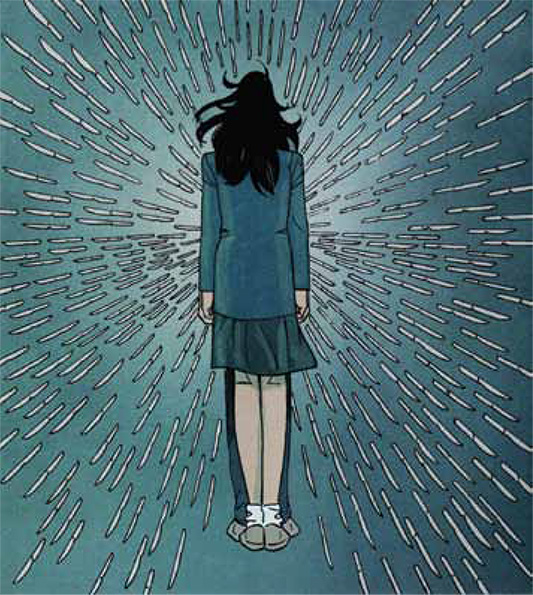
But he hasn’t abandoned comics. Far from it, as Carey writes ongoing series Crossing Midnight for DC’s Vertigo imprint. The genesis of the title lies in material that the writer enjoys watching and reading, as he tells me: “A lot of the influences on it are Japanese cinema and Japanese comic books. I’ve been reading Hideshi Hino, the guy who did Uzamaki, and Junji Ito and I was struck by the fact that these were genuinely terrifying and genuinely disturbing comics. It’s relatively rare in the Western market to have horror comics that are really frightening. Alan Moore famously did it with Swamp Thing and I think Neil Gaiman does it with some of the one-offs in Sandman.”
When he began planning Crossing Midnight, he had very definite ideas for it.
“I wanted a book that would play with some of the more interesting aspects of Japanese folklore rather than Japanese religion. The cultural stuff that we’re talking about is not to do with Shinto, it’s folk beliefs that go back centuries,” he argues. “Because there is this fascinating idea that everything is inhabited and everything has a spirit but also there’s this idea that there are thousands of different kinds of supernatural beings who live with us and are around us all the time.”
It’s obvious that the writer has gone into a lot of detail with his research on the series and he tells me that the title contains clues to the direction it’s going to take: “Crossing Midnight: crossing implies transition and it is a coming-of-age story but it’s also a crossing between the mundane and the fabulous worlds. Also a crossing is a journey and a quest and so it’s going to play out with one of the twins going in search of the other. It’s also about a journey of redemption and self-sacrifice. So it does have a lot of mythological underpinnings.”

My Faith in Frankie art by Sonny Liew and Marc Hempel
Carey has also written two books for DC’s newest imprint, Minx, which is aimed at teenage girls. The first title, Regifters, reunites Mike with the team responsible for 2004’s My Faith In Frankie: Sonny Liew and Marc Hempel. He seems genuinely excited that he got to work with them again, as he explains over another cup of tea: “It was great getting that team together again because the chemistry worked so well with Frankie, so the chance to go back for another pass was irresistible and, I think that, if anything, Regifters is a stronger story than Frankie. It’s a different proposition in that there’s no fantasy elements in it whatsoever, in fact it’s all very much set in the real world.”
Carey has decided to set Regifters in Koreatown in Los Angeles and his central protagonist is a Korean-American girl nicknamed Dixie, who is a Haikkido student. But here he gets to explore a different sort of world to that in Crossing Midnight.
“Haikkido is a big cultural thing in Korea because when the country was occupied by Japan, they weren’t allowed to practice it and so it’s a part of their cultural identity. Dixie wants to go in for this nationwide tournament which costs $100 to enter but she has found another use for that money. But there are free places to be won, so she convinces herself that she can win one of these free places. It’s a martial arts rom com. It was planned as a graphic novel from the start, 144 pages, so it’s a bigger canvas than the 88 pages we had for Frankie.”
The second title that Mike is penning for Minx is Confessions of A Blabbermouth and this time he’s not on his own: his daughter Lou has co-written the book with him.
“The blabbermouth in question is a teenage girl again but this time it’s set in London rather than America,” he says. “Tasha lives alone with her mother and her mother has been bringing home a succession of unsuitable boyfriends. Tasha runs a blog and calls herself a blabbermouth because she keeps no secrets. So one day her mother brings home this guy called Jem. He has a daughter of his own from his first marriage and he wants to be a strong father to Tasha. He reckons that her life is directionless and what she needs is somebody to come in and be the force of order in her life. They don’t hit it off at all and then Tasha meets his daughter, who she doesn’t like either. The daughter is very emotionally unavailable and very prissy but she’s going to Tasha’s school, so that forces them into contact with each other.”
But there is something else going on here, as Carey is at pains to point out. He reveals that Tasha believes her mother’s boyfriend is hiding a dark secret but obviously won’t tell us any more.
He collaborated quite equally with his daughter on this project and is happy to give us a glimpse of the way they worked. Taking a break to grab another tea, he continues: “We plotted it together. We came up with a beat sheet that was very long and detailed. As a 144 page book, we broke it up into a notional 40 scenes and then we horse traded,” he tells me with a smile on his lips.
“Each of us put marks next to the scenes that we most wanted to write and the scenes that we both chose, we horse traded. I would then say to Lou: ‘You can do this bit if I do this bit.’”
But Carey’s experience meant that this system wasn’t going to work.
“When we got started, inevitably because I’ve written 200 comic strips and Lou hadn’t written any, I was much faster than her. So by the time we got a third of the way through, only 17 scenes were written by Lou. So she reined me in and said to me: ‘This isn’t going to work. I’m not going to be the junior partner.’ So we discussed it and came up with another dynamic that worked. So in the end it is a fifty-fifty split because she wouldn’t accept anything less. She didn’t want to have her name on the book just as a courtesy. It hasn’t been easy but it has been very rewarding.”
In fact, Carey admits that he has never “co-written in such an intimate block by block way before. Usually when I’ve co-written in the past, one of us would take turns to script and one to dialogue, but this was really organic which has its strengths and, from the point of view of the process, its weaknesses. But the result was worthwhile.”
But’s it not only Vertigo that Carey is working for in the comics industry. He is also the regular writer on Marvel’s X-Men and this is a longheld ambition, he is unashamed to tell me:
“As with the novels, it was always something I’d wanted to do. I grew up with superhero stories. I don’t have any contempt for superheroes and I love them if they’re done well.”
 He has used Grant Morrison’s run on the team as a template for the way he’s approached tackling Marvel’s biggest superhero franchise.
“He set up some new and very radical situations and scenarios but rather than deconstruct everything, he takes the logic of the core ideas and takes them further than anyone before him had done. He was one of the inspirations for what I’m trying to do in the book.”
But the thirty years of history embedded in the characters was something that did concern him initially. But he managed to approach this in a way that would work for him:
“I was worried about the continuity, because I am an X-Men fan and I have read a lot of X-Men comics over the last quarter of a century. But when I say I’ve read a lot, I mean three or four hundred books whereas in fact there are three or four thousand X-Men comics that have been published. So I had enormous gaps in the continuity. So my first thought when Marvel offered it to me, when I realised that it wasn’t a joke, was: ‘I want to do it but can I do it? Can I actually get to the point where I am sufficiently in command of continuity that I don’t screw up every opportunity?’ So I said yes with trepidation but what I hadn’t realised, and what I’ve realised since, is that there are levels of continuity. You need to be in command of everything that’s happened in the last two years but the stuff that’s further back is less relevant.”
Carey sees X-Men as being like a soap opera but he doesn’t seem to feel limited by the restrictions of the title and the fact that you can never bring things to a total conclusion with an ongoing series: “It’s not frustrating as a writer because it’s the logic of all continuing narratives. Just look at Hellblazer: what if he was to give up smoking, get an allotment and grow vegetables? I think it’s an interesting time to be writing the X-Men because, in many ways, House of M took them back to the situation they were in during the Sixties. They’d reached a point where there were thousands of mutants and there were Omega mutants around every corner. You really did feel that the beleaguered minority were homo sapiens!”
Mike’s adjectiveless X-Men title has two regular artists on it (Chris Bachalo and Humberto Ramos) but he has only just reached the point where he is beginning to tailor his scripts to the strengths of each of them, as he informs me: “At the start, we were just working out the basics of a relationship. They are very different artists and there is a problem for some readers in making the transition from one to the other.”
But he is hopeful that Marvel won’t be changing art teams during a single story arc, so that does provide some visual consistency.
The writer is on the book as long as he can “keep delivering the goods.” But X-Men isn’t the only high-profile superhero book that he’s writing: he also pens Ultimate Fantastic Four for Marvel. For him when he was offered the book, it was just too good to pass up:
“It was a chance to go back to those Lee / Kirby stories, pay some serious homage and just play with those ideas and those characters,” he says with a smile on his face.
His love of the FF boils down to the fact that they are a contrast dramatically to the deviance of the X-Men: “I love the dynamic of the relationships in the Fantastic Four, I love their closeness. Wolverine and the X-Men are a tribe whereas the FF are very much a family.”
Carey isn’t just working for Marvel and DC either. He was offered Voodoo Child: Enigma, a six part series for Virgin Comics’ new Voices line. Created by Nicolas Cage and his son Wes, he got talking with the company through his relationship with their commissioning editor, Mackenzie Cadenhead, who just happened to be someone who had edited him at Marvel.
“Nic and Wes came up with this idea for a supernatural character, whose story would play out against the 19th century abolitionist history of Louisiana and the modern post-Katrina history of New Orleans. So Mackenzie showed me their pitch and it pushed all my buttons.”
Supernatural is something that Carey is obviously comfortable with (just look at his CV: Hellblazer, Castor, Lucifer) but it was also the historical elements of the series that he found intrigued him: “It’s supernatural but it’s rooted in the history of the US in the most interesting period of that history, the run-up to the Civil War. The period when the South is afraid that Lincoln is going to bring in an abolitionist bill and so they start breaking up the Union. It also brings in these horrific and poignant events in New Orleans over the last couple of years. It’s not so much a case of drawing parallels, but it’s harking back to that period and it’s looking at the present day through the prism of the past in a way that I think works really well. So you have a supernatural story with really sharp political overtones and with a realist dimension that I think will make it a neat book with a unique flavour.”
In fact, Carey’s become a dab hand at taking other people’s creations and investing them with a flavour of his own (just look at the list before) and so he was a natural choice for Voodoo Child. He even visited New Orleans to get a better handle on what was needed from him as a writer:
“I did do a lot of research. Nic and Wes had a very fully realised idea for the main character and the historical context from which the main character springs. When I was over in New Orleans, I put flesh on those bones to immerse myself in the cultural context which is obviously one remove for me being British. I also started making the connections between the past and the present of Louisiana, its vibrancy and its immediacy.”
It also gave him the opportunity to comment on the US political situation, his last chance before a change in government next year.
The outsider’s perspective is something that he finds satisfying to play with too: “The beauty of this creative model in Virgin Voices is that you get both the insider and the outsider view: you get Nic and Wes’s take on this situation and you get mine too.”
In fact, the writer’s place in the comic pecking order has changed dramatically since 2005 and he is grateful for this change in stature, he readily admits as we wrap up our chat:
“I am in a position I wouldn’t have imagined when I gave up teaching back in 2000.
The last two years have been pivotal. It is surprising to look back and see where I was even as recently as two years ago,when things were working out financially but security was a long way off. I’m very happy with where I am and what I’m doing.”
With a third Castor book out this summer, and a fourth a done deal, plus his continuing comic work and a film script (Frost Flowers, which may or may not see the light of day), it’s not surprising that he is pleased with his current position.
We part company, leaving the comfortable suburban surroundings of North Finchley, while Carey heads off to tackle his huge workload. Many writers get carried away with their own importance but he has remained very grounded. Perhaps that’s why he’s so in demand.
The Devil You Know: A Felix Castor Novel, vol 1 Lucifer Book One TP













You must be logged in to post a comment Login