

Feature
Throwback Thursday #9: Martin Asbury from Tripwire Annual 2008


With everyone getting excited about the trailer for Spectre, we thought we would kick off our Throwback Thursday with an interview we did with storyboard artist Martin Asbury, no stranger to James Bond, taken from Tripwire Annual 2008…
MARTIN ASBURY is one of the UK’s premier storyboard artists with a film career spanning 25 years. TRIPWIRE caught up with him to talk Tarzan, James Bond and how the industry has changed in a quarter of a century
Storyboard artists play a key role in moviemaking but they rarely get their due. Without their input, many of the greatest action sequences in modern cinema would have been impossible to plan and shoot. So we thought that, as part of TRIPWIRE’s remit to look at the work of people who are key in their industry but don’t receive the recognition they deserve, Martin Asbury’s name came up. Starting life as a newspaper strip cartoonist in England on Garth, he has moved on to become one of the UK’s most pre-eminent movie storyboard artists. So I contacted Martin and we arranged for a chat a few days later.
When we spoke, he recalls the almost arbitrary way he started his career in cinema: “I was a strip cartoonist and I was doing odd storyboards for TV commercials. I’d been approached by a guy who thought he was an agent for artists who could do storyboard work,” he told me. He sipped his tea and then continued: “I did a few of those then a friend of mine called Dez Skinn was renting an office in Wardour Street where he tried to represent freelance illustrators and, just as luck would have it, a man came in off the street and asked if we had any storyboard artists on the books. I think I was the only one Dez knew at the time who did storyboards and he told the man I also did Garth at the Daily Mirror, so the guy said he wanted to meet me. So I met the man who happened to be Stuart Craig, quite a well-known production designer and that job turned out to be Greystoke. Then I met [director] Hugh Hudson and the rest is history really.”
Asbury had dabbled in storyboards before Greystoke but only for commercials and the prospect of working as a movie storyboard artist was an enticing one for him:
“It was very exciting because it was a new departure for me really. This was like being a strip cartoonist, telling a story and I was given quite a lot of freedom at that point to design sequences. I didn’t know anything about films at the time but I did my best and really enjoyed it.”
The artist was very lucky, as he remembers, because he was given a lot of leeway with what he could draw. “I was left to my own devices to create sequences and then Hugh Hudson cherry-picked from what I’d done, looked at what he could do and couldn’t do.”
The value of storyboards is as much to see whether a scene is filmable in the first place and much of what Asbury created for Greystoke never even made it onto the screen, including a lavish shipwreck scene that he storyboarded in full colour, a single frame to an A4 sheet. But he doesn’t feel that his work has been wasted, quite the reverse:
“Because of what I’d done, they decided not to shoot it because it would save them something like £100,000 or some huge amount at the time and so that showed me the value of storyboards. They tell you what not to do as well as what to do,” he reveals sanguinely.
Asbury has worked with many of Hollywood’s biggest and most-renowned directors but he has also made a few decisions in his career that in retrospect he regrets. He had been in contact with Ridley Scott when the director was lined up to direct the big-screen adaptation of Frank Herbert’s Dune. He was set to join Scott because he had wowed him with his sequences as he was the only artist pitching who had read the book but Scott came off the feature.
“And then about the time of Greystoke, he rang me from Los Angeles, saying that he was going to do a film and would I go out there and I didn’t know how much money to ask for,” he tells me slightly sheepishly. “In retrospect I asked for too much money because I thought America would be paved with gold. Then I asked him what the project was and he said it was called Do Androids Dream of Electric Sheep? And I just thought: ‘I don’t want to do this’. So
I’m the guy who turned down Blade Runner. I don’t know whether he’d have employed me because I asked for too much money anyway.”
However, Asbury did get to work with Scott on his lavish fantasy production in 1984: “He obviously remembers me because he asked me to do Legend while in fact I was on Greystoke and I wasn’t aware how big he was at the time so I took it. I’m sorry because I would have done more work with Ridley if I’d been better then. I was so wet behind the ears with things like films and lens and crossing the line and doing continuity properly. It’s a shame, as he caught me in my storyboard infancy.”
As well as Scott, Asbury worked with Clint Eastwood on his fictionalised account of a director shooting in Africa, White Hunter, Black Heart and he found the experience to be a very satisfying one.
“It was excellent. The character in White Hunter, Black Heart was an artist and I had to be his hands drawing the caricatures and had to wear his trousers because of the way it was shot. I remember them being about twice as big as I was. It was great training on the ground. Clint Eastwood was a very nice man actually, very kind and gentle.”
He was signed on as storyboard artist on Alien 3 but he never finished all of the work because a production he was on before the film, Chaplin, had started up again and he had promised to return to it. He sounds a little regretful as he recounts his time on Alien 3:
“It was great. I was really excited because I loved the Alien film, I never stopped talking to Ridley about it. Alien 3 was David Fincher’s first film and he and I got on very well and at one point it was he and I against Twentieth Century Fox, who tried to bully him. And then stupidly, I promised Stuart Craig that I’d go back to Chaplin if it got started again. So I had to leave David Fincher in the lurch and I felt really bad about that. I felt honour-bound to go back because I had given my word.”
Fincher had some bold ideas for his vision of the third installment: “David was brought in after Vincent Ward, who was originally going to do it but he got fired, and he told me, whether it’s true or not that he got the job because he said to them ‘I’ll kill Ripley at the end of the film.’”
The artist also got to glimpse what could have been with Alien 3.
“Initially it was going to be a wooden planet: the whole planet was going to be made of wood, quite an interesting idea, and they weren’t going to be prisoners, they were going to be some religious sect. When I started the film, Ward was the director.
He was a nightmare because everything was a definite maybe, he’d never say yes or no to anything.”
Working on Neil Jordan’s Interview With The Vampire in 1994 was a pleasurable experience for him as he found Jordan to be “an extremely nice man. When I worked on it, I didn’t realise when I started the job that Tom Cruise and Brad Pitt were going to be in it.”
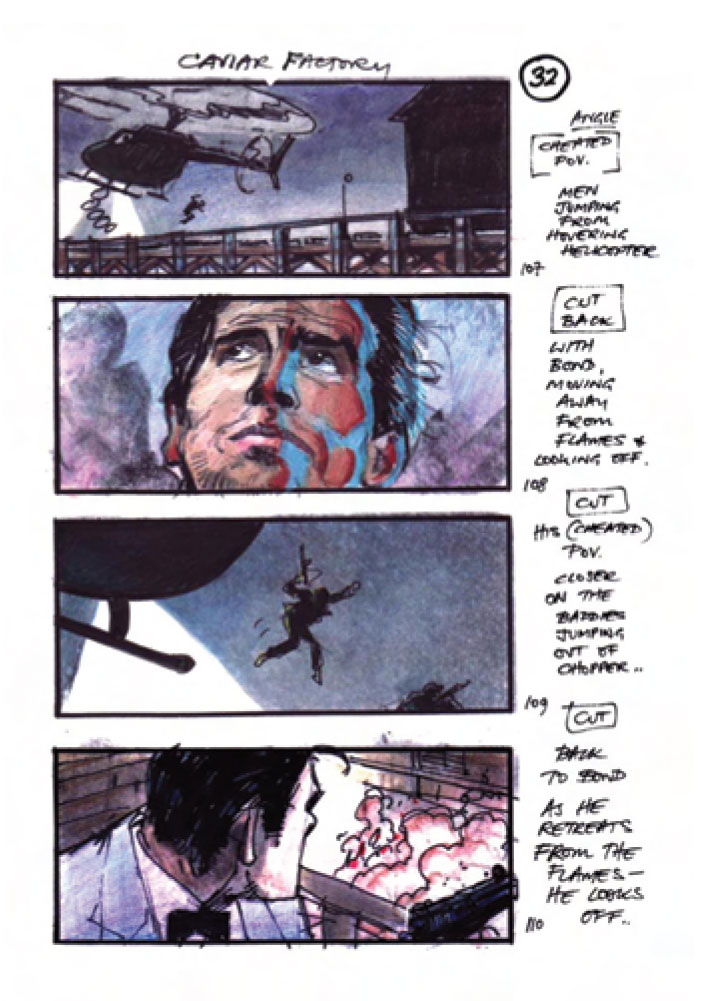
Asbury’s association with James Bond began with Goldeneye, during a period when MGM and Danjaq wanted to revitalise the franchise after the failure of Timothy Dalton in License To Kill in 1989. So there was some pressure on anyone who worked on Goldeneye to bring something new to the character but the artist didn’t seem too concerned by this:
“Goldeneye was to be a new Bond, a new grittiness hopefully and a director who wanted things totally different. I just loved working on Goldeneye and I loved [director] Martin Campbell; we got on really well and with a lot of the sequences if you put the storyboards next to the film, it’s the same. It’s very gratifying.”
 In fact, Campbell was a director that Asbury really clicked with.
“Goldeneye was great, a really creative process and Martin’s one of those few directors who are a thrill to work with really, who appreciate what I can give them and uses me properly.”
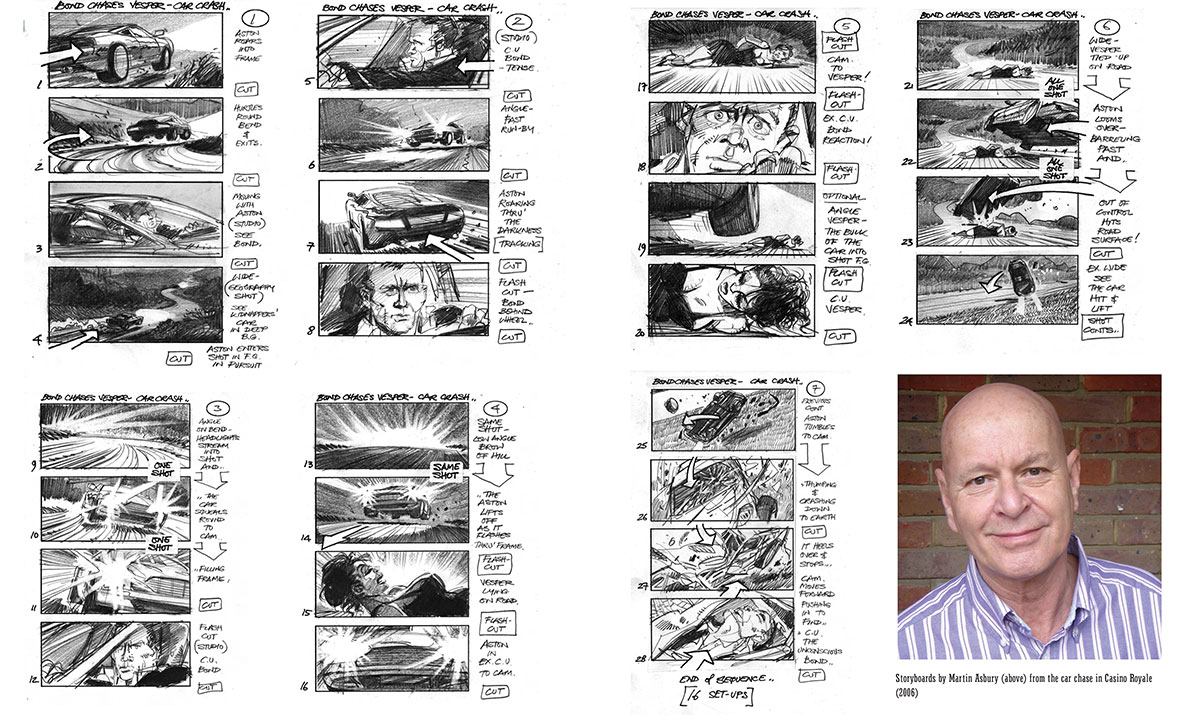
The storyboard artist went on to work on all of the Brosnan Bonds and reteamed with Martin Campbell for 2006’s Casino Royale, where he was involved with kickstarting the franchise once again. But unlike Goldeneye, the makers wanted to turn the clock back to the start of Bond’s career and Asbury found this other collaboration with Campbell just as satisfying as their previous Bond work:
“Martin was brought in because he did so well with Goldeneye and they were bringing in a new Bond and they thought he would be the best to do it and I think it turned out that they were right. I didn’t do quite as much work for him on Casino Royale as I did on Goldeneye because he had a lack of time on that shoot. But I followed him all around the world on it, doing the odd thing that he wanted. Everyone was very conscious that we were reinventing Bond, starting to show a new Bond, a younger Bond before he really became a killer.”
It isn’t just the old guard that Asbury has worked with either; in 2005, he got to work on Alphonse Cuaron’s dystopic sci-fi thriller Children of Men. Unfortunately, his experiences on the movie were less than ideal, as he remembers.
“Cuaron was a nightmare. He was obsessional and he was trying hard all the time to do things in real time,”he says slightly painfully. “He didn’t want to have many, if any, cuts and it caused an awful lot of trouble, not just for me but for loads of people. For the design for the interior of the car that’s seen a lot on screen, we had one cut in half so you could get the camera in it. Then it was driven by some poor stunt guy and it was just an awful nightmare shoot. He thought and he might be right that if you see something in real time on the screen, subconsciously you think it’s happening for real but I’m not so sure I believe that. Audiences now are so sophisticated that they accept cuts without even blinking an eye. They don’t even know that cuts are happening half the time and the audience will believe what you tell them.”
Although he worked on Bond throughout the 1990s and into Casino Royale, he only worked sparingly on Quantum of Solace, the latest Bond with Daniel Craig. This is because many of the new breed of filmmakers are no longer using storyboards and the man at the helm of Quantum of Solace and his team follow this method as Asbury told me sadly:
 “I’ve left the latest Bond film because the new director doesn’t actually use storyboards. He doesn’t like them. The second unit director who made his name with all the Bourne films, doesn’t like storyboards, he likes to wing it on the day. He has it in his head and writes a shotlist for himself but he doesn’t want it illustrated. But again the production has to see what needs to be shot, how much it’s going to cost, how long it’s going to take and so do the crew and the visual effects people. I worked from August to December on Quantum of Solace, so that’s quite a haul. The new kid on the block is called Pre-Viz so that’s what they want to do, and with Pre-Viz the difference is that once they’re done, they’re totally accurate. They take two or three weeks to do and three or four people to do them whereas I can do a sequence in a couple of days and then it can be picked about and talked about.
I also think it gives freedom for creativity whereas Pre-Viz doesn’t. I may well be a dinosaur now. Pre-Viz worries me.”
Having said that, The artist has been fairly busy before his James Bond experience and he even got to storyboard Wanted, the movie adaptation of Mark Millar’s Image series, directed by Nightwatch’s Timur Bekmambetov. The lo-fi attitude of Russia’s moviemakers was something that really appealed to him.
“The director was marvellous. He was very appreciative of what I did. He threw me once or twice and called me up from location and I had to draw the whole sequence just before he shot it. He wanted me to put my own input in as there was no ego there. He was endlessly coming up with new ideas and each idea was better than the one before. He was inventive and very creative. In Russia they are used to shooting films by the seat of their pants. If they had a car and another car for a car chase, another car being exactly the same as the lead car, then they consider themselves lucky.”
Although he has built up quite a career for himself as a storyboard artist, there are a few things he misses about working in comic strips. As we wrap up our chat, he admitted “I miss Garth because I wrote it as well and it was my own little world as it were. I miss the discipline of it and I used to do it in the old-fashioned way with a dip pen.”
One thing is sure: with the quality of his work and his experience, Asbury will continue to be in demand for many years to come.
It’s certainly a very long way for him from Wardour Street and Fleet Street… r
www.martinasbury.com
James Bond – 22 Film Collection [Blu-ray] [1962] James Bond – 22 Film Collection [DVD] [1962]











You must be logged in to post a comment Login