
Headlines
Director Robert McKillop Talks BBC’s Ludwig

An Offbeat Detective
Director Robert McKillop talks about the BBC’s new detective show Ludwig coming soon…
You worked with Big Talk before on A Young Doctor’s Notebook. Was that your first big break as a director?
It was my first proper job in the industry. I’d done a Coming Up before that for Channel 4 but that was more an entry level thing. A Young Doctor’s Notebook with Daniel Radcliffe and Jon Hamm was my first job. Thankfully Kenton (Allen, CEO Big Talk Studios) took a punt on a new director at Daniel’s request. Daniel wanted to work with an up-and-coming director and that was me off and running after that, which was a fantastic relief at the time!
What did you respond to first when you read the scripts?
I was drawn to the tone being a very unusual blend. I thought the humour was finely judged and laugh-out-loud funny. There was a sophistication to the idea of the puzzle setting and the detective taking on cases and trying to solve them through looking at them as puzzles rather than crimes. I really loved the idea of working with David and how the show had been written with him in mind. Mark’s dialogue felt so relatable with David’s voice in it. Each episode has a distinct visual approach, which appealed to me and there is a lot of emotion in the series. There is a slow-burning love story between David’s character John, and Anna Maxwell Martin’s character Lucy and the show is about family. It has an emotional core to it. The fact that James has gone missing. He’s left his wife and child in a situation that’s hard for them and John’s tried to support them. John is also remembering what it was like to lose his own father as a child. All those different layers were really interesting to work with.
What are the TV murder mysteries that you most enjoy?
Poker Face is a really smart, funny, enjoyable show. Like Ludwig it has got an offbeat sensibility and an interesting humour to it. There is a sophistication in the way the crimes have been set up and solved and there is an interesting guest cast every week that brings a different identity to each episode.
What do you love about David Mitchell as Ludwig?
David is such a phenomenal performer. He is so likeable, and you love being with him. He is very, very funny but also David puts in a beautifully nuanced performance that has got a lot of emotion. At the end of the first episode there is a scene where John sees his nephew Henry has discovered a letter that was left by his father. It reminds John of the night his own dad left and seeing the letter his mother read of his dad leaving her. The performance that David gives in that scene, just the look on his face is so subtle but so moving and so beautiful. One of the most beautiful things about working on this job has been discovering that part of David Mitchell as an actor.
What do you love about David and Anna’s chemistry together?
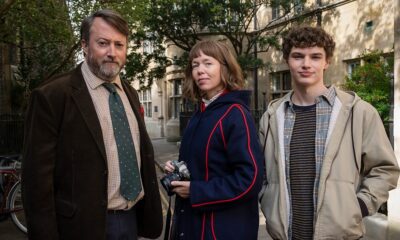
David and Anna are such a special pairing. I kept thinking I was so lucky to see them together for the first time on-screen. They have a similar comic chemistry together and a great energy as performers. David is a master of words and Anna is also incredibly funny with the way she uses language. Also, Anna has got a very enjoyable physicality and a kind of effervescent quality to her performance that David can sometimes offset with a deadpan approach and his masterly comic timing of how he can undercut things.
Did they have any questions for you?
No, they didn’t. The thing about Anna as a performer is she is very instinctive and impulsive. She is a playful actor so it was about letting her play and seeing how she and David would riff off each other. Whereas David is a very, very prepared actor who will stick to the text completely and then you can throw some different ideas in there with him as you go. Just being with John and Lucy when they are trying to solve a crime, put together clues and strategize what to do is exciting. It’s a ride you want to go on with them.
What does Dylan Hughes bring to the role of Henry?
Dylan is a wonderful actor. He brought a very emotive and grounded performance to Henry, and he has got a great dynamic with David and with Anna. He is a very naturalistic screen actor who is just very, very good at being in the moment. Also, you could really feel what was emotionally at stake for Henry since his dad has gone missing.
How has the puzzle solving aspect of Ludwig’s character shaped the visual tone of the show?
The central visual metaphor for the series for me has always been that John is a man who has spent a lifetime looking at the world in puzzle form. So, especially with the first episode, it was about how he enters the world of work, a very contemporary police station and getting a sense of how he is discombobulated by everything and trying to organise that visually. Over the whole series there is the puzzle of John trying to find out why James has disappeared, which predominantly happens in the workplace so I wanted the office to be a spatial puzzle that he had to navigate and unearth clues in. So I gave the office an unusual layout and design idea which allowed him to be looking for clues and trying to crack his brother’s disappearance right in the heart of the office where he could be found out at any second. Each episode has a different visual puzzle that needed to be visualised. Episode One was a syllogism, which was about plotting movement and positions so he could prove who the killer was. We set this up with an elaborately choreographed one take crane shot so you could see the movement of all the suspects in the building play out in real time as they leave work for the day, and the murder happens during that shot but we don’t see who did it. Episode Two was basically a spot the difference puzzle where John had to figure out what had happened to the man who is missing, so we made the house and all its features a big character in the episode. Episode 3 is a spatial puzzle in a church so the visual metaphor was about creating blind spots from the point of view of the witnesses, so John narrows his vision so he can focus on the details to help him solve the murder.
Does each episode have a different look to suit the murder puzzle?
In episode one it’s the office in the opening scene. Mark Brotherhood wrote this beautiful scene of the murder. The way it was written it all happens in one shot. You see lots of people moving through a building – through lots of grid if you like – at the end of a working day. One of the characters is alive talking on the phone but the next time you see him he’s dead and yet you haven’t seen how it has happened. You are left with a visual puzzle for Ludwig to solve.
Episode two is a spot the difference. The way we handled that puzzle was more to play it as a very frustrating situation for John because a spot the difference is so much easier than most puzzles he would encounter. It’s kind of beneath him. Yet he can’t solve it. The third episode in the church and on the River Cam, I was playing around with the idea of blind spots. John feels the reason that nobody saw the murder happen was their vision was obscured by where they were. The visuals are more about tunnel vision.
What discussions did you have with production designer Melanie Allen and your DoP Annika Summerson about the look of Ludwig?
Annika Summerson and I shot widescreen 2.39:1 with anamorphic lenses. With every scene we were thinking how we could push this to be cinematic but also to really engage with David the performer in this environment. How he is trying not to get caught while pretending to be his twin brother. At every turn he could slip up. We had to try and catch that energy and that humour as well as playing around with the idea of being a puzzle setter and seeing the world in puzzle form.
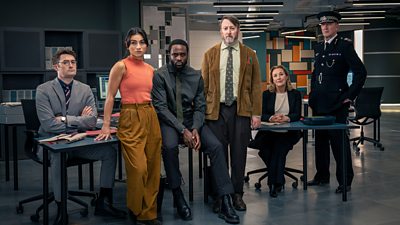
I worked very closely with production designer Melanie Allen especially on the design of the police station. I liked the idea of Ludwig hiding in plain sight. The office has an unusual layout of booths in the middle of the space for the police detectives. I looked at the Mattel offices in Barbie, which in my opinion were influenced by one of my favourite films, Jacques Tati’s Playtime, which was a 1960s critique of the modern workplace. We used a lot of the comic visual ideas of that. How David peeks over the edge of the booth to see what’s happening in the workplace or nearly gets caught when somebody comes into his booth.
Which locations were you most excited to film in?
I’m really excited by what we’ve done with this police station. It’s a fantastic piece of design. We did a lot of research into what police headquarters in different cities look like these days. There’s a common theme of very contemporary pieces of architecture. We enjoyed serving up something very different to other shows that have a police procedural aspect to them. I also loved the office in the first episode. It’s the Royal College of Pathology. It’s an incredible contemporary piece of architecture, very unusual and distinctive mix of concrete and wood, that really suited all the puzzle ideas.
Which locations provided interesting challenges?
Filming in Cambridge in the winter on a gondola was very cold. It was absolutely freezing. We were lucky that the day we filmed was beautiful sunshine so we could really enjoy the beauty of Cambridge filming on the water.
What was your most satisfying day of filming?
One of the most satisfying days was the opening scene of episode one, which is a crane shot that travels up and down the exterior of a building seeing the movements of all the suspects and seeing the murder happen. That was a very complicated thing to achieve on a show of this scale. We managed to borrow a technocrane from Mission: Impossible for half a day. We didn’t have much time to rehearse the shot, so I had to plan it to the nth degree before I got there. Where exactly everyone would be in the building at what time. How the camera would move up and down the building. We have ended up with something brilliantly cinematic and a compelling and distinctive opening to the show.
How has police advisor Malcolm Davies been of use to you with specific details of policing and crime scenes?
Malcolm worked very closely with the producer Georgie Fallon to give an overview of the whole show. How to do everything and how to make it feel real. We then carried that into all the scenes that we had. It was a very useful thing to have.
What do you hope audiences will enjoy about this series?
I hope audiences really enjoy seeing David Mitchell in the titular role as he is thrown into this incredibly unusual situation and seeing how brilliant a mind he has. To see David solving the murder in episode one where Ludwig is ticking off all the different combinations of letters and numbers of where people were in the spatial puzzle and doing this incredibly complicated monologue there are not many actors who could do that. David in full flow is incredibly compelling but also incredibly funny as he reveals the murders in a way that nobody else has revealed a murder before.