
Headlines
Director Jill Robertson Talks BBC’s Ludwig


An Ensemble Piece
Director Jill Robertson talks about the BBC’s new detective show Ludwig coming soon…
Kenton Allen loved your work on Last Tango in Halifax. Was there anything you took from making that show that fed into Ludwig?
As ever, it’s the importance of the writing. Mark (Brotherhood) and Sally (Wainwright) both have this amazing ability to go seamlessly between wit and pathos in an incredible way. And the energy of that juxtaposition really translates. It’s my favourite thing to watch, that balance. Of course, the other thing was the complete and utter joy of working with Sir Derek Jacobi again.
What appealed to you most about Mark Brotherhood’s scripts when you read them?
They stayed with me. That doesn’t always happen. I loved the pretence of this guy, John, going in and attempting to be somebody else because that gives you a tension across the series. Unless he’s at home with the Taylors there is always that underlying joke. It’s a fantastic concept. And I love that balance of funny and dramatic. I’m a fan of shows like Only Murders in the Building.
Where are we in the series story arc for John, Lucy and Henry by episode four?
It’s reached a really interesting point in the mystery of what’s happened to James, which is what John is there to find out. Things start to get a bit darker. At the end of episode three, we realise that there is somebody outside the Taylor house who seems to be watching them. That brings quite a different feel to episode four. It’s much more personal. Suddenly we think, ‘God, are they in danger?’ The comedy and wit is still there but there is much more of a sense of do they know what they are getting into?
How would you describe the murder-mystery in episode four? Ludwig calls it Rube-Goldbergian after the American cartoonist famed for his complicated gadgets.
It’s a complex way of getting to a simple ending. In this case: murder. It was by far the most intricate of the episodes that I had to do in terms of puzzle. It is very complex, and it took a huge amount of planning to do it accurately. Everything depended on the last bit of the puzzle and where all the characters were. And it all had to relate back to a chessboard for the denouement. Trying to translate a series of scripted moves from a chessboard, through a script, onto a 3-D building site was a challenge but a very exciting and rewarding one.
Are you good at solving puzzles?
I am quite logical, the way I look at things. I’m good at solving the puzzle of how to turn a script into a visual like the building site. I spent days and days there more I think than I’d done for any location in my whole career. I went back again and again until I had cracked it. I think I have more just a dogged determination. I’m nowhere near Alan Connor, our puzzle expert, or Ludwig. I like three-dimensional puzzles.
How did puzzle consultant Alan Connor help?
The brilliant thing about having Alan and Johnny Drewek, our Graphics Designer, who were our puzzle team, was that they gave us the confidence the puzzle was working on set. And that we understood it and that it was clever enough. Even when there is a flashback to John when he was a boy and there is a puzzle, we made sure that it was suitable for the situation and the characters and that if you freeze-frame the show and analyse all the puzzles, they all work. You must take your audience very seriously. That’s always at the back of my mind. You never take your audience for granted. That’s always been a tenet. We want to get the puzzles right anyway because Ludwig’s a puzzler. It’s the show.
What have you enjoyed about the chemistry between David Mitchell and Anna Maxwell Martin as John and Lucy?
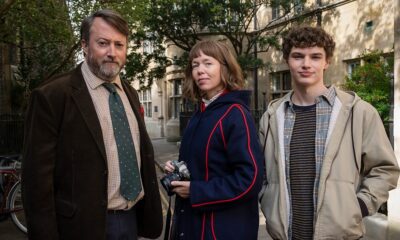
It’s a great onscreen partnership. They are both very adept, experienced and excellent actors but they bring very different energy. It makes them fascinating to watch together. It was exciting to do scenes with them because they are both so very good at what they do.
Do you think we see another side of David as an actor in this role?
I think so. Particularly in episode six where we have some much more emotional, darker scenes. His range is fantastic. The breadth here, his pathos and the sympathy we feel for Ludwig – what he brings is amazing. The nuance was lovely. It’s how to create a fantastic new detective character. His performance encompasses all that comedy and wit, cleverly avoiding obvious tropes. David plays his emotional depth so brilliantly. His scenes with Derek [Jacobi], in particular, which was one of my favourite days on set, were phenomenal. They really played well together. It was such a privilege to be on set with them.
What does Anna bring to Lucy?
She brought a massive energy and a great wit. She’s a fast-thinking, confident and direct foil for the more thoughtful, reserved Ludwig. There is a great scene where Lucy has been watching a film with her son Henry. He goes to do his homework and Lucy asks John to just sit and watch with her. He wants to go off and keep investigating the cipher because previously she’s been saying to him that he’s got to crack on with it. But she really wants him there and as she sits you see all the vulnerability and all the reality of what is going on with her missing her husband. Anna doesn’t speak but you see all that running through her. It’s phenomenal. It’s really moving. When you get those glimpses that makes her very three-dimensional and a really developed character.
Do we see how everything is affecting Henry’s character played by Dylan Hughes?
That really starts to hit home in the second half of the series. It’s upsetting enough that it’s his dad who is missing but time is moving on and they haven’t solved anything. John is not quite replacing his dad, but you have this other figure in the house who his mum is talking to. There’s a scene in episode four where it has really hit him emotionally. Dylan was great. He really took that on.
There is a great scene between Dylan and David in Episode 6 where John pretends to comfort an upset Henry as his ‘dad’ but then realises he needs to comfort him for real as his uncle. Is that a favourite?
It’s a lovely scene, and moving. They also have a scene together in episode four where Dylan really shines. He could bring that pain but also deliver that in a very teenage way of expressing it but not expressing it. John hears it and in a very John way deals with it by talking about emotions through the chess board.
What do you love about the byplay between sergeants Simon Evans and Alice Finch played by Gerran Howell and Izuka Hoyle?
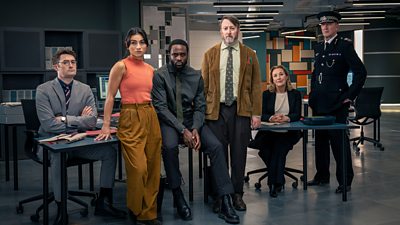
That’s another lovely double act. We run with it a lot in my three episodes. Alice is very ambitious. She’s very by the book and quite literal. Simon is not the same as Ludwig, but he is more akin to him. He sort of idolises him, which is very sweet. There is a lot of funny stuff with them which is nice to have to cut through the procedural in the series. We have an amazing ensemble cast. This was my third outing with Dot Atkinson. We also did Harlots and Pennyworth. She’s great. I really enjoyed her portrayal of Carol in Ludwig.
One of the murder mysteries takes place in a public school. How was that to film in?
We shot that in a couple of different locations because schools are quite hard to access as they are filled with pupils most of the time. Again, it was quite specific. It had to have a bell tower. It had all these puzzle requirements. Things that you see from certain places. And then we spent a long time working out how the locked door could be drilled through. How that would work on-screen. I watched a lot of YouTube videos about how to crack locks. We had a brilliant actor playing our caretaker Barry (Pablo Raybould). It turned out he was quite handy with a drill anyway so that also helped.
How did it compare with filming in Grange Hill early in your career?
Very different. This was a posh private school and Grange Hill was very much the modern comp. But whatever kind of school it is – and we didn’t have a lot of scenes with the kids because there has been a murder – we did try and reflect a real school atmosphere, a realistic and naturalistic school. I enjoyed doing the rugby scene. That was good fun.
Did you have an inspirational teacher in your schooldays or at the National Film and Television School?
I had an amazing teacher called Jeff Rolt when I was 11. He was the person that made me realise that I had a creative side and that it had a value. He had a way of inspiring and a brilliant dry sense of humour. He was the perfect teacher. We stayed in touch for all his life. At the NFTS there was Sandy Lieberson, an American producer who worked on Chariots of Fire. He was inspirational. I stayed in touch with him as well. The most influential NFTS masterclass was producer Andrew Macdonald on Shallow Grave. I ended up going to work with him and Danny Boyle on Trainspotting. I learned so much from them.
Tonally how would you say Ludwig is different to another detective series you directed Dalgliesh?
With Ludwig you’re creating this whole new, iconic detective. That’s exciting to do. Whereas with Dalgliesh it was about taking this classic literary figure and finding a new and exciting way to tell the stories, which had been adapted before. We went very much back to the text and what PD James had written. That’s quite a big difference and then obviously the tone of Ludwig is more broadly comic, but I think all the great detectives have a wit that cuts through the darker parts. That’s what endears them to us. That’s what takes us beyond the procedural or murder narrative and makes their character. Cracker, Columbo, all those great detectives. The wit is something that somehow is shared with the audience that the victims and the suspects don’t always understand.
No spoilers but can you tease a little of how the story in episode six differs from the previous murder mysteries?
Murder comes a bit closer to home. I was amazed when I read it. I think it’s a fantastic final ep for a series. It goes in quite a different way. In four we have the classic whodunnit. Five is more of a howdunnit and it’s much more personal for Ludwig. It’s much more about him so the murder works in a different way. With six the serial story arc really comes in to land and the stakes become the highest. How are they going to get out of this? It’s a brilliant piece of writing.