

Comics News
Tripwire Talks To Bill Griffith About Photographic Memory And A Career In Indie Comics

Griffith Observed
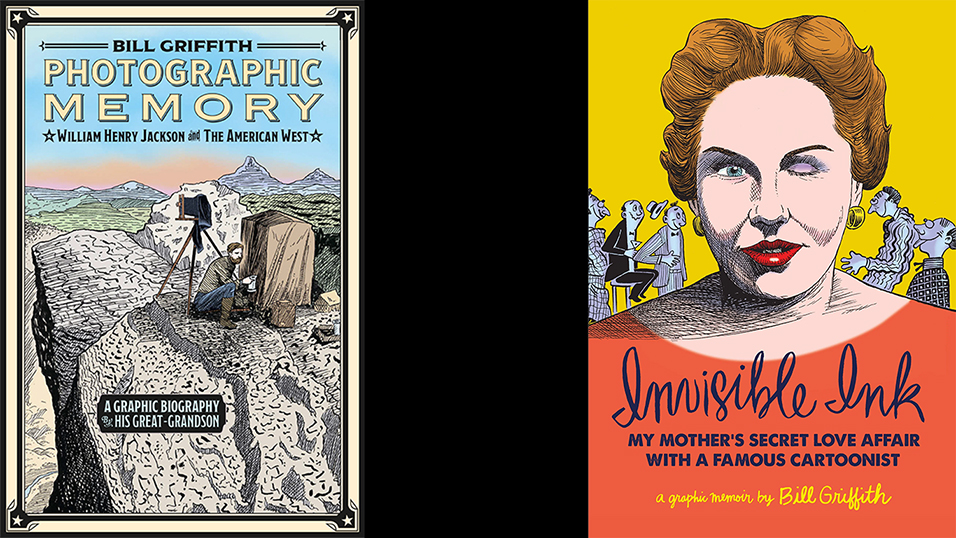
Veteran US indie cartoonist Bill Griffith, best known for Zippy The Pinhead, just spoke to Tripwire’s senior editor Andrew Colman about his long career in comics and his latest book, Photographic Memory…
TRIPWIRE: We’re going to talk about all of your career, but also the last three things you did – what you would call labours of love. Basically the more personal projects that you’ve done recently. We’ll definitely be talking extensively about those. Just to start off, I’m aware you grew up in a prototype suburb called Levittown in Long Island, rather similar to the new towns we had in this country after the war. What kind of an effect would you say did that environment have on your work, especially Invisible Ink? What effect did it have on you growing up in what came to be known as the American dream?

BILL GRIFFITH: Well, you have to remember, I moved to Levittown when I was seven years old in 1952. Levittown was designed to be occupied by returning GIs from World War Two. They were offered a free down payment. They could just move in and start paying their, you know, $75 a month for their mortgage. It was the only way my parents ever could have owned a home. I was born in Brooklyn, and I would have grown up in Brooklyn had it not been for Levittown.
As a kid, it was heaven. It was totally kid -centric. There were no fences around the houses. We just roamed at will. parents weren’t the way they are today. There was no such thing as a helicopter parent.
So it was wonderful. It started to become not so wonderful as I got older. And I realised I was in a land of utter middle class conformity. And I just ached to get out of Levittown. Luckily, New York City was 35 miles away, a fairly quick train ride. And so as soon as I got to be about 16 or 17, I planned my escape route. And I kept doing that until I went to college, which was also in Brooklyn – I went to art college in Brooklyn. So Levittown was two sided for me, it was wonderful as a little kid, and stultifying as a teenager.
TW: You produced the anthology Let Me Out of Here about the subject. How did you discover comics? What presaged your desire to be a cartoonist?
BG: It was Mad Magazine. Mad Magazine was like the life raft for me to grab onto. I think it was the first Mad 51 or 50. So I was a little too young for the first issue. But very quickly, you know, I would see it for sale in the local store in my neighborhood. And I knew it was for adults.
At that time, there was no label saying adults only. But I had the distinct feeling it was different from, you know, Uncle Scrooge comics and Little Lulu which I loved, but I thought that made it all the more appealing that it seemed to be over my head. And so, of course, I grabbed onto it and quickly became a huge fan, even though I understood only about half of it to begin with when I was eight or nine years old. But I remember issue number 11, I think it was, with the Basil Wolverton cover, where he mocked the idea of the kind of Miss America image, the beautiful young woman that adorned the pages of Life magazine in the 50s. Every issue of Life magazine just had a pretty girl cover.
So he parodied that beautifully. And I brought it into my house to read it. And my father took one look at it and tore it up and threw it out. He was absolutely correct looking back in doing that, because I had just brought subversion into our home. Everything that my father believed in was being mocked by Mad Magazine, either mocked or satirized or parodied or something close to that. And he correctly saw that.
At the same time, I remember Elvis invaded my world, too, and I picked up Hound Dog, you know, as a 45 for 99 cents, and I brought it home. And as soon as I played it, my father went crazy about that, too. What he objected to Elvis, the way he objected to Elvis was it was a white man sounding like a black man. That was not acceptable. My father was not a racist, per se. He didn’t act that way in his daily life. His purpose really was to defend me against the invasion of pop culture, which was a futile effort on his part. Pop culture was everything to me and to every kid I knew. So yeah, that got me started. It took a long time for me to think of myself as a cartoonist after that. But if it wasn’t for Mad, I don’t know, I probably wouldn’t have done it – I probably would’ve have ended up selling aluminum siding, you know, somewhere in Levittown. So thank, thank, thank God, for Harvey Kurtzman. I thanked him personally many times when he was around.
TW: Mad Magazine was my window into America when I was growing up in the 70s, from the early 70s onwards.
BG: And again, like yourself, it was a learning curve, because most of the references I just didn’t understand.
TW: So you went to Brooklyn to study art, is that right?
BG: Yeah, I went to a college called Pratt Institute. That’s right. And you did quite a lot of work there. I mean obviously, we know the timeline, but also some other key things happened at that moment.
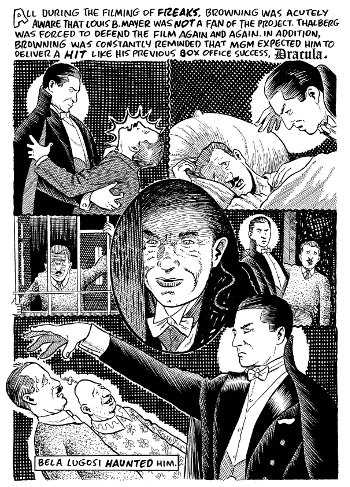
TW: In 1962, you went to see Todd Browning’s Freaks, which had a certain impact on you.
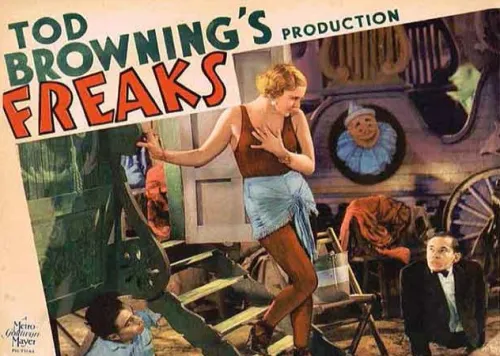
BG: Yeah, that was 1963. I was a sophomore at Pratt and in the student union building on campus, I saw a little notice put up. It said Freaks, a 1932 movie, and it listed an address in Greenwich Village in downtown New York. And then it said $1. So at that time, I was very fascinated by movies from the 30s. I had already seen some Groucho, some Marx Brothers and some Humphrey Bogart. And so I thought, OK, another 1930s movie. I had no idea what it was. I thought the title was odd, but I didn’t know what it was. So I went and saw it and it changed my life, literally. Once again, it took a while, just in the same way that it took a while for Mad Magazine to turn me into a cartoonist. It took a while for Freaks to give birth to my version of the pinhead star of that movie, Schlitzie, my character Zippy, of course. Because at the time I wasn’t a cartoonist. I thought I was going to be, I don’t know what, Jackson Pollock Jr. or Vincent Van Gogh Jr. or some idea of what an artist was. I was very much hooked on that image that I was going to devote my life to art and somebody was going to discover me someday and I’d have, you know, a great gallery exhibition, all these crazy dreams I had.
But what I was doing was I was suppressing the cartoonist, the wise guy in myself. I was pushing him down, and he had to come out. And he eventually did. And when I saw Robert Crumb’s first work, Zap No. 1 in 1968, maybe 67, 68, I took one look at it, and I said to a friend of mine, how did this guy get inside my head? And from then on, I just turned to comics. I just, I abandoned my painting.
My easel just gathered cobwebs in the corner. And I picked up a pen and I started doing comics. Very crude, no idea of how to go about it. I remember my first comics, I used the wrong kind of pen, the wrong kind of ink. I didn’t erase the pencil lines. So, when it was printed, the pencil line showed and I asked the art director, why is my comic wall hairy looking? And he said, well, you forgot to erase your pencil lines. First lesson, erase your pencil lines. Yes. So I had to learn. And luckily, this was the late 60s, counterculture, you know, hippies in charge of all kinds of media. The art director that I brought my first comics to later became the art director for The New York Times book review, Steve Heller. So I asked him why he accepted my crude comics when I brought them in. And he said, well, you you drew them to the correct proportions. Hardly anybody did that.
TW: You migrated to San Francisco in the late 1960s. Did you feel that you were part of the counterculture? Obviously you knew Robert Crumb, Shelton, Spain Rodriguez and all the other leading lights of the underground movement. Did you feel very much part of it?
BG: Yes, and very grateful for it. I didn’t really feel with it, kind of like the way Crumb felt at the time. I just felt grateful that there was this instant audience for my scribbles, for my early work, you know. And I was living in New York in 1968 when I did my first comics. But it was very quickly apparent that the New York comic scene was drying up quickly. There were no comic book publishers per se in New York. They were the way they were in San Francisco. There was just a couple of underground newspapers.
And, you know, they weren’t publishing enough of my stuff for me to earn a living at it, even remotely. So I then migrated, and brought my first comic out to get published by The Print Mint, one of the publishers in San Francisco. And that was it. I was seduced by San Francisco. I actually felt part of the scene there.
Yes, there’s a map that was produced within the past 10 years or so by an underground cartoonist named Jay Kenny. It’s a map of San Francisco’s you know, the Mission District and another adjacent district, which are just neighborhoods of San Francisco, and it has the addresses and little dots where all the underground cartoonists were living. There were 16 of us living all within 10 blocks of each other. I really felt we were part of an art movement of some kind. Aside from the underground and this whole counterculture thing, I thought we were part of an art movement. And we were redefining comics.
We were taking comics that had been handed over to commercial interests such as Marvel and DC and mainstream places like that. We were taking them away and turning them into things that were of personal use. Crumb, of course, was the first one to do it. We were all in his wake and grateful for that. Robert loved the comic book form so much so that in 1967, when he was talking to a guy who had a printing press, He literally, he gave birth to Andromeda Comics by just asking the printer, could you print on your printing press a 32 page, I think it’s actually 24 page, comic with four color covers. And the guy said, well, I only have a letter press, so it would be laborious and we’d have to hand cut them. Once they were printed, we’d have to trim them ourselves.
And Robert said, okay, that sounds great. And they printed, you know, Zap number one, not Zap number zero. And he initiated an entire movement in comics by doing so, just out of just the love of that medium, and the desire to wrest it from the commercial interests that seemed to own it with all their superhero garbage, and turn it into personal expression. Yeah, I mean, I don’t want to talk about myself, but I’ll go to the comics because of Bernie Wrightson, but I remember discovering underground comics, and what I remember very distinctly, and I’ll touch on what you just said, is that it was all very personal, and also was capable of talking about America as it was, because there were, you know, no shackles, there was, you know, it was limitless what you could say. It was completely uncensored, which of course, stood in contrast to the industrial use of comics that Marvel and DC represented, or even the kids’ comics at the time. There was no hint of this anywhere – I mean, Mad Magazine had done this already, it still existed, but it was kind of a shadow of its former self.
And it was the only magazine or comic that actually tried to be satirical. But they were mainstream. They had to obey the rules of the road. They couldn’t publish explicitly sexual material or use a lot of filthy language that would have gotten them taken off the newsstands. But we could, because we had our own newsstands. You have to remember; underground comics were also closely related to Rolling Stone magazine. So Rolling Stone magazine, at the same time, the late 60s, created an alternate distribution system just through their popularity.
We piggybacked onto that system. So underground Comics had an audience through a distribution system that mostly went into head shops and comic book shops, not newsstands usually, but…
TW: Were any of these shops on the Haight? I mean, did you ever brush shoulders with any of the rock and rollers living in that neighbourhood?
BG: Yeah. Well, you know, from the beginning, Robert sold his first underground comics by literally peddling them on Haight Street.
So yes, Haight street would have been the beginning, kind of of the whole process of getting distribution set up. There were several distribution outfits, and everything was run by people my age. Looking back, that was very strange. But it’s kind of what made it all work. We were all in the same boat together, it seemed, and nobody was in charge of it. Nobody was trying to take advantage of it.
TW: It sounds sort of idyllic.
BG: I guess it was. It didn’t seem idyllic at the time. It just seemed like we were struggling to, you know, get our work out to the world. But we had the system for that to happen. And without that, underground comics would have died quickly. They would have died. Just, you know, Robert’s work would have been the end of it. But we thought we had an audience, a fairly large audience. Yes, including, well, a few years later myself, but then I became totally obsessed with the counterculture because of starting with underground comics.
TW: Did you feel completely liberated?
BG: I mean, you’d been in this very, very formalised world and suddenly you were in a completely different space.
TW:Was there just this essence of freedom that you experienced? Was it just beyond that?
BG: Yes. I once did a kind of a satire. One of the underground or later underground publishers, Fantagraphics, asked me to do a page on how I became syndicated. So Zippy was the only underground comic out of all of those from those 60s and early 70s days to get into daily newspapers. So I was asked just to do a page about this. So I did it as a satire. And the basic joke was, you know, do your work, stand near your telephone, wait for it to ring, and little by little you will achieve daily syndication. all the while demanding no editorial guidelines whatsoever. So in other words, that was a method for instant failure. But in fact, that’s exactly what happened to me. The first Zippy Strip happened in 1970 in an underground comic called Real Pulp, number one. And this is all in San Francisco. Within a couple of years, where I saw Zippy was my most popular character, I started doing it as a weekly one -row comic strip for a local underground newspaper called the Berkeley Barb, Berkeley Health. And that kept going for a couple of years.

And one of the underground publishers that published the Furry Freak Brothers, Gilbert Shelton’s comics, Ripoff Comics, in San Francisco asked me to do a larger version of the Zippy strip monthly for their kind of tentative comic syndicate. So then I did a half page Zippy strip for a year or so. And then one day the phone rang and my local daily newspaper, there were two at that time, the San Francisco Chronicle and the San Francisco Examiner. The Examiner was the afternoon paper, therefore the weak sister of the two. In fact, it was slowly dying.
But the guy that ran it was Will Hurst III, the direct descendant of the original William Randolph Hurst, who started this huge chain of newspapers, and of course, his famous first being acted out by Orson Welles and Citizen Kane. So, this is his grandson. His grandson invited me into his office, and he said he wanted to shake up the Examiner. He wanted myself and Robert Crumb to do a daily comic strip. And he wanted to hire Hunter Thompson to do periodic essays.
I was the only one that worked out. Robert was living then, as he did for many years, with his wife, Aline Kaminsky, who’s also a cartoonist. They had been doing comics together. So Robert didn’t want to work for the San Francisco Examiner, but Aline convinced him, why don’t we do it together? We’ll do one of our, you know, cute couple strips. And so they did.
And of course, they included graphic sex. And the minute Wilhurst saw this, he said, I can’t publish this. Somewhere in the world, I don’t know where they are. I asked Robert once what he thought happened. There are 21 daily strips that he and Aline did for the Examiner that were never published. And Hunter Thompson said yes, that he would work for Hurst. But he was always very late with his essays.
And one day, Hearst invited him to come in for a personal meeting at the Fairmont in Nob Hill. When Hearst went to knock on the door of the hotel room, he heard gunfire. So he confronted a gun wielding drunk Hunter Thompson. And that was the end of their relationship. So I was the only one that worked out.
TW: So there’s this surreal, absurdist character, Zippy the Pinhead, who doesn’t really engage with anything that’s going on around him at any point while constantly babbling consumerist slogans. He’s like a vessel of pop culture detritus. Did you ever think that the readership of the newspaper would actually like the strip?
BG: Well, I found the few people that did like it, they picked up on it and they started reading it. But this was San Francisco in 1985, so people my age were still fairly dominant.
TW: The baby boom generation was still dominating.
BG: And some people who liked Zippy before when they saw it in the underground press picked up on it, and other people who had never seen it before picked up on it. Within a few months, Hearst told me that I had increased the circulation of the examiner by about 10,000 people. So I thought, okay, San Francisco had about 750,000 residents, and out of that 10,000 were Zippy fans. That’s enough. I can live with that. And it’s been that way ever since. I think Zippy is still with us.
TW;I mean, it’s quite incredible how you’ve managed to regenerate the character on several occasions.
BG: Yeah, and it’s, you know, it’s not for everybody. It obviously has the quality of a cult strip. But, you know, a large enough cult so I don’t have to sell aluminum siding. I can actually produce comics and pay the rent that way. Thanks for this. I wanted to talk to you a little bit about the things that underpin what you do.
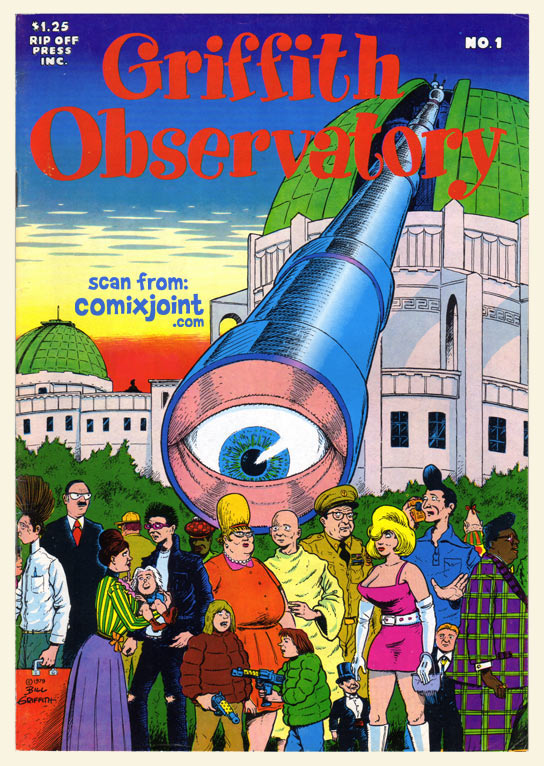
TW: When you did Griffith Observatory, the focus was your ruminations about pop culture and how not only was it in decline, but also that America was losing its connection with its past. It was almost as if you were concerned about losing that. I don’t know how you feel about that. Because as it evolves, as America changes, it leaves things behind. That seems to be an element of what you do.
BG: Well, at an early age, I looked backward in American pop culture to find things to like. Maybe it was Mad Magazine that was crucial – Harvey Kurtzman had a lot to do with that because he was always pointing out that everyone is lying to you. Your parents are lying to you. Your teachers are lying to you. The government is lying to you. They’re all lying to you. And what do you do with that? You make fun of it. Okay. You can’t, you know – Mad never advocated that you go into the street and start a revolution. There were plenty of counterculture people who did that, but of course Mad was not one of them. Their method actually was much more powerful.

Look at Trump today. He can’t take a joke. You know, these are people who are susceptible to satire in a way that it’s a dream for satirists to have that kind of reaction. So when I was young and then as I got older, I was always very critical of the state of American pop culture, and American culture in general. But I was always looking for past iterations of it that I could like.
And there were plenty of them. Like I said, as I started my college career, which only lasted two years, there were these repertory movie houses in New York that just played old movies, movies that you wouldn’t see on TV either. Just, you know, much odder movies. And I remember sitting in a theatre on the Upper West Side of New York and watching the early Marx Brothers movies.
And the only the only comparison I can make regarding how it affected me was that it was like taking LSD. You know, I forced my kids to watch Duck Soup. I insisted that they watch it. And they did. So just to let you know, there are Zoomers out there who have seen Duck Soup. Yeah.
I teach comics in New York at the School of Visual Arts. It’s it was founded in the 1930s as a cartooning school. Now it’s a fully accredited college. So my students, they’re all sophomores. So they’re all 19, 20 years old. And I am always sort of taken aback how little they know about the past of American pop culture. The past to them ends in about 1978 or something. They don’t go beyond that usually. That, however, has been changing in the past few years.
I don’t know why, but I’m very grateful. My class this year, they knew who Frank Zappa was. And when I told them I had been to Mothers of Invention concerts in the early 70s, they wanted stories. They wanted to know what was it like? I couldn’t believe these 19 -year -olds knew this. They also knew about Mad Magazine, which my kids before had never heard of. So I don’t know what’s going on. Maybe it’s a complete anomaly in my particular class, but I doubt it. I have a class of twenty and I would say five of them now, when I bring up certain subjects like Mad Magazine or even Andy Warhol, know what I’m talking about. I don’t have to explain. So I don’t know why, but I’m very happy about it because that was my feeling when I was their age.
I was very much more interested in American culture from the 1930s than I was from the 1950s or 60s. And that’s where I found surreal strangeness and inspiration and a sense of humor that was kind of anarchic, you know, compared to, I don’t know, Bob Hope or stuff that was being served up to Americans in the 50s and 60s. The 50s and 60s were a very bland cultural period. And so my reaction to that was to look, look back and find out where when it wasn’t bland, you know. It was a very constrained era.
TW: Here too. Yeah. The Hays Code obviously put paid to any kind of deregulation. But nevertheless, I think what you’re thinking of is how deregulated certain things could be. You find corners of pop culture, especially in film, which people haven’t discovered. And it’s your discovery when you do find something different and unusual.
BG: Yes. When I was first doing comics, and I needed reference photographs to draw a car, you know, or a tree, I had to go to the library. Now, of course, there’s a negative aspect to that, which is there’s too much to look at. So, I mean, in my class a couple of years ago, I decided to stop giving them slide talks because slide talks are just more screens for them to look at.
They look at screens all the time. One screen equals another screen after a while. You know, Marshall McLuhan said the medium is the message. That couldn’t be more true when it comes to the proliferation of screen visualization that goes on all day with everybody. So once again, I’m grateful for my kids now seeming to have escaped some of this and gotten an interest in kind of early pop culture that I’m interested in. I don’t know quite why it’s happening, whether it’s a sign or whether it’s just an aberration. I don’t know, but I’m grateful for it.
TW: As we’re looking back, we’d better get to the more personal projects you’ve done, such as Invisible Ink and Nobody’s Fool, and of course your current one, which is Photographic Memories, about William Henry Jackson Griffith, who was your great -grandfather.
BG:And my biography.
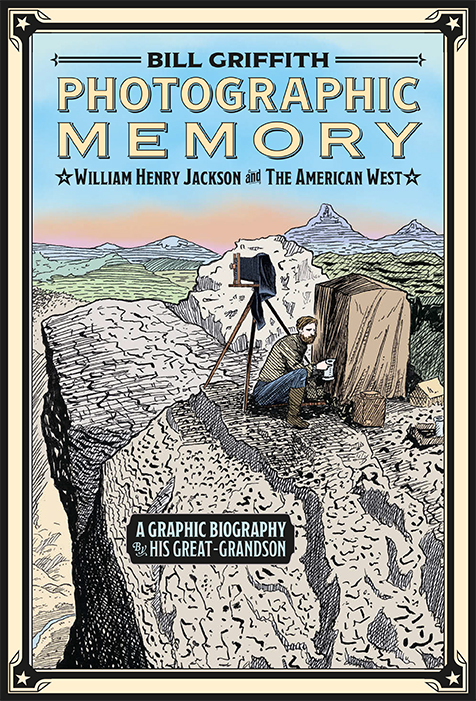

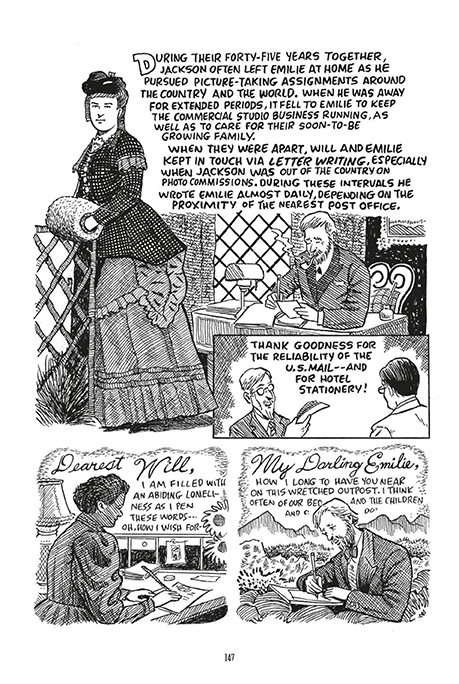
TW: Ernie Bushmiller, Three Rocks. That’s right. So these are things which are harking back again very significantly to earlier times. I’ll briefly talk about my favourite one, which was Nobody’s Fool. I mean, I did a detailed piece about it in Tripwire. What I found so wonderful about the work was how you successfully humanised the character, the protagonist.
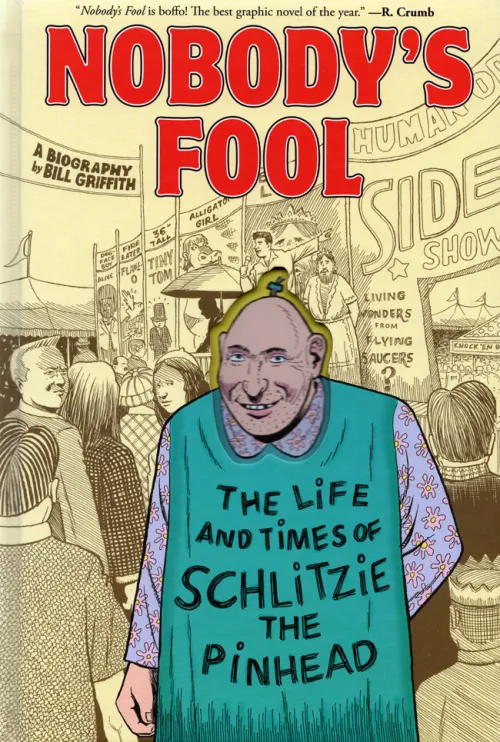
BG:I mean, even though he was a protagonist, he was also a sideshow, not just in real life, but in his own life. Yeah. Yeah. And to that I owe a huge debt, which I acknowledge in the book to a man named Wolf Krakowski. So Wolf Krakowski was 18 years old in 1964, 65. And he got a job with a travelling circus in Canada.
He lived in Canada. And in that travelling circus, the sideshow performers would travel with the circus from city to city. And his job, Wolf’s job, was to take care of Schlitzie. So they stayed in the same rooming house when they went to a new town. And he made sure that Schlitzie was fed and taken care of. And over that summer, when he worked for the circus, Wolf and Schlitzie became very close, which from everything I’ve read about Schlitzie was from Schlitzie’s point of view, just normal.
He tried to be close to everybody. If Schlitzie was introduced to someone, the first thing he would say is, are you married? By which he meant, can we get married? Male or female? He made no discrimination regarding gender.
So Wolf only knew Schlitzie towards the end of his life, but all during his career, he had these caretakers who traveled with him and took care of him because he was very popular.
He was making the circus a lot of money. But Wolf was the first one of those people, you know, to be a sensitive human being, to be like a really perceptive, sensitive young guy. He said all that summer, the book he was reading was Jean -Paul Sartre’s Being and Nothingness. So he’s reading Being and Nothingness and taking care of Schlitzie the Pinhead. That was his summer of 65. And he gave me insights and examples of their interactions that without that, I would have had to guess at this stuff. He gave me absolute verification.
TW: It’s just a pure slice of Americana. I found it quite depressing and heartbreaking, but at the same time, uplifting because he was so humanized. I didn’t realize that the sideshows were still going until the year before he died. Is that true?
BG: He died in 1971. Yeah. And there were still sideshows here and there at which he had performed. The year or so in which he died was really nothing, but just before then, in the late 60s, around then, he still toured.
Photographic Memory is out now from Abrams Books
https://www.abramsbooks.com/product/photographic-memory_9781419784149/













You must be logged in to post a comment.