Comics lost a true original on Thursday night with the passing of Neal Adams and here’s a number of tributes to him from notable people in the industry …
This tribute came from Neil Gaiman on his Twitter feed
Neal Adams is gone. He was the reason I drew Batman in every school exercise book. He reinvented the look of comics pages and characters, made me care about comics at the point where I didn’t care any more, and I wish I’d been lucky enough to write a story he drew. #RIPNealAdamspic.twitter.com/VXy9Zv74mL
This came from former Superman and Batman writer Peter Tomasi
#RIPNealAdams a true great. Did so much for so many. Lucky to have worked with him on both sides of the desk. Privileged to have his iconic name on a comic cover next to mine. I’ll remember lunch we spent talking movies/comics at a Terrificon years ago. My thoughts to his family. pic.twitter.com/N9cHrfJ681
I’m having a hard time imagining what the current comics landscape would look like if he hadn’t drawn Batman.#RIPNealAdams
— Odie O. Colognie, loyal and true blue.. (@JAMALIGLE) April 29, 2022
This was posted by comics writer and artist Jimmy Palmiotti
Neal Adams, one of my comic book heroes, just passed away.
This great man changed the industry in so many ways, all of them for the better.
Personally, he’s always been kind, giving, and always had a piece of advice for me every time I saw him.
I will miss him dearly.
R.I.P pic.twitter.com/LoXTzli4HS
This was from veteran comics artist Rafael Kayanan
As a child raised in the era of paperback cover art – I still vividly recall when I first saw these Neal Adams Tarzan covers, I did not know who did them but they finally captured a sense of tenacity and mood that I felt the character always had but no one ever got perfect. 1/2 pic.twitter.com/EkYbW6HESF
Two comics that changed the way my young mind was wired, set me on the path that defined my career. The giant behind them passed today. Rip Neal Adams pic.twitter.com/lE4DU9wZ7I
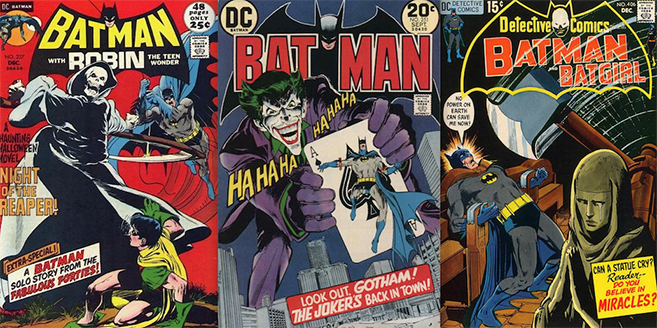
Comics has lost a force of nature. Neal Adams was a magnificent artist, but that might have been the least of his talents. It would have been enough if he had just been an artist, of course: being one of the two newcomers to comics in the 1960s (with Jim Steranko) that rekindled the aspirations of a generation to reshape the pages of comics; drawing the definitive Batman that Neal would argue with his customary modesty would make possible billions of dollars of revenue for the company; moving the world of American comic art back from design (exemplified by Carmine Infantino) and exaggerated cartooning (as leaped from the pencil of Jack Kirby) to a new balance of dynamism and illustration; and entertaining so many millions of us.
Neal was unstoppable. Barred from showing his portfolio at DC by production artist Walter Hurlicheck, told not to ruin his life by going into comics by legendary writer-artist-entrepreneur Joe Simon, Neal perservered. If the path in required Archie Comics gag pages or Jerry Lewis stories at DC, he’d do them as well as he executed Ben Casey for the newspapers. It was all a path to what he most wanted to do, and nothing could block him.
I met him through his art when I was 11…a startling departure from Murphy Anderson’s beautiful but very traditional work that had previously filled the pages of The Spectre, and that may have made him the first comic artist whose name I noticed. His talent began to explode on covers as well, a shocking combination of the designs of then-new DC cover editor Carmine Infantino and Neal’s powerful characters interacting in ways that simply weren’t very DC. I followed him through Deadman, met his Green Arrow modernization and his take on Batman in The Brave and The Bold, his ground-breaking collaboration with Denny O’Neil on Green Lantern/Green Arrow and crossed over to delight in his X-Men and Avengers.
What I didn’t know is that as Neal began shaking up the look of comics, he began devoting much of his energy to shaking up the processes. Creative people were treated very poorly in the field in those years, and most of the leaders in the community were afraid to champion the cause because of the likely consequences. The disparity of power between the owners of the comics companies and the creators was an immeasurable gap, and at its base waited carnivores ready to devour agitators. But a modern Don Quixote had no fear.
Neal wasn’t a perfect crusader. As my roles in the industry evolved, we’d spend decades arguing about principles and practices. He was idealistic, occasionally ill-informed or illogical, and often so impractical that he wasn’t able to forge the concensus that might have enabled him to accomplish more. Someone else might have been able to build the guild that the comics creators really needed in those years (and would still be benefiting from)…but no one else had a fraction of Neal’s courage or commitment to charge against the stone ceiling holding his fellows down.
Of the many fights won or ignored, the one that was most visible was being part of the team (with Jerry Robinson and Ed Preiss) that labored to restore Jerry Siegel and Joe Shuster’s credit to Superman, and economic dignity to their lives. Jerry was probably the more suave negotiator, Ed the wise lawyer…but Neal roared the loudest. And they won.
Principles mattered. Our first argument was the dressing down he gave me for using his Superman sketch (bought from him for $6 at my first Comic-con) as the cover of my fanzine: “Didn’t you know the difference between buying a piece of art and buying reproduction rights?” Actually, at age 14, I didn’t. But I learned.
Over the years, we’d wrestle over contracts and sometimes fail to reach agreement because it didn’t matter that what was being offered to him was financially better, but didn’t conform to the structure he wanted to make a precedent. We lost some magic that way.
But I’m proud that when I presented him a bonus check for our use of Ra’s Al Ghul in Batman Begins he felt it was fair, possibly the first such payment he’d ever been willing to characterize that way, and even put the moment up on his website in celebration.
Neal was a born teacher who needed no classroom. Bring a portfolio to his desk at Continuity Associates, and you’d leave humbled, with art lessons and advice that might last a lifetime. And after your second or third return, improved but assaulted anew each time, he might send you up to DC or Marvel or Warren or Gold Key, opening the door with a phone call ahead that had the power of the most talented endorsing the next up-and-comer. The list of people who benefitted from that open door would be longer than this document, but just start with Frank Miller, Bill Sinkiewicz, Denys Cowan….so, so many more.
Like all of us, he was imperfect and inconsistent. When he briefly formed a comics publishing company, the results were less than epic, and the dealings with talent didn’t always live up to the principles he’d campaigned for publishers to adopt. But we got Bucky O’Hare out of it.
He was idiosyncratic: he wore cornflower blue shirts like a uniform to business meetings and conventions, having researched that it was the color that was most convincing. We shared a love of comic character-themed ties, and when I left my desk job, he took custody of a portion of my collection.
He was a family man, who ran his studio as a very extended family: a circus managed by his daughter Kris, filled with his wife, ex-wife, children turned artists, and the many, many lost boys who’d found it their Neverland, a place where dreams really did come true and you never had to grow old. We didn’t think he would, does the enfant terrible ever mature?
He’d been ill these past months, but I’m still shocked at his passing. How did the Angel of Death ever win that inevitable argument, and why did it have to be so soon?
Neal Adams was both an unstoppable force and an immovable object.
The world just lost an amazing artist, a brilliant storyteller, a wild creative force of nature, a man who forever changed the comics medium and the culture of entertainment. His impact was beyond seismic; it also changed the course of my very existence.
His work saved my life. Literally.
Without his work, without HIM, there wouldn’t be me, at least not the me that I am today.
Neal was my artistic father, mentor and dear dear friend.
I miss him.
Love you, Dad. Rest in Peace.
I’m sorry folks. I’m in shock. It’s going to take me some time to process this.
Like Frazetta and Corben, Neal was somebody I somehow just assumed would always be there. Just too damn huge to ever go away. And, I guess, he never really will in that he lives on in so many artists he influenced and inspired. Someone made the comment today that no-one since Kirby did so much to change the look of comics and I think that’s probably true.
I was a MARVEL ONLY kid so I entirely missed out on so much of the ground-breaking stuff Neal did on books like Batman and Green Lantern, but he did those couple issue of the Avengers–One in particular knocked me for a loop, the one where Ant Man goes down the Vision’s throat and looks around in there–That one was just SO different than anything else I was looking at back then.
So was I influenced by Neal? Not consciously–I mean one look at Neal’s stuff and I KNEW I was never going to attempt to draw like that–His was draftsmanship was just too damn good–No tricks, just amazing drawing. But I don’t think it was possible to look at his work and not bring SOMETHING away from it–Even it was just the knowledge of what was possible.
This was what former Marvel editor and writer Jo Duffy had to say too about him
Our website uses cookies for ads personalisation. By using our website and agreeing to this policy, you consent to our use of cookies in accordance with the terms of this policy. If you do not consent to the use of these cookies please disable them following the instructions in our Cookies Policy so that cookies from this website cannot be placed on your device.
Functional
Always active
The technical storage or access is strictly necessary for the legitimate purpose of enabling the use of a specific service explicitly requested by the subscriber or user, or for the sole purpose of carrying out the transmission of a communication over an electronic communications network.
Preferences
The technical storage or access is necessary for the legitimate purpose of storing preferences that are not requested by the subscriber or user.
Statistics
The technical storage or access that is used exclusively for statistical purposes.The technical storage or access that is used exclusively for anonymous statistical purposes. Without a subpoena, voluntary compliance on the part of your Internet Service Provider, or additional records from a third party, information stored or retrieved for this purpose alone cannot usually be used to identify you.
Marketing
The technical storage or access is required to create user profiles to send advertising, or to track the user on a website or across several websites for similar marketing purposes.













You must be logged in to post a comment Login