
Headlines
Jodie Whittaker, Tamara Lawrance, Bella Ramsey and Siobhan Finneran Talk BBC’s Time Season Two

Telling Important Stories
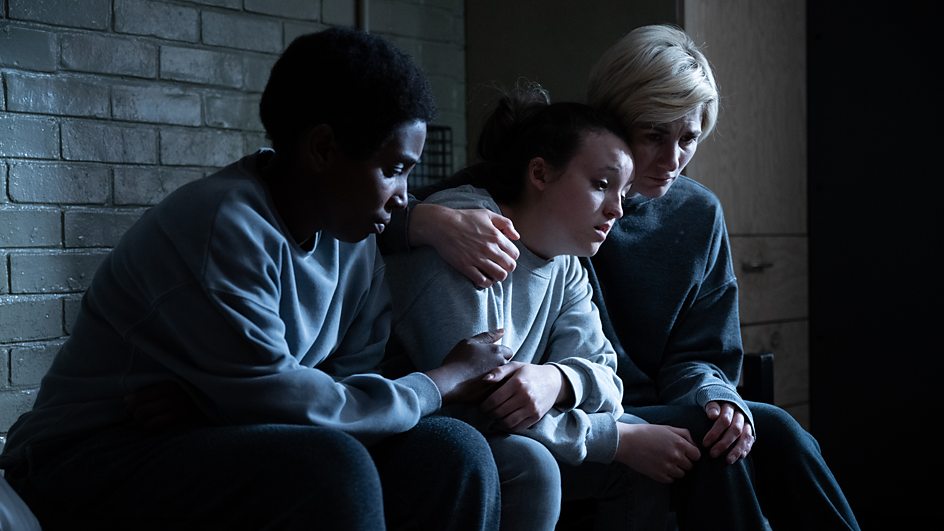
The BBC’s hard-hitting prison series Time comes back for a second run soon and here’s the latest cast Jodie Whittaker, Tamara Lawrance, Bella Ramsey and Siobhan Finneran talking about it…
Tell about the experience portraying these characters and how you prepared for the roles?
Jodie: I’ve got a career defining moment to talk about. In Doctor Who I was playing a role and in every press junket I wasn’t asked about how it felt to play that. I just was playing the Doctor and it was my own version of that character who’s an alien. It was such a wonderful experience because it was the ultimate playing pretend. And it’s been three years of running around and having this other thing which isn’t a human experience – you’re essentially playing somebody who has all this life experience so you can be incredibly mercurial and you don’t need to be limited to the constraints of the time period or the setting.
On Time, it’s been really interesting to jump back into something where you have your character’s experience and you have to be incredibly respectful and loyal about that person’s journey. With someone like Orla you’ve got to be absolutely clear about where you’re from and what the constraints and possibilities are because of who you’re playing.
Bella: We’re representing real people and real situations and scenarios so I think it’s really important to get it right. Kelsey is, amongst many things, a heroin addict. And so understanding addiction and trying to embody that in a way that’s real and not a caricature is really important. These are people that are very much in the world and I think that’s why it’s important that we honour that.
Tamara: For me, the research was quite alarming. I can’t remember all of the stats now, but the biggest thing that stood out to me was the intersection between childhood trauma, people in the family who’ve offended before, domestic violence survivors, sexual abuse, poverty and mental health issues, and how all of those things intersect as reasons why people commit crimes. On the other side of that, recognising how prison exists pretty much as an industry, as a business, pre-eminently even though as a society I think we’re led to believe that it’s about rehabilitation and when you see and you understand the stats of what everyone is experiencing, for me I was quite shocked that there’s not much focus on care especially around mental health and families as well. I think prison decimates a lot of community and that then becomes a cyclical thing, because if you have less people to lean on, you’re more likely to leave and re-offend or self-harm. And these stats are a lot higher for women than for men as well. And so, yeah, I kind of was shocked and taken, yeah, taken aback by that and thought that as a society people in general I think we need to deal with the root cause rather than the symptoms.
Bella: And you have a line about that in the series?
Tamara: Yeah, “a third are mentally ill, a third are smack heads and a third shouldn’t be here”.
Bella: I feel like that sums it up massively.
How has it been working with the other cast members?
Jodie: Time is an incredible ensemble piece and every single person has their vital role within any moment which can often be in scenes where not everybody’s necessarily leading the dialogue. There are a lot of scenes in the visiting room with characters that maybe don’t have dialogue, but they have incredibly important moments of eye contact that can tell an entire story in a side glance. It’s really wonderful being surrounded by such a brilliant cast and crew and so you have this, our energies between takes feed each other, so that then when there is this moment of drama or stillness or emotion, it’s like we’ve all been there for each other in whatever state we’re in and it lets everybody thrive. An environment has been created where everyone can work, and it feels really beautiful to be a part of that.
Siobhan: It’s a real privilege for me because I’m getting front row seats to watch some really quite stupendous acting, so I don’t have to wait for it to come out on the telly. I’m getting to sit in the room and watch really incredible actors do really incredible work.
How has it been filming very emotional and intense scenes?
Bella: We’ve had some long days of high-level emotion scenes, all day. You’re switching on and off all the time. And the reality of that, because between the moment of action and cut, it’s real. And even though your body and the trauma isn’t actually happening to me, Bella, the trauma that I’m creating in my body and in my mind to feels real. The lines get blurry. Your body almost doesn’t know the difference between real trauma and induced trauma.
Jodie: The physical thing of shaking and crying or getting yourself into a very heightened state, it stays within you. It’s difficult as well when you are filming with little beings. Orla has scenes with her children who are 8, 9 and 12/13. So the whole thing of that being real, to have two little faces kind of looking at you and these wonderful little actors… It can be one eighth of a page in the script and it can have only taken an hour out of your day to shoot that, but the residual effect on you lasts for quite a while. And it’s really important to experience that because that is what some people’s life is and we’re lucky this is not happening to us, but we’re very aware that it is happening to a lot of people.
Tamara: That’s what’s been getting me – whether they’re the principal or more tertiary storylines, everybody’s carrying a massive history and everything is so rooted in reality. There’s a character who receives a card from her son and it really touched me, the amount of people that are so disconnected from the people that they love and maybe never hear from them. Fiction is painful enough, but the reality of that must be insurmountable sometimes. It’s really hard hitting stuff.
Why are these important stories to tell?
Jodie: When you’re in something, not in the narcissistic sense, but you hope what you individually do contributes to a bigger thing, which is hold up your end and make sure the truth of this person’s storyline is delivered in the best possible way. Knowing the impact that Time series one had, it gives a window into something that has no window. People who have no experience of prison have a very strong idea about it… Hopefully this humanises a situation that any of us could be, every single privileged person in this room could be in this situation.
Bella: We can have biases and we think about people in prison, but it’s so complex. I think just understanding how complicated everything is, nothing’s linear, nothing’s black and white. Just seeing that and respecting everybody’s individual story is so important.
Jodie: There’s a scene where you say to Orla, some of the…
Siobhan: Some of the nicest people you’ll ever meet are in prison.
Jodie: And also that coming from your character and in particular, because someone in your position would have experienced the best and worst of everyone.
Tamara: I think we’re led to believe it’s a moral issue, people in prison are bad and people who are not in prison are good – when actually, victim and perpetrator are two sides of the same coin when it comes to people in here. It’s important to understand that.
What I found interesting about this script is that every character that has kids has experienced loss in some way. I think it’s really important to show flawed mothers or complicated situations within which people have to raise children. Orla isn’t a bad mother, but she obviously did something that people see as illegal to keep her kids warm. I think we are taught that being a mother is a divine right, being a mother should be the highlight and love of your life. It should be the best thing that ever happened to you and should be easy despite all the pain, which is also Abi’s storyline, the psychological pain of having children – none of these things are ever spoken about.
Some of the most detailed stories I’ve heard about this have been from people in this cast who have shared their stories, or the research that I’ve done, but it’s not commonplace. I know a lot of people that still feel like there’s a box in their life that they haven’t ticked because they’re not married or haven’t had kids yet. But actually, sometimes, having kids is the undoing of someone. I think it’s important to show that because if it might make someone think twice about whether they have capacity in their life actually to manage caring for someone else, because a lot of the women in this show actually needed to care for themselves first, and I think that’s something that is a very important narrative that I will always stand by.
One of the stats was only 9% of kids that have mothers in prison are raised by their biological fathers, which means over 90% of children are either in care or being raised by someone else. And so a lot of people that are in this place, have no support. And some of that lack of support is the reason they’re here in the first place. I think just dispelling the myth of the benevolence of motherhood is important, and showing that actually we’re humans that are dealing with lots of systemic, personal and physical layers, as well as being expected to take care of someone else.
For me, it’s incredulous some of the things that women are expected to be able to carry along with everything else. I hope this shines a light on the pressure on women. Maybe if it even leads someone to ask somebody else: ‘How was that experience for you? How are you coping?’
What appealed to you about the series and your role?
Jodie: I read the script and it was one of those moments where I went: ‘I don’t know if I need to read this, I think I’m probably just saying yes!’ Because I was so excited to see the culmination of names pop into my inbox of who’s doing it, the first series, who’s written it, who I was going to get to work with and all those things. And then when I started to read Orla’s storyline, I was just very excited to immerse myself in something that felt like a brilliantly difficult challenge, because I’m very lucky to not have come from Orla’s world, but I feel as if there’s so much of Orla that feels very within me and kind of within all of us. Orla’s a lioness and the decisions around the need to keep her cubs shows the fierceness of that. She emotionally leads to decisions, not academically leads to decisions, and that is me all over.
Siobhan: Well, I just felt very honoured to be asked to come back to do another series of it because I had such a great time. It sounds wrong doesn’t it, always sounds wrong with this subject matter to say I had a great time and very much enjoyed the first series. But when I started reading these scripts… What you can say. I think they’re genius, they’re brilliant, and they’re raw. They just get hold of you and then don’t want to let you go. I was a hell yes as well.
Bella: I was the same, I just sat down and read the first for 40 minutes and was like ‘wow, that’s amazing, but I don’t know if I can do that, but I’m not going to tell them that I don’t know if I can!’ Kelsey’s so far removed from me in so many ways, but I really wanted to do it because it’s phenomenal. So I was like ‘yeah, this is amazing, absolutely’. Even for the rehearsal process I was still worried, but when we got on set on the first day, and it wasn’t until the first action that I was finally like, okay, I might be able to do it. Now I’m very comfortable with Kelsey and I now feel like similarities have emerged since then. So I’m really happy to be to be here.
Tamara: I was excited about a prison drama actually. I thought this is going to be good, especially because I knew who was writing it and obviously what it was following. But then I read Abi’s storyline and my head was a bit in my hands for a little bit. These really are traumatic characters, but luckily we’re in a cast where you feel safe. It’s hard to be vulnerable when you don’t feel safe, but the team and the scripts are a redemptive quality to every storyline. Every character goes on an amazing arc and every character in the background also feels real as well – there’s no cardboard cut outs anywhere. It’s a privilege to be able to tell a story depicting this subsection of society. So yeah, I was happy to come onboard.