


Feature
The Genesis Of Guillermo del Toro’s The Shape Of Water Part Two

Creating A Unique Love Story
♦ Guillermo del Toro’s The Shape of Water won the director a Bafta this month and it looks like the film should do well this Sunday at the Oscars. Here’s the genesis of the film part two…
AMPHIBIAN MAN: THE CREATION
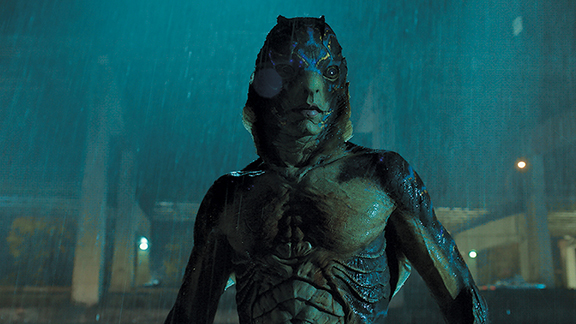
There have been human-fish hybrids or mermen seen on screen before – including Guillermo Del Toro’s own Abe Sapien from HELLBOY – but for the creature in THE SHAPE OF WATER, Del Toro wanted to leave all predecessors behind. He envisioned raising the bar to a new level of realism, crafting a being of such biological plausibility it might inspire a human woman’s mad passion.
Three years before THE SHAPE OF WATER began shooting on sound stages in Toronto, del Toro hired Guy Davis and Vincent Proce to begin design work on the lab and the water cylinder. The next year he hired two sculptors, David Meng and Dave Grosso to begin working on the design of his Fish Creature at his Bleak House workshop at his own expense.
Del Toro was so committed to getting the creature right, he financed the design of the creature from his own pocket, spending hundreds of thousands of dollars in a process that took some 9 months of gestation. “I knew I wanted the creature to feel real but at the same time for it to be beautiful which is a very hard line to tow,” confesses Del Toro. “I knew it was going to take a long time, so I didn’t even put it in the film’s budget. This is truly the hardest creature design I’ve ever done.”
Early on, he assembled a crack team of artists who are pros at infusing life into the imaginary, including Shane Mahan of Legacy Effects, a creature designer extraordinaire and visual effects supervisor known for his award- winning work bringing the superhero IRONMAN to life and for PACIFIC RIM; and Mike Hill, a renowned sculptor who specializes in ultra-realistic models of monsters from classic horror movies and has worked on such films as THE WOLFMAN, APOCALYPTO and MEN IN BLACK 3.
The team worked tirelessly from sketchbook to maquette to the fully-realized creature suit that transformed Doug Jones. Says Hawkins of what they achieved: “I feel the creature is one of the most beautiful things I’ve ever seen. I had to be reacting to someone who feels alluring to Elisa and because of their work that came naturally. I didn’t see Doug at all; I saw this incredible, mysterious specimen. Others might see a monster but Elisa sees something else entirely and that comes across.”
Del Toro had his own way of testing whether the design was attractive enough. “Every night, I took it to my home and got the female vote: enough ass or not enough ass, enough abs or more abs, shoulders bigger or slimmer? It just had to be a creature you could love fall in love with.”
The initial inspiration for the creature came directly out of nature, with his bioluminescent skin, layered eyes and strong, sucking lips merging into a sleek, humanoid-style form. For those whose love is sculpting new life forms, the proposition of creating something so original was jaw-dropping.
Explains Shane Mahan: “The idea from the beginning was to really push the idea of an aquatic form of life that has existed for millennia, to make it feel like a living creature from the sea with the kind of shifting, phosphorus colors you would see in tropical fish, but in a fleshy form that is compelling.”
Looking for someone to blow the whole process open, Del Toro recruited Hill, having recently been wowed by his life-like monster sculptures at a horror film convention. “Mike has a connection with monsters that is uncanny, and I thought we needed that level of insight,” says the director. “The difficulty with this creature is that we were not just sculpting a creature – we were sculpting a leading man.”
Hill recalls the mission Del Toro set for him: “He said he wanted me to give the creature a soul. He wanted it to be something a woman could fall head over heels for in every way. So I started sketching a handsome looking version of a fish man, giving him kissable lips, a square jaw and doe eyes and I went from there.”
The process got so intense, Hill spent night and day collaborating with Del Toro on clay sculptures, each sketching and scratching and revising the forms over and over. “After weeks and weeks and weeks of sketching with the clay, we finally nailed it,” Del Toro recalls.
The creature was now reinvented in a more sinewy form. “I wanted to make him a bit more caliph like, and because Doug is so slim, I thought let’s not waste that, and let’s not build bulk,” explains Hill.
Hill and Del Toro perused an encyclopedia’s worth of real-life fish as they worked. “We wanted him to look like something that you might see washed up on the shore of a beach and at first think, oh, that looks kind of like a fish, so it was important to use realistic fish colors that are familiar to people,” Hill says.
The enchanting tropical lionfish, a vibrantly colored, venomous creature native to the Pacific became the model for how the creature would eat – with its internal membrane that allows the fish to swallow its food in record time. Hill also looked to the natural world for the creature’s translucent bioluminescence. “People with aquariums are often attracted to glowing, see-through fish so we wanted to echo that idea,” he elaborates. “Later, Legacy came up with a way to re-create that idea in an opaque suit that looks fantastic.”
Even with the clay designs completed, only half the work was done. The next step was equally tough: turning the models into a series of practicable latex suits that a human being could move inside. Legacy transformed Hill’s maquettes into a magnified, digital image, which was then sculpted further, etching in more muscularity and vascularity. Work also began on the creature’s facial elements, especially his eyes. Recalls Mahan: “One of the early conversations was that Guillermo wanted the eyes to be changeable on set in order to change the mood or look of the creature. Since you can’t take Doug’s makeup off to change them, we ended up coming up with a magnetic system to interlock the eyes. It was the only solution. Once we were shooting, we would change the eyes four or five times a night.”
The most minor seeming details – for example, creating a working set of gills for the creature – garnered tremendous time and thought. Says Mahan: “His gills were especially challenging because we were dealing with a lot of water in some scenes. But they were also exciting, because the gills gives the creature an additional way of reacting without words and we could use Doug’s breathing to enhance emotions like excitement, anger or affection.”
As early renditions of the suit were put through their paces, Del Toro was a constant driving force for the Legacy team. “He has a love for our craft that is infectious,” says Mahan. “He would meet with us anytime, late on a Friday night or on a Sunday, and he was involved at every turn. It’s very rare that you find that kind of interest in being so super refined and for us, that kind of obsession is inspiring. You end up wanting to invest more and more into making it as great as it can possibly be.”
Finally, four spectacularly intricate suits, each capable of getting waterlogged, were made for the production. Says Del Toro: “Shane and the whole team at Legacy were incredible partners in the design. They were instrumental in developing the color, solving the logistics and reconciling the beauty of the design Mike and I did with something that would be truly functional.”
Painstakingly constructed as it was, the suit proved to be a daily challenge for Jones, who had to not only learn to live in it, but to fall in love inside it. Legacy made it as pliable as it could possibly be, though it still had the quality of a constricting vise. “The suit is super tight and inside it there are actual corsets to make it even tighter. But we segmented the abdominal plates so that they do give and move a little bit. It’s not solid, so it can create the graceful motions the story demands of Doug,” Mahan says.
The skin-tight fit and athletic nature of moving in the suit pushed Jones to “get into the best shape of my life” at age 56, he says. “I knew this would be my most physically demanding role, so that spurred me. Just wearing the suit, which has foam latex rubber and silicone designed to always spring back to the position it was sculpted in, was an intense work out. Every movement is like doing a pushup or a pull-up.”
Jones’s extensive transformation also meant spending two to four hours daily in the makeup chair. In some scenes, he was entirely blinded by prosthetic eyes. The suit also took four people to hoist Jones into it. “It was a daily comedy of tugging and pulling and baby powdering as well as shoving, shifting, zipping and snapping as four grown men pulled on my arms and legs,” Jones laughs.
SHAPING THE VISUAL EFFECTS
The film’s visual effects supervisor, regular Del Toro collaborator Dennis Berardi, became another key partner in crafting the creature’s full existence. When Berardi read THE SHAPE OF WATER he says he was overcome with feeling – and also excitement about what lay ahead. “I could see how my team could make a real contribution to the film’s core emotional components and I was all in,” he recalls.
Berardi began by creating an exacting digital double of Doug Jones in the prosthetic suit. “Guillermo wanted the creature to not only be able to emote like Doug but to also move underwater in a certain way so we did a lot of early movement tests with our Animation Team at Mr. X and we got to the point where we could do a digital version of the creature that could match up with Doug’s beautiful performance,” he says.
Crafting the underwater movements was a research-intensive process that involved looking not only at Olympian human swimmers but such aquatic species as sharks, puffins, otters and penguins. “We looked at anything that moves very gracefully through the water in order to base it all in reality,” Berardi explains.
The result was a digital mirror reflecting Jones’s powerful acting with the added dimensions of a creature that doesn’t exist — the real and the unreal aligning in synch. Berardi even played with the creature’s colors, shifting them with his mood. “Our hope is that the audience can’t distinguish at all between the digital version of the creature or the Doug Jones version. Doug’s performance informs our animation and I think our animation has also informed how Doug was photographed. If the audience can’t tell which is which, we will have succeeded,” says Berardi.
Del Toro’s encyclopedic knowledge of cinematic history, especially monster movie history, was a constant resource. “He knows creatures like the back of his hand,” Berardi muses. “I can show him any reference from any movie and he can destruct the method used to create it. So that gives him a unique ability to communicate what he wants based on stuff that he’s seen and also what’s in his mind. He gives you magical inspiration, then challenges you to bring your own ideas to the table, which is so rewarding.”
The Shape of Water genesis feature part two www.tripwiremagazine.co.uk
SHOOTING THE UNREAL FOR REAL: THE CINEMATOGRAPHY
THE SHAPE OF WATER’s shadowy atmosphere drops the audience into the depths of the story – and Dan Laustsen’s creative cinematography was vital to achieving Del Toro’s vision. “The final design of the creature is done with light,” Del Toro emphasizes. “If I did not have a D.P. who understood that it wouldn’t work. Dan also understands it’s not just about key light, cross light, rim light, etcetera. He’s not technical; he’s emotional. I think all great cinematographers are emotional. A great cinematographer is like an orchestra conductor – he transmits emotion with light instead of musical notes.”
Laustsen recalls that as he read the script he wondered aloud: “How are we ever going to shoot this?” He goes on: “But then I talked to Guillermo and his vision was so strong, I started to believe it was possible. This film was both a big challenge and a fantastic experience for me.”
The rich silence of the film’s two leads especially tantalized Laustsen. “That whole idea of two mute characters connecting is very cinematic,” he muses. Equally inspiring was the idea of using a kind of visual liquidity to make the whole narrative ebb and flow like water. “Everything’s in motion in the film,” Laustsen describes. “Guillermo wanted lots of camera movement, and he likes very precise movement, so we worked with all kinds of cranes, dollies and Steadicams, and it was very exciting.”
Laustsen put the much-loved Arri Alexa digital camera through its paces, using Arri/Zeiss Master Prime lenses, which allowed for maximum precision. He explains, “Guillermo wants crisp, crisp images where everything is sharp, and you can really see the details with this combination.”
Early on, Del Toro and Laustsen flirted with shooting the film in a classic black & white, but they reversed course – and both agree it was a catalytic decision. Working instead with monochromatic tones of color, they meticulously shifted light and texture to craft a more modern, yet desaturated look, full of deep-sea tones. Explains Del Toro: “I knew I wanted the film to be monochromatic, so most of the palette is blues and greens with amber as a counter-balance. Red only comes in as the color of blood and love.”
An almost architectural lighting design formed a centerpiece of the work. “Dan is a genius with light,” muses Del Toro, “and he was able to light the film as if it was 1950s black & white even though we use color. The light is very expressionistic and full of shadows and I think feels very classic.”
Lighting was especially vital when shooting the creature. “He’s not really a terrifying character, but he is fascinating and the camera is fascinated with him,” says Laustsen. “Is he an animal? Could you call him a person? In terms of the cinematography he had to be lit very, very carefully, because of course as an audience member you want to see every part of him, but we also wanted to keep him a bit mysterious.”
For some of the underwater sequences, Laustsen went Old School, harking back to the technique of shooting “dry for wet,” creating the illusion of water. This involved utilizing heavy smoke, wind machines and projection to create a dripping, pulsating atmosphere akin to water –while allowing the actors to work with their eyes open, vital to their expressions. Says Del Toro: “We did a lot of research on how to do dry for wet well – from how many frames per second to use to how you can create floating particles. We knew the key was to create a video projection of caustic light on the characters that is very operatic.”
Recalls Doug Jones: “When we did the dry for wet scenes, Sally and I were working in fog with lights zigzagging around like waves. It was quite unusual, but when I saw the video playback, I was like, ‘dang that looks real.’”
Real water also played a role in the bathroom sequences, which meant challenging tank work. Summarizes Laustsen: “Shooting underwater is always a big challenge because of the lack of communication. But the underwater part of things was the really the least of our worries in those scenes. Most of all, we wanted Elisa to look amazing and the creature to look a little scary and the whole thing to be very, very romantic.”
THE LOOK OF WATER: THE DESIGN
Del Toro is as much a world-builder as he is a director, and for THE SHAPE OF WATER, the world he wanted to create was a blend of historically authentic Cold War America with the patina of a timeless legend. The design was ambitious. Elisa might lead a quiet, nearly invisible life but she roams through realms that are epic: from the covert government laboratory where she works to the apartment leaking flickering light from a B-movie theatre below to the Maryland coast where the film reaches its climax. Like the fluidity of the camera, the design features curves and serpentines set against a world where hard lines can be drawn in men’s minds.
Says J. Miles Dale: “Guillermo is undeniably a grand visualist. From the sets to the costume to the camera, no detail is too small for his attention. So that also makes him a kind of catnip for designers. With Paul Austerberry, the process started early, designing the lab, Strickland’s office and home, Elisa and Giles’s apartments and the bathroom that becomes so important to the story. He spent a lot of time really nailing the palette, and it was the same with Luis’s costumes. Guillermo always has very specific ideas about colors and textures and Luis just ran with that, coordinating with Paul and Dan the whole way.”
For Del Toro, bringing in Austerberry – who is also working on the forthcoming PACIFIC RIM: UPRISING – was a must. “I fell in love with the fact that Paul has a very strong opinion of design, meaning he could counter anything I talked about with new ideas,” Del Toro says. “But even though Paul has great ideas, he’s also very practical and that was important because this film had such a big scope, with complex sets and underwater shooting. He had to be able to orchestrate and manage all that.”
Research and realism were the twin poles of Austerberry’s work, which helped transport cast and crew. “The sets were like stepping into a painting,” says Sally Hawkins. “That’s what it felt like to me.”
Austerberry began by rooting his designs in the actuality of the early 60s, with its mix of futurism and sleekly functional mid-Century design. “Guillermo and I talked about basing the design in reality so I started with a ton of research, looking through books and archives of all kinds of government research labs, pulling lots of references,” he says. “Guillermo always says you first need to make a place grounded in reality in order for it to become fantastical, so we were as authentic to the period as we could be in the story.”
The laboratory, where the creature is housed in a secured, indoor pool, establishes the mood with its blending of emerging high tech with a timeless hall of horrors. “We didn’t want a lab that would come off too sterile and bright, which is what you usually see, so we went the other way with a laboratory where you feel lots of unsettling things have gone on in there and it has some dark history,” Austerberry explains.
The creature’s room is a maze of pipework, ducting and cylindrical chambers. Says Del Toro: “For the creature’s compound, I wanted the feeling of a dungeon with all the chains, surgical tables and the steampunk pipes. It is not a pleasant, well-lit lab — I wanted it to feel almost more medieval than modern to add to the fairytale feeling.”
Continues Austerberry: “The pipes you see look like heavy cast iron pipes, but they’re all done out of Styrofoam. That set was such a complicated jigsaw puzzle, we were working on it right down to the wire. On top of everything else, we had to design everything to endure lots of water and steam and for a huge lighting job as well.”
Austerberry had in mind Brutalist architecture – the concrete-heavy, function-based style that flourished from the 50s to the 70s — for the compound. Searching for a less angular version, he found reference photos from a concrete French sanatorium that was more rounded. “I didn’t want hard, rectangular lines which felt too modern sci-fi,” he explains.
Then there is the capsule in which the creature first arrives. “It’s described as an iron lung in the script so I pulled lots of historical references of iron lungs. There was one in particular Guillermo loved. He loved the color, the shape and language of the materials. It was one of the first things we designed actually because it took over 8 weeks to fabricate. The idea is that the chamber is on wheels so it can then be attached onto the larger pressurized cylinder in the laboratory to transfer the creature.”
For the laboratory’s NASA-like “command center,” Austerberry crafted a typically 1950s glass tile mosaic – but out of tile-board, which allowed for rapid deployment. “I went looking in the research for 50s wall murals and I discovered a Lisbon tile mosaic that had a really amazing green-blue color palette that Guillermo loved. You see a lot of it because Strickland’s office is so high up and otherwise fairly stark, but there’s this beautiful color palette going on behind the big glass panes of windows.”
Strickland’s office floats above the command center, an eye in the sky, full of surveillance equipment. “He overlooks the minions working for him through the glass via an early closed-circuit camera system we based on 1960s TV studio set-ups. When you see Strickland behind this wall of images it really speaks to how he sees himself as above everyone and privy to all information he can take” Austerberry reflects.
The laboratory’s bathroom and locker room each host key scenes and these were shot in Toronto’s massive Hearn Generating Station, an old power station that has become an icon of a bygone industrial age. “We looked at Hearn because it has tiled rooms. Unfortunately, the tiles in Hearn are cream and Guillermo was like, ‘we can’t have that color in this movie,’ so we ended up still using it but hand-painting every tile to be in our palette,” Austerberry relates.
Austerberry especially loved designing Elisa and Giles’s apartments sitting atop a classic bijou-style movie theatre. To forge the exterior, he used Toronto’s Massey Hall — a designated National Historic Site of Canada, which was designed in the neoclassical tradition by architect Sidney Badgley in 1894 and extensively refurbished in the 1940s to become a now popular performing arts theatre. Though it was never a cinema it evoked the elegance of an old movie palace and, with a lit marquee, fit the bill.
The interior is where Austerberry really took off creatively. Del Toro wanted Elisa and Giles’s apartments to be two halves of a whole, much like their essence as friends, divided by an arched window.
The director describes: “Their apartments are like two hemispheres of the same globe, but we lit each half differently. With Giles, even if the scene was at night we lit it like sunset in very warm tones. The color-coding of Elisa’s apartment is aquatic, with cool lighting and lots of cyan. Hers is corroded by water, while his is not corroded at all. His is full of wood and golden light, very grounded colors because he is the grounding for Elisa, whereas Elisa’s apartment has the magical light of the cinema below.”
Elisa’s apartment was a favorite of both director and designer. “We talked a lot about the idea that once this was a grand room but at some point there was a fire and it never got repaired so it looks very aged with that patina Guillermo loves,” says Austerberry. “Guillermo brought us an image he had from a photography competition in India with an old lady in a darkened room with a really aged textured and a cyan blue wall in the background and that became a big inspiration.”
The walls were a major focus and an exhaustive quest led Austerberry to a vintage Anglo-Japanese wallpaper pattern featuring little curves that subtly resemble fish scales, similar to an ancient Japanese engraving. He then merged that pattern over a faded cresting wave reminiscent of 19th Century Japanese artist Hokusai’s iconic woodblock print, “The Great Wave of Kanagawa.”
“We had a scenic artist paint a beautiful version of the Great Wave in textured plaster and then we just layered and layered and layered over it until it’s basically gone but you still sense there’s this shape of water on this wall,” Austerberry describes. “Guillermo wanted the wall to be stark and subtle but to tell a little story if you knew what you were looking for. So that’s how it became so finely detailed.”
All of the walls in the apartment were created as “wild walls,” meaning they were all on quick-releases so that could be moved at a moment’s notice to accommodate a roving camera. In addition, the windows each had to be plumbed for the deluge of rain that leads up to the film’s climactic moments. When it came to the floor, Austerberry crafted leaks in the subflooring so that light from the cinema penetrates through, merging Elisa and Giles’s daily life with the movie fantasies running down below.
Then came the most challenging set of all: the modest, retro bathroom, which is Elisa’s oasis from the world – and then becomes the creature’s refuge and the site of their deepening romance. Ultimately, Austerberry knew his set would become a pool. “Our sets are generally made out of wood, Styrofoam and plaster. But for this one we had to make everything out of aluminum and Bondo instead of plaster because it all would ultimately be submerged in a tank. At one point, we actually lowered the sets slowly into the tank so that you can see the water rise. It was all very, very tricky to pull off,” he describes.
Tricky as it all was, the pay-off was generous. “Elisa’s flat simply took my breath away,” says Hawkins. “The richness of it and the colors – it was like working inside a poem or incredible piece of art.”
Adding to the production design, visual effects supervisor Berardi helped to place the story in a now-vanished 1960s Baltimore, recreating the city digitally from archival photos. “The idea was that it should feel photo-real, yet with that fableistic component — which is a tough balance to strike,” Berardi notes. “What helped is that Guillermo is so collaborative. Even when we came up with something pretty good, he was always asking ‘OK, what can we do now to make it great? What’s the next level?’”
The fuzzy line between fable and reality is also woven into the fabric of Sequeira’s costumes for THE SHAPE OF WATER. “In Luis’s work, every piece reflects the interior of a character,” says Del Toro, “from the beautiful shark-skin suit for Strickland that is almost James Bond perfect to Elisa’s dresses.”
Sequeira has worked with Del Toro on “The Strain,” but this process was new. “On this film, we didn’t have a lot of concept art so it all started from discussion on each of the characters and their different worlds. Hundreds of photos and images were collected and from that, we started really refining the look of each character as part of the storytelling,” he explains.
Elisa’s costumes were informed at once by her working-class status but also by a subtly buoyant aquatic theme. “Elisa isn’t a person who has a lot of clothes, so she needed just a few pieces, but very special pieces,” says Sequeira. “She is in blues and greens, watery colors, for the most part. There is a little red only near the end of the film, signifying a shift in her resolve.”
Octavia Butler’s Zelda is in contrasting colors. “I wanted to do a kind of a bruised fruit palette for Octavia so it would feel very different from Sally’s character and different from all the other female characters in the film as well,” says Sequeira.
Sequeira’s team did a lot of their own crafting, creating everything from Michael Shannon’s hats to vintage shoes, jewelry and undergarments. “One of the important things to Guillermo was that the clothing not only be accurate to the period but look as though it has lived a life,” Sequeira says.
Watching his costumes in action on Austerberry’s sets really brought it all home for Sequeira. “That’s the beauty of film — when the costumes combine with the hair, makeup, lighting, sets and the actors it becomes something magical,” he says. “Suddenly, it’s 1962, only it’s Guillermo Del Toro’s unique version of it.”
DANCING IN THE DEEP
The film’s entire collaborative circle – including cinematographer Dan Laustsen, production designer Paul Austerberry and costume designer Luis Sequeira – combined their creative energies for one of the film’s most unusual sequences: a Golden Hollywood style song-and-dance number that could be out of a 1940s black-and-white feature but for the fact it features a mute cleaning lady and piscine creature. Like the classic movie musicals, the number is reserved for a moment in which emotions burst out beyond the boundaries of convention.
“The creature only knows about six words and Elisa wants to tell him, ‘you’ll never know how much I love you,’ so she wonders how do I say it? That’s when she starts singing,” Del Toro describes. “I knew this was a big gesture for a film of this size and we would need to allocate the resources very carefully. So we had just half a day to shoot the musical number.”
Rather than emulate the more static MGM musicals of the ‘40s, Del Toro looked to the more energetically fluid style of Stanley Donen, famed for his debonair symbiosis with Gene Kelly on such films as SINGIN’ IN THE RAIN and IT’S ALWAYS FAIR WEATHER. “Donen did all these sweeping cranes, so I thought I’m going to mix the aesthetics of a classical black-and-white musical with those cranes. It’s a combination of the two styles – and it comes at a moment in the story when everything is so dire that it kind of breaks up that energy and sets things flowing into the last movement of the film,” Del Toro explains.
The scene was literally like a dream to Hawkins, a dream she’s had since childhood. “I was obsessed with Fred Astaire and Ginger Rogers as a child,” she notes. “I watched nothing else. But I never thought that I would ever experience that kind of magical cinema myself. Yet here I was living that dream and I got to wear the most beautiful dress and glide into the air. Honestly by the end of the scene, I was so happy I felt I never needed to work again. I thought I might just go work in a bookshop for the rest of my life!”
Doug Jones was a bit taken aback by such an unconventional turn for a non-human character, but he knew it would work in Del Toro’s hands. “This movie musical moment is the most unusual I’ve had as a creature but it’s one of those things only Guillermo could pull off,” he reflects. “I could not wait to do the scene. Sally and I were both a bit terrified and excited, but that only seemed to unite us more.”
Shot in color with vintage lighting, the sequence was later processed into a time-warping black & white. Meanwhile, Sequeira found joy in designing Elisa’s vintage 1930s dress for the dream dance number. “Ginger Rogers was the inspiration but then there was a lot of working with the intensity of the color and how it would respond to the lighting to really maximize the impact,” he describes.
Del Toro also brought in a full orchestra for the number, but notes it was likely not what they were expecting. “I think the orchestra probably thought they had been booked in a gig from hell because they come in with their tuxedos and their instruments and they sit down and then comes a fish-man and woman in a sequin dress and they start dancing,” he laughs, “but it was a great day.”
Read the first part here
http://www.tripwiremagazine.co.uk/headlines/genesis-guilermo-del-toros-shape-water-part-one/








You must be logged in to post a comment Login