

Headlines
30 Years of Dark Horse: Mike Richardson

Holding The Reins Steady
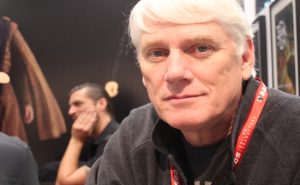
♦2016 marks the 30th anniversary of Portland’s Dark Horse Comics. As part of our celebration, we spoke to its President, Mike Richardson, who founded the company, to talk about how the company began, how it has changed in three decades, what Dark Horse Comics is now and much more…
TW: When you set up Dark Horse back in 1986, it was a comic market dominated by Marvel and DC. What was the initial impetus for you to create Dark Horse?
MIKE RICHARDSON: Way back in 1986 there were a number of factors that contributed to making the move. First, I was a comics fan, and I was tired of the Marvel and DC stories that seemed to be cranked out in the ‘70s and early ‘80s. I thought that their were better stories to tell. Second, I had become acutely aware, through the signings I at my comics shops, that the creators of the books I had enjoyed throughout my life did not have any ownership in their own creations. As an art major and former commercial artist, this was a real sore point for me. Finally, the rise of the Direct Sales Market offered new publishers the opportunity to print to order, a situation that allowed would-be publishers such as myself to avoid the potentially devastating returns the would undoubtedly result from traditional newsstand distribution. All of these elements, and my own growing entrepreneurship. gave me the impetus to launch my own publishing company,
TW: You had retail experience before setting Dark Horse up. It seemed to be a very bold move to shift from retail to publishing. What did you possess that made you feel confident that you could create and maintain a publishing company?
MR: I was raised with a sort of “just do it” mentality. I never really thought much about failing. Once I decided to get into publishing, I was focused on making the company work.I never really think about failure.
TW: How did you get Chris Warner and Randy Stradley on board the company?
MR: We were all members of a fan publication called APA-5, a ‘zine created by comics pro Mark Verheiden. Membership was limited to 35 members with a 15 person waiting list. Members created their own section each month and sent it to a “central-mailer” who collected contributions into a single book and mailed the resulting volume back out to members. APA-5 was focused on comics but there were other APAs dedicated to other subjects. Both Randy and Chris were APA-5 contributors, as were Paul Chadwick, Randy Emberlin, Frank Miller, Mark Badgers and others who went on to become comic pros.
TW: How do you think Dark Horse has evolved and changed in its 30 year history?
MR: Well, we started out with 2, myself and Randy, and we grew to 150 employees. In the beginning, Randy and I did everything from writing the books, pasting them up on a light table, creating the marketing plans, and boxing them up for the distributor. Now we have whole departments handling those chores. Our publishing schedule has expanded to include other types of books beyond comics. We have a toys and collectables division (Dark Horse Deluxe), a digital storefront (Dark Horse Digital), and an entertainment division (Dark Horse Entertainment). The entire industry has evolved from those early “wild-west” days of the Direct Market and, of course, we’ve evolved with it.
TW: Prior to Dark Horse, comic companies were predominantly based in New York. How important do you think it was that Dark Horse was based out of Portland, Oregon?
MR: It was important to us, since we lived here. The fact that most of the comics industry was based in New York and we were way out here on the other side of the country was extremely unusual at the time and it lent an air of mystery to our company. We saw things written that included phrases such as “…the mysterious Dark Horse…” and “…outlaw comics publisher Dark Horse…”. We loved it. Portland, I think, was still a mystery to most of the country back then. We had an amazing record of success in persuading comics people to move out here. I had three different tours that I took visiting creators and potential employees on in an attempt to get them to relocate here. I almost lost the Mignolas when I took a wrong turn out of the lava fields near Bend and it took us about 4 hours to get home. Over the years, we moved several hundred comics people into the area. Others came on their own. Today Portland is the comics center of the country with n abundance of talented creators and really great comics companies.
TW: On a related question, do you think the fact that it wasn’t based in New York has given it a unique attitude and tone separate from the New York publishers like Marvel and DC?
MR: I suppose that could be true, but since I had lived in Oregon all my life, I had no knowledge of their “attitude, and frankly, I couldn’t have cared less. We wanted to do comics our way, and we wanted to do them differently. Our initial line proved that: Concrete, The Flaming Carrot, Mr. Monster, Boris the Bear, and of course, Dark Horse Presents. Very quickly we were publishing Aliens, Predator, and finally Star Wars. We created those books in a way that was very fresh when considering how “licensed” books were done in the past.
TW: Did you ever imagine that the company would be celebrating its 30th anniversary?
MR: Honestly, it never occurred to me that we wouldn’t. The only surprise to me is how fast those 30 years have gone by.
TW: It seems that Dark Horse has always managed to balance creator owned books like Hellboy and The Goon with licensed properties like Aliens and Predator. Do you think this is one of the reasons that it has continued to survive over thirty years?
MR: Yes, I do. For the most part, I think the enthusiasm we have for the books we do shows. That plus the diversity (that word) we’ve built over the years. Not only do we have a varied publishing line, but we have the different divisions. When one part of the company suffers a down year, the others are there to pick it up.
TW: How has the comics industry changed since Dark Horse was set up back in 1986?
MR: Several major shifts have occurred over the last 30 years. First, the rise of the Direct Sales Market, that is, the rise non-returnable comics distributors who specialized in comics and related merchandise. This market allowed publishers such as Dark Horse to print to order, thus making it much easier to create a sustainable business plan. The number of comics shops grew also, as did the number of Direct Market distributors, due to the fact that there was now a source of comics and relate products became available. Unfortunately, the market focused on creating pseudo-collectables rather than building on the reader base. and many comics buyers were turned off. At one time, Dark Horse dealt with 19 different comics distributor, Sadly, that number now stands at one.
Another major shift is the rise of graphic novel sales in the traditional book stores. Though graphic novels sales had been rising in bookstores, I believe it was the success of Shojo manga that really fueled interest. As Shojo and manga in general slowed down, more shelf space was made available for comics publishers.
TW: And how has your role at Dark Horse changed over the past thirty years?
MR: The biggest change is in the amount of time demanded. Employee issues, growth planning, schedule development were all pretty easy when we were an eight person company. We could walk down to the local bar after work and plan an entire season. Now we have a lot of moving parts and a number of managers. Information has to be shared. More meetings and more planning are crucial. Things really do change as a company grows. My time is divided between the different divisions. I also continue to write. That was one of the keys to starting the business in the first place. Randy and I wrote and created much of what we did in the early days of Dark Horse. I smile now when I see someone wonder how come the publisher at Dark Horse is writing comics, publishers don’t write. When I started the company, I wanted to write, not publish.
TW: Dark Horse has always been very active in film development. Is this still the case and how important do you see film and TV as part of what Dark Horse does?
MR: Filmed entertainment has always been an important part of the company. We set up our first project early on. It’s a little known fact that Group W was trying to option Boris the Bear for television. When Jim and I couldn’t come to an agreement, they moved on to the Turtles. The rest, as they say, is history. I set up Dark Horse Productions, later changed to Dark Horse Entertainment, around 1990. Since that time, we’ve produced over thirty films and television projects. The number seems appropriate considering the anniversary. As we move forward, it seems comics have become an increasingly important part of the entertainment landscape, and we will be increasing our own visibility. We are in the midst of the second season of Dark Matter on SyFy channel with several new series on the horizon, and we are set to have our next feature begin shooting early next year based on Jeff Jensen’s Green River Killer graphic novel. We have a dozen or so projects in development at the moment.
TW: A question I have to ask. How much of an impact do you think the loss of Star Wars to Marvel has been for Dark Horse?
MR: Well, I’d be lying if i said that it had no impact. Sales clearly took a dip, and I might say it took a little longer than I expected to recover, but we’re seeing the climb back right now. We have an amazing schedule set for 2017, which should be our biggest year ever. In the end, though I would have loved to have published Star Wars forever, and the financial rewards are obvious, it may have worked out best that it went away. The title seemed to swamp the company’s profile, with new people over the last decade or more seeing us only as the Star Wars publisher. Now it’s gone and those people can take notice of the rest of the line. The property is in our rear-view mirror now and we don’t think about it anymore. I did say at a recent retailer meeting that I was positive that Marvel was about to publish the best Star Wars comics that could ever be published, and i knew that for a fact since they had announced they were going to reprint the Dark Horse books.
TW: You used to be well known as a writer but that seems to taken a back seat in recent years. Is writing something that you would like to return to at some point?
MR: Interesting question, since I’ve been writing all along. I wrote one of our last Star Wars books, Crimson Empire: Empire Lost, which did extremely well and was the third part of the series created by Randy and myself. Recently my graphic novel, 47 Ronin, illustrated by Stan Sakai, was named to the YALSA (American Library Association) list of Great Graphic Novels for Teens, and two of my recent graphic novels, Father’s Day and Deep Gravity, are being developed for film. So, I’ve never stopped. It is hard to promote yourself too much when you also happen to be the publisher. And, of course, as I pointed out earlier, everyone knows publishers can’t write.
Mike Richardson 30 Years Dark Horse www.tripwiremagazine.co.uk










You must be logged in to post a comment Login