

Feature
Throwback Thursday: A Clockwork Orange

For today’s Throwback Thursday, we present Peter Mann’s piece on A Clockwork Orange which originally ran in Tripwire Digital back in 2011…
40 Years of Kubrick’s Classic
Sad and obsessive teenage behaviour: on the day I watched A Clockwork Orange for the first time, I’d already been to see a double bill at the Birmingham Scala, (one half of which was Hammerhead (1968)), and after it I headed off to an all-nighter of Jack Nicholson movies in Quinton. Or it may have been a horror-film all-nighter in Birmingham. I forget for two principal reasons – drugs, and the fact that I spent most of my time between the ages of 13 and 19 either drawing, or watching movies. Sorting out which movies, and when is thus difficult, and probably the only reason I remember A Clockwork Orange is that to see it I had to travel out of the city centre to the ABC Bristol Rd – previously a Cinerama movie house. There I saw it, along with the equally ‘controversial’ (i.e., silly, but Oscar winning) Kama Sutra Rides again.
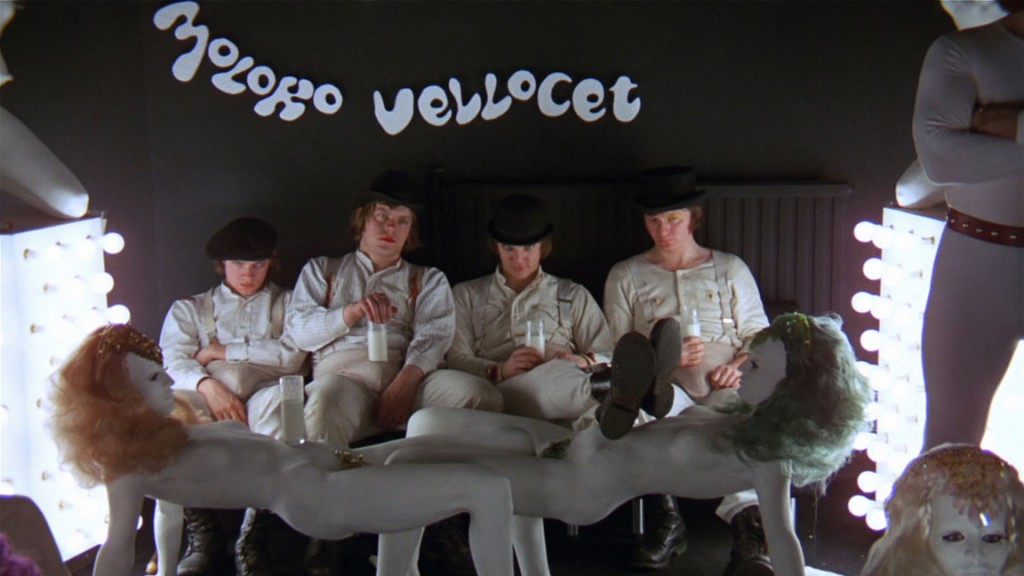
My overwhelming impression of A Clockwork Orange is still the quality of the music and the set design. Wendy (aka Walter) Carlos performed the music, probably using the 900 Series Moog Synthesizer she had previously used on Switched on Bach. The set design, specifically the Korova Milkbar was impressive – the Milkbar itself being inspired by the sculptures of English pop artist Allen Jones. ‘Inspired by’ here is a synonym for ‘plagiarised from’, as Jones had turned down Kubrick’s request to design it, on the fairly reasonable grounds that Kubrick didn’t want to pay him to do it.
The film itself struck me as a stylish, but largely uncontroversial version of Anthony Burgess’s excellent novel. Which shows how much I know, as immediately afterwards an atmosphere of moral hysteria was inculcated as reports of ‘copycat’ crimes filled the UK papers and various teenage miscreants blamed their misdeed on seeing Kubrick’s film. This struck me at the time as being unlikely: there’s a lot of classical music and ‘art’ to put up with in the film, and I don’t remember a queue of skinheads at the cinema. I do remember skinheads however, and I suspect it was unfortunate that Kubrick released his film featuring juvenile thugs with a clear-cut uniform at the precise moment that Britain had an army of juvenile thugs with a clear-cut uniform on the streets. Skinheads having roughed me up a few times in my youth, I don’t think many of them saw an art film running over two hours. Their lawyers now, that’s a different story.
So, is the film ‘controversial’ or not? The elements that have most caught the headlines over the years are straight from Burgess’s book, as is the three act narrative structure. A Clockwork Orange is set in England in the near future. Alex is a Beethoven-loving gang leader, whose favourite pastimes are mostly of the violent kind. Alex and his gang – his ‘droogs’ – speak in Nadsat (from the Russian prefix for ‘teen’), a form of Russian-influenced English. Nadsat is used less heavily than in the book, but the opening lines are peppered with it:
“There was me, that is Alex, and my three droogs, that is Pete, Georgie, and Dim, and we sat in the Korova Milkbar trying to make up our rassoodocks what to do with the evening. The Korova milkbar sold milk-plus, milk plus vellocet or synthemesc or drencrom, which is what we were drinking. This would sharpen you up and make you ready for a bit of the old ultra-violence.”
Vodka and Red Bull, anyone?
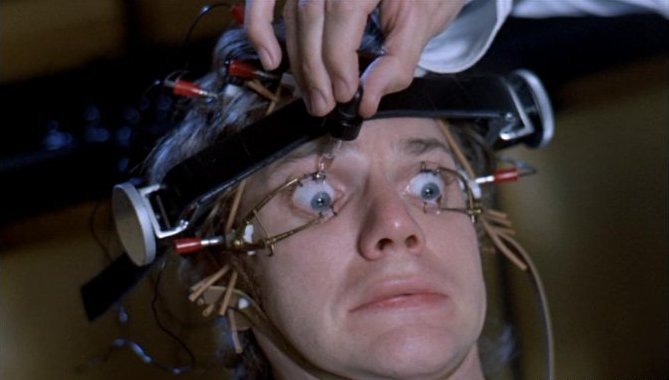
 We follow Alex on his odyssey of sex and ultra-violence, culminating in Alex bludgeoning a woman to death, and being abandoned unconscious at the scene by his droogs. Alex ends up in prison, where he agrees to try aversion therapy – the Ludivico Technique – to shorten his jail sentence. Alex is drugged and strapped to a chair, with his eyelids kept open, and forced to watch violent films. The drugs cause Alex to be physically sick at the violence, but have a side effect: the film soundtracks are by Beethoven, and the Ludovico Technique destroys his love for classical music.
The treatment ‘successful’, Alex is released back into society, but unable to protect himself from his former colleagues (and his former victims) he ends up injured in hospital. Psychological tests show that Alex no longer has an aversion to violence. The government offer Alex a well-paid job in reparation for his trauma. In his hotel room, the stereo playing Beethoven’s Ninth Symphony, Alex envisions himself having sex in the snow with a woman in front of applauding Victorian onlookers.
“I was cured, all right!”
A Clockwork Orange caused outrage on release, and here it’s interesting to compare and contrast with another controversial film released in the same year, Dirty Harry.
Dirty Harry was described by Newsweek as “a right-wing fantasy”, by Variety as “a specious, phony glorification of the police and police brutality with a superhero whose antics become almost satire” and was accused by Pauline Kael in The New Yorker of a “single-minded attack against liberal values”.
Contrast this with criticism of A Clockwork Orange, which was almost entirely focused on the likely effects on the audience, who are assumed to be mostly potential juvenile offenders.
“…the adventures of the psychotic Alex rampaging to music, are likely to have a more sinister effect on those who see for the first time a fantasy realised on the screen. … A fantasy of exciting violence … a subversive tribute to the glory of youth” Maurice Edelman.
Once this narrative was established it was hard to break:
“At the Old Bailey we kept seeing people on assault charges who had seen the film and been impelled to go out and beat someone up. Most of us who worked at the court thought this a load of rubbish but unfortunately such cases got a lot of publicity and many judges would impose lesser sentences in these cases. It got to the stage when we referred to these cases as ‘Clockwork Orange defences’ and it came almost boring as one after another tried using this excuse” Mike Purdy.
The Daily Mail reported the murder of Frank Boulton, a 50-year-old wood seller: “In the film A Clockwork Orange, banned in some towns because of its violence, a kinky group of teenagers in fancy dress savagely attack an old tramp, leaving him for dead.”
Steadily this wave of hysteria spread, exacerbated by 70s decency campaigner Mary Whitehouse, and local authorities began to ban the film from their cinemas. Kubrick became more distressed by the ‘controversy’ and after 61 weeks on release pulled A Clockwork Orange from UK cinemas, the self-imposed ban lasting till his death in 1999.
Anthony Burgess still curses Eric Swenson of W.W. Norton, his American publishers. Their version of the book, which Kubrick used for the film, omitted Burgess’s postscript in which Alex is shown grown-up and “putting violence by as a childish toy”.
Both A Clockwork Orange and Dirty Harry are products of their time, at different ends of the same discussion about the rights of society versus the rights of the individual. In the 1960s and 1970s social mores were loosening to a degree not seen since Regency England, and probably never seen at the level of the working class. The on-screen thugs of Kubrick’s film were already present on the streets of England, and were unlikely to be influenced by it: their culture predated the film. The film was a useful whipping boy for those who worried about social change in the same way that Dirty Harry was a reaction to that change. The question – society versus the individual – has never been satisfactorily answered, and probably never will be – there are simply too many variables.
Is A Clockwork Orange a good film? As an effective piece of filmmaking I prefer Dirty Harry. Burgess and Kubrick seem to me to be loading the deck in favour of their argument. Dirty Harry does exactly the same thing, but is a more effectively directed and honest film.
I’ve never been convinced by the “Kubrick as genius” argument. Many of his films have ineffective endings and tip over into unintentional comedy – the ending of The Shining comes to mind. A Clockwork Orange has brilliant set design, marvellous music, first-rate acting, but is ultimately unpersuasive. Treated as a big budget science-fiction/horror film it’s enjoyable, but you’d rather see Alien. In reality it is the myth of the film, resulting from its decades long banning in the UK, that gets it accorded such interest.
PETER MANN











You must be logged in to post a comment Login