

Comics News
Tripwire Talks To Chris Weston


The Weston Front
Tripwire’s contributing writer Paul N Neal just caught up with artist Chris Weston to talk about 2000AD, working for DC and more in this extensive interview…
Paul: Chris, I’d like to start our discussion as I always tend to do. I’d like to ask when your relationship with comics began. What were the first comics you really recall enjoying? Did you buy them for yourself or were they given to you? Which titles were they, and did they begin to inspire you toward creating your own art?
Chris: I had a great Dad who used to buy me loads of comics when I was a kid. They were mostly British comics like Victor, Bullet, Hotspur, Lion, and Valiant. He understood that they were serialised stories and he made sure I never missed an issue. He used to read them too. We’d discuss them and come up with ideas about what would happen next. I think he loved reading them as much as I did, so I was quite surprised to discover that most people considered comics to be for kids only. I was an army brat and mostly grew up abroad without a TV. Comic Books and drawing were my prime source of entertainment. All the kids I knew were heavily into comics and we’d swap them or lend them to each other. The Asterix and Tin-Tin books were really popular too and all the libraries stocked them. I rarely encountered American comics, but I quite liked the Batman and Superman books when I could get my hands on them. All my friends seemed to be into comics too and discussing them was very much a part of our daily lives.
Paul: I think that was true for all of us.
Chris: My first great “comic love” was Vulcan Weekly. It reprinted the best of Fleetway’s strips like “Archie The Robot”, “The Steel Claw” and The Spider. The quality of artwork on those last two strips was astonishing. However, the highlight of that comic was The Trigan Empire, painted in full-colour by Don Lawrence. It blew my mind when I first saw it at the age of six. I collected every issue and was quite horrified when my Dad cut out all the Trigan Empire pages. He had a reason, though: he gave them to my uncle who was a professional bookbinder and restorer who worked at the British Library mending historically important books (such as The Domesday Book). My Uncle bound all those Trigan pages into a single book and it remains one of my most treasured possessions.
Paul: Did comics inspire your love of art and creating your own art?
Chris: Yes, definitely. They went hand in hand. Even as a kid I used to draw my own comic book stories. I used to draw this strip called Dustbin Army about living dustbins that used to fix army vehicles. It was obviously inspired by my Dad who was in the Royal Electrical & Mechanical Engineers. I was always copying pictures from comic books, mostly because I wanted to put posters up on my walls of my favourite comic characters and no-one seemed to be selling any; so, I made my own. I wasn’t an outgoing, sociable sort of child. I preferred to spend all day indoors drawing or reading comics. I used to go to the cinema a lot, though. As I said before, I was mostly raised without a TV, so my parents would go and see lots of films instead. They usually took me, and I saw all sorts of age-inappropriate movies. The cinemas on the army bases never used to worry about that sort of thing.
Paul: How did you first come to be published in 2000 AD? Were you a fan beforehand?
Chris: Yeah, I was a huge fan. I started reading it from Prog 3 and have been a loyal reader ever since. I think most people know how I got into drawing comics for a living. In fact, they’re probably sick of hearing me go on about it! When I was thirteen years old, I discovered that Don Lawrence, my favourite artist and the co-creator of The Trigan Empire, lived close to me! I asked if I could visit him, and he generously agreed. It is with much embarrassment that I must confess I probably pestered the poor fellow by occasionally asking him if I could visit him again to watch him work. Luckily for me, he tolerated my presence without complaint, and these visits went on regularly for another few years. During this time, my desire to become a comic-book artist took full possession of me. Eventually, Don offered me a year’s full-time apprenticeship, something he’d already granted to my friend Liam Sharp.
Paul: Liam is a legend I agree.
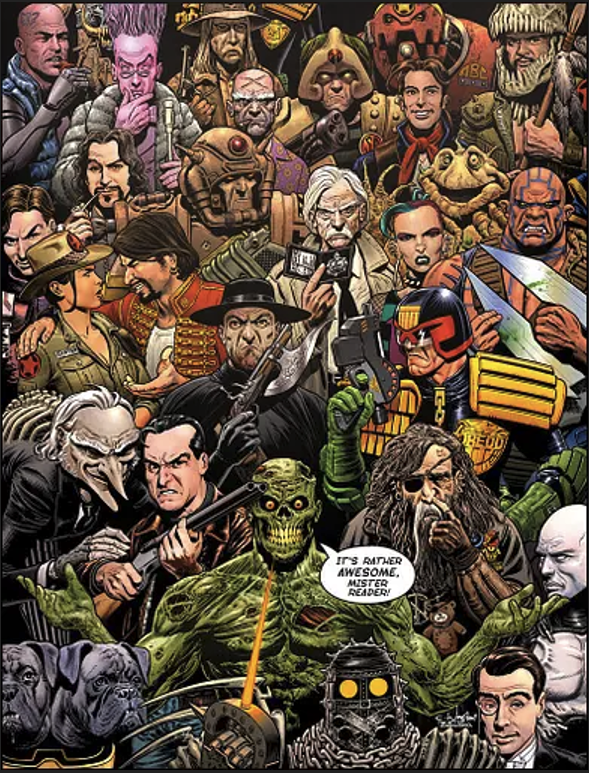
Chris: I quickly agreed and after a year studying under Don, (who turned out to be a brutally honest taskmaster) I had a portfolio strong enough to present to 2000 AD. I also owe Don’s old artistic agent, Pat Kelleher at Temple-Rogers a huge debt of gratitude for taking me on his books and introducing my work to Richard Burton, the editor of 2000 AD. As you can see, I have been the beneficiary of extremely good fortune, and I have never stopped counting my blessings. I have constantly tried to earn this glut of good luck ever since by pouring my heart and soul into my work. I think it’s one reason why I produce such detailed artwork: to make up for the years of rejection I avoided at the beginning of my career thanks to people like Don and Pat and to shoo away the guilt that constantly gnaws away at my confidence.
Paul: What was your first published 2000 AD work? I would imagine it must have been a thrill to see your art in print in the Prog?
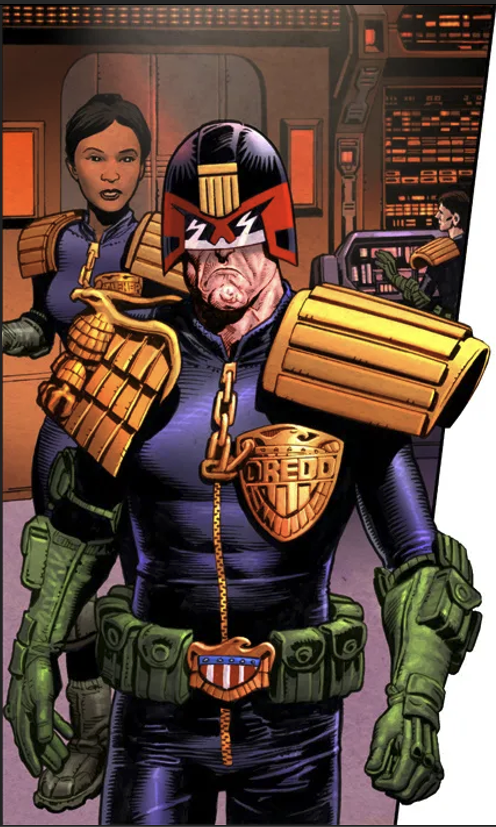
Chris: Oh, it was a dream come true. I had two Dredd pin-ups published first, and then I was thrown in the deep end with Judge Dredd: A Night at The Circus. My artwork was quite abysmal, but in another stroke of luck, there was a shortage of artists at the time, so I think that helped secure me the job. Most of the A-list talent associated with the first ten years of 2000 AD had buggered off to work for US comics publishers; people like Bolland, McMahon, Cam Kennedy, Kev O’ Neil, Brendan McCarthy, Dave Gibbons etc. That left a huge hole that needed filling and I was part of the second wave of 2000 AD artists who took the comic into its most derided era: The Nineties. My delight at seeing my name within the pages of The Galaxy’s Greatest Comic didn’t last too long, as the flaws in my work soon became apparent, even to my arrogant young self. After a couple of Dredd stories, I was taken off and given some Future Shocks to draw. This is traditionally the first place new artists get to show their stuff, so it felt very much like a demotion at the time. But it was a sensible move; I wasn’t ready for Dredd. I needed to learn my trade slightly removed from the main spotlight. I was very fortunate that Richard Burton and Alan McKenzie felt I had something worth nurturing. I can remember the day I picked up the Prog that contained one of Dougie Braithwaite’s Dredd stories. His artwork was so good, and I realised then how far I had to go. It was quite a tough thing to suddenly become aware of your shortcomings. I became very depressed about it.
Paul: How did your career with 2000 AD progress?
Chris: Quite steadily. After what I considered to be a sensible “demotion” to Future Shocks, I then progressed onto an irregularly-scheduled strip written by John Smith called Indigo Prime. This was right up my alley! I was heavily into psychedelic music at the time and used to frequent underground garage-punk nightclubs in Brighton with all their weird liquid lightshows. Basically, while everyone else was Raving and enjoying the Second Summer of Love, I was busy experiencing the First! With Indigo Prime.
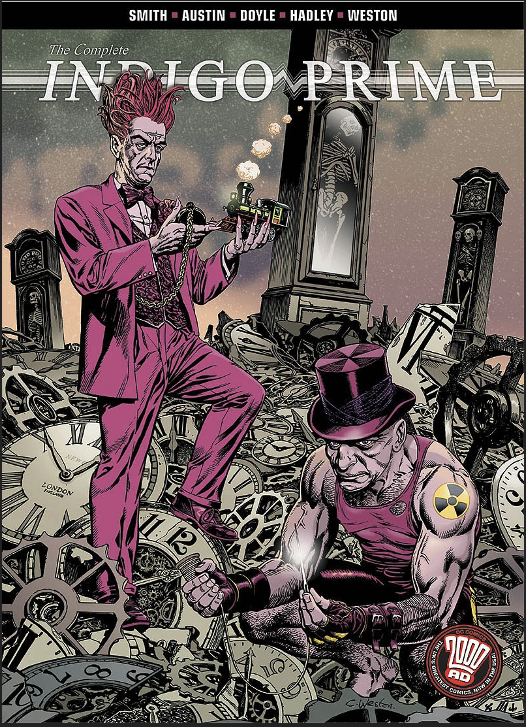
Chris: I found a perfect vehicle to do weird and trippy artwork that complemented the music and lifestyle I was living at the time. The psychedelic imagery of the Sixties drew heavily on nostalgia for Victoriana, and I was into that too. I used to have a huge volume of Victorian Punch magazines and I would pore over all the amazing illustrations it contained. I would marvel at the detailed level of crosshatching involved. All these influences seemed to coalesce in my head, and one day I came up with the idea of a time-travelling steam-train, one year before the one that appeared in Back to The Future 3. I thought this would be a good idea for an Indigo Prime story and so I told John Smith about it. He liked it and added the notion of having Jack the Ripper aboard the locomotive. Genius! And so Killing Time was born. Luckily this story proved really popular with the readers of 2000 AD, mainly because it was possibly a refreshing antidote to all the acrylic-heavy Bisley-inspired art that pervaded the comic at the time.
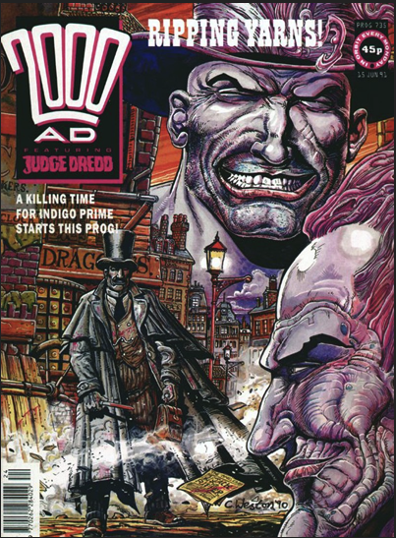
Chris: The first few chapters of Killing Time were drawn in a scratchy pen and ink style, with ink washes. This turned out to be too time-consuming, so I switched to using colour markers as the series progressed. Strangely, this change in materials and style really suited the narrative, as the time-travelling train moved out of the Victorian age and into a strange and psychedelic landscape. Apparently my violent and over-detailed art was really popular with the schoolkids who were questioned as part of a market research campaign conducted for the creation of a sister-paper for 2000 AD called Alternity!
Paul: Was Killing Time popular?
Chris: The popularity of Killing Time did a lot to boost my confidence after the battering it took after my earlier “demotion”. These green-buds of pride were soon crushed mercilessly beneath my mentor Don Lawrence’s heels, when he gave a scathing critique of the art I was doing at the time, telling me I just couldn’t draw at all! It was pretty devastating to hear that, I’ll be honest. I felt like giving up my comic career, and maybe I should have, because I could see what he meant: my work may have been weird and imaginative but, underneath it all, my basic illustration skills were still quite poor. But like Zack Mayo in An Officer and a Gentleman I couldn’t quit because I didn’t have anywhere else to go! I just had to crack on, do some life-drawing classes, put in the hours and improve.
Paul: Can we discuss Canon Fodder?
Chris: I think you can see my work improve considerably during my time on the strip I did next: Canon Fodder. This was written by a newcomer on the comics’ scene called Mark Millar and it followed a similar template to Killing Time: famous Victorian characters going on a trip into a strange and surreal reality. This time it was Sherlock Holmes instead of Jack the Ripper. The Canon Fodder character himself was a thinly disguised rip-off of Marshal Law, Mark’s favourite comic strip at the time. To be honest, I didn’t think the story was that good. The sequel, written by Kek-W, was much better. However, Mark was a lot of fun to work with. He was very funny and we’d chat on the phone for hours, laughing our heads off. The calls soon dried up once he got given more talented artists like Bryan Hitch and Frank Quitely! That’s showbiz!
Paul: Could you describe how you made your choice to work for American Publishers? Your Fantastic Four First Family with Joe Casey springs immediately to mind.
Chris: Fantastic Four: First Family followed a much longer run over at Vertigo/DC Comics where I drew Swamp Thing, The Filth, The Invisibles, Time Breakers, Garth Ennis’ War Stories, The Authority, Enemy Ace, Time Breakers and Lucifer. It was quite an extended run, and I was astonishingly prolific by my usual standards.
Chris: I came to DC Comics as part of a “bumper package deal” with Mark Millar & Grant Morrison. I guess I was part of their gang when they made the jump to US-based comics. Mark and I had just revamped 2000 AD’s Rogue Trooper following our work on Canon Fodder, but he was already contemplating a step across the pond to work at The Big Two.



Chris: He was extremely ambitious and quite canny when it came to upwardly mobile career moves. He knew how to charm the right people, and he was a lot of fun to be around. He introduced my work to Stuart Moore, an editor at Vertigo/DC and I was given an issue of Mark’s Swamp Thing monthly during his River Run arc. That was my US comics debut and I would work exclusively there for the next decade, roughly. It was an exciting time to be in comics, there seemed a lot of opportunities to be had and fortunes to be made. There was a little gang of us: Mark & Grant, Steve Yeowell, Frank Quitely and Jill Thompson, when she was in town. It was probably the only time of my life when I’ve ever felt like I was in with in-crowd. I think we had quite a bit of buccaneering swagger to us that had yet to be worn away by hours of long work and deadline stress (the less-than-glamorous reality of making a living in the comic book industry). Eventually Mark & Grant’s relationship imploded spectacularly, and Grant got me in the divorce deal. Mark went off to do The Ultimates with the super-talented Bryan Hitch. It was the most high-profile, ultra-commercial comics project you could imagine at the time. In contrast, Grant and I created The Filth, which was the exact opposite: complicated, obscure and challenging. Grant often said The Filth was a result of the depression and illness that plagued them at the time, and it’s easy to see that within its pages. However, I think it holds up well, though.
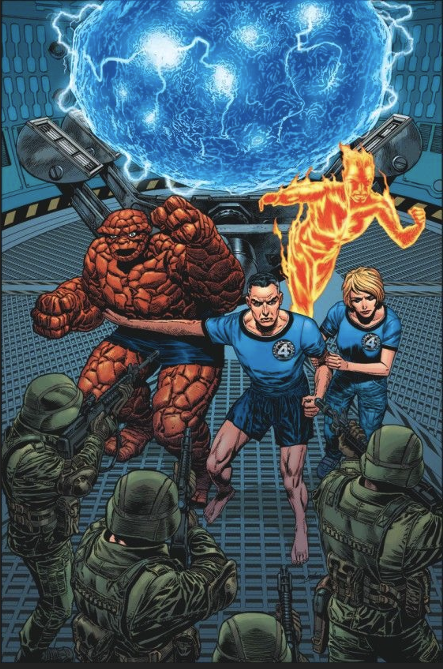
Chris: By the early 2000s, I had turned out an incredible number of pages under an extremely stressful series of deadlines. But somewhere along the way I was losing pride in the finished results of my work. I think it was just a classic case of burn out but it took me a long time to diagnose that in myself. Joe Casey offered me the job as artist on his Fantastic Four: First Familyseries over at Marvel and I made the leap. It was an origin tale, designed to cash in on the release of an all-new Fantastic Four movie.
Chris: Again, Joe was good company, and in the breakdown of my relationships with Mark & Grant, I think I may have relied on him too much as a replacement. To my shame, I did tend to pester him with a lot of phone calls, but he endured them politely. Gary Erskine was inking me on that again, too. He had also worked with me on The Filth and we made a great team. I think we already had similar and complementary styles to begin with. In fact, his work on Warheads was a huge influence on my early work; it was like a beautiful combination of Garry Leach and Geof Darrow.
However, I’m not sure how much fun it was for him to ink me on Fantastic Four: First Family. My pencils were detailed and polished enough to be considered finished artwork, and you could easily have printed the comic from them.
Paul: Could you describe how you made your choice to work for American Publishers? Your Fantastic Four First Family with Joe Casey springs immediately to mind.
Chris: There was very little wiggle-space for him to bring himself to the job. I don’t know if this reluctance to loosen up was ego or Insecurity on my part. Probably a bit of both, but it wasn’t much help to anyone. Also, it didn’t turn out to be the most economical of decisions, either: I was then producing highly rendered art for a reduced pencil rate, and I had less original art to sell as it was shared with the inker. On Fantastic Four: First Family, I let Gary keep all the finished art, as I had produced them through a blue-line technique, where I sent him the pencils digitally and he printed them out in blue ink and inked those. Being slow, I relied quite heavily on the sales of original art, so the loss of this income hit me quite hard.

Paul: Could you please explain how illustrating The Twelve with JMS came about please? And why was there such a huge time gap between the last few issues?
Chris: The Twelve was the moment when the wheels on my US Comics career came flying off spectacularly. Aubrey Sitterson was the commissioning editor, but he soon left the company to pursue his career elsewhere. This was the first disappointment for me on the book as I’d built a nice relationship with him, and I knew he had my back. Progress on the book seemed to falter quite quickly after that. I don’t think Joe Michael Straczynski’s own relationship with Marvel was in that good a shape: there had been some disagreement over the One More Day storyline for Spider-Man.

Chris: JMS has since admitted publicly to having had some health issues that he didn’t want to discuss at the time. This is quite understandable. He’s entitled to his privacy, but at the time the lack of communication was extremely frustrating. Scripts dried up with no explanation or offers of substitute work from Marvel. I was already in a bad financial situation, because I still hadn’t learnt my lesson about doing pencils: I put way too much time and detail into them and didn’t receive a wage appropriate for the effort I put in. It was a really worrying time, financially. I became very stressed over the situation and frustrated at the perceived lack of leadership and communication from the other parties involved in the series.

Chris: The lateness of the book attracted quite a bit of derision from the fans, and I even received some hate mail, which wasn’t very nice. I didn’t want to damage my already fragile relationship with JMS or Marvel by screaming “It’s not my fault!”. So instead, I wrote and drew my own fill-in issue called Spearhead and after that the criticism I was receiving seemed to evaporate. The main book still wasn’t proceeding on schedule, and my financial situation was growing direr by the day.

Chris: And then, out of the blue, I was thrown a lifeline: I got an offer to be the concept artist on The Book of Eli, a big-budget sci-fi film starring Denzel Washington and Gary Oldman. I’d always wanted to work in films, and I needed the money, so I took the job. Tom Brevoort, the editor on The Twelve was very understanding about it and gave me his blessing. Working on The Book of Eli with director Albert Hughes turned out to be one of the most enjoyable experiences in my life, and to this day I bore people rigid with my “Gary Oldman stole my kettle!” anecdote. I made so many new friends on that film, and got to travel round New Mexico; it was life-changing. I didn’t feel too bad about adding to the delays on The Twelve as I knew JMS had done some extra film work of his own during his time on the book.

Chris: Once The Book of Eli was over, I came back to complete the remaining issues of The Twelve. This time, it went far more smoothly; the scripts were (mostly) on time, and I was inking the pages myself. I don’t think all the delays helped the sales of the book at all, and I have to accept my fair share of the responsibility for that. However, I think it’s a quality product, and I think I deserve some credit for staying loyal to it throughout its troubled production. It was frequently tempting to walk away from the project, but I was determined to push the book over the finishing line.

Chris: I am really proud to be part of the finished book, even if it did nearly bankrupt me. I’m convinced that a sequence from the opening chapter of The Twelve ended up in the Captain America: First Avenger movie. It seemed identical, but Marvel claimed otherwise. They owned the rights to it, so they could loot it any way they wanted, but they denied it had any influence on the film script.

Chris: The Twelve even received an Eisner nomination for Best Limited Series. I was able to attend the ceremony, as I was at the San Diego Con that year, taking part in promo-activities for The Book of Eli. I was sat next to JMS, and the thought of meeting him in person for the first time was a bit daunting. I had no idea if there was any bad blood between us. By that point we’d both taken a turn in being the villain of the piece, but I was still relieved when no fisticuffs broke out between us. I can’t say we really bonded, though, either: JMS was suffering from a nasty dose of laryngitis at the time, or that might have been a good excuse for him to not talk to me. There was an embarrassing moment during the Eisner ceremony when the nominations for Best writer were announced. When I heard Grant Morrison mentioned as a nominee, I whooped, clapped and cheered my head off out of loyalty to my Filth partner. Unfortunately, the next nominee to be announced was JMS for The Twelve, and he was sat right next to me! Obviously, I then had to whoop and cheer at an EVEN MORE insane volume to eclipse the support I gave Grant. I must have looked like a complete nutcase.
Chris: I think JMS warmed to me, somewhat, despite his inability to utter a single word in my direction. We got some photos together, though, including one where he mimed stabbing me in the back with an imaginary knife. Unfortunately, the photos were taken on his partner’s camera, and I suspect he decided against sharing them with me… or the rest of the world. But we follow each other on Twitter now, and he always praises the work I did on The Twelve, which is appreciated.
Paul: Could I backtrack a tiny bit. Might you possibly be able to explain “Gary Oldman stole my Kettle” please? It sounds like a fun story.
Chris: I could have sworn everyone was sick to death of my “Gary Oldman Stole My Kettle” anecdote. Just in case there is, indeed, a rare person who somehow managed to avoid it, here we go: When I went out to Albuquerque, New Mexico in 2007 to work on The Book of Eli I found myself almost alone in the studio as someone who required regular and frequent infusions of English tea in order to keep functioning. I’d anticipated this situation and smuggled a massive bag of PG Tips through customs, enough to keep me going through production. The New Mexican crew seemed to survive exclusively on coffee, a drink I couldn’t stand. Luckily, a lovely production-assistant called Brian bought me my own kettle to brew up with, and all was right in the world.

Chris: Gary Oldman had been cast as the villain, Carnegie, and there was much excitement in the production offices as we anticipated his arrival in Albuquerque to begin work on the film. I remember a production assistant holding up a sheet of fax paper (ask your parents what that is) as she declared: “Hey, we’ve just heard from Gary’s people. They’ve sent his list of wants!” I looked at the sheet expecting to see all sorts of Hollywood diva demands, like the classic bowl of M&Ms with all the brown ones removed. To my surprise, Gary Oldman only had one single request on his list: a bag of PG Tips! This warmed my heart! Gary Oldman, A-list, LA-based superstar for nearly two decades was still keeping it real!
I never saw Mr. Oldman arrive on set, but his presence was made aware to me on a Monday morning when I went to the studio kitchenette to make my first brew of the day: MY kettle had disappeared! “Uh, has anyone seen my kettle”, I asked?
“It’s in Gary Oldman’s trailer.” I was told. Gary Oldman stole my kettle? Well, in truth, it had been given to him by another production-assistant, so I doubt he was aware of the larceny. But it was a gentle reminder of my place in the pecking order. However, I shamelessly milked my mock-outrage for as many laughs as I could get! Eventually I got to meet Mr. Oldman in person, and he turned out to be a diamond. He was down to earth and a good laugh. He didn’t display any superstar airs and mingled amongst all the cast and crew as if he was just one of the gang. I was even able to pretend-scold him for stealing my kettle! “Ah, mate, sorry about that!” he giggled! But I ‘forgave’ the infraction and even granted him access to my own massive sack of PG Tips!
Paul: Wow. That is a great story. Could I please ask how as an artist has technology changed the way you create your artwork? …and for that matter if it has altered you own personal reading habits in regard to comics?
Chris: It hasn’t really affected it too much. I introduced computers into my art about 20 years ago and not much has changed since. I always used photo-reference in my work, and the computer is just a much more convenient way of handling and manipulating those resources. I create a collage or montage that can then be printed out and light boxed. Previous to owning a computer I’d have done that by photo-copying the photo-reference at the required size and then literally gluing the panels onto a board. This was then photo-copied again and light-boxed. The computer streamlines this process and increases your options. Despite being taught by Don Lawrence, I was always more drawn to Frank Hampson’s way of working where he created props and models and made extensive use of photographic reference. The difference is, Frank had a studio of about five assistants who helped create this material. I’m on my own but having a computer helps make up for that. What has been a great boon is the online resource for 3D models. If I want a particular make of aircraft or car, it’s very easy to find. I can download it and manipulate it into the precise angle I require. Before, I’d have to go to the library, find a book containing the approximate reference and swipe it from there. So, the computer helps the art come out much more accurately than the way I saw it in my head.
Paul: How does colouring work for you now?
Chris: Whenever I colour my work, it is mostly done on the computer too, but in my heart, I wish I still hand-painted the pages. Full-colour original art looks so much better when you hold it in your hands. However, with “analogue” art, you have to ignore the parts you wish you could have changed. Not everything comes out the way you want it, but in real life, you don’t have “Command-Z” to erase your mistakes. But that’s okay, the readers don’t know how you saw that in your head. They may actually like some of the choices you made that you personally are not so keen on. I’m reluctant to go full-digital, mostly because I’m too lazy and can’t be arsed to find the time to teach myself the digital skills required. But, also, I like having finished artwork in the real world, as it gives me a decent supplementary income from selling the original pages.

Chris: I’ve never really got into digital comics. I’ve never owned an iPad or any other kind of tablet, so the opportunity has never arisen. I’m just not interested. I like my comics on paper; the rougher and pulpier the better. I don’t even like comics that are printed on glossy paper. I like my art in matte!
Paul: That is a truly fascinating answer. Thank you. After your spell working in America, you seem to have come full circle and returned to 2000 AD. Would you say working for Tharg is your “spiritual home” as an artist?
Chris: Oh, definitely. Much as I’m proud of my US comics work, a lot of it has been accompanied by some notable amount of drama or stress. I can think of several times during my career when I retreated back to 2000 AD to lick my wounds or recharge my creative batteries in a more relaxed and friendly atmosphere. You won’t believe what a huge sense of relief it is to get another script from them. Drawing Judge Dredd is one of the greatest jobs on the planet, and I’m delighted to be given the chance to do that. I’m in great company, when you consider some of the incredible talent who have worked on the strip in the past. The current crop of artists who work on the comic are damn good too, like Staz Johnson, Dylan Teague and Patrick Goddard. They keep me on my toes!
Paul: 2000 AD is pretty cool.
Chris: 2000 AD is one of the few places where I can get to do the whole thing: the writing, the pencilling, the inking and the colouring. I really feel like I can deliver a 100% authentic “Chris Weston” product there. I’ve also been lucky to forge a creative partnership with the writer, Rob Williams on Judge Dredd. Brainstorming Dredd ideas with him is really great fun. I occasionally declare pompously that I’ve done my last Dredd story, but I soon relent whenever I get the chance to do some more Sensitive Klegg with Rob. He’s got a real knack for comedy, and our phone calls (when we knock our Dredd stories together) make me laugh so much.

Chris: I think it’s about time Rob and I did something creator-owned together, and we frequently run ideas by each other. However, we just haven’t found the right project yet. I’m sure it will happen one day. We’d have to do that outside of 2000 AD, though, as they don’t run creator-owned strips, unfortunately. There isn’t really an incentive to create new strips for a company if they aren’t going to share a healthy percentage of the potential rewards with you. I think it’s very important for creators to have a decent stake in their creations, and it’s nice to know I’ve got some Filth, Ministry of Space and Time Breakers in my back pocket just in case Netflix want to throw some serious money in my direction for an adaptation. I won’t hold my breath though; that gold rush seems to be over.
Paul: The COVID pandemic interrupted the entire convention scene for all comic fans, but can I ask if conventions are a part of being a professional comic artist that you enjoy? …and do you have any fun convention stories? Have you ever been star struck by any celebrities?
Chris: I don’t do too many comic conventions. I tend to turn down more than I accept. I put in long hours of work on the weekdays, usually working late into the night, so I want to devote my weekends entirely to my family. I’ve never really made large sums of money at a convention so I can’t even justify attending them as a supplement to my income. I tend to think of them as a young person’s game, and I’m increasingly finding the sheer physical act of hauling my banners, t-shirts, sketchbooks and prints across various forms of expensive public transport (in order to get to a convention) way too much hard work. “I’m too old for this shit!” I often mutter.

Chris: That said, once I’m at a Con, I usually enjoy myself! I love seeing all the cosplayers and getting to hang out with my friends and colleagues. And it’s great catching up with the punters and familiar fans. They all seem to be really lovely people and I’m very grateful that they dig my work so much. Occasionally I’ve done a foreign convention and they’ve been enormous fun. I didn’t get into this job to become a celebrity, but I have to admit it can be quite nice when you get treated like one. However, it takes me a long time to recover from a Con; they usually wipe me out for days after and I lose a considerable amount of time that could be spent drawing.

Chris: Earlier in my career, I attended a few conventions in the USA, and they were pretty riotous. I tended to hang out with all the same British creators that I hung out with in the UK, which was kind of ridiculous. We could have saved ourselves so much money by not blowing it on expensive plane flights and hotels, and just met up in the pub back here in Blighty. But it was great fun back in the Vertigo days to go to San Diego with Grant Morrison, Mark Millar, Frank Quitely, John McCrea, and the rest of the UK gang. It’s the only time in my life that I’ve felt like I was one of the cool kids. The night Grant and I met a Bizarro cosplayer and took him with us to a DC comics party will always stick in my memory. He stayed in character all night, following me about and I ended up having to buy him loads of drinks because he didn’t have any money. I began to wish I had some blue Kryptonite to ward him off with!
Paul: So, what does the future hold for you?
Chris: I think it makes sense to do more creator-owned work, and to that end, I’ve allowed myself to be lured back to a US-based comics company for a new mini-series. I can’t reveal any more than that, sadly. But I’m sure I’ll always make the occasional appearance in 2000 AD if they’ll have me. I don’t think I’ll ever completely cut my ties with them. And I’ll try to do the occasional film job too, just to boost the old bank balance. I recently finished some character designs for the John Wick spin-off show which was really good fun. I designed a batch of crazy, 70s-exploitation-style assassins. Seeing them brought to life was so thrilling. I also did some work for the costume department on The Flash, but who knows if any of that will see the light of day!









You must be logged in to post a comment Login