

Interview
Throwback Thursday: Joe Quesada

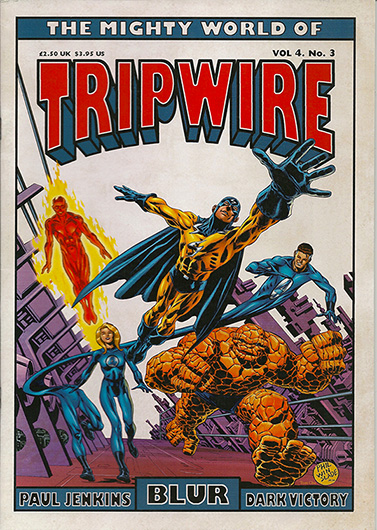
For this week’s Throwback Thursday, we rerun our interview with Joe Quesada taken from Tripwire Volume 4#3, published way back in December 2000, when he had just been made Marvel’s Editor-in-chief
Nice Knight For It
 TRIPWIRE: As you were at Marvel Knights for three years, you know the company pretty well anyway. Do you think that the recent inclusion of Axel Alonso and Stuart Moore as editors has changed Marvel at all?
JOE QUESADA: It’s a little too soon to tell because neither of them have been here for very long, so these guys are just starting to get their feet wet here. But I think that it’s changing the chemistry here in editorial because they have come in with a certain perspective on comics that hasn’t been seen at Marvel in many years. The editorial core that we have here, while they’re great, have been through corporate hell over the last few years, not knowing which way to turn and which way the axe will fall. Stuart and Axel bring a whole different mentality, so it’s a meeting of the minds and things are starting to gel.
TW: Now that Marvel has had a big change at the top, do you think that it increases the pressure on DC to do the same and get a new face in the equiva- lent position there?
JQ: It’s hard to say. You would hope so but DC have also been very good at stay- ing the course and laying low, so consequentially, they law low during good times and during bad times, so you can always find them in the same spot. I don’t know if it’ll force them into doing anything because they’ve kept the same straight poker face through good and bad times.
TW: So Stuart Moore is in charge of the Marvel Knights line but he has said that, because it’s a successful line, his job is to steer it in the same direction and hope that he’ll be able to maintain thing.
JQ: Stuart comes in with his own sensibilities and if I just wanted a carbon copy of me, I would have looked for someone like that. He comes in with his own ideas of what comic books should be. Another thing that’s happened is that the attitude of Marvel Knights has been slowly bleeding into regular Marvel editorial, which is why guys like Jenkins are starting to get work on some of the mainstream books. Eventually Marvel Knights was going to have to find its own voice and I think that’s what Stuart brings to it. He brings in a whole new sensibility to stuff that I never would have thought of in a million years and he’ll continue to redefine Marvel Knights and bring it into the next year.
TW: Michael Straczynski is taking over as regular writer on Amazing Spider-man. This will mean that you’ve got one book in the line with a celebrity writer. How do you think this will help Spider-man in general?
JQ: There is something to be said for the whole celebrity factor. We’ll get some immediate play on that but I think if you read his work, you’ll notice that it always comes with a foundation of wonderful craft and technique. Another reason for getting a new writer on that book is that Howard Mackie has been on it for a very long time and both he and editor Ralph Macchio steered us away from one of the worst periods in Spider-man’s life, the whole Clone thing. If you’re on that book long enough, fans will eventually hate you. Howard had said everything he had to say, so we chatted and he told me that he wanted to get off the book. Luckily Straczynski was around and I asked him first. I think that he’s going to bring in a new voice which is really something that the character needs. Luckily for us, he has major cachet outside the comics industry but he also has tremendous writing skills.
TW: When you were appointed, you said that Spider-man was the character that needed to be looked at very closely, didn’t you?
 JQ: It was Spider-man and X-Men because we’re very lucky. Most companies that deal in entertainment are fortunate if they have one icon but we happen to have many icons. Our two main ones are Spider-man and X-Men, but within X-Men, you’ve got Cyclops, Wolverine and so on, so it was very important for us to look at these books and try to avoid making the mistakes of the past but repeating the successes as well. If you take a look at the comics industry, we really need to start making changes because people are asking if we’re risking too much but, to be honest, sales are as low as they can possibly go and if they get any lower, no-one’s going to care, so we have to start making some radical changes just to see what happens.
TW: So you’re going to be finetuning the line and looking at ways of improving and altering it?
JQ: Nothing is sacred. I’m tired of reading mediocre stories, not just at Marvel but in comics in general. I think that we’ re letting it all get away from us.
TW: In the last issue of TRIPWIRE, when we asked Todd McFarlane what he thought about your appointment as Marvel Editor-In-Chief, he accused you of betraying your roots as an inde- pendent publisher and proving that you’re not ‘One of us’. What’s your response to that?
JQ: The big question that I have to ask is when Todd uses the word ‘Us’. He hasn’t been part of us in years. He sits at home and worries about what would happen if he ever drew a comic book again.
There’s a reason why Todd doesn’t draw and that’s because he’s afraid. There’s a magazine that was published recently with a quote of mine which says ‘Since I’ve been at Marvel, I may have gained
some weight but Todd’s gotten old.’ There is no rebellious attitude in Todd. He doesn’t have the nerve to come back. He sits at home, wrapped in his Spawn posters, sitting there counting the money
from his DVDs and every time Wanda suggests to him that he draws a book, he protests and says ‘Please don’t let me go out there again, it’s really cold.’ One day, people might realise that the emper-
or doesn’t have any clothes. Todd isn’t out in the trenches with us. He has abandoned the industry that made him his little toy company. Wouldn’t it be great if he came back and did the industry that made
him a little bit of a favour? He is part of something else now, part of the machinery that I work with here at Marvel. Just because he doesn’t wear a suit and tie, he’s still the biggest insider on the planet. It’s very easy for Todd to call himself a rebel but how many rebels get sued for millions of dollars by professional athletes? The problem is that he likes to make waves.
TW: When we spoke last, we talked about some very nebulous plans. Is a creator-owned line still a possibility?
JQ: Yes, but you’ve got to understand that a creator- owned line is something that you have to develop slowly. The other thing that’s important is that you have to launch it properly. We do have stuff that’s in the works. We’re creating certain models through which to launch creator-owned material properly. But Marvel’s tried this in the past and we really don’t want to fuck it up. If it’s going to fail, we want to be able to say that we’ve given it our best shot.
TW: Has the Ultimate line worked out as well as expected so far?
JQ: It’s actually working out better than planned. We’re planning magazines in the Ultimate line and there’s some very good stuff happening there. The idea with the line is to get the material into the hands of kids and we’re getting there.
TW: What’s the most important thing to learn from the success of the X-Men film that can be applied to the comics?
JQ: It’s that whole continuity spectre. The X-Men movie proved that you can tell great X-Men stories without having to make reference to stories that happened years and years ago. The archetypes and the icons still work but what we’re doing now in this industry is that we’re telling stories about stories. A writer will come in and say that they want to write a story about Spider- man rather than a story about what’s happen- ing outside their window. Back in the days when there were no Spider-man stories, these guys would have to come in and write stories cold. I’ll take Marvel as the example. We have a miniseries that was out recently called Search for Cyclops. Now that’s only really important if you give a damn that Cyclops is missing or if you’ve been reading X-Men and know that he’s missing to begin with.
TW: So the plan is to simply or refine the line so that they can be enjoyed by anyone and people can dip into them without hav- ing to worry about thirty-six years of conti- nuity?
JQ: That is the ultimate goal, and the other thing that we need to do is to start defining the books. We have so many X-Men books and I compare them to different sorts of detergent: we have lemon fresh, wintergreen and peppermint but it’s all just fucking detergent and it all does the same thing. So we’ve got the core X-books, and if we have these splinter books, then they need to be better defined.
 TW: Would you trim them if they’re not serving a purpose? Theoretically speaking?
JQ: Hypothetically I might consider that.
TW: As Editor-In-Chief, do you have an assistant?
JQ: No. We’ve only got forty books. It’s not as if I’m handling two hundred books a month and the phone doesn’t stop ringing. An assistant seems redundant right now.
TW: In twelve months time, what position would you like Marvel to be in?
JQ: I’d like to see that the accessibility of our books is growing. We’ve blown a full genera- tion of kids who’ve never been exposed to comics, so I’d like to start reaching the next generation. I’d love to see fans looking at our books, saying ‘I can feel the discernible differ- ence.’ If the fans can start feeling that, then I know that we’re doing something right. I think that we have a really good game plan. The business model that we’re working off involves relying on our trade paperback division. For lack of a better word, our backlist is our bitch and we don’t use it enough. But we’re getting there.
JOEL MEADOWS









You must be logged in to post a comment Login