

Headlines
Throwback Thursday: Greg Rucka

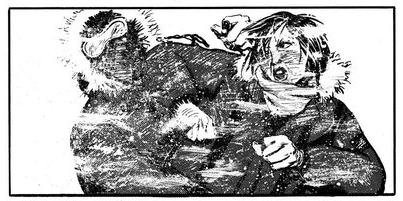
♦Back in Volume 2 #5 which was published back in May-June 1998, we spoke to future superstar writer Greg Rucka about his series Whiteout, which was just about to begin from the nascent Oni Press…
COMING IN FROM THE COLD
Crime Writer GREG RUCKA’s been very busy recently, with his first comic project for Oni Press, Whiteout. JOEL MEADOWS found out more…
Greg Rucka may be a name you haven’t heard before as a comic reader but once Whiteout appears in July, all that’s likely to alter. A crime story set in the wilds of Antartica, the idea was triggered off by an offhand comment from someone:
“Somebody mentioned to me that they thought that the US government had a law enforcement person in Antartica, who was responsible for all of the Americans on this huge continent. My first thought was ‘What do you have to do wrong to get that job?’. Then I set about doing preliminary research.”
Whiteout is a crime story that travels the length and breadth of Antartica:
“It’s all over the ice. It starts with this person dealing with what she assumes is the death of an American team but, because of the nature of the continent, by the end of the first issue she’s at a fictional British base.”
Antartica is a setting which has been overlooked and, contrary to popular belief, Antartica isn’t split into areas controlled by particular nationalities:
“One of the things I discovered was that all of the bases tend to be fairly multi-national, certainly the big ones like McMurdo. A large base can have up to 10,000 people during the summer. Of those 10,000, at least half are non-American personnel.”
Whiteout is a mix of various genres, not just crime fiction:
“It’s great because it’s an environment that begs for a spy story. You get a very classic Western feel to it (McMurdo’s basically a frontier town) and lo and behold there is a law enforcement officer, who’s a marshal. It’s a western as well as a locked room or locked continent mystery.”
Rucka’s break with Oni had a lot to do with the fact that he was recommended to them by someone else in the industry:
“I’ve been going to the San Diego Comics Con for a couple of years and I’ve known some people in the industry before Bob [Schreck, Oni’s Editor-in-Chief], in particular a woman named Patty Jeres at DC. Patty had read my books and knew that I was interested in writing comics. At the last San Diego, she walked me over to the Oni booth, and said ‘You two need to talk.’ Bob and I went out back and I pitched this to him. When I showed him my books, he eyed them warily and asked if I wanted to adapt them. When I said that I didn’t, that got me over the first hurdle. So he read the books, as well as passing them around a lot of the community in Portland. Everybody liked what they read which meant that Bob accepted the Whiteout proposal and the proposal went over well enough that they accepted the book.”
Like another recent interview subject, Kevin Smith, it’s always been Greg’s ambition to write comics. Whiteout has been very rewarding for him so far:
“Scott Nybakken, who also works for DC, got me into comics when I was twelve years old. We both grew up in the same town. In college he and I tried our hand in doing a comic book that was a dismal failure. It was something that I’d been hoping to pursue for a long time.
Having said that, to a great extent, what I do professionally is write and, if that’s a screenplay, a stage play, a short story or even a comic story, they’re all very different but they’re all fundamentally the same.”
Greg is all to aware that it’s not as easy as it seems to write comics:
“I think it’s a hell of a lot harder than most people realise to write a successful graphic story. It is really difficult to appropriately wed image and words. I’ve been accused of hyper-realism and I’m very reductive as a writer. I cannot write florid prose well but I can write journalistic prose very well and I think one of the things I can wdo with a fair facility is pick the right details in a scene.”
Rucka’s been quite successful playing around with dialogue in his novels and this is something he takes satisfaction in:
“I like working with voices. There’s a reason that the narrator in all four of the novels are all first person. There is no third person, omniscient god voice in Whiteout. Because I’m hyper-realistic, it begs certain questions and in a way I don’t think it’s a question that a lot of people ask. If you read a novel like Keeper or The Big Sleep, a first person narrative, one of the first questions that the reader should be asking on some level is ‘Who wrote this and when did they have time to write it?’ and, with the third person omniscient, the question should be: ‘Who is this person and what’s going on with this voice?’.
Rucka is a big fan of the private investigator genre and Whiteout is the latest expression of this: “One of the wonderful things about the form, and I’ve never said this in the foreign press so I don’t know how this’ll go over, but I do think that the private investigator is a very American form. One of the things that has happened is we have all ethnicities, all sexual preferences in the private eye novel at this point. In a very romantic sense, this reflects one of the ways that Americans define themselves, as a big melting pot country. The other thing that happens in the mystery is you’re asking questions of social import.”
Whiteout is no exception. Here, Rucka uses the fact that the two protagonists are both women to highlight social problems:
“By the end of the first issue, our major characters are two women: a deputy US Marshal stationed at McMurdo, Carey Stetko who encounters a British woman named Lily Sharpe. There’s a neat social dynamic and a state of siege that the women live in. I wanted to take two strong women who don’t initially really like each other and don’t trust one another, each working with what they feel are separate agendas. Then I’ve put them up against a whole bunch of men who will ask why they’re there and, because of the difference in numbers between men and women, if they don’t want to sleep with them, then, by their logic, they’re either lesbians or ‘frigid’.”
As a writer who’s so at ease when it comes to writing dialogue, Rucka has a very specific way of dealing with this aspect of writing:
“For the most part I listen to conversations. I don’t like writing in dialect. What I try to do is work on word choice. I discovered in working in comics that dialect will work easier because of the iconography of the form.”
Like everything else in his work, Rucka chose the title Whiteout very deliberately:
“Liquid paper product in this country is called Whiteout and that’s one meaning. It doesn’t actually snow a whole lot in Antartica. It’s the ice and snow that has fallen over thousands of years and, when the wind kicks up, it kicks the snow up into the sky and it’s very dangerous to be out in those conditions. Pilots have described it as ‘trying to fly in a bowl of milk’. You lose all perspective: the horizon disappears and that’s technically called a Whiteout. By the end of the first issue, one of the characters is caught in a Whiteout. It’s a great term for any sort of mystery because you’re lost and you don’t know where you’re going. It also sounds cool.”
JOEL MEADOWS
Whiteout Vol. 2: Melt, Definitive Edition Whiteout, Vol. 1, Definitive Edition









You must be logged in to post a comment Login