

Interview
Jamie Delano Interview 2000

We interviewed legendary British writer Jamie Delano (Hellblazer, Animal Man) back in Sept this year but we first chatted to him way back in November 2000, in Volume 4#2.
Chain Reactionary
TRIPWIRE: How did it feel coming back to Constantine with Bad Blood after a break?
JAMIE DELANO: Constantine is the kind of old pal who you can re-encounter after years of estrangement and seemingly pick up the relationship where you left off. For a while you are best buddies again, “reminiscing” in a nostalgic bubble, but eventually you realise that the intervening years have pulled you into different orbits and you start to get cranky and irritated with one another, anxious to get back to your contemporary reality.
TW: How do you feel about Constantine nowadays?
JD: As hinted above, I sometimes feel that, for me at least, Constantine was a product of a specific era – the 1980s – and he is still struggling to come to terms with the 90s, let alone the 21st Century. But then that is part of the cynical old fuck’s charm, I guess. He’s still not buying the bullshit. And he definitely should not give up the struggle to find his contemporary role.
TW: What do you make of the Azzarello run?
JD: On the strength of the first (prison) story arc, I have high hopes. It’s time the stay-at-home fucker got out and about a bit, tried out his jaded English slyness against the bare-faced twisted horror of the American freakshow.
TW: Do you think it’s essential that Constantine is written by a British writer or has the current run proven that that’s not necessarily the case?
JD: As a general rule, I don’t see that it matters what nationality the writer is as long as they have a reasonable command of the language and something to say in it. However I would be nervous of someone unfamiliar with the culture trying to handle Constantine on his quicksand-home-turf of British society. The promiscu- ous success of the US cultural-imperialistic effort has given us foreigners an advantageous (if undoubtedly superficial) insight into the interior workings of The Great Satan that I doubt our own popular cultural exports (Upstairs, Downstairs, Four Weddings and a Funeral etc.) can match. That said, I really loved the Azzarello story in the Hellblazer Secret Files book where the demon Nergal intro- duces the juvenile Constantine to the delights of smoking at a Liverpool murder- scene. And I read a good story by Darko McCann that was set in England, so maybe I’m talking out my arse. Comes down to it, it’s connecting with the spirit of the character that counts. Get that hook set and the rest will follow.
 TW: Outlaw Nation has seen a name change, from The Great Satan. How unhappy were you when this occurred?
JD: Considerably, but at the time I had more pressing concerns in my life to distract me from getting too bloody minded and splattering the Internet with futile bile. DC wouldn’t let me call Bad Blood ‘The Bastard’, either – but I generally get my way as far as story content goes… for which I’m grateful. So it’s a trade-off I can live with.
TW: Did it strike you as odd since Vertigo publish a regular called Lucifer? Or were they concerned that they would have two regulars with similar names?
JD: I’m told that a couple of our less-attentive readers expressed confusion when Lucifer was solicited, due to my assiduous pre-publicity on behalf of The Great Satan. I felt that, since Lucifer was scheduled for publication some six months in advance of The Great Satan, most people would figure things out in time: DC decided to play it safe. In case anyone is confused now. Outlaw Nation is “The Great Satan” in every- thing but the title on the cover, and has nothing at all to do with Judeo-Christian mythology.
TW: This is the first time in years that you’re going to be seen on the stands on a monthly basis. How do you feel about this?
JD: Well, its nice to be able to take advantage of an advantageous dollar/sterling exchange-rate on a regular basis for a while. It’s weird. Until people started saying: “It’s good to see you’re coming back”, etc., I hadn’t really felt I’d been away. Working on one- shots and miniseries is – for me anyway – as much of a full-time job as writing a regular monthly book. A disproportionate amount of development time (both creative and bureaucratic) goes into a short work in ratio to its (in my case at least) often fleeting presence on the ‘stands: and I find it a tougher discipline to structure a succinct and self-contained short-story than to write an open-ended series. With the latter, the possibility always exists to indulge those whimsical tan- gential thoughts and say: “Oh well, I can always wrap it up next month. So if anybody thinks I’ve been slacking: it ain’t so.
TW: Do you think the fact that you have concentrated on one-shots and miniseries over the last few years has meant that, now you’re returning to a regular, you have renewed vigour for a longterm series?
JD: Hah. For me these days “renewed vigour” comes in the form of triple espressos laced with pharmaceutical taurine — but that is largely as a result of my rapidly advancing age and depredation of my life-force under the repeated assaults of the brain-dead zombie mutants of rural fucking England where I currently have the misfortune to reside.
But yes, I am enthusiastic about Outlaw Nation. The first six issues are written and I am just freeing myself from the distraction of one other project before returning to the new series full-time for the foreseeable future. I hope that the sce- nario I have set up for the series will offer enough scope and variety of character to enable me to relax and have fun for a while. Of course, if no-one buys the thing because I’m a forgotten old has-been, then I guess that will be a self-fulfiling prophecy.
 TW: How did artist Goran Sudzuka get involved?
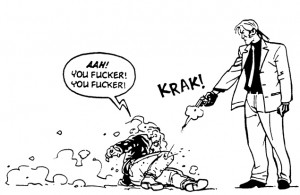
JD: I think he asks himself the same question every time he downloads one of my insane scripts. There was some talk of a twisted covert “arms for artists” deal obscured by the confused politics of the former-Yugoslavia, but to the best of my knowledge Goran is an exceptionally talented Croatian artist, samples of whose work passed under the astute eye of DC editor Axel Alonso, who not having an immediate suitable forum for Goran’s work, passed it to the equally astute Stuart Moore. Fortunately, Goran is so good that even I could see the quality at a glance and insisted Stuart sign him up forthwith for Outlaw Nation. Goran has subsequently so put his unique stamp on the book, with his powerful characterisation and clarity of visual story- telling, that I find it hard to imagine what it would be like without him. So if any weasly editor reading this is contemplating poaching him away from the Vertigo “ghetto” with an offer of big bucks and a string of glamourous superfolk to screw… be warned! Try it and I’m gonna do bad voodoo on you!
TW: Do you think that the presence of a non- American or British artist has meant that the look of the title has a different feel to it?
JD: Well, it looks different to anything else DC is publishing right now. You’ll have to classify it for your- selves: all I can say is, the guy can draw and I’m glad to have him doing it on my story.
TW: DC describes the series as ‘part road movie, part generational drama.’ Would you say that’s a fair description of it?
JD: It’s a partial description of it. And to be fair on the people who have to come up with that copy, I struggle myself to define the precise nature of the book. It does have road movie and “generational drama” elements — in that its protagonist arrives back in the US after a 25- year absence MIA in Vietnam, only to have his memory scrambled in a beating administered by anti-Castro Cuban Americans in Miami because he bears a passing resemblance to Fidel. Thereafter, he spends some amne- siac time on the road, rediscovering his identity and extraordinary family history and finding out how his larger-than-life outlaw cousins have advanced the “American Revolution” while he has been away.
But Outlaw Nation is also my attempt to write an “American Adventure Yarn”… fast-paced and hard- boiled… human drama with big horizons. Fundamentally, it sets out to explore the nature and pur- pose of rebellion in a 21st Century. global Capitalist world, but fortunately it frequently gets distracted having fun with some of the archetypal rebel heroes and antiheroes of American pulp fiction. I think of it as kind of a dime novel on dope… a stoned surreal thriller into which, every so often, reality intrudes and makes its chilly presence felt.
TW: Can we expect Outlaw Nation to be as dark and as pessimistic as your previous work?
JD: Show me the champion of moral rectitude who’s not a vicious hypocrite and I’ll write about him/her. Overt moralism is a stalking-horse for venality. Good and Evil is a percentage game. I like people who keep track of their running score. Dark and pessimistic? Everyone says that is what my work is; so I guess it must be true. I find that strange. Okay, I get a bit carried away at times if no one has the sense to rein me in, but my tongue is often quite firmly in my cheek when I write. The world is a dark and savage place… and it seems to me sometimes that most of the people in it survive only through means of some genetically programmed opti- mistic delusion. I guess it is an unhealthy quirk of my nature that I find it funny and fascinating to observe their reactions when the dope wears off and Darwinian reality snarls in their face. Then again, I had a thought once that it might be a kind of magic: put characters through the evil shit that scares you and maybe it will leave your own life alone. Can never be a hundred percent successful of course: there’s always a couple of devils who’ll slip under the wire to keep you in your place.
(Pause for another espresso.) Hey… you want me to work in the day and make sense, you have to pay me — and even then there’s no guarantee.
But the short answer to the original question is: No. Outlaw Nation is certain to echo my “voice” and be imbued with my personal obsessions, but – clutching desperately here for analogy – it owes far more to Jim Thompson, Robert Stone and Thomas Pynchon than HP Lovecraft…
TW: How have you approached this series when compared with some of your shorter works?
JD: I think I pre-empted this question somewhere above. A lot of hard tedious work (over more than a couple of years) has gone into developing a suitable scenario. Now the trick is to kick the story off from that basis into previously unimagined areas with enough vigour to give it a life of its own. Once the right number of characters are walking and talking successfully, they should take over. It’s just a question of observing their lives and writing down the interesting bits.
 TW: You never seem afraid to experiment. Would you say that Outlaw Nation’s structure is going to be as experimental as your other work?
JD: I never feel experimental. But I do get bored easily… sick of the sound of my own voice creeping into a character after a while. Mainly though, my “career” has been a completely unplanned, haphazard progress from one project to the next. I finish a thing, and either I have an idea I want to pursue which calls for a suitable vehicle and I have to invent, develop and sell the project, or someone asks me to do a turn on an established book and hands me a vehicle ready-made.
TW: How structured is the series? How far ahead do you plot it?
JD: I have the feel and loose shape of the thing bumping around in my head. As the characters assume their personalities, some detail becomes clearer. But the beauty of the scenario which I have developed for Outlaw Nation is the flexibility that it should provide me to indulge myself by following at will those “plot angels” that flutter tangentially by from time to time and make a series worth writ- ing. A tight plot is a really useful tool to aid in initial focusing on a work and to give a writer the confidence to start writing, but in my experience they are usually best abandoned early on. Otherwise it gets boring – just a question of getting the characters from A to B to C , etc. – and a bored writer inevitably means a bored reader.
Of course flying by the seat of your pants is dangerous, too… easy to get snarled up in a high-voltage power line and crash and burn.
TW: Is there any danger that, with the inclusion of Glenn Fabry as cover artist, that people will make comparisons with Preacher?
JD: I’m sure that inevitably they will. But I think that Garth’s and my own voice and sensibility are distinct and different enough that most people will tell us apart.
TW: Fabry seemingly lives a life on the edge. How do you think that influences his work? Are his covers based on your scripts for each issue or do they have more of an abstract feel to them?
JD: I take it you refer to the fact that Glen lives in Brighton, on the southern edge of Britain. The only way I can see that his work is affected by this is the occasional streak of seagull shit and whiff of the briny noticeable about his faxes.
Glenn has a great talent for assimilating the essence of the story from the script and assembling a strong image that expresses that. Some of his pieces are more literal interpretations of story elements and characters than others, but they generally get your attention and are good to look at in their own right. He also has a penchant for the grotesquely humourous which I find endearing.
TW: The last innovative regular that Vertigo launched, The Minx, only managed to last eight issues. Do you think that there’s a large enough audience for Outlaw Nation to keep it going for some time?
JD: I have absolutely no idea. If there’s not, I’ll have to think of something new to do pretty damn quick.
TW: What else are you working on at the minute?
 JD: I’m not working on any other comics at the present. I promised myself I would leave myself the space to be able to focus on and take my time with Outlaw Nation for a while. I have been a little distracted in developing a screenplay version of Hell Eternal (DC Comics 1997, with Sean Phillips) for a British film pro- duction company, but the bulk of the work on that is done now (for good or ill) – so Outlaw Nation is it.
TW: What impact, if any, is X-Men The Movie going to make on the general perception of the comics industry?
JD: I really haven’t given it a thought. If a comic property makes money as a movie, I guess the parent media conglomerates that own the other comic properties value their possessions slightly more highly than they might have done otherwise…but otherwise, it’s probably just another movie.
TW: Do the injustices in the world still annoy you as much as they did ten years ago or have you mellowed?
JD: The older I get the more I come to understand that “Justice” for most people in this world is an aberrant occurrence in an otherwise fucked-over life… and consequently should be celebrated and applauded wherever it finds the courage to show its face. It may surprise you that -despite my earlier splenetic outpourings – I am constantly amazed and gratified by the grace and fortitude of the human spirit in the face of a callous and brutal “world”. Sure there are a lot of vicious subhuman fuckwitted shits out there masquerading in store-bought clothes, but here and there amongst them you’ll find a man or woman who is what William S Burroughs called a “Johnson” – a genuine human being… someone who cares and is worth caring about. So far the population of the Outlaw Nation numbers quite a few Johnsons amongst it, but the “shits” have a growing presence.
Mellowed? You’ll have to be the judge of that.
JOEL MEADOWS









You must be logged in to post a comment Login