

Comics News
Alan Moore Interview

Moore of The Same
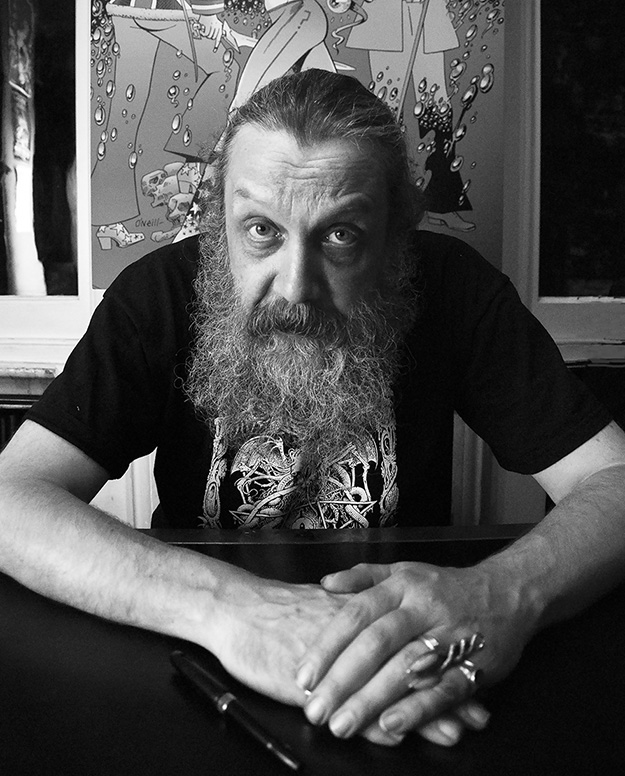
On Goodreads.com this week, Alan Moore answers a series of questions submitted. So here is a small selection of the questions and answers
Ask the Author: Alan Moore
Hi Alan. You’ve said (correctly, so far as I can see) that the advent of mass communication has led to the death of any discernible counterculture. Is this because a counterculture needs an element of insularity in order to thrive – the ‘cult’ aspect of it, I suppose – that the internet does not afford? Or is it the result of a larger, more depressing shift in society, priorities, ways of thinking etc? Or: other!
Alan Moore: You may very well be right that a counter-culture needs a certain amount of insularity or distance that the internet doesn’t provide, and I think there are also other factors which abet this situation. I recently acquired a wonderful array of small-press poetry magazines from the 1960s and 1970s – poetry was always somehow at the heart of the counter-cultures that I remember – and what most struck me was the immediacy and authenticity of these stab-stapled physical artefacts. Obviously produced a home by people who were driven by a real passion, these were very definitely anti-corporate manifestations of a dissenting culture. I’m not sure how much real articulate dissent contemporary internet is capable of fostering. Still, it’s with us and clearly isn’t going away. It’s my hope that an alternative culture could emerge that is not so completely in thrall to the internet; that can use that technology for the things it is genuinely useful for, but that can also appreciate the need for a supplementary print and artefact culture, which is fulfilling different needs. This is a subject which I’m relatively optimistic about, and which will be the subject of a day-long seminar that I’m taking part in at Northampton’s Nene College on November the 28th, along with Robin Ince, Josie Long, Francesca Martinez, John Higgs, Grace Petrie, very possibly Melinda Gebbie and an outside chance of Scroobius Pip and some Syrian refugee poets. I think that the event will be streamed – a clearly positive use of the internet – and so I suppose we’ll have a chance to find out then how workable modern technology is in regard to a counter culture. And in the evening, we’ll be having an old-fashioned Art School Dance, which as any admirer of the poet Pete Brown would surely tell you, goes on forever.
Out of all of the many, many things you’ve written, which is your most personal?
AM: By definition, The Birth Caul must be the most personal piece of my writing that anyone has actually seen or listened to. However, next year I expect that to be superseded by Jerusalem, which is as close as I will ever be able to get to articulating my experience and my background in terms of a fiction.
Do you believe knowing that you’re living inside of a horror story makes it easier to live there?
AM: It’s really only fictional people that live in horror stories. Real people, even if they’ve been the subject of special rendition and are currently receiving electric shocks to their genitals somewhere in Egypt, are not in a horror story: they are in the same ordinary reality as you and I, which we are all a part of and which we all, by our actions and inactions, help to create. I think it would be best if we agreed that we are living in the real world, and if at times it reads like a horror story – or worse – then we are the only authors, and we are the only authority that is in a position t fix or change that.
If you could be killed in a horror film who would you want to be killed by and how would prefer to be killed?
AM: I’m sorry, but I genuinely never give a moment’s thought to matters like this, and really can’t provide an answer for this question.
What horror novel do you find the most terrifyingly realistic? I.E. the scariest thing is that this could actually happen.
AM: Well, in order to fit the criteria of an event that could actually happen you would be very limited in your number of choices. It would have to be some nuclear war or environmental collapse scenario, I imagine, so perhaps a novel like Cormac McCarthy’s The Road, or a television production like the English film Threads, which I can best describe as The Day After for grownups.
Has your interest in the esoteric sciences (occultism) been a life-long venture or was there a particular event that got you interested in magic?
AM: I suppose I had only an average person’s interest in occult matters for the greater part of my life, and while there were various factors that led to me becoming a magician back in 1993, one of the most compelling was writing a few lines of dialogue in From Hell to the effect that the one place gods and supernatural beings inarguably existed was within the human mind, where they were real in all their ‘grandeur and monstrosity’. Being incapable of finding an angle from which that wasn’t true, and realising its implications, I felt I had no real choice other than to become a magician.
Solitude and isolation is often considered the scariest situation for people, but is it possible to transmute void and stasis into a compelling story?
AM: With enough energy and ingenuity a writer can do almost anything. If you want to see a brilliant example of a drama involving a single individual isolated in a single room, then I strongly suggest you watch Robert Altman’s stunning film Secret Honor, starring the uncanny Phillip Baker Hall as disgraced former president Richard M. Nixon in his post-Watergate retreat at (I believe) San Clemente, sitting in a heavily-guarded room and speaking his awful truths obsessively into a tape-recorder. If you ever see a more accomplished or more disturbing Gothic drama, I’d be very surprised: at the end of the film the viewer is absolutely desperate to get out of this cramped little room full to bursting with evil history, and at the same time is aware that the central character never can. I can even imagine a good enough writer being able to craft a compelling narrative about an empty room with absolutely nobody in it…but probably best not to try this at home.
Recently, I discovered your documentary on Northampton, ‘Don’t Let Me Die in Black and White’ on the dark recesses of the internet, and as with much of your work, was struck by just how much you allow a sense and understanding of place to inform a story. How do you think that understanding of a place’s history can be mined, exploited, or drawn upon to create a sense of horror and fear?
AM: In my opinion (which is not at all humble, and which, indeed, often stridently insists that it be universally accepted as established fact) place is probably the single most important element of any work of fiction; arguably even more important than the characters and the plot, as it is always place that both character and plot emerge from, and exist in the context of. This is true whether we’re talking about a real, existing location, or about a landscape that the author has invented. While place is obviously massively important in successful horror fiction – Lovecraft’s fictitious Arkham or real Boston; M.R. James’ Aldeburgh; Ramsey Campbell’s Brichester or Liverpool – I would say that this was just as true of every other type of fiction. Certainly, an exhaustive investigation of a place that is very tiny when considered in three dimensions and immense and haunted when considered in four or more is what the entirety of Jerusalem is predicated on. And while there are certainly considerable horrors and tragedies bound up in that place, I feel that unless we excavate the whole of a place, including its humour, its triumphs, its history and its politics then we run the risk of not understanding it in its entirety. Of course, the slant that we put on a place will vary depending on what we want an individual story to achieve, but I would advise that you find out absolutely everything that you can about a place, trusting that fascinating or reveal details will be uncovered, or previously unnoticed poetic linkages. Nearly all of what I consider my most important works are predicated on place: Lost Girls in the Bodensee area; From Hell in London; Voice of the Fire and Jerusalem in Northamptonshire and the half-a-square-mile Boroughs district respectively; all of my magical performance pieces set and performed in Fleet Street, Highbury, Red Lion Square, or at a Victorian Crown Court in Newcastle; and of course Unearthing, which was an attempt to combine a deep study of a very unusual place with a deep study of an individual who had lived his entire life in that place – a necessary combination of psychogeography and psychobiography. Yeah, place: where would we be without it?
Also, in case my previous question was boring. Here’s one a bit more interesting. What would be the scariest way to die?
AM: The scariest way to die, surely, would be after a life that was not sufficiently considered, understood or engaged with, wouldn’t it? As for your question on the re-reading and editing process, it depends on the author and on the work. With Jerusalem, I’ve been very exacting and thorough. Other works, I’ll proofread them a couple of times and then leave it to the production people and editors. But that’s just me. Mike Moorcock tells me that he has to resist the temptation to go back and look at a work because he feels that if he did he’d never stop fiddling with it or revising. One of the benefits of coming from a background of pulp periodicals like Mike and I is that everything is at such a breakneck pace that you don’t really get the time to develop a habit for fussiness.
Here is a link to the entire series of questions and answers
Alan Moore Goodreads interview
From Hell Nemo: River of Ghosts (Nemo Trilogy 3)
 League of Extraordinary Gentlemen Omnibus











You must be logged in to post a comment Login