

Comics News
What Makes A Good Comic Editor Interlude: Steve Rude

Nexus Points Of View
Some weeks ago, Tripwire’s contributing writer Paul Neal completed Part One of his article that asked a series of comic book professionals “What makes a Good Comic Book Editor?”
A link to that article is provided here:
https://tripwiremagazine.co.uk/interview/tripwire-asks-just-what-makes-a-good-comic-editor-part-one/
The wonderful writer and artist Steve Rude contributed to the article in question. Through an unfortunate bit of bad timing Steve provided some follow up thoughts and memories about his experiences after the article was completed.
Along with his original contribution, Tripwire thought it was only fair to share his original contribution once again alongside his additional insights on the subject.
Part Two of Neal’s article will be online very soon…
Steve Rude.
(Writer, Penciller and Inker, Co-creator of Nexus, Eisner, Harvey and Inkpot award winner.)
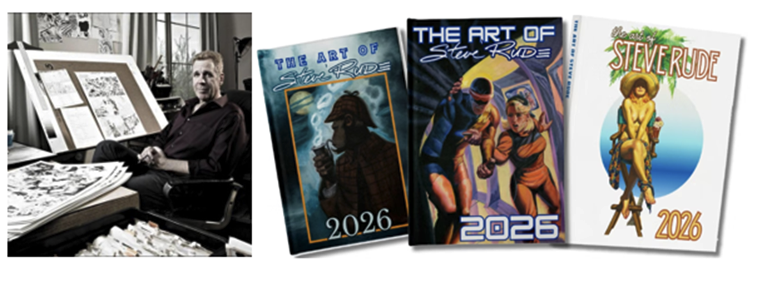
TRIPWIRE NOTE: Photo credit, top left by Greg Preston.
I’m not an “officially designated editor”, but in a sense we all are. Like everything else, “Editor” is just a name, a word meant to describe a task.
The first thing to know about editors is that they have a point of view. They only want work to come in on time and done well. If a particular editor is better than most, they will suggest things that the artist or writer may have missed that could change for the better.
Perhaps some “angle” of the given story or the rendered art that would really boost the story to higher levels. To me, a “non-editor”, it’s not as hard as some might think. It just needs time to gestate and become greater than say, a ‘first draft’, might deliver.
Great ideas can come from anyone. You just have be of a mind that is studied and shrewd enough to add to the overall performance. In a sense, every area of art has some manner of performance connected to it. The better you perform, the higher the enjoyment content.
***
Here’s a follow-up your editor question, where I break down my time with each book I was involved in:
1st editor— Rich Bruning, Capital Comics
I always liked Rich as an editor, as well as the editor that assisted him at Capital, Karin Preus.
Both were helpful with advice I may not have seen as a young artist. The close-knit group at Capital was unsurpassed and sadly, never to be encountered again. Typical of small companies vs. big.
Multiple attempts to keep in touch when Rich took editorship at DC went unanswered. I miss those days.
2nd editor – Rick Oliver, First Comics
I always seemed to experience conflict with Rick, no doubt due to his constant vigilance to keep the trains running on time. In the decade I worked for First, I can’t personally recall a single word of praise from Rick, whose style of communication seemed one of buried praise and unsympathetic over-reaction. Every editor has their means of dealing with creators and assessing their work. So, in that respect he did what all “team players” do – carry out their companies mandates.
3rd Editor – Mike Carlin at DC Comics
Mike and I never gelled. I grew to like the guy when not working together, but we never developed anything close to the relationships I had at Capital or other key editors over time. Mike Carlin had worked for Marvel after moving on to DC, and his style was to enforce its stringent policies.
Polices such as not allowing a single character – real or imagined, to feature in any of their books. With DC, a postage stamp sized image of Elvis was cause for merciless deletion, as well as dozens of other things I drew in to amuse the audience. Other such examples would be giving the Batplane a Whammo logo on its underbelly, or likenesses of Michael Keaton and Jack Nicholson walking together while counting royalties from their movie roles. Apparently the real world doesn’t exist in DC Comics.
But maybe I’m the one who’s confused. I thought comic publishers were about publishing comics and entertaining their dwindling audience. But here come the lawyers, only doing what they’re hired for – protecting their clients and taking the fun out of everything. For shame on DC and Marvel. Apparently the adage that Stan Lee once spoke has been completely forgotten beginning with “Comics are supposed to be fun.”
The 1999 Jimmy Olsen book from ace editor Mike McAvennie, along with me drawing the thing and scripter Mark Evanier almost never came to pass. After months of delays, I finally called up Mike M. to asked him who exactly is delaying this project, since it was already put on schedule.
Seems the hold up with this book was – ya ready? – they couldn’t decide on what kind of paper to print it on, and what to call the damn thing.
Clearly, someone had to take charge and remedy this nonsense. I called up the editor-in-chief, Paul Levitz, whom I was told was the cause of this delay. This was back when you could actually get a real person on the phone. Talking to Paul, I proceeded to suggest what kind of paper to be used, and a title of “the Jimmy Olsen/Superman special” – something like that. Wow, that was tough. Now I might even be able to start drawing finally.
In my four decades drawing comics, there are three editors that have always maintained high appraisal from me 1. Mike McAvennie, the editor just mentioned on the Jimmy Olsen special, 2. Tom DeFalco who edited our really cool Spider-Man, 3 issue series, and 3. Glenn Greenberg, who engineered the Hulk vs. Superman one shot, to be developed into a 48-page book from a briefly described paragraph written by Stan the man.
One paragraph vs. almost 5 pages or drawings? Sure, no prob. A shame that the excellent example of Glenn didn’t seem to last long. Marvel unexpectedly canned him, probably soon after completing the book with quickly assigned security helping to escort him from the premises, cardboard storage box in hand. Way to go, Marvel.
The other editors I’d like to make note of here will sadly, have to remain nameless. But briefly, the first of these editors was someone who solicited a 6-issue miniseries that was to be released a few months from the time I started. This was to be an intensely researched effort and ended up going with 3 other artists who proceeded to be even later than if I had done the whole series myself. This prize editor was also the one who told me comics don’t need page numbers anymore. Brilliant. The final prize goes to an editor whose style was so intrusive, I would gladly have awarded him a high dive from the 45th floor. Ouch.
Finally, the other great editor I had when moving to Dark Horse was the uber-intelligent Anina Bennett. Now there’s a gal who knows how to assemble books and get cooperation out of people. My variety of hats will always be off to her for her diligent and dedicated work for so many unsung years.









You must be logged in to post a comment.