

Comics News
Tripwire Talks To Doctor Who Comic Artist Lee Sullivan

A Life Lived In Comics
Tripwire’s contributing writer Paul N Neal chatted to Doctor Who and Transformers artist Lee Sullivan about a career in comics and what gets him excited…
PAUL NEAL: I like to start at the beginning. Can you say what were the first comics you recall reading and enjoying? Perhaps can you say how old you may have been, or how much they cost? After all, most fans remember their first few comics.
LEE SULLIVAN: I would have been five years old, and it would have been TV Comic, which I was already reading before the first Doctor Who strip started in Nov 1964. I can remember the excitement of reading that for the first time. It also featured Fireball XL5 and Supercar, which I was a fan of and probably why my parents bought it for me. It was 6d per week – approx 2.5 pence these days. It would have been delivered from my local newsagents in Stopsley, Luton.
PN: Would it be fair to say you are a Gerry Anderson fan by any chance?
LS: Haha, yes. Last year I drew a Fireball XL5 strip for an anthology book, and I’ve done a lot of Anderson-related work, including a long run on Thunderbirds, all of which pleased me no end. I have a LOT of Anderson toys and models.
PN: Before we get ahead of ourselves, can I ask a tiny bit about your background please? As an artist would you say you are professionally qualified with letters after your name or are you more self taught?
LS: I went to art school for 4 years, training as a technical and wildlife illustrator. So, I have a diploma and other qualifications in art.
PN: Given your background, were comics your immediate choice for a career? Is that what you wanted to do at the time?
LS: I had wanted to when I was younger, but the training pushed me towards industry and graphic design work, so I went to work at British Aerospace for five years, then freelance. It was a while before I remembered what it was, I had wanted to do, and before I got the opportunity to work in comics. I had been jolted out of my complacency when I saw the first issue of Doctor Who Weekly, and then I did some samples but didn’t really know how to present them to anyone. An agent rejected them. It took another ten years before I got the job!
PN: What was your first ever published comics work? Who was your first editor?
LS: My first editor was Ian Rimmer but quickly followed by Simon Furman, on Transformers UK weekly. I started on covers for a year or so, then got a Transformers Annual story to do as my first strip.
PN: Who was your favourite Transformer to illustrate?
LS: Galvatron. He was great fun because he was mad. I based his face on Jack Nicholson in The Shining. I always imagined Optimus Prime as Adam West.

PN: You are obviously best known for your Doctor Who strips but before talking about them I must ask about your Judge Dredd stories. I believe they were mostly for John Wagner. Can you comment on those scripts? Are John Wagner’s as artist friendly as I am told?
LS: I did a Dredd for a yearbook that was written by Simon Furman and inked by Kev Hopgood, edited by John Tomlinson. Then I worked on 2000AD quite a bit from 1996 – 2002 (Future Shocks/Vector 13/Black Light/Mercy Heights and of course, Dredd). All of the Dredds were for John Wagner, I think. Ironically, I previously worked with his erstwhile partner Alan Grant on Robocop which was heavily inspired by Dredd, before I worked on Dredd. John’s scripts were definitely artist-friendly, though (and I may have been lucky here) I’ve never had any artist-unfriendly scripts as far as I can recall from any of the writers I’ve worked with. I didn’t have much contact with John (again, this applies with most writers) during the work, but I have spoken with him subsequently at a couple of conventions, all very friendly. I worked on 2000AD for two editors; when a third came along I wasn’t used again. That’s how it works, it’s entirely at the discretion of the commissioning editors and whether they like your stuff.

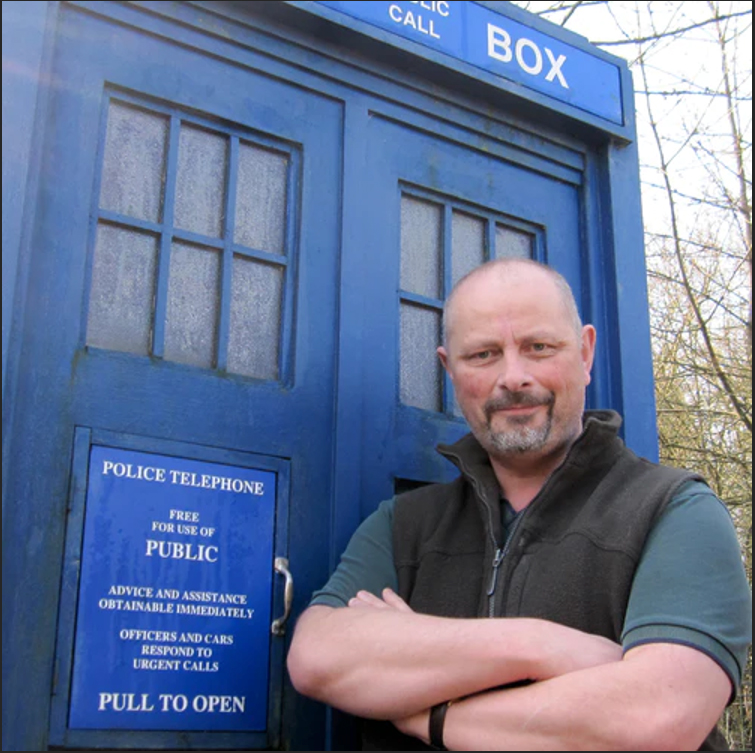
PN: You clearly love Doctor Who. The photo for this interview gives the game away a little bit. Before discussing your work on the comics, could you describe how you first discovered the programme, and do you have a favourite couple of doctors or episodes?
LS: I don’t know if I actually saw the first episode, I was certainly watching (aged 5) when the first Dalek story appeared, and I was hooked thereafter. I loved the security of the team and the TARDIS in the face of ever-changing circumstances. The miniaturisation story had a huge effect on me, and the Web Planet remains a favourite. It was hugely ambitious and completely thrilling. Later, Power and Evil of the Daleks, most of the UNIT stories. My Doctors are really the first 3, before the sense of knowingness within the show and my own maturity set in.
PN: Could I ask your opinions about the New Doctor Who since the revival in 2005? Do you have a Doctor since then that you have enjoyed watching? Have there been any episodes you have been especially impressed with? As a fan myself I liked Peter Capaldi for example.
LS: I’ve made a point of not commenting about the revival. It’s too complicated with all the different fan viewpoints and whatever I say I’d risk irritating someone, which I’m not interested in doing – I’m happy to continue being associated with the show. So, my line is generally ‘spendid chaps, all of them’.
PN: That is probably a wise policy. Some Doctor Who fans are perhaps too passionate on occasion. Could I ask how did you get the job illustrating Doctor Who? Who was your editor at the time?
LS: I had begun drawing Transformers comic strips for Marvel UK, and the second strip I drew featured ‘someone like Richard Branson’. For a laugh, I actually drew Branson. Richard Starkings, who was the editor of the boy’s range of comics where the Who strip came from was part of it. We had been discussing me drawing a strip for DWM and when he saw I could draw likenesses, he thought I’d be a good fit for the upcoming 25th anniversary story featuring all the Doctors and dead companions. I did that and then my first strip featuring human types properly – and it was successful. Richard and I conspired to work on a Who/Dalek story next, as we were both fans of the 1960s comic TV21 Dalek strip. That also was very popular and my career started there.
PN: Which Doctor Who story that you have illustrated would you say you are particularly pleased with?
LS: I think it tends to be whatever you’ve done most recently, and Liberation was a tour-de-force and a return to my roots after 20 years away. It also paid a lot of tributes to the classic Dalek strips before it.

IMAGE NOTE: Above. Lee allowed me to share this image WITH the watermark because he has been the victim of image theft in the past. That is a perfectly reasonable request.
PN: Can you comment at all on any of the writers that have written the Doctor Who stories you have been a part of? Have any been any stories that have been more challenging than others? Do the writers’ scripts vary in style?
LS: Scripts do vary in style, that tends to be because of the type of content, so if you have an action script where lots of incident is occurring, there tends to be less room for reflective character traits to illustrate. The story ‘Up Above the Gods’, a two-hander featuring the 6th Doctor and Davros (by Richard Starkings) was much more character and atmosphere led, I really enjoyed that, but the challenge is to make those quiet scenes interesting visually. All the writers I’ve worked with have produced very clear descriptions of what they want, and most are happy with the solutions I come up with. I think generally if you hire an artist, you have to accept they will take the story and shape it using their strengths.


I always try to serve the script though. Writers trying to be too prescriptive of the exact page layouts etc. really is counter-productive and frustrating for everyone in the end.
PN: For many artists, the rapid developments in regards to computer technology has changed their approach to their work. Would you say technology has changed the way you create your art?
LS: I embraced digital art as soon as I saw Dave Gibbons demonstrating a high-definition Wacom tablet, and since Doctor Who – Prisoners in Time for IDW, I have been drawing fully digital finished art for comics and latterly have learned to paint and colour in Photoshop. I saw straight away how much more streamlined and flexible digital could be. Although you never have pieces of actual art to sell, the advantages of production outweigh the disadvantages by some distance. I’ve always tried to keep up with these developments, but I think AI may be where I part company with technology. I think in the right hands it will be a useful tool, but I also fear an awful lot of artists will no longer be needed to be as skilled in the nuts and bolts of drawing. And although superficial creation may be enhanced, if you don’t know, say, the rules of perspective, it will be difficult to judge whether an image is right or not, and why. And for sure, people who have no talent at all can and are achieving good-looking results. The plagiarism aspect is deeply troubling too, creatives are always up against penny-pinching by people who undervalue the work, and this is such an obvious way for artists and writers to be paid less and so also increase publisher’s profits. I’m fairly pleased that I won’t have to deal with this, I think I will probably be able to continue to use my methods until I fade away into semi-retirement in the next few years.
PN: Have you ever been starstruck meeting anyone at comic conventions?
LS: Not really, because they are all just people, and I enjoy meeting them. Some are a bit stand-offish, but most are nice. I met a lot of Doctors etc. I met Sophie, Sylvester and Colin Baker, they were quite often on the same signing gigs as me in the early days of my DWM strips. Pertwee and Tom were both quite electrifying: each just like their screen personas. Meeting Nichelle Nichols was amazing, because she had such an interesting life, and I spent an evening chatting with her which was wonderful. I met Shatner in Toronto when I worked on TekWorld, and he was filming TekWar. He was very affable then. He didn’t really remember when I met him not so long ago.

Photo Credit: Mr Lee Bradbury
PN: Do you have any other fun convention stories you can share, or is it a case what happens at a con stays at a con?
LS: I can’t think of anything interesting enough that is very shareable.
PN: I often ask artists that work on superhero comics which superpower they might enjoy, but given the fact you have a history of illustrating Dr Who, may I just ask: “If you could time travel when would you like to go? Would it be the future or the past and why?”
LS: I’d go back to my early years or even before, to see my (long deceased) parents in their prime and see what they and I was like. I thought Stark meeting his father in Avengers Endgame was very affecting.
PN: What does the future hold for Lee Sullivan? Are there any creator owned projects in the pipeline? Have you looked into the whole Kickstarter process for any passion projects?
LS: I’m not really interested in starting a creator-owned project now, I’m happy to be heading into semi-retirement. I’d like to just potter about doing odds and ends, but after my current run on Who ends I have some Anderson-related strips to do before I can get to the pottering.
PN: Thank you for your time, Lee Before we finish is there anything you would like to promote currently?
LS: Liberation of the Daleks, obviously, and the first 5 graphic novels of Rivers of London are still producing royalties, so I’m very keen for people to buy those, plus they were a real tour-de-force working on them, and I’m very proud of the work I produced, creating a visual world from the novels by Ben Aaronovitch.











You must be logged in to post a comment.