

Comics News
Throwback Thursday: Jason Aaron

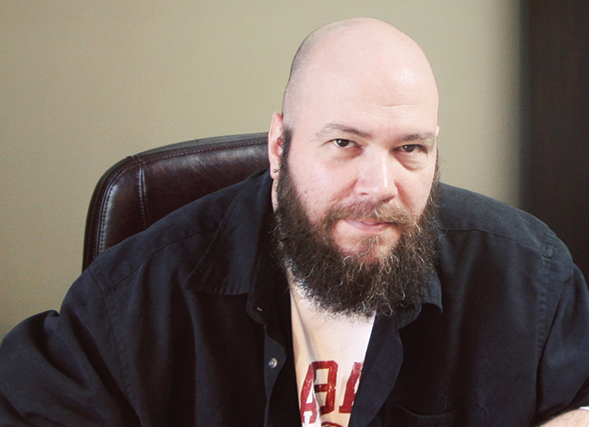
Back in Tripwire #55 in summer 2011, we interviewed future superstar Jason Aaron so here it is as today’s Throwback Thursday
HARD BOILED
 One of the most fêted writers of left-of-centre mainstream comics to emerge in the last decade, Jason Aaron has made a name for himself with work like The Other Side and Scalped. TRIPWIRE caught up with him…WORDS: JOEL MEADOWS
 TRIPWIRE: Your professional career began with you winning a Marvel talent competition back in 2001. Had you always wanted to write professionally?
JASON AARON: Since I was a kid, yeah. In school I was always writing stories, the kind of stuff that would probably get me expelled or sent to a psychiatrist these days. The earliest one I remember was called “Charlie Brown and the Chainsaw.”
TW: The first series that brought you to people’s attention was The Other Side for Vertigo. How did that come about?
JA: My cousin, Gustav Hasford, was a Vietnam vet and a novelist. He wrote the book that Kubrick’s Full Metal Jacket was based on. The Other Side came about from me researching my cousin’s life and meeting up with some of his fellow vets. There was a chunk of my life there, a couple of years probably, where I was reading everything I could find on the Vietnam War, including comics. The Other Side just naturally grew out of that.
TW: How did you approach The Other Side? Did you read a lot of books on the subject of Vietnam?
JA: Everything I could find. I loved Wilfred Burchett’s stuff. He was a British reporter who traveled on the ground with the Viet Cong and the NVA, actions that later had him branded a Communist. I loved Bao Ninh’s The Sorrow of War, a great novel that looks at the war from the Vietnamese perspective. And Don Lomax’s Vietnam War Journal is one of the best war comics ever.
TW: Even though it ended in 1975, the Vietnam War still seems to hold a fascination for readers. What do you think the reason for this is?
JA: It has a powerful legacy for the United States, and it’s a war that for many years no one wanted to talk about. So a lot of those thoughts and feelings were bottled up for a very long time.
TW: How long has Scalped been percolating in your head for?
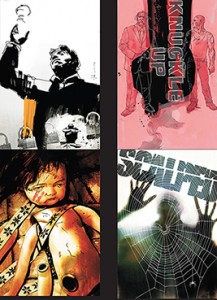
JA: Scalped came about just when Will Dennis, my editor on The Other Side, asked me to pitch him some more ideas. I knew I wanted to do a crime series, and the setting just seemed to click into place. I was kind
of surprised no one else had done a typical sort of noir story set on a modern-day Native American reservation.
TW: It continues to feel, even more than 100 Bullets, like it would be a great fit for an HBO TV series. How much of a fair comment would you say this is?
JA: I would agree with that. There’s always talks and interest in Scalped becoming a TV show. Who knows if it ever will? I’m just happy to still be working on the comic.
 TW: What were the biggest influences on Scalped for you as a writer?
JA: James Ellroy and Cormac McCarthy, the world’s two greatest living writers. The Wire, the finest TV series every broadcast. And maybe a little bit of Billy Jack thrown in.
TW: Setting it in the world of the Native Americans works so well that it’s surprising that this is a device that hasn’t been used more often. Is it the fact that you live in Kansas, which has a lot of Native Americans, that acted as partial inspiration for the series?
JA: We don’t have any big Native reservations in Kansas, though there is an old Indian Mission just down the street from my house. Native culture was just something I was always interested in, going back to when I was a kid.
TW: How did you research the series?
JA: Lots of reading and talking to folks in the know. Like I said, it was something I’d been interested in for a while. Especially the history of the Plains Indians and the modern- day struggles of militant Native rights groups like the American Indian Movement. And that research has been ongoing. Even 50 issues into the series, I’m still learning things.
TW: How did artist RM Guera come on?
JA: Through editor Will Dennis. Guera just kind of fell into Will’s lap right around the time I had pitched him Scalped. So it was definitely a sort of “match made in heaven.”
I can’t imagine having created Scalped with anyone else but Guera. He’s brought life to these characters in a way that I don’t think anyone else could have. He’s as insightful a collaborator as you could ask for.
TW: Like 100 Bullets and Preacher, you have had pretty much the same artist on board. What is the advantage of this?
JA: It gives you the time to grow together, to find your groove. It took Guera and I at least a couple arcs to get there, as it does with anyone. Thankfully the book’s been able to find enough of an audience that we’ve had the chance to really grow as a team.
TW: How closely do you collaborate with Guera?
JA: We talk when we can, but always from long distance. We’ve only ever met in person once. It’s more the mindset. We’ve been on the same page almost since the beginning. We have so many of the same interests, the same reference points. So rarely do we ever disagree on story points or characters.
TW: You also throw in things that you wouldn’t expect in a straight crime series like a sympathetic gay hitman. How important is it for you as a writer to subvert the crime genre?
JA: You want to keep people guessing. Scalped is noir, and like most noir it has a sense of inevitability to it. Often you know how things are going to play out. The trick is to make the characters compelling enough that you’ll still want to stick around and watch their long slow slide into despair. I’ve tried to make every character in Scalped as complicated and multi-faceted as I can. Those are the sorts of characters I love to read and the ones I have the most fun writing.
 TW: How long will Scalped run for?
JA: I haven’t put an exact issue number on it yet, but we’re entering the home stretch.
TW: How much of Scalped will be resolved?
JA: Some characters may get a more ambiguous ending than others, but for the most part, everything will be wrapped up and readers will see, for good or for bad, how every character’s arc turns out.
TW: You also write Punisher and Wolverine for Marvel, two totally different series to Scalped. What is it about the more mainstream material that you enjoy as a writer?
JA: It’s fun to flex different creative muscles. Scalped is my baby and always will be, but getting to play with some of Marvel’s biggest toys is just as exciting.
TW: What advantages does comics have over something like television to tell the sort of stories that you find satisfying?
JA: There’s a lot less red tape involved in comics. I only have to deal with an editor and an artist in order to get my story on the page. I would go crazy in Hollywood.
TW: You also seem drawn to darker protagonists like Wolverine, Punisher and Dashiell Bad Horse. What is it about anti-heroes that make them more interesting for writers?
JA: I like the guys who are tortured and flawed. And having them be able to kick lots of ass ain’t so bad either.
Scalped Deluxe Edition Book One HC Scalped Deluxe Edition Book 2 HC









You must be logged in to post a comment Login