

Column
Serialised Storytelling October

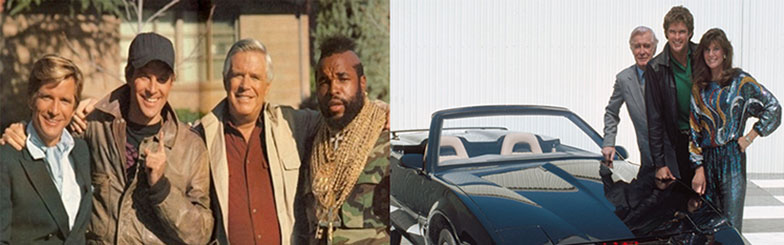
The A-Team and Knight Rider: How Have They Aged?
♦In his latest column, Tripwire’s Contributing TV writer HUGH DAVID talks about two Eighties TV shows which have just hit DVD: The A-Team and Knight Rider…
As comics have learnt from cinema and television, so too has television learnt from comics, often more so than cinema. To those who missed the era, it is not surprising that weekly serial television was often enjoyed by kids who read comics, and vice-versa, for similar storytelling reasons. If those raised on HBO, Showtime, Sky and DVD boxsets find our nostalgia for older shows hard to understand aesthetically, then maybe they can grasp what we relished about them in narrative terms, and why we can still settle down and watch them today.
Which is a way of saying that, if you were a fan of Glen A. Larson’s KNIGHT RIDER or Stephen J. Cannell & Frank Lupo’s THE A-TEAM, you are surely not going to be disappointed by this month’s blu-ray sets from U.K. archive specialists Fabulous Films. Back when comics were built to be read in single issues, even if they added up to larger arcs, TV did the same, filling up 50 minutes (or 45 after PAL conversion) around ad breaks with stories that rarely needed you to know any more backstory than was given in the credits sequence. Influences back and forth could occasionally be seen, but following actual comic-book adaptations in the late seventies (most notably Marvel’s THE INCREDIBLE HULK and DC’s WONDER WOMAN), many kids were more than ready for something similar yet original to television, even if adults who loved Cannell’s grittier 70s work (THE ROCKFORD FILES, BLACK SHEEP SQUADRON) would be disappointed by his and Lupo’s effort. Both shows were high concept before Hollywood called it that; KNIGHT RIDER was “Corporate LONE RANGER with talking car”, while THE A-TEAM was quite literally THE MAGNIFICENT SEVEN meets RAMBO: FIRST BLOOD. Their opening narrated intros, iconic logos & opening credits themes were all you ever needed to know to understand the story about to unfold; these were the embodiment of the famed principle that ruled for so long in American comics, particularly at Marvel, which would be swept away as the decade went on: every issue is someone’s first.
As such, their narrative simplicity was a boon to efficient mass production (first units shot the actors while second units got on with the action, with the minimum done to cover the joins) and audience reponse, making for easy and rarely-demanding weekly consumption and inevitably global popularity on an unprecedented scale. It helped that both had multiple-demographic-friendly leads (something pointed out by the late Larsen in the featurette on the KR set) – David Hasselhoff wasn’t shy about beefcake yet remained kid-friendly, while Mr. T fulfilled similar duties for THE A-TEAM (reputedly George Peppard remained miffed throughout the show’s existence that though he was supposed to be the star, it was Mr. T whose profile exploded), with Dirk Benedict there for those to whom muscles or skin colour didn’t appeal. KNIGHT RIDER was possibly less of a comic book than THE A-TEAM, but both worked perfectly well when adapted to the page in various annuals, LOOK-IN Magazine of course and for THE A-TEAM, the short-lived TV COMIC and a three-issue Marvel series. The latter, now described by Wikiedia as a mini-series but which memory says it was billed as a series before being cancelled, in particular demonstrated how readily the one format matched the other written by Jim Salicrup (#1 & #2) and Alan Kupperburg (#3) and art by Marie Severin & Chic Stone (#1), Jim Mooney, Joe Giella & Stan Goldberg (#2) and Kupperberg, Brian Moore & Goldberg (#3).
Interestingly both demonstrated the influence of Donald P. Bellisario’s MAGNUM, P.I. in rehabilitating the media image of American military veterans who had survived the Vietnam War. Bellisario had, of course, mentored under both Cannell and Larsen prior to MAGNUM, but it says something about his first production success that both the old hands stepped up immediately; it’s easy to forget before re-watching the pilot that Michael Knight has a similar background to Magnum in Intelligence before becoming a cop and then a roving trouble-shooter for a privately-funded think tank. This latter point illustrates the key ideological difference between the two shows; KNIGHT RIDER was built on the idea that one man, admittedly backed by corporate funding and tech, can make a difference, while THE A-TEAM goes right back to the SEVEN SAMURAI and beyond with its professional warriors without a war, mercenaries looking not just for a job and a fight but also a cause. It has to be said that while one can imagine the heroes teaming up, given the Foundation for Law and Government’s lobbying and government contacts, it’s highly likely the two would end up at odds, which begs the question: could the team build something to counteract KITT’s seemingly unlimited tech tricks? (If that’s controversial wait to get a load of the gender, race and class issues embedded in both productions! Although both are transitional, RIDER is definitely more retrograde than the first two seasons of TEAM, before that too succumbs to lowest-common-denominator BS. Their worthiness as role models is definitely worth calling into question, even if the critics at the time might have gone after them for the wrong reasons.)
While not obvious binge material the new HD masters look pretty damn good, definitely a step up from Universal’s AIRWOLF set last year (which was still decent enough) but sharing many of the same faults. Certainly the shows both look better than ever on modern equipment even as original production flaws and limitations reveal themselves – contrast is sometimes an issue, especially on the KNIGHT RIDER set where some of the earlier series have some very dark shots, especially with interiors (the pilot does go for a “noir”-like light scheme given the plot); later series look better but were presumably shot on better stock given bigger budgets, and were certainly better lit. THE A-TEAM has the opposite problem, with the pilot looking great, very filmic, while the final season has some serious contrast issues, with the low-lit Robert Vaughn scenes on his character’s plane full of problematic grain issues not in the original transmission or VHS release.
Craig R. Baxley’s superlative 2nd unit work and stunts on THE A-TEAM have, curiously, aged better than the still-impressive stunts on KNIGHT RIDER, mostly because of how the latter are edited into the overall episode, which sometimes plays them down, but also because in the former they’re the money shots and Baxley’s work would seep back into Hollywood from PREDATOR onwards. On the other hand the “comedy” of both shows often falls flatter than a pancake, which speaks volumes to changing times. THE A-TEAM set has a short but solid interview with Stephen J. Cannell, in which he gives co-creator Frank Lupo his due, alludes to some of the Peppard rumours (including how he basically ran Melinda Culea off the show) and shows a healthy degree of self-deprecation. The KNIGHT RIDER set has a featurette interviewing Larsen, Hasselhoff and more about the show, one about KITT, one about the stunts, a pair of photo galleries and a producer/star commentary on the two-part pilot. Both carry a half-hour featurette about 80s US TV that was tied to the original DVD releases as part of the Universal Playback line. (Note all the extras date from the original DVD sets.)
At £149.99 RRP these are gifting options for the Christmas season, although some will wait for price drops, while others will stick with their DVDs citing the specious argument that it was broadcast in SD. These are real upgrades, however, and worth it for the dedicated fan with modern kit.














You must be logged in to post a comment Login