

Comics News
Joe Henderson and Lee Garbett Talk The Big Burn Coming From DSTLRY


A Devil Of A Heist
Don’t ya just love a good heist? Whether it’s an unimaginable caper, an impossible escape, or the art of the con, we have long been seduced by elaborate crimes that unfold before our eyes and then go unpunished. It’s so good to be so bad, right?
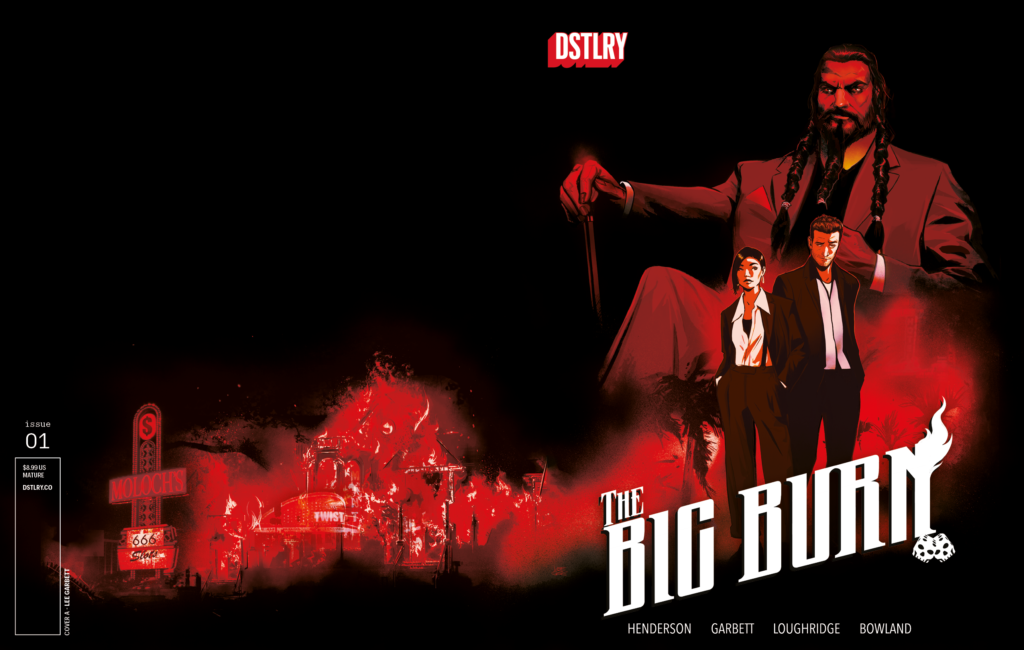
This July, DSTLRY is coming out with a red hot heist comic, The Big Burn, cooked up by Joe Henderson (Skyward, Netflix’s Lucifer, White Collar) and Lee Garbett (Shadecraft, Skyward, Loki). It’s the story of two swindlers, who suddenly find themselves cornered. Owen and Carlie sell their souls to the devil to grant themselves freedom but live to regret their decision and set out to pull off the mother of all heists – they’re going to try and break into hell, which is built like a Vegas casino and get their souls back. Tripwire Magazine’s contributing writer Ernie Estrella spoke with the co-creators on why they chose the confidence game as their latest collaboration.
“I love heists,” Henderson stated. “To me, the heist of hell is the greatest concept you can possibly have, because what’s more valuable than a soul?
“I do love a good heist movie, Garbett added. “It’s just so much fun to watch a gang of characters excel at what they do in a super-high stake scenario.”
When Henderson sifted through what his latest caper needed, he looked to Steven Soderbergh’s flirtatious fun in Out of Sight and Ocean’s 11 as inspirations and grounded it, in fantasy. But how do you make it feel like it has value, he asked himself. Through a love story who compromise themselves in a moment of weakness. After all, it’s just a soul right? Or at least that’s what our protagonists think.
In an important sequence in the first issue, readers will discover that Henderson anchors passion, undying love, and the thrills of being with someone to the soul. Take that away and what Owen and Carlie are left with are the ruins of their relationship.
“Losing your soul, to me, means becoming dull to the world,” Henderson described. “It’s like your taste buds being gone or not being able to smell freshly baked bread. Whatever drives you and makes you feel awake in the morning is gone. Your eyes are open and you’re a robot. You’re there, you’re alive, but everything is muted.”
The first issue of The Big Burn is told through Owen’s point of view; Carlie tells her side of the story in the second. Owen likes to push the problem away, bluffing through life and living in denial. Carlie decides to take the problem head on. Different perspectives, different approaches and two vastly different outcomes, but neither is headed towards a happy ending. That’s because the devil, Moloch, is toying with them.
“Moloch, has his own pain,” Henderson explained. “He has his own issues and it parallels our heroes, but he’s not going to show you that. He’s not going to show anyone who works for him. He’s the boss. He’s the one who is going to show extreme confidence at all times.”
Henderson is not so unfamiliar with the devil. He was the co-showrunner of Netflix’s Lucifer and a staff writer on White Collar, a series all about a con man who can’t change his stripes. It was both the thrill and challenge to try and not repeat himself.
“Writing heists are hard and mind breaking because you have to come up with a crime that is believable enough to happen but is also never thought of before,” Henderson admitted. “Then you have to come up with a way to do it that all of the best security and authorities couldn’t prevent.”
“I also had to make sure Moloch was nothing like Gaiman’s Lucifer, Netflix’s Lucifer Tom Ellis or any other Lucifer. I’ve written the devil in 93 episodes of television. I wanted someone who is magnetic, but is a villain like Terry Benedict in Ocean’s 11. If this is a casino, well, who is someone who runs the casino? What is that vibe? What is that energy? Lee came up with this beautiful design where his hair braids and his goatee form a pitchfork. You got the devil iconography right there in his face.”
“Hell is a casino and the idea is the torture is the proximity of hope, never attained,” Garbett imagined. “Visually we wanted the occupants to feel like they’re in a great place, having the greatest time, so we couldn’t have demons with pitchforks pushing people into fires. It had to feel like a cool spot but I added a gothic element to the surroundings. The idea that Moloch couldn’t resist setting his casino in an enormous Cathedral felt right for the character.
But Owen and Carlie aren’t getting out of this pickle by themselves. They need help and every good heist has a montage of the perfect pit crew to do the job, getaway clean and stump the authorities for the juicy headline. Or not.
“If you’re going to rob hell, you’ll need to assemble a crew of the damned,” Henderson proclaimed. “But here you don’t get to pick and choose the best safe cracker, the best getaway driver, whatever. You have to find the best of the ones who (also) sold their soul to the devil and convince them to join you.”
Garbett aimed to capture some of that ‘easy cool’ of the characters from those movies while trying to show that they’re not the pick of the litter. “They’re damaged and possibly aren’t all singing from the same hymn sheet, but they’re going to try and steal their own souls and that gives us the highest of stakes.”

So while the crew Owen would have chosen if their souls weren’t hanging in the balance, he must make this crew work. Look even deeper and readers may find that different members represent the other parts of what the soul is composed of.
“All of these characters miss something,” Henderson explained. “One of the things we dig into in later issues is what they’re missing and what they think is missing versus what they truly want. Owen and Carlie represent the love, so they need to steal their love back. But different members of the crew need something back.”
Henderson has been working on versions of this particular heist for nearly 20 years but it took the recent Hollywood strike to provide the time to think of a breakthrough. He wanted to represent all of the sins of hell in one location–a casino. That opened up the idea that the casino was the devil’s playground and who would be pulling the strings.
“Heist movies have to have rules and obstacles and you have to be consistent,” Henderson underlined. “If you cheat during a heist movie, you’re done. Same with a heist comic, you have to make sure all the rules are consistent and followed.”
“Our hero sees them as an opportunity. Rules are limits on Owen but also on the Devil. He is used to bending the rules and isn’t used to his rules being challenged. What Owen looks for is complacency. The fun of it is playing in the familiar but having the metaphors that exist within this. The vault has souls because those are the things most valuable. Torture is monotonous unless there’s an art to it. You have to give them the high before you give them the low.
This is the third time Henderson is collaborating with Garbett on a creator-owned comic. They first connected on the science-fiction adventure Skyward (optioned by Sony Entertainment), then the follow-up horror series Shadecraft, both for Image Comics.
“He’s so good at grounding the impossible,” Henderson glowed about Garbett. “He makes every character feel alive and real. Even if you’re walking through the devil’s casino, or low-gravity Chicago, or even if shadows are coming to life, you believe this person’s experience in the way that he conveys their emotions on their face.”
“Anyone can draw glowing hands, but not everyone can make you believe that someone is afraid of them.”
Garbett has already shown off insanely beautiful vistas and things that lurk in your nightmares, but it’s his ability to control pace, convey charm and style that made him perfect for The Big Burn. He has a way of making things look, as Henderson sums up, “fucking cool.”
Conversely, Garbett trusted Henderson from their first team-up and with each book they produce, readers are left satisfied experiencing tangible characters in larger-than-life situations. The Big Burn aims for the same bullseye.
“Joe’s characters leap off the page and the way he writes makes it so easy to visualise the world and the scenes within,” Garbett explained. “He writes these amazing high-concept worlds and then populates them with people you immediately fall in love with – or love to hate. As the artist tasked with bringing it to life, visually, it’s just a dream. I’m reading the scripts and I can’t wait to get going on it.”
“And to make sure neither of us ever get too comfortable or complacent, we like to throw in the odd surprise, here and there. Joe will throw in some stuff I’ve never handled before and I’ll try and interpret things in a way he may not have seen coming. It’s fun and, as I say, built on a lot of trust in each other’s abilities.”
“We’re an ocean apart but we have similar backgrounds and similar sensibilities so I think we understand each other. It’s been such a happy collaboration from the get go and we’ve built up a lot of trust with each other and what we’ll both bring to a project.”
Their migration to DSTLRY comes with great anticipation and eagerness to not only tell new stories but also be inspired by what other creators are doing at the boutique publisher and with the added real estate of the bigger pages.
Garbett bought an A1 drawing board and lightbox because of the wider pages, the double page spreads are enormous, so much that the traditional 11 x 17 art pages are dwarfed by comparison. It’s also allowed artists to think about new page layouts and designs.
“You’re forced to make some of the work more gestural and not get too noodly with it and that brings a whole new energy to the work,” Garbett boasted. “It’s also very cinematic in scope so it really lends itself to dynamic action scenes and exciting vistas. It’s been perfect for telling stories like The Big Burn.”
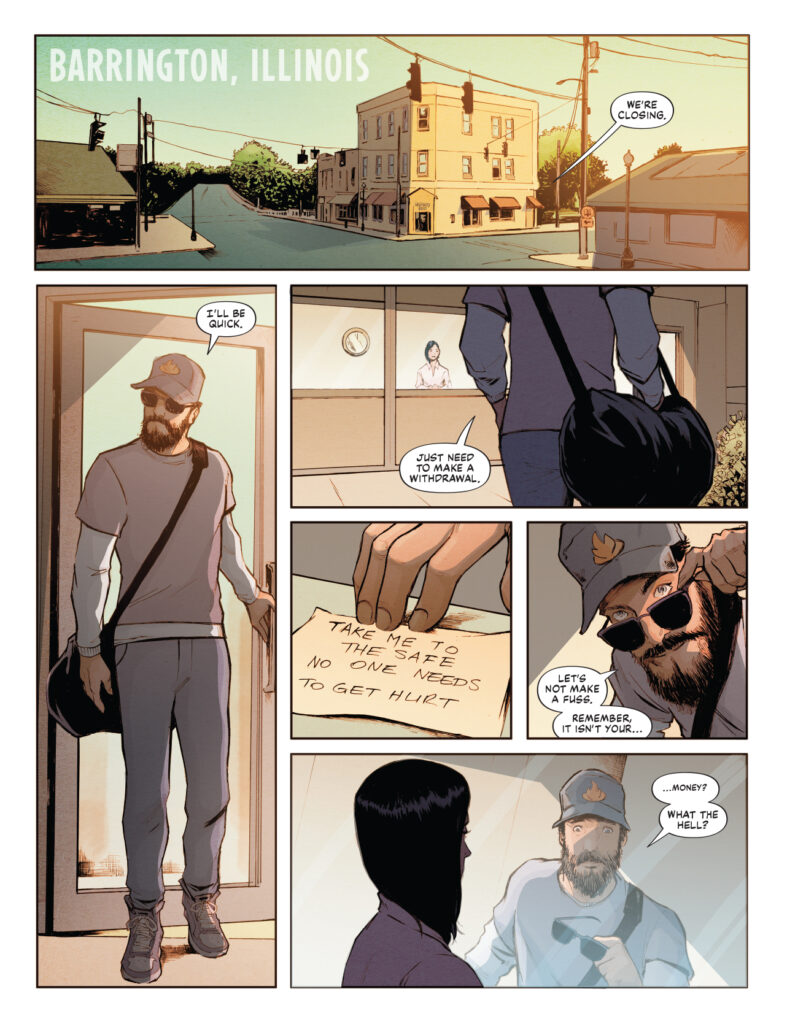
Henderson pondered how he could write the script so that Lee could show off in a way that so many other DSTLRY artists have in the new format. “So I tried to empower Lee moreso and leave the script a little more loose just to see Lee embrace it, show off and innovate,” Henderson said. “I wrote a bunch of double-page spreads to give him a chance to show off the beautiful, BIGGER pages. For example, Lee took a five-panel page with dialogue and turned it into a 12-panel grid and made the pacing better and it’s funnier because of it.”
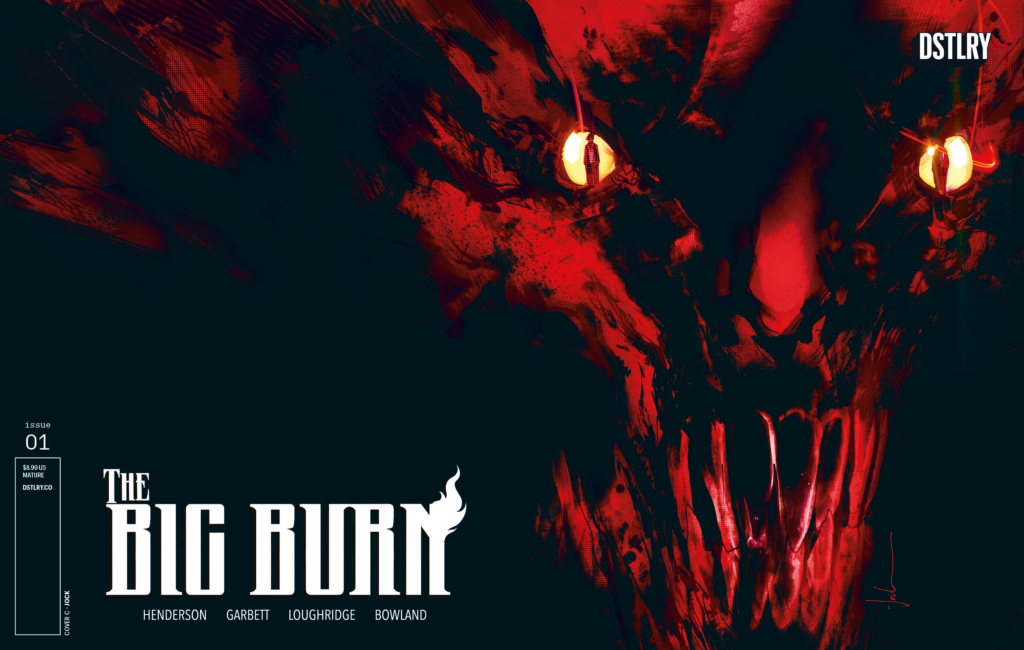
And what’s becoming a popular reaction by the creators of each DSTLRY book is their reactions as the DSTLRY founding creators take a crack at their creation with a variant cover.
“Honestly, that’s when it feels like the book truly comes alive,” Henderson said smiling. “When it’s just me, Lee and our team working away, it’s OUR book. But the second these incredible artists bring their own rendition of the characters, that’s when it goes beyond us. When it feels like the characters are their own people. It’s thrilling, especially when you have artists of this caliber doing it.”
“Yeah, DSTLRY are killing it with their variants and I absolutely love that part of the process,” Garbett added. “Seeing some of the best in the business interpret your characters and designs is the most amazing feeling. When they’re taken from you and made flesh at someone else’s hands, they somehow take on a life of their own. I love it, especially when it’s some of my genuine heroes stepping up and making the most gorgeous art for the book. It’s the best feeling.”


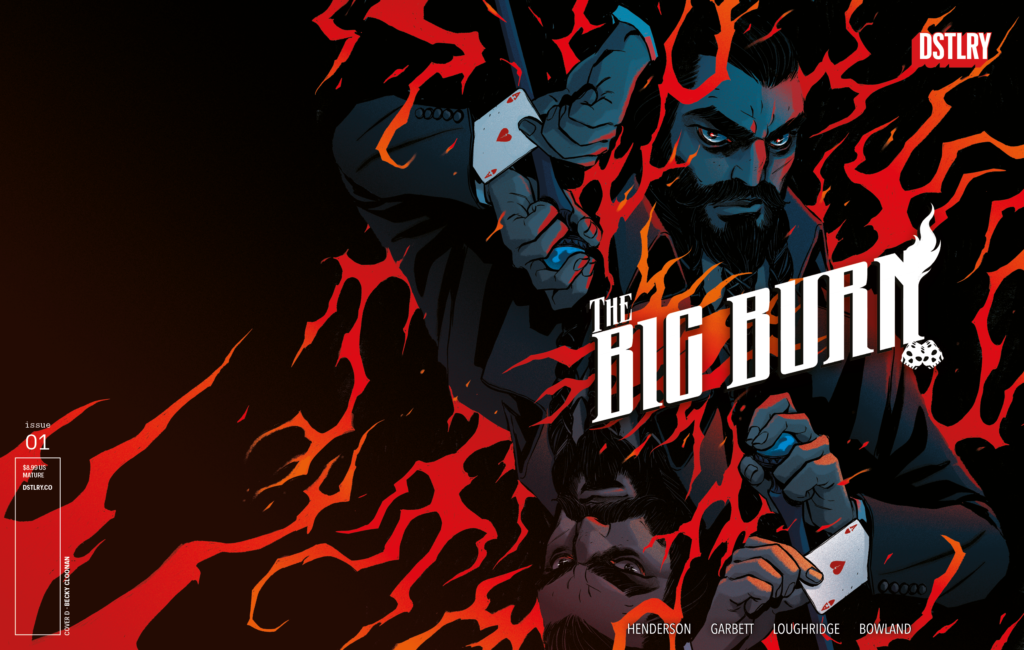
The Big Burn hits comic shops and digital in July and pre-orders are available at your local comic shops until June 10 for $8.99. A 14-page Ashcan is also available at https://dstlry.co/products/the-big-burn-1-ashcan-garbett-cover-a
The Big Burn is written by Joe Henderson with Lee Garbett providing interior art and the regular cover art for each 48-page issue. Lee Louridge is providing colors, lettering by Simon Bowland and variant covers by Jock, Tula Lotay, Becky Cloonan, Junko Mizuno, Jae Lee as well as a blank sketch cover.











You must be logged in to post a comment.