


Feature
Top 10 Cinematic Robots

Film’s Top Artificial Intelligence
♦ Our Contributing Writer James DC sharpens his pencils and gives us his Top 10 Cinema Robots of All Time
Robots, androids, cyborgs, droids, automatons, machine-men, mechanoids, biomechanoids, simulacra, robot clones, facsimiles, fembots, gynoids, robo-pets, etc. They all essentially add up to the same thing: an artificial, mechanical or partly mechanical, cybernetic-based ‘being’, intelligent to some degree, completely non-organic or otherwise partly human or alien in origin. (To make things simpler, from now on, I will mainly use the word ‘robot’ to encapsulate all of the above, as well as referring to the subjects as ‘he’ or ‘she’). The forerunners to such beings were originally conceptualised in ancient global mythology, thousands of years ago, but the robot as we know it today reached Western mass culture via the forward-thinking literature of the late 19th century, and later the pulp science fiction boom of the early 20th century. Gradually, the special effects of early silent cinema became efficient enough to match the wild imaginings of the SF genre’s visionary writers and artists; one of the first ‘proper’ screen robots being the robotic chauffeur in the British-made The Automatic Motorist (Walter R. Booth, 1911). Cinema audiences around the world have been treated to a fantastic array of all types of robots ever since such primitive yet quaint machine-men. Robots and their ilk are quintessential, evergreen metaphors for some of the most pressing concerns and questions of humanity: free-will, consciousness, identity, the origins of life, and this is why they are still so popular, especially in our increasingly technology obsessed times.
“Obviously, there are many beloved, legendary robots, of all sorts, which had to be left out in such a minimal list, but my criteria allows me to replace some of them with earlier or more emblematic versions of the same ‘template’.”
Obviously, there are many beloved, legendary robots, of all sorts, which had to be left out in such a minimal list, but my criteria allows me to replace some of them with earlier or more emblematic versions of the same ‘template’. For instance, I am sure some will bemoan the fact that R2-D2 from the seminal Star Wars (1977) isn’t included, but as with C-3PO basically being a copy of the robot in Metropolis (1927, at No. 1 in my list), likewise R2-D2 is essentially the same as Huey, Dewey and Louie, from Silent Running (1972, at No. 9). R2-D2 is chirpy, childlike and adorable, yet strong-willed and logical when necessary, all whilst looking quite basic and even a bit ‘silly’ – just like the aforementioned droids who were created 5 years earlier and thus ultimately win out. However, the corollary has been applied when it comes to the ‘Gunslinger’ in Westworld (1973) who is the Terminator by any other name, but without the time travelling plot, on top. The demonic cowboy android was no doubt a huge influence on James Cameron’s The Terminator (1984, at No. 2) and could easily have replaced Schwarzenegger’s T800 if it were not for the fact that the latter android is even more scary, amazingly well crafted and…well….just cool. The Terminator is also one of the greatest science fiction movies, so there is no way its robot could be topped by Yul Brynner’s gunslinger, regardless of Westworld coming first, chronologically, and however brilliant it surely is. The same cannot be said for R2-D2 when compared with Huey, Dewey and Louie, however much we all love him and however well designed he is.
Obviously, there are many beloved, legendary robots, of all sorts, which had to be left out in such a minimal list, but my criteria allows me to replace some of them with earlier or more emblematic versions of the same ‘template’. For instance, I am sure some will bemoan the fact that R2-D2 from the seminal Star Wars (1977) isn’t included, but as with C-3PO basically being a copy of the robot in Metropolis (1927, at No. 1 in my list), likewise R2-D2 is essentially the same as Huey, Dewey and Louie, from Silent Running (1972, at No. 9). R2-D2 is chirpy, childlike and adorable, yet strong-willed and logical when necessary, all whilst looking quite basic and even a bit ‘silly’ – just like the aforementioned droids who were created 5 years earlier and thus ultimately win out. However, the corollary has been applied when it comes to the ‘Gunslinger’ in Westworld (1973) who is the Terminator by any other name, but without the ingenious time travelling plot, on top. The demonic cowboy android was no doubt a huge influence on James Cameron’s The Terminator (1984, at No. 2) and could easily have replaced Schwarzenegger’s T800 if it were not for the fact that the latter android is even more scary, amazingly well crafted and…well….just cool. The Terminator is also one of the greatest science fiction movies, so there is no way its robot could be topped by Yul Brynner’s gunslinger, regardless of Westworld coming first, chronologically, and however brilliant it surely is. The same cannot be said for R2-D2 when compared with Huey, Dewey and Louie, however much we all love him and however well designed he is.
I have attempted to include a few unusual or more rarefied examples from a wide-ranging array of different types of robot but, inevitably, some of the best cinematic robots display a more relatable, humanoid form, as well as most of them originating from America and Hollywood – which is perfectly understandable given the prohibitive budgets required to create believable, sophisticated robot props and costumes. Despite whittling the list down to just ten, I should give additional, honourable mention (in chronological order) to the following iconic films, TV series’ and robotic characters which had to be left out:
The Mechanical Man (1921), the Tin Man (The Wizard of Oz, 1939), Superman: The Mechanical Monsters (1941), Kronos (1957), The Colossus of New York (1958), Astro Boy (1959 – 2009), Robot ‘John’ (Planeta Bur/Planet of Storms, 1962), the Cybermen (Doctor Who, 1966 – ), Mechagodzilla (1974 – 2003), K-9 (Doctor Who, 1977 – 2011), Marvin, the Paranoid Android (The Hitchhiker’s Guide to the Galaxy, 1981/2005), the Borg, Data (Star Trek, 1987 – 2002), Ghost in the Shell (1995), The Iron Giant (1999), Bender (Futurama, 1999 – 2013 ), the Sentinels (the Matrix films, 1999 – 2003), WALL-E (2008), Ava (Ex Machina, 2015). Of course there are many more fantastic robots from the history of film and TV, but look out for the next fascinating iteration in just a few days time, when Marvel’s Vision will make his second appearance, to date, in Captain America: Civil War. Plus the Ghost in the Shell live action remake which will be released in 2017.
It should also be noted that HAL 9000, from the best science fiction film ever made; 2001: A Space Odyssey (1968), is not in my list (as he is in some other robot lists) because it is doubtful that he fulfills enough of the requisite attributes for any type of ‘pure’ robot. Sure, a little bit like Proteus (1977, at No. 7), or perhaps even Alpha 60 from Alphaville (1965), he sometimes projects his ‘consciousness’ into other areas, buildings, mobile attachments or vehicles which could be interpreted by some as limited, long-distance ‘robots’. However, in the long run, he is much more a ‘stationary’ computer intelligence than other similar candidates and a line finally has to be drawn somewhere.
“Klaatu barada nikto!”
1) FALSE MARIA
Metropolis. 1927. Director: Fritz Lang
The prototypical image of a robot on film, this legendary version of an android is still the best designed, almost a century on, having given a focus to the vast German Expressionist sets and sublime science fiction aesthetics of Fritz Lang’s silent epic. The abiding moral message of Metropolis is about the evils of class and wealth division, which nicely doubles up in terms of the universal man/machine dichotomy. But perhaps the film’s most spectacular achievement was leaving future generations the timeless image of the robot; the svelte, subtly erotic, Art Deco features of ‘false’ Maria, an evil Doppelgänger borne of occult pseudoscience and the cosmic ravings of a mad scientist. The successful creation of the robot by sculptor Walter Schulze-Mittendorff was astonishing given the limited capacity of technology and prosthetics in the 1920’s, and it still looks thoroughly modern today. Brigitte Helm, the woman behind the mask, had to stand virtually still in costume for painstaking hours on end during the wonderful ‘transformation’ scene, and at one point even passed out. Suffice it to say, the highly popular C3-PO from Star Wars (1977) was largely based on this classic, hugely influential design, hence his absence from this list. Ultimately, the false Maria is the apotheosis of robot concepts and design throughout the centuries, and she is all the more remarkable for not having dated, at all, in our hyper-tech bewitched times.
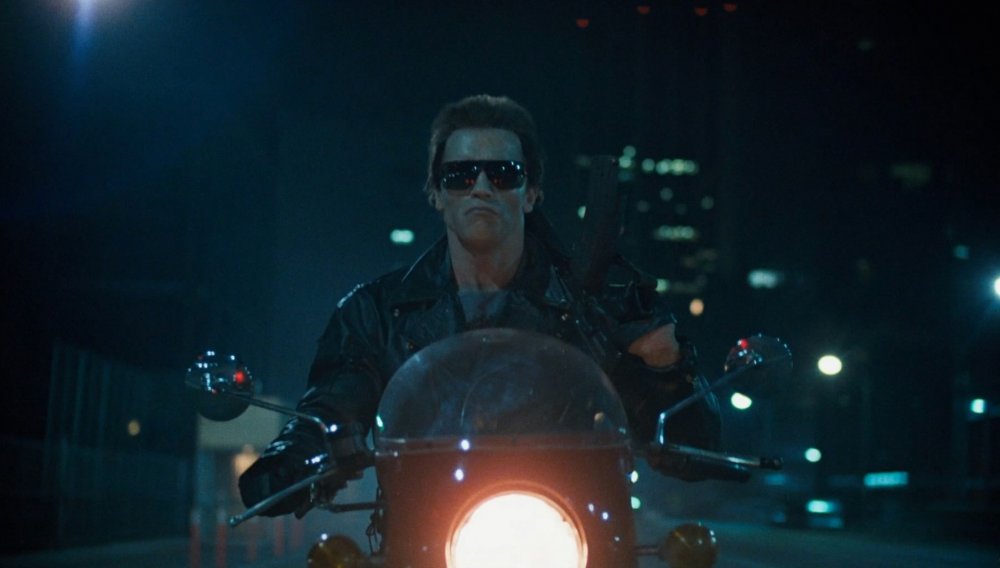
2) T800
The Terminator. 1984, James Cameron
In a toss-up between the T800 and the more advanced, shape-changing T1000 from Terminator 2, Arnold Schwarzenegger’s awesomely formidable but somehow charismatic version ultimately wins out. In this stunning, bravura classic, which takes its cue from many foundational SF texts (especially the canonical film Westworld, with its just as pitiless android), the T800 is a cyborg assassin from the future who…..well, I’m sure you all know, by now, the seminal time travelling plot with all its ingenious twists and turns, so I won’t labour it here. For once, a cinematic robot is truly fearsome; you really do believe this thing can walk, talk and burst right through a guy’s torso with one punch (even if the 80’s analogue-based special effects don’t always totally convince, in the latter stages of the film). Perfectly embodied by the similarly robotic acting of Schwarzenegger, the T800 is a tough-as-nails, logical killing machine which relentlessly endeavours to fulfill its murderous mission. There has never been a more authentic realisation of an ice-cold, artificial intelligence. Cameron and his special effects team used the customary 80’s combination of animatronics and stop-motion animation in order to envisage the archetypal killer cyborg, its seemingly invincible endoskeleton (its ‘real’ guise) a supreme example of utilitarian, ergonomic, ultra hi-tech design – which still looks futuristic more than 30 years later.
3) ROBBY THE ROBOT
Forbidden Planet. 1956, Fred M. Wilcox
The charming and avuncular Robbie is the stellar attraction of this game-changing, brilliantly realised SF version of Shakespeare’s ‘The Tempest’. With a relatively impractical and unrealistic body, Robbie’s look nevertheless suits the films weird, other-worldly atmosphere, displaying a flamboyant, clever form in the grand old tradition of a wind-up tin toy. Robbie is inordinately intelligent and super strong, with a deadly laser weapon at his disposal, yet is completely servile to his human masters, tacitly obeying Isaac Asimov’s famous ‘Three Laws of Robotics’ (which makes a refreshing change in terms of the story’s ‘Internal Logic’, even compared to robot characters nowadays). Despite this, he also seems to have an innocently humorous element built into his circuitry, as evidenced by his slightly jovial shenanigans with the crewmen of the spaceship. Robby is a perfect summation of the various types of pulp magazine robot imagery from the previous decades, and this is partly why the film is so respected by science fiction fans; it was one of the first blockbuster films to get the robot ‘right’. The partly functional Robby, who was created from scratch at great cost, was so successful and popular that he was later commandeered (after being slightly modified) for the classic science fiction TV series Lost in Space, as well as for numerous appearances in other films and TV shows, throughout the ensuing decades.
4) DALEKS
Dr. Who and the Daleks. 1965, Gordon Flemyng (first BBC TV appearance: 1963)
Perhaps a controversial choice – as opposed to the undoubted cyborgs the Cybermen, also from the classic TV series Doctor Who. However, the Daleks are also a type of cyborg and are much more iconic in my book (plus they starred in two movies). With a bizarre pepper pot design, a sink plunger for a weapon and the immortal war cry “Exterminate!”, the fascistic Daleks (a grotesque product of nuclear armageddon on their home planet Skaro) are among the most formidable and ruthless – but also coolest – tyrants in the universe. And for any pedants out there; I do know they aren’t ‘robots’ per se. However, they are partly roboticised hybrids, essentially an alien/machine interface, more like a cyborg, controlled by tentacled, atrophied mutants from inside their protective metallic shells. Moreover, they act like, and are seen and experienced, as robots, to all intents and purposes. (I think a good litmus test would have been to ask a 5 year old child, in the early 60’s, what type of ‘monster’ or ‘creature’ the Daleks were, and no doubt most replies would have come back as ‘robots’). The Dalek iconography is so familiar to audiences everywhere that it has been kept to the same basic design over the last 5 decades and numerous versions of Doctor Who – notwithstanding their recent ability to get round that pesky ‘stairs’ problem by simply hovering above them! Their design may seem slightly absurd or ludicrous to some, but the Daleks are so unique and significant to science fiction, generally, that they are a force to be reckoned with. Ultimately, the Daleks are some of the best known and well loved robots, worldwide – certainly in the UK, anyway.
5) GORT
The Day the Earth Stood Still. 1951, Robert Wise
This seminal science fiction film is basically a sophisticated, modern morality tale, warning against M.A.D. (Mutually Assured Destruction), and the wonderful robot character Gort is pivotal to that storyline. Boasting an impenetrable, silver metallic casing, plus a visor which opens to reveal a deadly laser beam, the 10 foot tall Gort is someone not to be fucked with! Sure, we can all see the creases in Gort’s supposedly ‘metallic’ armour (a ‘Neoprene’ rubber suit, worn by a 7ft tool actor) when he bends his knees to walk, but his first appearance, slowly stepping out of a gigantic flying saucer and accompanied by Bernard Herrmann’s eerie Theramin soundtrack, is awe-inducing and spooky. We later see him vaporise the enemy army’s artillery, tanks and guns with the use of his eye-laser, and these are well crafted, believable effects for the time. Gort’s brooding presence is powerfully enhanced by the fact that he has no face and is silent, throughout; this guy is serious and doesn’t mess around. (The CGI rendered robot in the vastly inferior 2008 remake is based on this original elegant form, but cannot convey the same impact). Gort, who essentially is a kind of interstellar policeman, is finally dissuaded from destroying the Earth – for continuing to ‘pollute’ the galaxy with nuclear weaponry – by the utterance of the legendary, pacifying line: “Gort, Klaatu barada nikto!”.
6) ROY BATTY
Blade Runner. 1982, Ridley Scott
Unlike the psychotic, malevolent android Ash in Ridley Scott’s other legendary SF film Alien, Batty (brilliantly played by Rutger Hauer) and his fellow Nexus-6 Replicants are ambivalent, complex, fully-rounded characters, sympathetic to us because of their tragic awareness of their own inevitable, accelerated demise. These artificial humanoids attain a semblance of humanity whilst searching for a soul within their own circuitry. The enigmatic, Übermensch-type Batty is the leader of his rebel androids and possesses superhuman strength and abilities, plus ultra-intelligence; his is a recipe for perfection, if it wasn’t for his built-in mortality. But for all we know he may as well be just an ‘enhanced’ human, since we never get to see his machine-like insides. In this sense he is symbolic of the tricky, interrelational dynamic between real-life androids and humans, and the consequently unsettling phenomenon of the ‘uncanny valley’. Blade Runner was revolutionary in many ways: it wasn’t quite the first to do so, but the nuanced, sophisticated portrayal of artificial intelligence was a big deal for a mainstream movie back then. However, it is now de rigueur – and unfortunately rather cliché – for robotic characters to carry the burden of such existential ruminations. Director Scott was at the peak of his powers in the early 80’s, but it was the genius of Philip K. Dick’s source material and his thematic preoccupation with robots and simulacra that elevated the film to a classic of philosophical science fiction. The film’s abiding questions and ideas of A.I., consciousness and determinism are enthrallingly distilled in the scene when Batty dies, uttering his pensive, sorrowful ‘like tears in the rain’ monologue, further inviting us to ponder the folly of humanity playing God with artificial life.
7) PROTEUS
Demon Seed. 1977, Donald Cammell
At first glance the power-hungry, insidious Proteus may not seem like a ‘classical’ robot, in the sense that its corporeality is vague and indistinct, but the dissemination of its will, remotely, through portable appliances and robotic devices, effectively furnishes it a ‘body’ with which to ultimately enact the birth of its own mutant progeny. A dark, unsettling, cinematically experimental film, Demon Seed pushed the concept of a superior A.I. to new extremes; Julie Christie’s character is imprisoned in her own home by the tyrannical machine entity, which forcibly impregnates her, ready to give birth to a final, cyborg manifestation of itself. In other scenes, Proteus (voiced by the mockingly smooth, velvety tones of Robert Vaughn) builds for itself a huge, origami/decahedron type machine which can spontaneously change shape and resynthesise itself at will, the contraption being used to great affect when it decapitates a would-be rescuer. This undervalued and stylish cult classic – directed by the unconventional, free-spirited Cammell – adroitly juggles interconnected themes of authoritarianism, domestic psychopathology, technological slavery, artificial life, and the autonomy of consciousness. And at the centre of it all is Proteus, one of the most radical and unusual robots in cinema.
8) THE IRON MAN
Tetsuo: The Iron Man. 1989, Shinya Tsukamoto
An eight ball out of nowhere, this utterly bizarre, low-budget miracle was filmed on 16mm by Japanese wunderkind Tsukamoto. With hardly any rhyme or reason to the proceedings, a Japanese salaryman notices, one morning, strange metallic spikes protruding from his stubble, and thus begins the weird metamorphosis from normal human to weaponised, super-powered cyborg, which rapidly takes over his entire existence. As he mutates, growing metallic shards, circuitry, cannons and heavy weaponry from his body, he joins in a cataclysmic battle with a similarly evolving opponent. This is ‘body-horror’ at its most flamboyant, thrilling and visceral, with scenes of speeded up, stop-motion live action, near-subliminal editing and incredible, orgasmic violence. In one of the most demented scenes ever committed to film, the burgeoning nightmare shifts into hyperdrive when the salaryman’s groin suddenly erupts into a massive, erect drill bit which he then uses to tear into his (erotically willing) girlfriend during a psychotic form of intercourse. The amazing, final scenes of one-on-one combat with his robotic enemy show up the similarly themed fights in the Hollywood Transformers movies for the kiddie-claptrap they really are. As with the decades old cycle of outsized ‘kaiju’ monster films (beginning with Godzilla in 1954), Tetsuo is part of the wider cultural response to the catastrophic atomic bombing of Japan, in World War II. Moreover, the country’s obsession with technology and the constant development and refinement of real-life robots can be seen as a collective striving for a kind of hi-tech transcendence of past traumas; and Tetsuo is a prime example of that fixation.
9) HUEY, DEWEY AND LOUIE
Silent Running. 1972, Douglas Trumbull
In this counter-culture classic, Bruce Dern plays Lowell, the environmentally conscious hero who is safeguarding the last vestiges of Earth’s extinct flora and forests, which are barely kept alive inside the geodesic dome of a space freighter, far out in the Solar System. In this respect he is assisted by three invaluable service droids who share the horticultural duties. But tragedy awaits them all, and the droids take on the mantle of ultimately saving the plants and trees in an incredibly poignant, heart-wrenching finale. Serenaded, in one scene, by the beautiful, bitter-sweet voice and harmonies of Joan Baez, these cute, seemingly cheerful little robots manage to elicit, with limited recourse to body movement and gesticulation, a plethora of emotions in the viewer; from laughter, joy, dismay, and finally, sadness. There are other impactful sequences, such as when Lowell plays poker with the robots, joking with them about their cheating behind his back, and when he gives emergency ‘surgery’ to Huey, who he accidentally knocked over and damaged while recklessly driving a buggy, we genuinely fear for its life. The amputee actors who acted ‘inside’ the robots did a consummate job and if there had ever been an Oscar nomination for ‘robo-acting’, they undoubtedly would have won. Huey, Dewey and Louie are some of the most ‘human’, and therefore lovable, robots in all of cinema, despite their utilitarian, basic design – it’s a sure bet that a young George Lucas was avidly watching these droids in 1972. As well as Star Wars’ R2-D2 (1977), they no doubt influenced the character and makeup of countless other robots, from Buck Roger’s ‘TWiki’ (1979-81), The Black Hole’s V.I.N.CENT (1979), right up to Moon’s GERTY (2009) – which is a direct homage to Silent Running – as well as the more recent robot companion in Robot & Frank (2012).
10) MURPHY
RoboCop. 1987, Paul Verhoeven
In this sophisticated SF satire (which took reams of inspiration from the earlier British comic book character Judge Dredd) Alex Murphy is a hard-bitten cop, in a near future Detroit, who gets shot to pieces in a vicious gang-murder. But revolutionary technology brings him back from the brink of death to be reborn as a state-of-the-art cyborg cop, later taking revenge on the perpetrators and meting out instant justice to anyone who dares to cross the law. Rip-roaring, witty action scenes abound, and Murphy employs some ingenious, cool gadgets with which to fight crime, like the Beretta 93R machine pistol which swivels out from the side of his leg. However, Murphy’s sarcastic quips, such as “Thank you for your co-operation”, as he blows away his enemies, are almost as cutting as his firepower. Of course, Murphy’s (stop-motion animated) robot colleague ED209 is more powerful than him but is fatally flawed in that it randomly kills innocent bystanders, by default. Famed special effects expert Rob Bottin excelled in creating the highly realistic, mobile RoboCop suit – six of which were made – at a cost of a whopping one million dollars, at the time. Nevertheless, the suit was often cumbersome and filming was stopped for 3 days while Peter Weller learned how to move and act inside it. The brilliantly conceived design of the slick, sophisticated cyborg is a knockout, but ultimately, it’s the internal conflict between Murphy’s human emotions and memories and the infiltration of cold logic into his computer-connected brain that is the real heart of the film. The 2014 remake was, in the main, superfluous to the Verhoeven classic, with a robot design that relied far too heavily on Bottin’s original.
And to round things off, here is the early robot film The Automatic Motorist (Walter R. Booth, 1911), which is proof positive that filmmakers have been obsessed with robots for well over a century, now.











You must be logged in to post a comment Login