

Film News
Throwback Thursday: Iron Man 2

Back in Tripwire #54, out in Summer 2010, we spoke to UK post production house Double Negative about working on Marvel’s Iron Man 2. With Captain America: Civil War hitting UK cinemas tomorrow, we thought it would make an appropriate throwback for this week…
Creating A Stark Reality
SUITCASE ARMOUR DEPLOYMENT
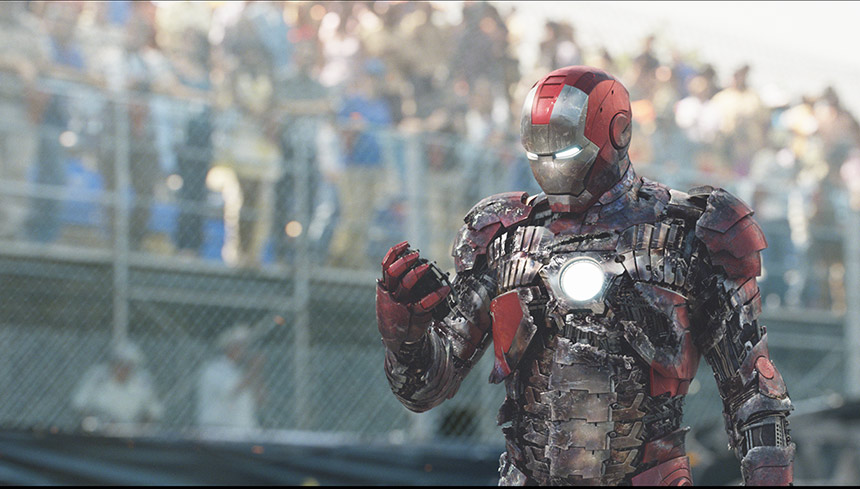
There’s no doubt in the minds of Double Negative’s Mark IV Iron Man team, that the suitcase armour deployment was Double Negative’s (DNeg) biggest animation challenge in Iron Man 2 and they quickly discovered that their most difficult hurdle to overcome was the fact that there was no distinct road-map.
The crucial part of the transformation was the transitional phase of the machine that lay in between the Suitcase and the Final Armour. Recalls Animation Supervisor, Paul Davies, “ We knew it was essential that the artists stack and move parts in ways that felt mechanically feasible and visually linked up from shot to shot, so we developed a system allowing the animators to grab any of the suit’s 3,000 parts and build custom rigs for each shot.” The obvious logistical challenge was organizing the thousands of parts, but the most difficult and enjoyable task was drawing visual cues or connections between the different stages of the transformation. Once the transformation was over there would be nothing left resembling the actual case, so the team needed to utilize the shapes that most closely resembled key features and attempt to systematically knock out features of the Suitcase that would have no use down the line.
The Suitcase handles plunging inside of what would become the gloves was a perfect way to start making things disappear and once the animators established that key action, the next effort was focussed on creating an interesting metamorphosis, while also trying to maintain a volume that would be plausible to lift and contain enough key features to deploy across the following shots. Astonishingly, while the team had originally contemplated automated solutions, every piece was ultimately animated by hand. This gave the animators the flexibility to approach the sequence with an element of speed and control.
The next stage was 2D, recalls Davies “Once we had a buy off on the movement of the armour our 2D team combined the armour with the footage of Robert Downey Jr.” Shots where Stark’s arms were going into the suit created a challenge to line up because of the positioning of his arms and the fact that they did not convincingly sell the idea that he was doing the ‘pushing’ action. This was resolved by making his arms CG. In the end the only real thing was Robert Downey Jr’s head and the rest of him was CG. Says 2D Sequence Lead, Christine Wong, “Integrating his (Robert Downey Jr’s) head into his helmet also proved difficult and the team had to work frame by frame to get it looking right.” This was achieved by using a combination of painting and rotoshapes to make the transition believable and tracking in patches of hair, which were then animated as being pushed down. Finally, the addition of shadows helped to further sit him into the helmet.
Says the Animation Sequence Lead, Michael Bomagat: “You can scrutinize frame by frame to try and find holes in aspects of the logic or the design of the mechanism. But seen in context I think the sequence is largely successful because of the overwhelming amount of visual information to process and it only gets more and more complicated, leaving the only option to sit back, relax and enjoy.”
BRINGING WHIPLASH TO LIFE
With the arrival of Iron Man’s arch-nemesis, Whiplash, on the racetrack, the action develops into a fierce battle between the two. During this fight, DNeg needed to develop an effect to illustrate the damage inflicted on Iron Man by the whips. Iron Man 2’s Visual Effects Supervisor, Janek Sirrs, provided the team with video reference of thermite burning through steel, to use as a starting point. This was characterised by blobs of what look like molten metal, showers of sparks and lots and lots of smoke.
Dneg’s thermite team was led by Lead FX Artist, Eugenie von Tunzelmann, working closely with lighting artist Seth Dubieniec, 2D Sequence Lead Christine Wong and Lead Animator Andy McEvoy. They started by trying a liquid simulation for the molten metal, but immediately found that it wasn’t quite suitable for their purposes. It was difficult to get small droplets, and difficult to direct to the extent that they wanted to — for instance, they wanted control over how much of the molten metal stuck to Iron Man’s suit and how much rained down to the ground. They achieved more success with a particle simulation in Houdini and a lot of work was put into this simulation to ensure that the particles were emitted in clumps and with enough energy and randomness to mimic the look of the thermite blobs. Another advantage of the particle simulation was that it proved easier to control the overall amount of molten metal that was emitted, allowing precise control over the volume of the effect and how much of the frame it took up. The thermite effects needed to be much more contained than the real-life thermite the team had observed in the reference material, as in real-life it would quickly engulf Iron Man and completely take over the shot.
The team knew that adding three layers of effects over the top of each other might look chaotic, so it was essential that the other layers that comprised the thermite — the sparks and the smoke — were visually closely connected to the molten metal. The smoke simulation was achieved with DNeg’s in-house fluid solver, Squirt, and was emitted from the molten metal particles, with the volume being dependent on the temperature of the molten metal so that it stopped smoking as it cooled. The sparks were a Houdini particle simulation and these were also emitted from the molten metal whenever it collided with an object — so every blob that impacted Iron Man or the ground, for instance, would result in a shower of sparks. The sparks themselves were extremely high energy and very erratic, sometimes bursting into showers of secondary sparks mid-air, all in keeping with the behaviour of the thermite reference material the team had studied.
These molten metal and sparks were also required to cast interactive lighting and reflections on to everything around them, including the smoke, Iron Man’s suit and the surrounding environment. All of these layers had to be balanced carefully in the composites. The lighting artists could creatively add point lights to help boost the reflections where needed, so these had to be balanced in the composite as well, along with heat distortion and glow on the molten metal and sparks to make them look hot and dangerous.
RECREATING RACE DAY
All of DNeg’s work on Iron Man 2 took place in the Monaco Formula 1 Race Day sequence. Says Sequence Lead Jenni Eynon, “One of the huge challenges the Dneg team faced was adding 22 CG race-cars onto a live action back-plate for the race footage. The shiny surface of the cars meant it was important to reflect as much of Monaco as possible back onto them so they would sit into the plate convincingly.” To realise this, Dneg’s onset team took extensive photography and lidar scans of the Monaco racetrack during an actual F1 race day, which provided the team with enough material to recreate a CG Monaco racetrack and stitch together panoramic images that cover a high percentage of the architecture that lined the road. Dneg’s T.D.’s created a tool called ‘bubbleworld’ to convert these images into ‘reflection cards’ and place them along the edges of the CG racetrack. These reflection cards were used within Dneg’s image based lighting pipeline to allow them to efficiently position textures / photography in 3D space for reflecting onto the surface of the cars, avoiding costly ray trace calculations of renderable geometry.
Reflection cards gave the team a great starting point for most shots but for others, such as the onboard camera shots, they weren’t providing the desired look. Recalls Eynon, “We had access to high speed footage using cameras, fitted with fish eye lenses, mounted on the front and back of a race car, which had been driven around the racetrack at speed. The synchronised footage taken from the front and back of the car was merged into a sequence of images, which then contained a 360-degree view of the racetrack as the camera moved along it. This sequence of images was mapped onto a spherical ‘reflection light’, which surrounded the digital car and followed it along the track. Once the image sequence of the reflection light was synchronised to match the position in the filmed back plate, it resulted in synchronised reflections running over the digital paintwork of the car.”
While the bulk of the cars’ environmental reflections were derived from a spherical HDR image, the self-reflecting surfaces had to be calculated using ray-tracing techniques. The car models needed to be incredibly detailed, as some shots drew right in to the back of the cars and showed the inner workings of the vehicles. To cut down on render time, trace sets were created for geometry that would benefit from ray-traced reflections while objects that were hidden far enough under the chassis were left out. These trace sets let the reflection light know which objects it should ray trace reflections for and which to use the image based reflections.”








You must be logged in to post a comment Login