

Headlines
Edvard Munch Review

Chronicling The Life Of An Artistic Genius
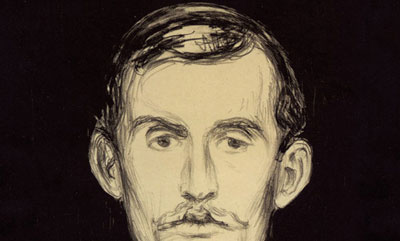
♦Tripwire’s Contributing Editor James DC reviews a forgotten classic about the life of Norwegian painter Edvard Munch, now on DVD and Blu-Ray…
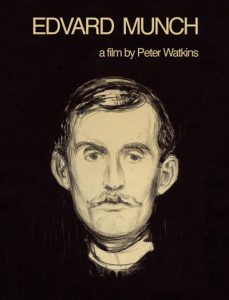
Edvard Munch
Director: Peter Watkins. 1974
On Blu-ray/DVD now
Peter Watkins is one of the most radical, inventive and sophisticated British film directors of the last five decades, but hardly anyone, outside of a few scholars and aficionados of arthouse cinema, will have have heard of him. This is a great shame, because his body of work contains some wonderfully powerful films, which can be ranked with the best of them. One of the reasons for this is that many people in the mainstream film, TV and media industries have, to an extent, shunned him because of his Left-leaning opinions and rigorously critical condemnation of how most modern films and TV programmes are produced and created; often in a manipulative fashion, cynically customised for our increasingly shallow media landscape. His critique of dumbed-down mainstream media is entirely correct, and his films attest to the fact that, if things were different, so much more could be achieved in contemporary audio-visual culture in terms of talent, originality and intelligence. Many film critics have unjustly neglected or attacked Watkins’ body of work, and this is a reprehensible travesty considering that he has been such a unique and pioneering talent in British cinema for the past 50-odd years. (Often struggling to get his projects greenlit, if at all.)
This, Watkins’ eighth feature, focuses on the formative years of Norwegian, proto-Expressionist painter Edvard Munch, most famous for his 1893 painting ‘The Scream’, which is now emblazoned as a fashionable design on teacups, curtains and lampshades, the world over. This is highly ironic because, as this superb biographical film shows, Munch was either ignored, lambasted or even banned from showing his work for much of his life, just as Watkins has been censured and pilloried over the years, which is doubly ironic and one of the many synchronous currents flowing between the director and his principle subject in this compelling, beautiful film.
The film covers, in detail, around twenty years’ worth of Munch’s life from his troubled, sickly childhood in Oslo, Norway, to his neurotic thirties around the beginning of the 20th century, in Berlin and later, Paris. It especially highlights his early years as a struggling artist when he dealt with debilitating psychological issues like shyness, loneliness, depression, jealousy and unrequited love, as well as the state and media-led public disdain and disgust for his work. One of the main strands of the story – which sticks strictly to the emotional and historical truth of what actually happened – deals with Munch’s on-off, tragic affair with a married woman: a ‘Mrs. Heiberg’. The devastating climax to this affair, when Heiberg conclusively rejected Munch, mentally scarred him for the rest of his life, becoming the emotional core and inspiration to many of his most enthralling, moving paintings. Watkins adroitly employs this seminal, traumatic experience in Munch’s life as the central whirlpool of the film, around which all other events ebb and flow.
As per most of Watkins’ other films, the structure of this one is unique; utilising a semi-improvised, documentary aesthetic which incorporates non-actors and Watkins’ own narration over the top. (If you have seen Watkins’ most famous film, the nuclear holocaust-set ‘The War Game’ (1965) – which itself was shocking and controversial for the time and consequently banned by the BBC – then you will immediately understand his singular vision and style of filmmaking.) Throughout the film the camera moves in and around the sets and actors, in true cinéma vérité fashion, often zooming into, or lingering on, the protagonists’ faces, with all of their nuanced emotions and subtle expressions exposed, like unveiled landscapes of the mind. Moreover, throughout most of the film, the actors turn to look straight at the camera, effectively staring at ‘us’ and breaking the normally sacrosanct ‘fourth wall’ whereby fictional characters are meant to be only distant, abstract ‘players’, not directly or reciprocally ‘involved’ with the viewer. This produces an odd, startling effect at first, but soon enough one comes to embrace such an enticing, intense technique, somehow feeling a lot closer to the characters who are, after all, ultimately ‘real’ people, recorded for prosperity on film regardless of whether they were acting at the time, or not. Just like the figures in Munch’s paintings, who also disconcertingly stare back at the viewer, the characters in this film alternately implore us, coldly regard us, flirt with us, accuse us, or berate our ‘complicity’ in the actions taking place. This ‘intrusive’ filmic device creates a liminal, uncannily intimate ambiance; a sort of interstitial communicative zone between the viewer – or more correctly watcher or observer, in this case – and the inner life of the ‘living’ people, on film. This clever, documentary infused trick, along with a few scenes when characters again speak directly to the camera, but in a sort of mock interview set-up, is part and parcel of Watkins’ avowed mission to create new forms of visceral interaction between the filmmaker and his/her audience. In lesser hands such playful, blatant effects, during a semi-fictional biopic, would come across as pretentious, awkward and unwieldy, but Watkins’ sure touch renders these scenes emotionally authentic and intellectually mesmerising.
Throughout the narrative the dense layering of visual leitmotifs and overlapping episodes of time, akin to fragments of suddenly remembered personal history in the mind’s eye of Munch (played with naturalistic, mysterious grace and gravitas by non-actor Geir Westby) reflect what is going on in the ‘real’, present world of the film, intruding upon, and interjecting with, the contemporary scenes and action around the painter. In this sense, the film is visually analogous to the mental workings of the brain; a metaphorical reenactment of the melange of various states of consciousness which we all experience, day-to-day, whilst also being a corollary to the abstract Modernist tendencies in art and literature which were taking hold of European culture at the time the film depicts. (That other great iconoclast Nicolas Roeg is the only other British filmmaker I can think of who employed such metatextual or supratextual techniques, with his classic 1973 film ‘Don’t Look Now’ perhaps being closest, in spirit and technique, to Watkins’ ‘Edvard Munch’.) One such continuously regurgitated ‘memory’ – often interspersed and juxtaposed with a second motif of Munch tenderly, romantically kissing Mrs. Heiberg, in happier times – shows Munch’s younger sister Sophie coughing up blood as she dies from tuberculosis; it is a profound, disturbing image, reflected by another recurrent motif showing Munch as a child, almost dying from a similarly severe illness. Much of Munch’s early family life was tainted by premature death, madness and conflict with his pious, devoutly religious father, and the film intermingles these pivotal episodes, which so obviously influenced him, with those of his later artistic development and spiritual and psychological trials, to great effect.
In a later stage of his life, when Munch has broken free from the religious and moral confines of his oppressive parents and the well-to-do, stiff-necked milieu of Oslo, he begins mixing with a small group of radicalised bohemians, poets, philosophers and musicians, including the playwright (and seemingly misogynistic) August Strindberg, and anarchist writer Hans Jæger. These scenes portray the protagonists’ unshackling from conservative political strictures, all bolstered by notions of free love and individual autonomy, thus giving a rich historical background to Munch’s own feelings, decisions and creative output; such textured, contextualising detail is often left out of standard biopics. Watkins’ ostensible portrait of Munch, like all the best biopics, explores much more than just the subject’s life story, elucidating and extrapolating from the personal and private into the larger cultural and sociopolitical preoccupations of the time.
Impeccably researched, and authentic in costume and location, the film evokes the melancholic, bittersweet essence of Munch and his most iconic paintings in robust, yet sensitive form. We see the paintings in detail and during the process of being created, sometimes interspersed with memory sequences from Munch’s past; he often drew upon the tragic experiences and psychological torment of his youth to fuel his lyrical, hallucinatory imagery. Munch’s paintings are some of the most searing disclosures of the human soul ever put to canvas, and the film does him justice by mirroring his sensibilities via a similarly symbolically loaded style. In the last few scenes there is an almost unbearably poignant, sublime sadness which I defy anyone not to be touched by. Watkins’ film does not glorify Munch, or his paintings, it only seeks the truth of the artist’s life and work – or at least one of many truths. A piece of genuine artistry like this, with real depth and meaning, is akin to an oasis in the desert to a dying man in this age of falsity, superficiality and stupidity.
With its subtitled dialogue (accompanied by Watkins’ English narration and commentary) and running to three and a half hours duration, ‘Edvard Munch’ may initially seem like a long slog to those unused to such endeavours, but soon enough one gets sucked into the fascinating story and complex inner life of this famous, troubled painter – I was hooked almost immediately, and had to take only a 10 minute tea-and-toilet break halfway through. Besides, none of these attributes should deter you if you are at all serious, or curious, about cinema as art.
Ingmar Bergman loved this film and described it as ‘a work of genius’, which is high praise, coming from such a revered, canonical filmmaker. Indeed, it is very ‘Bergmanesque’ in many ways, and there can be no greater praise, in my book. But what is greatest about Watkins’ film is that it transcends all of its inspirations, influences and initial subject matter to become a rare, multifaceted jewel of world cinema – it sometimes feels so ‘real’ that one seems to be literally watching the actual historical people (which the actors are depicting) through some bizarre portal in time. Not many films can elicit such revelatory, unusual sensations. In conclusion, ‘Edvard Munch’ is a masterpiece of its kind and deserves to be widely seen, and better known.
This lovingly restored, full-length, high definition version from the superb ‘Masters of Cinema’ label is the best that you will get, along with a very informative and lavishly illustrated 80-page booklet.
For the Blu-ray and DVD go to : www.eurekavideo.co.uk/moc/edvard-munch
More information on Peter Watkins and his wonderful films : http://pwatkins.mnsi.net/munch.htm
Also look out for, on the ‘Masters of Cinema’ DVD/Blu-ray label, Peter Watkins’ incredible 1971 film ‘Punishment Park’, which posits a future dystopia in which a troop of fascist police interrogate, punish, and hunt down countercultural prisoners across an American desert. This is one of the best science fiction films ever made. It is highly symbolic of the Vietnam war and protest-politics of the time, but still extremely relevant to our current era, with its pertinent sociopolitical commentary, themes and undertones. I hope to review this film in more depth, at a later date.











Simon Elmer
November 9, 2016 at 2:24 pm
Good review, James, of an exceptional film, and thanks for introducing me to this director, whom I know I’ll be following for many long hours through his interminable and brilliant films.