
Doctor Who
Writer Inua Ellams Talks Writing Next Sat’s Doctor Who

Tapping Into A New Culture
Writer Inua Ellams talks about writing the new episode of Doctor Who on this Saturday…
Welcome to the Whoniverse. How did your involvement in Doctor Who come about?
I got really excited when it was announced Russell was returning as I’m a huge fan of his work. I dropped him a message. All I said was that I’m really excited by what you’re going to do next, I’m a huge fan of your work and I can’t wait to watch the next series. Within an hour, Russell responded saying “Inua, I’m a huge fan of your work, would you come and write for us?” I said “Absolutely!”. I went up to meet him and we chatted and set up an idea, and it began burrowing away.
Have you always been a fan of Doctor Who?
Yeah, I’ve been watching since I was ten years old in Nigeria. I’m a huge fan. There was a long hiatus when there was nothing happening. Then when the show returned, I watched most of them.
What is the process of writing an episode of Doctor Who? Is it different to what you’ve done before?
The turnover time is faster. A play takes me five or six years to write, but we had to do this in a relatively short time – in about a year. It’s also very different from writing a regular drama, when much of the information and storytelling comes out through dialogue. You have to think pictorially. It took me some time to really boil down into that. I had really great script editors, particularly David Cheung, who worked with me diligently across the script. Russell’s vast knowledge and experience and input was, without a doubt, viscerally important to writing it.
I really liked working with Russell. There was something the previous showrunner said to me, Chris Chibnall, which I think is true: “Doctor Who is a sci-fi and horror for eight years old, but also for all ages.” I kept that in mind. What would terrify an eight-year-old, but what’s also fun and exciting. How do you honour as much of what has come before, whilst creating new things for a new generation? It was great to grapple with and I had so much fun.
What can you tease about the episode you’ve written?
It’s entirely set in mostly one location. The moral of the story is to give credit where it’s due. And I took that little idea and expanded it, and really drew it out. It is a huge story, but also a very simple that sits on a lot of social history. It’s one location, a lot of fun, a lot of mythology written into it, but a new myth too.

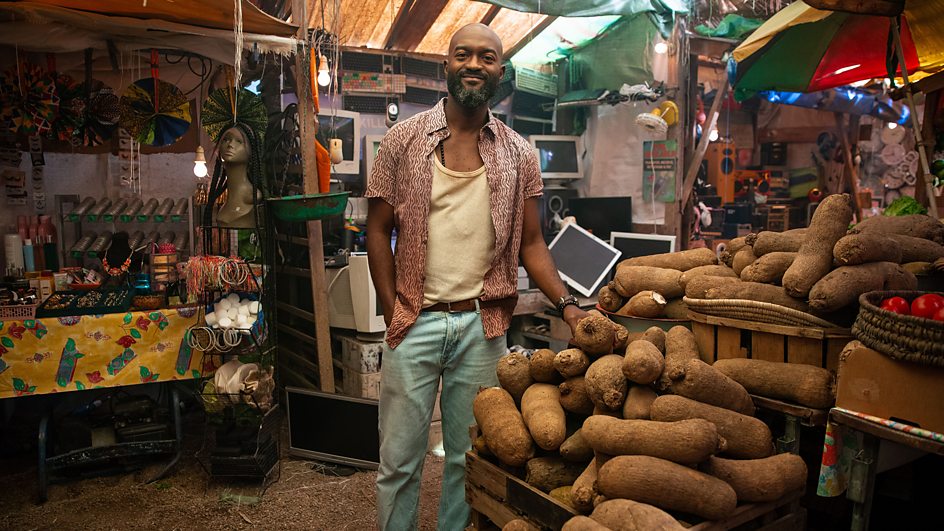
What does it mean to you to set this story in Lagos, and why did you choose the barber shop?
I was a kid in Lagos when I started watching Doctor Who. The show taught me to really dream beyond my present reality, to go across the universe, to leap into incredible adventures. When I became a displaced person and an immigrant, I forgot about what it felt like to be in Nigeria. Sixteen years passed before I returned to visit as an adult, and something began to nestle and settle into my body.
My body remembered a way of being, a sense of freedom. So, to take Doctor Who, this Doctor particularly, to Lagos sort of felt like stretching an olive branch out to the Inua who lived there three decades ago.
I guess what I’m trying to show is a little bit of the magic of Lagos, a little bit of the sparkles that exist when you choose to discover it. Doctor Who is full of incredible stories, and this is what happens in barber shops. Incredible stories are told. So, I was trying to unite them all.
What was it like writing for the Doctor and Belinda?
Ncuti and Varada brought so much joy and tenderness to the script I had written. Early in the drafts, I tried to make fun of the fact that he’s called the Doctor and she’s a nurse, I tried to play out a sort of buddy-cop relationship, but I quickly realized, there was much more at play, and something deeper between them.
The series starts off with Belinda determined to get home, the Doctor trying everything he can to get her home, and the frustrations all that causes. There’s a shift in this. Compared to other companions, Belinda doesn’t want to go on adventures. She loves her work, she wants to do her work, she’s thrown into this adventure. Most companions decide to go with The Doctor but Belinda doesn’t have a choice. Keeping that in focus really underpinned the decisions I made about how the characters talk to each other.
If you could travel in the TARDIS to any time or place in the Universe, where would you go?
I’ve talked about going to see the Pyramids when they’re being constructed, eyeing the blueprints so we could build them now. That’s still top of my list.
If you could describe your episode in one word or phrase, what would it be?
It’s a call to artists and creatives, to always give credit where it’s due.