

Comics News
Tripwire At 25: Dave McKean


♦February 2017 marks the 25th anniversary of Tripwire, which began as a print magazine back in 1992. So every day this month, we shall be representing a classic interview or feature from our long history. For today’s classic interview or feature, we represent our interview with Dave McKean, conducted by editor-in-chief JOEL MEADOWS, which ran in Tripwire #54, out back in July 2010…
Creating Moods
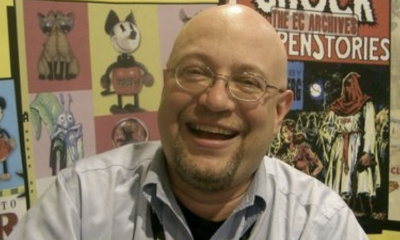
DAVE MCKEAN started life as a regular collaborator with writer Neil Gaiman on projects like Violent Cases, The Sandman and Signal To Noise. But over the years, he has diversified and moved from illustration to photography, design, music and even direction. For him, it all feeds into the same place. TRIPWIRE caught up with Dave McKean in spring at his studio down in Kent. Appropriately he is located in the Weald in the south of Kent a short drive to the coast, tucked away in a converted oasthouse. He is a very private man and it makes perfect sense that he lives in a place that is quite hard to find (I drove around for over a half an hour before I found his house). On a gorgeous spring day, we sat in his studio, next to where he lives with his family, talking about his career so far. Photo: JOEL MEADOWS
TRIPWIRE: So you went to art college? How useful did you find that?
DAVE MCKEAN: I had a great time at art college and it changed me completely and utterly as a person. It changed my interests, the friends I made and their interests and their influence. So it was incredibly useful. I spent the first year arguing with everybody incessantly and wishing they would just leave me alone to do what I wanted to do. I’d just about realised that all they were trying to do was open my eyes and get me to try things in the second year. In the third year I got down and did some work and in the fourth year I realised real life was approaching rather quickly and I’d better get a bit serious. And then I left art school in exactly the right state of mind to start it. I would always recommend anybody to go to art school and I’m wary of people who either didn’t have a good time or don’t recommend it because I think it says much more about them individually than it does about the art school experience.
TW: So you were open to new things?
DM: I was not open to new things when I went but they forced my eyes open and unblocked my ears. And that’s the job of art school really. It’s entirely dependent on the teachers and the people you happen to come across.
TW: So what was it that they particularly exposed you to at art college that you either hadn’t thought about before in terms of kind of art?
DM: It was anything and everything really.
TW: Did you do Fine Art?
DM: No I did two years of general things where they get you to just try everything which was great. I tried photography, silk screen printing and audio visuals and then two years focusing on supposedly graphic design with illustration. But I mostly did illustration and film. And I had a great drawing teacher who also taught semiotics, so that was very important for me. I had a design teacher who was running a design company. He wasn’t just a full-time teacher so he gave me work. It was nice to be paid but it was also great to have real deadlines with real clients.
TW: So it did give you a mix? Because the thing I’ve always noticed about you is that you’re interested in so many different things. I presume you enjoy the variety? Do you enjoy the chaos of all the different forms?
DM: I like the differences really and the different things inform each other.
TW: Which art college did you go to?
DM: I went to Berkshire College of Art and Design.It was local to me. It was not a great art school but when I was there it happened to have three or four really great teachers.
TW: So you were there around 1983 or 1984?
DM: I was there 1982 to 1986.
TW: That was a good time in the general scheme of things. A lot of things were happening…
DM: Yes and comics were coming into their own. Modern comics, I should say. It was a strange time in the film industry with the crossover from analogue to digital. So I was at art school doing hot metal type and sending my typesetting away.
TW: Were you one of the last people who did that?
DM: It was the last year. I wasn’t allowed to touch the computer then. The men in the white suits had to touch the computer.
TW: It’s amazing to think that now when everybody from school kids to everybody up, everything is done digitally. Their homework is done on computer.
DM: But it gave me a great understanding of what the basics are.
TW: And was it the fact that you had to physically handle things like the hot metal, was that what gave you that unique sense that you have?
DM: Yes and also a love of actually making physical things. There is something that you get out of hot metal type or something handmade that you can’t get out of a computer. You always spot people who don’t know where these words have come from by calling it ‘leeding’ rather than ‘leading’ because it’s lead. It’s a piece of lead that you put in between the lines.
TW: So you finished in 1986. When did you first meet Neil [Gaiman] then?
DM: It was around then.
TW: Was that at a comic convention?
DM: No I got together with two friends at art school, Neil Cowan and Neil Jones, all Neils and we did four comics together, called Meanwhile.
TW: I remember. I think my brother picked up one of them.
DM: Oh dear. Please burn it.
TW: It was back in 1986 but he probably got rid of it a long time ago.
DM: Good.
TW: But you’ve got to start somewhere.
DM: But we did everything.
TW: So you drew it, lettered it?
DM: But we also shot the dot screen film, took it to the printer and oversaw the print…
TW: Because in those days it must have been so hard because it was before the days of digital and everything was done with plates, wasn’t it? And with separations?
DM: Oh yes. And we did 200 copies of each one and on the last two I did handmade bits on the cover. We dotted in red eyes and we sprayed the background blue.
TW: I imagine you’ve got a copy for yourself?
DM: I think I might have hidden one away. But those were seen by a guy who was working for a comic that never happened.
TW: Was this an anthology? Because I remember reading Speakeasy; it was reported and then it was announced. Then something dodgy happened. Did he run away?
DM: He turned out to be not the person that he claimed to be.
TW: That happens a lot in comics.
DM:…and the office we were meeting at, the owners of the office didn’t know anything about it. It was a bit of a pirate operation. And so it all died.
TW: But the deadline thing must have been useful because it focuses you as an artist because you can’t just sit around and go ‘I’m going to write my magnum opus or draw my masterwork and no-one’s asked me for it so I’ll just get to it whenever’?
DM: Yes. Your own work tends to slip to the bottom of that schedule. It was good.
TW: So were you a comic reader as a child?
DM: Yes.
TW: What did you read?
DM: I was not a very good reader. I didn’t read too many books but I found and loved comics. So initially it was black and white reprints of American comics.
TW: Like Marvel stuff?
DM: Mighty World of Marvel and that kind of thing. Then very quickly I found DC comics, Warren Magazines and found Heavy Metal.
TW: That must have been quite an eye opener, those magazines because they were so different to what you had seen before?
DM: The first issues of Heavy Metal were amazing because they were the first few published. They were the ones with Moebius.
TW: You were reading Epic Illustrated as well, presumably? When you were at college?
DM: Yes.
TW: Because I used to borrow that from my brother. The idea of Marvel publishing this slightly avante-garde magazine was amazing…
DM: I was actually at a little convention in London when it was launched. I think [editor] Archie Goodwin must have been there launching it and he brought a lot of the artwork with him.
TW: So am I right in thinking that you did some Judge Dredd sample pages?
DM: I think I did two. I did a comics page and a pinup page and I hope they were never printed. Certainly the comics page was never printed.
TW: Did you read 2000AD when you were a kid?
DM: No.
TW: It was just an opportunity to get some work, basically?
DM: It was one of my tutors. It was probably one of the only comics he knew and he said that you should try them because they’re English. And I went with a mate from art school called Grahame Baker.
TW: So this was around 1982 or 1983?
DM: That would have been 1985.
TW: So towards the end of your art college?
DM: It was because of life coming in and being a bit more serious, so I was thinking about what I was going to do for a living.
TW: So it seems like you’ve dabbled in all of the disciplines that you did at art college like the photography. You’re an illustrator but there’s also that photographic element to your work. Do they all just intersect with each other? You don’t see a difference?
DM: They’re all basically the same thing. It’s taking a brief or a story or an idea or something and finding the best way to express it. And sometimes it’s best as a drawing, sometimes it’s best as a piece of music or a film.
TW: I can see a connection between your graphic design and your illustration and the work of someone like Vaughn Oliver, who did the 4AD covers. Would you say that’s a fair comment?
DM: Absolutely. He was the main guy. Neville Brody I liked but I found it cold and humourless and I didn’t like it. I admired it but I didn’t like it. But Vaughn Oliver and the people that he chose to work with mostly. His design is beautiful with the photographs by Simon Larbalestier are just gorgeous. And it wraps around the music and really creates a whole world.
TW: What was the first comic work you did?
DM: I did a Mister X story. Violent Cases, which was our first book. Then Black Orchid, Arkham Asylum. Hellblazer covers for 22 issues and then The Sandman.
TW: So going back to something like Violent Cases. Was it quite daunting to produce a reasonably longform project?
DM: No, not at all. It was absolutely no pressure. We didn’t actually do it for anybody. Neil [Gaiman] and I just wanted to do it as something to do. He had written it in a writer’s workshop and I liked it. And then about a quarter of the way through, we showed it to Paul Gravett because I think he wanted both of us to do something for Escape. So we showed it to him and said ‘Look we’re doing this thing and it’s actually quite long. I don’t think it’s going to fit in Escape.’ So he just said ‘Well, fine we’ll just do it as a separate book.’ Halfway through Escape merged with Titan Books and it became a Titan book. Three-quarters of the way through, Neil blagged us a meeting with Karen Berger and Dick Giordano. We showed it to them and we got work. So that book really worked for us. It’s a first book, it’s very very basic and raw but the thing I’m happiest about is on the back it says ‘General Fiction’ and that’s what I wanted to do. That was the flag I wanted to plant.
TW: Even after that, they put graphic novels in places like the humour section…
DM: And it wasn’t science fiction or fantasy or horror or superheroes. It was just general fiction.
TW: So Violent Cases gave you more confidence for Black Orchid visually? I know it was a completely different style…
DM: I don’t remember not feeling confident actually about that. I don’t know why. I think we both panicked a little bit after we got the job and realised what we were doing.
TW: So was it one of these things where you took the meeting not expecting anything to happen and then when they said ‘okay we’ll take it’…I know the anecdote but did it scare you a little?
DM: It’s very hard to think back and remember exactly what we were thinking. I don’t remember feeling worried about doing it. I think probably I felt a little worried that Neil had got me into doing 150 pages of superheroes. It was my insistence that we get something in about the rainforest in there, something I feel something about because I certainly don’t relate to Batman or a woman dressed as an orchid. So that was all fine. But I remember my general state of mind then was I don’t think I’m worthy of giving professional work to so I never quite believed that they meant it. I just thought they were being polite and they would leave and I’d never hear anything from them again. That was partly because before that, I’d gone to New York and I’d shown my stuff to Neal Adams and he said ‘Great. I’ll send you a story. We’ve got a book. Crazyman. We’ll send it to you.’ It never arrived and I called but it never arrived. So I just thought it was another one of those. But I also remember thinking that ‘God, some of the stuff they publish is crap. I’m sure we can do better than this.’ So it was those two feelings.
TW: But it was one of DC’s first books to look like that visually, wasn’t it?
DM: It was the first for them. Epic had obviously done painted stuff with Kent [Williams] but DC hadn’t…
TW: So it was quite a gamble for them, for DC to go ‘let’s put this quite expensive format book out with these two guys who are not unknowns but not that well-known…’?
DM: We were unknown. It was a big gamble, which they realised halfway through, so they gave Neil The Sandman…
TW: So that he was doing that for them as well as Black Orchid?
DM: And they wanted me to do covers for Hellblazer to put my name out there as well.
TW: With the Hellblazer covers, is it correct that you actually physically built those?
DM: They were all sorts. The Sandman covers were sort of built and the Hellblazer covers were a mixture. Some were paintings, some were collages.
TW: But again it was interesting because I remember buying Hellblazer 1 back in 1987 and it looked like no other DC book before. It was such a bold move, it felt so different. What did you feel at the time?
DM: I didn’t think about the difference because I wasn’t really looking at comics at that point, I was looking at Vaughn Oliver and record covers and book cover designs at the time. And next to those there’s nothing special about it.
TW: The thing about the cover is that it’s a portal to the book, isn’t it? The cover is the hook that gets people through the door, so it’s like the shopfront. Is that how you approach cover design?
DM: Yes.
TW: Should it give an abstract flavour of what’s inside or not necessarily?
DM: The Sandman and Hellblazer were slightly different. With Hellblazer I knew Richard Rayner and Mark Buckingham, I felt very bad doing covers for his book. It felt like it was his book and he should be doing the covers and if our positions were reversed, I would want to be doing my own covers. But he seemed okay with it. We would meet in London and he’d show me what he was doing. So I was to do something that felt like it would blend it with his. With The Sandman covers, that book was just part of the sausage machine of the industry so it got different artists every issue, so I didn’t feel at all guilty.
TW: But your covers gave it a unifying look and the two things that are constant are Neil’s writing and your covers.
DM: Exactly and so because you’ve got different artists inside, the characters change all the time so I wasn’t worried about my visualisation of them. They would change. So the covers on The Sandman became a sort of filter. You could go through the filter of the cover and then you’re into Neil’s writing illustrated by somebody else. So the whole idea about putting Sandman on the cover of every issue immediately went.
TW: For the Hellblazer stuff, did you get a script or did you get Richard’s pages?
DM: I seem to remember I got a script and whatever Richard had done at that point. He was always very behind, I think, so I think I got a few pages.
TW: So obviously it was a different relationship because Neil was your friend by that point but while I’m sure you’d met Jamie [Delano], the relationship was different?
DM: It was different and also as The Sandman progressed, it turned into a writer’s book. It also became apparent that Neil had a much larger scope for us and even an end in sight. Also he became progressively later and later as he put more and more time into each issue. He was putting five and six weeks into each issue on a monthly book and that doesn’t go. So by the end of it I had nothing to go on.
TW: So you would have to use an abstract image?
DM: Or I would have a 10 minute conversation with Neil about what on earth he had planned.
TW: So he said to you ‘This is what’s going to happen in the next few issues’ and you would go ‘Fine, I’ll just go and put something together’?
DM: ‘It’ll have this character in it and it’s roughly going to be about this, I think’ and then I just did a bunch of covers. And it’s astonishing how many of them hit the imagery on the nail.
TW: I suppose that because you’d been working together for so long that you were of a similar mind.
DM: At that time, I think we really were.
TW: Your career is in three or four chunks. There was the comic work. When did you start Cages?
DM: 1990.
TW: So that was a little bit later. Were you inspired by the fact that you’d done work with writers and now you wanted to explore some things yourself?
DM: Yup. There were some things I was happy with on the work we had done but a lot that I wasn’t, so I just wanted to correct all that really. I wanted to write something on my own because I had ideas for a few things.
TW: It was a mammoth undertaking, I would imagine, because it was such a huge project…
DM: It was and also it was with a new publisher, an umbrella publisher called Tundra who collapsed under their own ambition. But at the time I thought it was an extraordinary opportunity that comes along once in a lifetime almost. Somebody with almost unlimited funds and an enthusiast backing a group of creators to form an umbrella unit so we had complete autonomy but the power of a block. It was great and it should have been fantastic.
TW: So it was just circumstances that meant that it didn’t last…
DM: It was poorly managed and there was a great deal of stupidity and greed. But I didn’t want a page rate or an advance because I realised that it was a risk and I wanted us all to be sharing the same risk, so I was happy to share in it. So I did other work in-between. That’s why it took so long. I did Mister Punch in the middle of it, as well as Signal To Noise, so that’s how that worked.
TW: Mister Punch was Gollancz, wasn’t it?
DM: Yes.
TW: Again it was a book publisher taking a chance on a line of graphic novels?
DM: But that’s what we thought we were doing. I thought the point of what we were doing was to get comics out of the ghetto of comics publishers, shops, distributors and make contact with the real world so having real book publishers was important. And I thought we were trying to raise the standard of comic book writing to a level on a par with great TV writing or great film writing or great books. What seems to have happened is that they’ve dragged the movies down to their level. So that’s what I thought we were doing and that’s what I’m still trying to do really.
TW: So what was your first graphic design commission then that you did? Would it have been just after college?
DM: I haven’t really been ever commissioned to do graphic design on its own. I do the whole thing.
TW: So let’s call it illustration / graphic design.
DM: If I do a CD cover or a book cover, then I’ll insist on doing the type. But that’s only because of my experiences at the very beginning where I got some really bad art directors.
TW: So you’ll shoot your own photos, you’ll design it, you’ll typeset it and deliver a finished .pdf?
DM: Yes.
TW: And is that just because you like the control?
DM: It’s because of that, it’s because I enjoy it. I enjoy all the different processes. I think type is as important as images and everything else and so it’s awful to fall at the last fence when you’ve put all this work into an image and you get a crappy pink logo or something. So I’m not Vaughn Oliver but I think I can design better than the crappy pink logo. So I prefer to make my own mistakes.
TW: And you enjoy the whole process? The idea of sitting down and going ‘Okay you’ve got the concept. The poster’s for a new play. What should be on the poster?’ Once you’ve done that, you shoot somebody. And then once you’ve got the shots you’re happy with, you’ll design something around it. And you’ll play with type.
DM: Yes, and that’s the other reason. It’s nice if the type integrates with the illustration and vice versa.
TW: You’ve got the art but you’ve also got the typographical elements. They both feed into each other.
DM: Yes and type in a comic strip is expressing the words that people are saying.
TW: And if something is badly lettered, it’s noticeable. Good lettering should be invisible.
DM: It should but there are things that you can do with the lettering that express what’s being said and it’s rarely used.
TW: Do you mean things like capping up words?
DM: Or just handwriting something gives it a humanity and a personality. The shape and style of word balloons. It’s an icon, it’s an image. It’s part of the expression of the piece.
TW: But is it the move over to digital which has caused a lot of companies to use a lot of digital houses and so some of that has been lost?
DM: No I think they always just went for a very straight house style.
TW: Is it just being pragmatic on their part?
DM: Yes it’s a sausage machine, so they can just churn it out. On a monthly schedule you can’t be messing around with breaking bounds of typography. But if you’re doing a book on your own and you want to try and explore that, there’s no reason why not.
TW: So presumably that’s why in terms of the comics and illustration, the work that we’ve seen from you in the last 10 to 15 years has been your own work?
DM: It’s been progressively more my work.
TW: You prefer the liberty of working on a book, say a graphic novel which has got say an 18 month or 2 year lead time rather than working on a monthly title that is chained to the demands of the market?
DM: I couldn’t do a monthly title. It just wouldn’t suit my life. I’m happy just doing individual books and short stories that I can collect into volumes and I’ve just become more confident as a writer.
TW: With something like Mr Punch, and I’m talking about the overall feel so obviously it’s Neil as well, but it felt very much almost like a BBC2 drama.
DM: I don’t know. I don’t know what it is about it that would make you say that apart from the fact that again it’s general fiction.
TW: Perhaps that’s it because it is general fiction.
DM: It was made to be a comic, to be expressed as a comic. All of the puppets are photographic and all of the humans are drawn, deliberately opposite to what you’d think and that’s the sort of thing you can do in a comic. It would be tough to do on screen.
TW: I was just thinking about the feel of the story.
DM: Well, that’s probably it. It feels more like Dennis Potter than it does Marvel or DC.
TW: Signal To Noise was serialised in The Face?
DM: Yes.
TW: So how did that happen?
DM: The Face had done some reviews and paid attention to new comics coming through. I’d done some editorial comics for them and they wanted something longer as a way of ending The Face. They were going to stop and in the end they chickened out of that.
TW: They stopped quite a few years later.
DM: They stopped because they were forced to. If they’d stopped in 1990, it would have been a bold choice with the magazine of the 1980s ending rather than closing it because of money. So that’s what Signal was about and we just did it for that. And it was odd to do because it was a monthly schedule. It was slightly difficult but it was only six or eight pages. But it was still a bit tricky. But the trickiest thing was we had a story where in episode one, this guy finds out that he was dying and only has a certain amount of time to live. And in the last chapter, he dies and we didn’t actually know how many issues we’d run. So either he was going to go downhill really quickly or he’d go into remission halfway. We had no idea. It was down to the schedule really, which is why it’s not very satisfying, certainly in its magazine form. In the book we added a couple of chapters and that made it better.
TW: That was Gollancz too, wasn’t it?
DM: Yeah. And that made it better. But since that came out, I still really love the basic idea of Signal to Noise: what do you choose to do with the rest of your life?
TW: If your life is only a short period?
DM: Actually, no in its broadest sense. Why are you making the choices that you’re making bearing in mind the fact that we will all die eventually. We are all on a deadline eventually.
TW: Do you mean in a conscious way? We don’t always make decisions consciously, do we?
DM: Yes and I think we realise that we do. I’m not a big believer in the unconscious. But for the person who does actually find out they have a serious deadline, six months or four months, how does that affect your choices? And if it does affect your choices, why weren’t you doing that to start with? Those sorts of things. I love that. So I’ve written it as a film and it’s the best thing I’ve written. It’s way broader than the comic.
TW: But you still haven’t found a home for it?
DM: I haven’t.
TW: Would it be hard to film?
DM: No, it would be pretty low-budget. We got lots of European production companies interested and we got Channel 4 interested and I got Alfred Molina interested. And I got Guillermo Del Toro interested to executive produce it. And even with all of that, I still haven’t been able to push it over the edge. So it may end up being a graphic novel adaptation of a graphic novel.
TW: So, moving onto your photography, do you still shoot with film then? Or do you mix?
DM: Up until just last year, I’ve been working on film because I like the physical feel of it.
TW: But now do you think that digital cameras have reached the stage where you can actually ape the feel?
DM: No.
TW: So is it a different sort of artform then?
DM: There are some obvious differences and they’re just so pleasurable to work with. The fact that you can immediately see the image you’ve shot. The fact that you can shoot 3000 pictures on a subject and just delete all the rubbish. All of that is incredibly useful. The clarity is very good. The colour space is not as good as on film and I like the physicality of film. Most of my pictures have got scratches and scrapes.
TW: So you’re not a convert but you are coming over to the digital side?
DM: I’m not going to hang around doing something just out of sheer bloody mindedness. If it’s easier and the results are the same, then I’ll use Photoshop.
TW: So what are you working on at the moment?
DM: At the moment I’m editing my second film, Luna.
TW: When is that coming out?
DM: We’ll finish it this year.
TW: Have you got a distributor for that?
DM: No, it’s been funded through an English production company and we still own everything so we haven’t had to do any deals with sales agents upfront which is usually the way at terrible rates. So our plan really is to finish it and then do the festival circuit and see what kind of life we can build for it after that.
TW: So is that a fantasy film?
DM: It is a fantasy film but it’s a contemporary drama. It’s about four people, two couples who meet over a long weekend in a little isolated house in Devon. One of the couples lost a child and this is the first time they’ve really socialised so everything gets very emotional and overwrought. So in that sense it’s just a kitchen sink drama. But through it is this sequence of strange dreamlike sequences showing the life of the child that died at different ages. So in that sense it’s a fantasy film.
TW: And was it a very small crew?
DM: Yes very small crew, small budget. Even smaller than Mirror Mask. But it’s mine. I didn’t fund it but I wrote it, directed it and I’ve helped produce it. I’m editing it. I’ve obviously designed all the animation although I’m not physically doing the 3D animation.
TW: Do you get more philosophical as you get older with stuff when it comes to things failing to happen?
DM: No. The thing that’s changed is my relationship to the film industry. Four years ago I assumed: ‘Right this is what I’m doing now. I’m now making films and I’ll do illustration on the side.’ So I got a manager and I got an agent, William Morris Agency. I was sent piles of scripts to read and I did meetings and lunches and I wrote Signal to Noise, I wrote Varjak Paw, Caligaro. So it goes on and on. Nothing happened. Having said that, we’ve shot Luna and it will now be released. Varjak Paw is with Sony Pictures and they’re developing that. So we’ll see. But about two years ago, my attitude changed. Actually it was after we shot Luna and the money ran away so it was sitting in a box, so I couldn’t touch it and I’d written this story called Caligaro, from the Cabinet of Dr Caligari, as a film that would cost around $15m. It was a low budget film but more than I will ever see in one place and I just for some reason one day thought ‘I could get up now and I could start it as a book this afternoon.’ The clouds went and so that’s been my change really. I’m doing books. And if films happen, fine, I’ll go to work. But I’m doing books.
TW: So are you a photographer, an illustrator, a designer, an artist or are you all of those things?
DM: I try to avoid the description really.
TW: If someone you’ve never met comes up to you and says ‘You’re Dave. What do you do?’…
DM: It depends who they are. I almost never say artist because I have my own definition of artist. I think the word has been corrupted beyond belief. However for example locally, I play badminton. If they ask me, well they wouldn’t really know what illustrator means. They’ll have a vague idea but they would probably think I’d be doing the cartoons on Sunday supplements. So I might say ‘I’m an artist’ and then specify. But I don’t really define it. The Italians have a word ‘creativo’ which is just anybody who creates almost anything. And it covers people like Fellini who was a cartoonist, a filmmaker and a costume designer and it’s because he has a worldview, he can express anything. And I like that.
TW: So film and photography still influence you?
DM: Right now, that’s exactly what I’m doing. I’m watching a film every night and editing in the day. And I’m doing a book with a French publisher. It’s a pornographic book. It’s a 240 page story with one image per page and no text. Purely images and it tells a very simple story. The story is not the point. It’s about sex. Pornography is boring and repetitive and grim mostly. And yet it’s about something that we all do. I always wanted to try and do something that works as pornography but also tickled the mind and was aesthetic and was beautiful.
TW: So how have you approached that visually?
DM: It changes style. It’s a series of sexual encounters and each one is done in a different style. It’s silent because partly that’s how I thought it should be. I did a short erotic story for the same publisher, Delcourt, in a book of shorts and a woman wrote them all. And she sent me the script, and I just didn’t think the dialogue was necessary. The event worked nicely, but the dialogue seemed redundant. So I asked if I could strip out all the words and she was a bit sceptical, but it worked really well I think.
TW: So how far along are you with that?
DM: I’m about halfway.
TW: And that’s coming out next Spring?
DM: Hopefully the end of the year because I’ll hopefully finish it in a couple of months.
TW: Do you think it takes a while for a creative person to find their feet?
DM: People are different. Some people are like hothouse flowers: they burn incredibly brightly and suddenly everything works for them in their twenties and then after that it’s slow decay as they just start repeating themselves. I just take a long time to learn anything properly and so I think hopefully I feel like the work I’ve been doing each year has been progressing and getting better. I was happy with the book I did with Heston Blumenthal and I’m now doing a book with Richard Dawkins which is shaping up very well
JOEL MEADOWS










You must be logged in to post a comment Login