

Feature
Throwback Thursday #10: Andrew Colman revisits Superman 70th Anniversary (Tripwire Annual 2008)

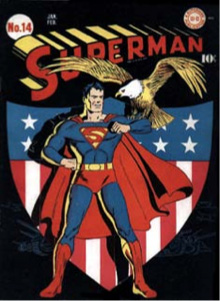
Here’s a piece that Andrew Colman did to celebrate the 70th anniversary of Superman, which ran in Tripwire Annual 2008
Is there a task more daunting than writing a summation of comics’ most celebrated and discussed character? There can scarcely be a more durable figure (or brand) in the history of mass media. Forged at precisely the right moment, less than a year before the beginning of World War 2, Superman was the vessel that carried countless wish-fulfillment fantasies and provided an immediately recognizable emblem for a country that was caught between depression-era austerity and the resurgent patriotism that was necessary to take on global conflict, and triumph.
So much has been written about the genesis of the character, most notably by middlebrow journalists (such as Howard Jacobson of The Guardian) who claim that Superman’s mythos was a conflation of two distinct strands of the Jewish experience — the biblical (the infant alien Supes being discovered in a field, Moses-like, by the Kents) and the mystical (the character being a super-powered modern Golem that would fight the Nazis). That, however, would never have been the intention of the two meek Cleveland suburbanites who created him.
Writer Jerry Siegel and artist Joe Shuster, both timid, loner adoloscents who found sanctuary in the nascent science-fiction fandom of the 1920s had been touting their character for several years before National Periodicals expressed an interest. Immersed in what would now be referred to as “pop culture”, the two lads had, after a litany of rejections, developed an amalgam of many previous cartoon adventurers, adding offhand humour, fantasy and violence to the mix. DC mavens Harry Donenfeld and Jack Liebowitz had previously been peddlers of highly lucrative exploitation (“adult”) magazines and saw this skintight-costumed ubermensch as a chance to break into the new medium of children’s comics, but they could never have imagined the vast, sweeping potential of this super-powered nemesis of crime.
In June 1938, Action Comics 1 arrived on the nation’s newstands. Within three years, the character was firmly entrenched as an icon of America — appearing in two comics, a newspaper strip, a radio show and cartoons shown in cinemas. Siegel and Shuster’s idea was a juggernaut, with all four media contributing to his pre-eminence and back story. The newspaper strip, which ran concurrently with the comics, gave a far more detailed origin than what appeared in Action Comics. The radio show, which started in 1940, brought us such overly familiar declamations as “Up, up and away!!” “Is it a bird, is it a plane…” and “This looks like a job for Superman!!!” It was also here that the first tinkering with what Superman could or could not manage occurred, as the show made it clear that Superman could not just leap tall buildings, but fly. And then there were the beautifully- produced Max Fleischer cartoons.
Received wisdom regarding the early Superman stories to feature in Action and the solo Superman book (which debuted a year after his first appearance) is that they were crude and simplistic — however Siegel’s writing and Shuster’s capable artwork were not just dynamic but innovative. The supporting cast and their relation to the titular hero were already fully formed – Lois Lane being immediately introduced as the romantic foil that she has remained to this day, along with Superman’s alter ego Clark Kent and his position as roving reporter at the Daily Star (later, the Planet). Within two years, his arch-enemy Lex Luthor also made his entrance, along with Jimmy Olsen.
As the ‘40s arrived and war in Europe and Asia beckoned, Superman’s profile continued to grow, aided by some magnificently stately covers by such illustrators as Fred Ray, Fred Guardineer and Jack Burnley, which mostly featured him unfurling a flag or bashing Nazis. By the early 1940s, Action Comics and Superman were both selling in excess of seven figures, making Donenfeld and Liebowitz very wealthy men indeed.
Thus it was inevitable that there would be scores of imitators, leading to a cottage industry of such copycat characters that seemed to rise without trace. National, who rapidly developed a reputation for kneejerk litigation, could do little about MLJ’s Shield, or Timely’s Captain America and the Sub-Mariner, who were very much separate archetypes, but found it easy to instantly shut down more slavish efforts such as Fox’s Wonder Man, who barely lasted an issue. However much tougher competition materialized a mere six months after Superman 1 in the none-too-wholesome form of Fawcett’s Captain Marvel. Drawn with deftness and panache by C.C. Beck, the character’s titles (there were several) remarkably outsold Superman’s for most of the Golden Age era, despite DC’s constant legal challenges regarding his similarity to their cash cow. Fawcett only caved in to the pressure in the early ‘50s, after the super hero genre had gone into severe decline.
By the beginning of the 1950s, Superman’s status as the principle super-powered character on the drugstore rack was assured. He had largely seen off his competitors through National’s persistent legal wrangling and shrewd, if not pioneering marketing ploys — the radio show had lasted most of the previous decade, only for it to be superceded by the arrival of Superman’s TV show in 1952. Regardless of the teething problems inherent in the new medium, the non-existence of special effects and the distinctly unheroic-looking George Reeves in the lead role, the series managed to run for 5 years. Equally significantly, the turn of the decade saw a huge downturn of interest in costumed heroes, as (with the war very much yesterday’s news) their chest-beating super-patriotism was no longer in demand by the nation’s kids, who were soon to be seduced by other less innocent genres such as war (ironically), westerns, science-fiction and those garish, notoriously explicit crime and horror books. Superman, along with Batman and Wonder Woman, was the only survivor of this sub-cultural shift. Indeed, he was as popular and indestructably enmeshed in the medium as ever, his longevity assured as the core of four-color nostalgia for his own and future generations.
Although the mid-1950s version of Superman remains the most familiar both for aficionados and those with only a passing interest in the character, it is at this point that the franchise began to atrophy. For most of the 1940s, Superman had been the saviour of mankind, doing battle with evil businessmen, corrupt politicians and Axis stooges. The gradual move towards lighter, more fantasy-orientated stories was signalled by the arrival of Mr. Mxyztplk, The Toyman, The Prankster and other comedic villains. Also during this period his powers were constantly refitted to include complete invulnerability, X-Ray vision, heat vision and so on. Whatever serious subtexts that could be divined by today’s cultural commentators would evaporate at the point when editor Mort Weisinger came on board, mining Superman’s Kryptonian past not for emotional effect, but to invent various types of Kryptonite and super-relatives or pets such as Krypto, Comet and of course Supergirl. Also (much to the chagrin of Siegel and Shuster, who were not consulted) a Superboy title was published. Furthermore, on a completely separate level, there was the surreal and totally bonkers anomaly that was the race of Bizarro Supermen and their inverse planet.
Of course one could argue that such a monolithic and pure character as Superman would have to rely on constant changes and additions to the legend to maintain interest and provide new plotlines, and for most of the 1950s, when DC basically had the entire super-hero market to themselves, such policy worked reasonably well. The corollary of this was that whatever credibility the character may have had was to slowly diminish under the weight of so much tinkering. Far worse was that plots such as a supporting character gaining powers or becoming evil (usually Lois Lane or Jimmy Olsen) were recycled endlessly, especially in their two spin-off titles. Lois and Jimmy’s solo magazines were for the most part embarrasingly bad, remaining that way until the revamp that occurred at the end of the ‘60s. That said, there were still some entertaining (if mawkish) stories to be found in Superman’s main title, especially the “imaginary” tales, usually drawn by the excellent Curt Swan or Kurt Schaffenberger, that began to appear in the early ‘60s. Such yarns, which were outside normal continuity, were usually about Superman getting married, dying or being sent back to Krypton’s pre-destruction past. It says a great deal that it is these stories that are most fondly remembered by fans.
Despite the upheaval at DC that was brought on by Marvel’s overwhelming resurgence during the 1960s, the Superman family of titles were given only the mildest of makeovers by newly appointed publisher Carmine Infantino. Nevertheless in 1972, Len Wein, under the stewardship of the Superman line’s new editor Julie Schwarz, managed to institute changes that, although hardly groundbreaking, did succeed in shrugging off most of the 1960s absurd legacy. Clark Kent was repositioned as a TV reporter, with the stories and art reaching a new level of maturity, particularly in his relationship with Lois Lane. Not to mention that Kryptonite and many pointless characters were quickly dispensed with.
Although somewhat of a throwback even then, Superman was still DC’s top-selling character in the 1970s, and continued to retain his standing in the medium. This would explain the march that DC stole on Marvel in 1977 when the first Superman film was released. Marvel had been in pole position for several years by this point, with DC spiralling ever downwards in terms of market share. Marvel had attempted to make inroads into TV and cinema with the Spider-Man movie and Hulk series, but the Superman film traduced both with ease, blending an earnest reverence for the character with a dry sense of humour that was never overbearing or arch. Without any doubt the best comic-based transfer up to that point, the movie evoked the spirit of the comics with a knowing script, decent special effects and excellent performances. It was what the franchise had deserved, and remains a classic, although later, far more vapid sequels were to tarnish its glow.
The 80s onwards saw numerous attempts from DC to rehabilitate Superman on a critical level, mainly through brash and widescale revisionism of the character’s tortuous continuity. Crisis On Infinite Earths, the seminal maxiseries that DC published in 1985, saw the company excise vast amounts of backstory from Superman’s history, not to mention killing off Supergirl and The Flash. It was DC’s first real effort to rationalize and cohere their ludicrously disparate universe, but although this saga, along with most of the Superman output at that time showed much improvement, The Man of Steel himself remained very much as he was. Even the farewell story by Alan Moore in 1987 and John Byrne’s mandatory retooling of the character, both highly praised at the time, scarcely dented the overall inflexibility of his line of titles.
After further, and ever more vapid alterations to the format, DC hit upon the idea to temporarily kill off their flagship through the massively hyped (yet quite gripping) Death Of Superman story arc that ran through all of the line’s titles during 1992. This again proved successful in regenerating sales and raising profiles, but, to all intents and purposes it was always just another event series, albeit one that would prove highly influential over the next decade and a half. Thereafter the franchise was once again blessed with two TV shows that reinforced Superman’s legend and were again entertaining whilst staying loyal to the source material, especially Smallville, which detailed Superman’s teen years before he donned his costume. If anything that, along with yet another superfluous high-budget movie (Superman Returns), showed that the well would likely never run dry.
In the last decade, in spite of the static nature of Superman’s regular titles, there have been several series that have engendered somewhat of a renaissance for him, such as Waid and Ross’s postmodern Kingdom Come, Loeb and Sale’s A Superman For All Seasons, and of course Morrison and Quitely’s idiosyncratic All-Star Superman. In the end, Superman was still the venerable old institution that, despite his inherent decency and lack of demons (Stan Lee claimed he never much cared for him) would always be the unimpeachable, beloved icon and standard-bearer of all that an idealised America was supposed to be — a reliably archaic, heavily baggaged, indestructible war horse steeped in history that still attracts writers and artists across the creative spectrum, and who still demands, nay deserves, our interest after 70 years. Here’s to 70 more.














quest bars
August 28, 2015 at 3:06 pm
It’s a pity you don’t have a donate button! I’d certainly donate to this excellent blog!
I guess for now i’ll settle for bookmarking and
adding your RSS feed to my Google account. I look forward to brand new updates and will talk about this site with my
Facebook group. Talk soon!
admin
August 28, 2015 at 3:24 pm
We do have a Patreon campaign though http://www.tripwiremagazine.co.uk/support-us/
best wishes