

Headlines
Quentin Tarantino Review Day Seven

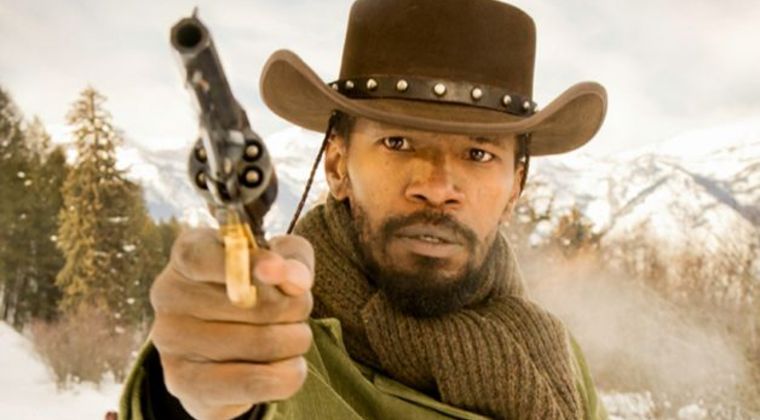
Shackled
♦ With the release of Hateful Eight in the UK on 8 January, we thought we would take another look at the previous seven films of Quentin Tarantino. It’ll be one per day, and today is the turn of his seventh film, Django Unchained, released back in 2012.
Django Unchained
Director: Quentin Tarantino
Stars: Jamie Foxx, Christoph Waltz, Samuel L Jackson, Kerry Washington, Leonardo DiCaprio
Quentin Tarantino is a very frustrating director. His twenty year career started with three seminal movies – Reservoir Dogs, Pulp Fiction and Jackie Brown. Django Unchained, was his seventh film, and and as was rapidly becoming the case with his canon, Tarantino split the cinemagoing audience into those who ‘got’ him and those who didn’t. Reservoir Dogs, Pulp Fiction and Jackie Brown were great films. Kill Bill Parts One and Two were indulgent and messy and Inglourious Basterds was incoherent and vapid. The director had lost his golden touch for dialogue and intriguing scenarios. So now we come to Django Unchained, Quentin Tarantino’s ‘Southern’ about the emancipated slave of the title, played by Jamie Foxx, and his quest to free his wife Broomhilda (Kerry Washington) from the clutches of her evil master. Django is assisted by his friend, bounty hunter Dr King Schultz, played by Christoph Waltz. The original Django films were budget spaghetti westerns featuring Franco Nero as their everyman star. So the title and main character of Unchained is little more than a nod by Tarantino to Nero’s kitsch classics. The film opens very strongly: Django is freed from his captivity by Schultz, who agrees to make him his partner and also help him track down his missing wife. Waltz is very good as Schultz, a character who the audience has some empathy with, and Foxx acquits himself well in the title role. The pair discover that Broomhilda is being held by the malevolent plantation owner, Calvin Candie, played with no little panache by Leonardo DiCaprio. So the pair create a pretext to see Candie in order to bargain with him for Django’s wife’s liberty. Tarantino’s regular collaborator Samuel Jackson plays Candie’s factotum, Stephen, his role somewhat perfunctory compared with many of his other onscreen personas.
The first half of the film works well structurally: Tarantino builds up a good rapport between Django and Schultz and he manages to keep it everything rolling along. It is really once they get to Candieland, the plantation, when the cracks start appearing. Tarantino can’t help make his scenes far longer than they should be and consequently there are long, lingering shots that tether the pace and action. DiCaprio is in very good form here – a very sinister turn underpinned by his usual commitment. However it all unravels in the last act, which sees a return to the cartoon violence and lack of cohesion that has been the hallmark of every Tarantino film since Jackie Brown. There is also a rather silly cameo from Tarantino at the end, which shows once again that despite his all too apparent shortcomings as an actor, there has to be the mandatory cameo, reminiscent of a geek Hitchcock.
Which leads us to the inherent issue – Tarantino is a film geek at heart, and, while there is much to be lauded for his love of film, he still can’t create a work which manages to transcend his somewhat servile need to pay homage to what he reveres. He also is obsessed with creating tawdry, flashy set pieces that the script and plot suffer as a result. The tone is predictably uneven here too, and it’s hard to empathise with or care about the characters when they lack depth and backstory. Critics will continue to fall over themselves to praise his work because they are scared of being out of touch and also because of the handful of exceptional films he made early on in his career. But in the final analysis, Django Unchained is self-indulgent, lacking in coherence and far too long. There are some memorable performances here certainly but it’s not enough.
JOEL MEADOWS










You must be logged in to post a comment Login