

Film News
Tripwire At 25: Drew Struzan


♦February 2017 marks the 25th anniversary of Tripwire, which began as a print magazine back in 1992. So every day this month, we shall be representing a classic interview or feature from our long history. Back in Tripwire#54, published in summer 2010, we chatted to master movie poster artist Drew Struzan. All Photographs by MARK BERRY…
Movie Masterclass
Photograph©2010 Mark Berry.
Photograph©2010 Mark Berry.
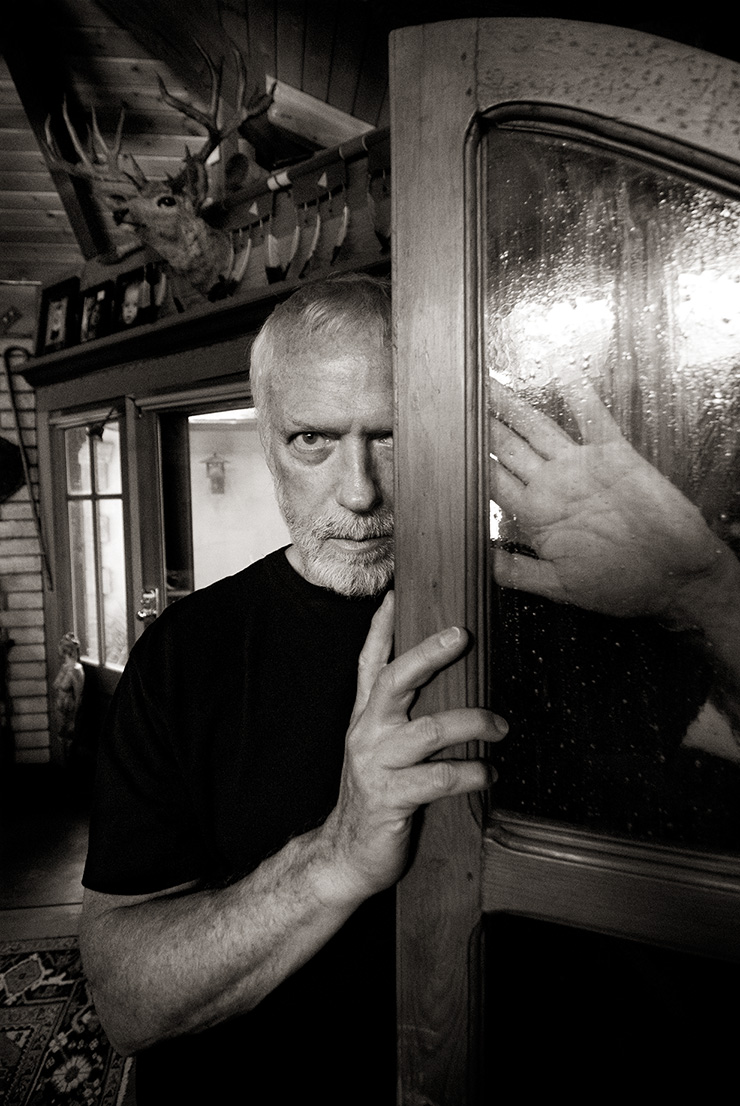
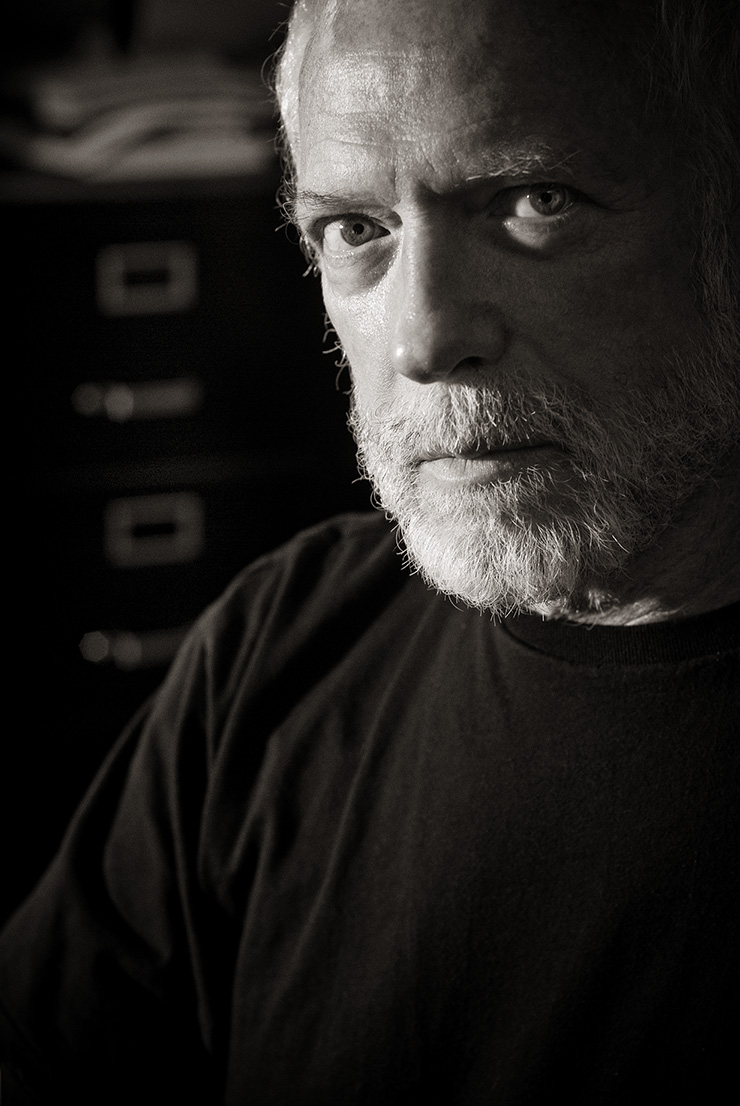
DREW STRUZAN is the last of the movie poster illustrators, creating memorable and distinctive images to grace film advertising for over forty years now. We caught up with him at his home in Los Angeles to talk about the art of the film poster, his career and more…
TRIPWIRE: What do you think makes a good film poster?
DREW STRUZAN: Well, I think commercially and financially it’s one that gets people interested in the product. The thing about movie posters is that it’s very different from other products. They only have one weekend to sell the idea to come and see what we’ve done. There’s other things like the trailers that keep people interested. But what the poster is supposed to be for initially is to excite people about the possibilities of the movie. So a poster has to tell people something about the spirit of what the director and the story had in mind. So I think a good poster is one that does that: inspires, excites and gives people a sense of the product. But for me personally because when I was doing it, I always had in mind the commercial uses of it. I always thought that art was the perfect medium for that purpose because art historically inspires, excites and motivates people. It keeps them interested and makes them question and makes them want more. So I always tried to take what was basically advertising and turn it into art. So for me I made art whether the client saw it as art. Over the years the response has told me that it worked really well, or at least my concepts have. People collect it, they’ve written me online and sent me things through the mail saying how much they appreciate it. They decorated their lives and it inspired them for years; even after having enjoyed the movie, the posters became something they enjoyed. To me that’s what makes a good poster.
TW: So a good film poster will transcend the film that it’s attached to? I don’t have many film posters but I have a Funeral in Berlin poster and I’m an admirer of the Bob Peak stuff and the Italian Hitchcock posters. Should a poster stay with you long after the film sometimes?
DS: I know they do for some people. I sit alone at home in my studio, in my own head most of the time. But the reactions I’ve had from other people tell me that they do live on. I think it’s because they do the work of art and it’s part of their lives for many different reasons. It’s not just a remembrance of the film but it becomes something in and of itself.
TW: When you first started work as an artist…if you had to pick your five favourite movie posters, the ones that inspired you when you were a kid, what would they be?
DS: Well that’s an interesting question. I didn’t have the typical childhood memories because I didn’t have those experiences. When I got into the business, it wasn’t anything I aspired to do. I fell into it. I was requested to start doing movie posters and I had a lot to learn about their history, their practical use as well as what I could do with them. I didn’t have the ones I knew I liked or even the ones that were a part of my life. I found it peculiar that other people have that experience even with my work.
TW: Did you basically learn on the job once you started getting work? Once you started getting work doing film posters, you had to go and do the research?
DS: Not in the sense that I had to go and start reviewing the history of it. I did have to learn the business though. I was hired initially because of taste and my technical abilities. I had worked in advertising and they thought I would be appropriate for the movies. A good movie’s about the human condition so they needed portraits that really spoke to them and to people. They asked me to work in the industry because I had that capacity and, as I learned technically how they were used, what they needed, what they wanted to see and what inspired people. I learned it as I went along. Probably one of the benefits was because I didn’t have historical context for the poster as an object. I just had artistic training and ability and I just brought that to what I was doing. In retrospect, I just did what I liked and because of that it gave a new take on what the poster could be. So it did change the way most people looked at posters and what posters could be because I wasn’t imitating history.
TW: Was your work on the album covers good grounding for you as an artist to get to work with an art director and to work from a brief?
DS: Oh yeah. I actually worked in a studio for a couple of years so I worked with art directors. I saw the jobs come in, what the clients wanted, and I got to understand that. And then I saw them being produced and what the responses were to it. It gave me a good grounding in the job and in the world of commercial illustration. When I started working with directors and producers on videos and movies I knew how to speak with them and understand what they were talking about. I knew how to translate it into my language which is the visual language. So it was a grand experience and training. I went to school where I learnt my skills but I didn’t learn the business until I actually started working in it.
TW: So were you a film fan before you started doing the movie posters?
DS: Why would I have to be?
TW: You didn’t have to be but it comes through in your work. Were you a film fan?
DS: I saw very few films as a young person and most of my film experience was watching TV. A lot of the classic movies I thought were in black and white actually were in colour but I never saw them in that. I think what makes me different is I didn’t have any other experiences. So when I got into the movies and started really understanding them and seeing them, it was because I was doing the job. And what made me different was basically my personality. I think I have a sensitivity so when I saw the project, the film or talked to the director I connected with them very quickly.
TW: Was it also because you had the fresh perspective — you weren’t bogged down with years of having worked in film — that gave you a fresh pair of eyes that you could approach these things in a different way?
DS: That’s exactly what it was.
TW: I am going to pick out a couple of big points in your career. You collaborated on a Star Wars poster in 1977. How was that experience? I know you collaborated with another artist on it. Was that the only time that you’d collaborated with someone else in such a way?
DS: Yeah it was. It was a one-time thing.
TW: How was it collaborating with another artist on a film poster?
DS: It was grand because we had mutual respect and so we could communicate, and speak the same language. It was Charlie White who had the job. He was a marvellous airbrush artist, well-known at the time. He painted beautifully but he didn’t do portraits. He knew my portrait work from the album cover work I did. So he just called and said ‘Do you want to share a painting?’ So I’d do the portraits and he’d do all the other stuff. So I said ‘If I do it, will you use the airbrush?’ because I’d never seen an airbrush before. So I got to watch an airbrush and learn how to do it. It was great fun, a learning experience for me and it was a respectful collaboration so it was very special.
TW: So did you work directly with Lucas on that or did you work through an art director?
DS: No I worked with Charlie White because he had a studio with a number of artists and people working in it. I just worked with him and I didn’t have anything to do with Lucasfilm. It was years and years before I directly connected with Lucasfilm and even longer before I ever met George Lucas.
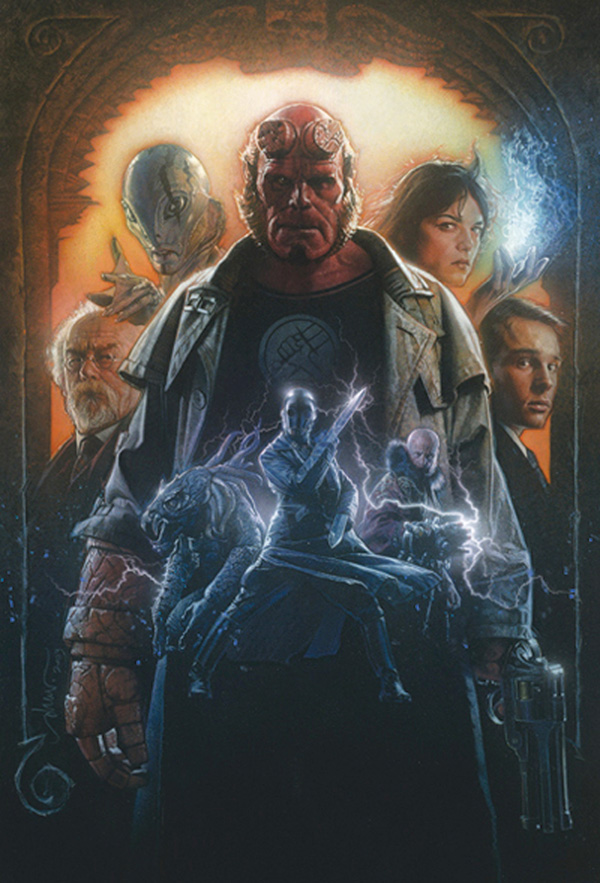
Hellboy poster
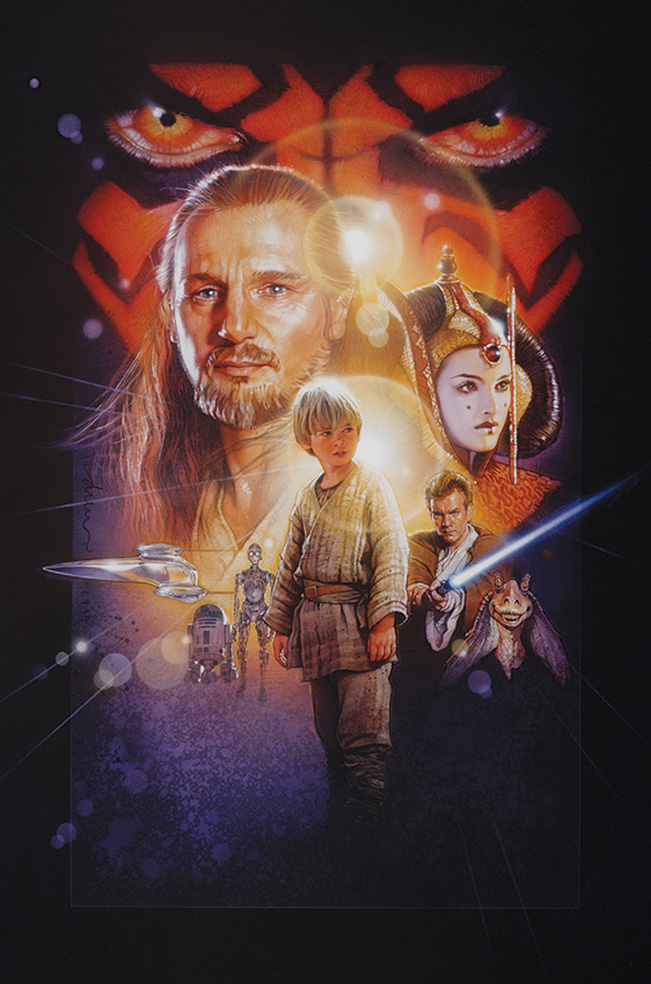
Star Wars: Episode 1: The Phantom Menace poster
TW: Was that for the Indiana Jones work?
DS: No a lot of the Indy stuff came out of design studios. It was not until I got established that I dealt with them. There are thousands of artists who’ve painted Star Wars stuff. With that first movie there were loads of paintings done for it and it was the same for Indy. You didn’t become THE artist immediately. My Raiders was used overseas and then on Temple of Doom they had another artist paint the first one. Then they said ‘let’s get your take on it.’ So I did Temple of Doom and within a week it became the main poster and that’s the one everyone remembers. But it wasn’t until I got more and more established that they began to call me directly. Then I became known as the official Indy guy and official Star Wars guy. But it wasn’t a path that was immediate.
TW: But the Indiana Jones posters had a very classic look and they were very distinctive. You could tell that it was your work. Was that something you strove for from the beginning of working as a poster artist and as an illustrator? That aficionados would see your work and go ‘That’s a Drew Struzan’?
DS: No that didn’t happen (laughs). I was all over the place using different styles and techniques. I didn’t have one thing that I was selling. The Indy thing only became the recognisable style because I kept doing the same thing for Indy as that’s what they liked and they wanted. So over time, my look and my take on Indy became identifiable with me. As I remember it, it wasn’t an Indy legitimate thing unless I did it. I had no foresight about this stuff. It happened later. People will always see it that way and go, ‘Oh he had this great design and this great purpose.’ My purpose was very simple: I wanted to make art and I wanted to make a living. It all happened around me.
TW: Do you think working as an illustrator is something that gives you discipline? You’re producing art but to a deadline so you’re forced to focus? Or is it just a necessary evil of what you do?
DS: It’s necessary for the industry to produce work fast, to think on your feet and be creative. The deadlines didn’t force it. It’s like when I went to school. I went there six days a week, five nights a week. I was carrying a huge load in college and I had to paint pictures for every class every night. It just taught me to be a hard worker and when I got into the industry I didn’t feel it was hard necessarily, it was just a job. I worked through holidays and weekends. Even if I had a broken back and I was sick, that’s what I did. The only difference is that when I paint for myself, I can take my time. I can think about it, change it and live with it for a long time. The only difference with illustration is that you do it, you earn the money and then it goes away. You don’t have a chance to rethink it. I don’t think artistically it made any difference.
TW: In terms of other artists influencing you, who would you name? Obviously you’ve been working for so long, so I’m sure it’s become less of an issue these days but, when you first started doing the posters, who would you say were your largest artistic influences?
DS: I had a good classic education, drawing and painting. I learnt to paint and draw in all different kinds of styles historically and modern. Then I got into the industry and that’s why I didn’t have my own style. I could paint like anybody and when I was young, they would say ‘We need a Rockwell and he’s not around any more’ so I did a Rockwell. If they said: ‘We need something that looks Art Nouveau’ so I read up on the style which took me to Mucha. When I was working in the record industry, a book came out on JC Leyendecker and he’d been kind of forgotten over the years but when the book came out he became very popular again. So everybody wanted a Leyendecker for their artwork. So that’s where my influences came from. So I paint in many styles and techniques but it was the industry that required certain ways of painting; they wanted naturalism. They wanted something you could read from across the street. It’s a poster after all. I gave it the depth that it needed so people could look at it closely and you could live with it for a while but it also had to be the bullseye right in your face that made a good poster. It worked very well for me because I liked iconic images. I just happened to have the taste that worked well in the industry I wound up working in.
TW: You were obviously very versatile and able to tailor your style to the particular job and that’s quite a strength as an artist. Did you enjoy the variety of being able to do work in a slightly different style dependent on the job?
DS: It was just where I came from, I suppose. Even now, when I’m painting for myself, each picture is different. It’s the inspiration, not the technique or the style that interests me. Is that my life experience or my personality? Nature or nurture? I don’t know. But it’s just what I do and I enjoy changing and mixing styles to suit.
TW: By the time you’d done some of your bigger jobs like the Back To The Future stuff, you were fairly established, so I assume you were given a reasonably free hand after you got the brief from the art director? That you were able to turn in the work without too much revision?
DS: Well there’s a misconception! (laughs)
TW: Well, if you could clear that up…
DS: In the movie industry because so much is riding on that one thing and so many people are involved, it’s a very complicated process. So they would read the script, see the film and then they would tell me their concepts and I would give them my own. Then I’d do many sketches, drawings and even paintings, looking for what would please them or what would make them happy. So I’d go through stages and stages and even after they approved a finished composition, they made changes on finished paintings and changed their mind. They changed composition, content and I’d change original art a million times. That’s the one thing people don’t understand what’s very different about the movies compared with other industries is that, for example, with a book cover, I do one drawing, they say ‘fine’ and I paint it. Then they print it. That was very seldom the case with movie posters.
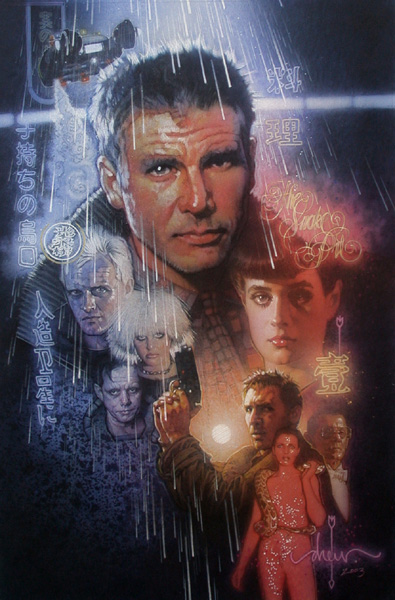
Blade Runner poster
TW: So it was often the case that you had multiple revisions even from the original brief that they gave you?
DS: There were so many opinions and the movie makers are visual but the advertising people are usually suits, in my opinion. They’re not visual so they’ll tell you what they feel and what they think but they can’t translate it into a picture. Once they see it, they’ll go ‘Oh that but not that’. In my opinion, it’s a wonder to me that anything good ever came out.
TW: So do some posters come out as almost consensual because they’re the result of compromise between the studio executives and the art department? The poster may not have been the best idea but it was a consensual compromise between the management and the art directing side?
DS: That’s a good thing in some ways because I learnt how to deal with it psychologically. ‘It’s their project and they’re hiring me to do it’. So I learnt how to listen to ideas and make their ideas as good as I possibly could. In doing this, it broadened my outlook, my vision and my abilities to be able to paint and please people. So it made me a more giving and understanding person because it had to. I don’t think it made the posters worse and in many occasions I think it made them better. I like working that way because it made me a better painter as I had to listen to people. I learnt how to paint and connect with people. I think that’s part of the reason why people like the work. I wasn’t just a selfish painter in a closet, painting to please myself. I was painting to please others.
TW: If you had to choose the one poster or the one series of posters that you felt was the most successful creatively for you in terms of work for hire for the movie stuff, what would you choose?
DS: That would be hard. Part of the reason is because they were changing all the time.Some of the ones that I really liked were the ones that they were the least bothered with, as I see it. When I did Temple of Doom they already had a painting from someone else, so they came to me and said ‘let’s see what you think.’ I did one drawing, they liked it and I painted it and they used it. That was very strong and uncompromising so I thought they would change it. But there were others like Hook which they changed constantly. I worked on that for six months and we still missed the deadline, yet it’s a beautiful, beautiful poster. It cuts both ways. The nature of the movie industry is quite different to almost any other form of illustration.
TW: So when you used to do the posters, did you have people sit for you or did you use photographic reference?
DS: Yeah sure Harrison Ford sat for me (laughs)…
TW: Fair enough. So you must have used reference photos?
DS: The only time in almost forty years that I had anyone pose for me was when I did Back To The Future II and III. I actually got to go on the movie set and Michael [J. Fox] and Christopher [Lloyd] actually posed for me, so I took photographs. I took them home and painted from the portraits I was able to take. But all the rest of the time, it was based upon the movie and the stills they shoot on set. Because by the time I get to them, the movie’s in the can, the actors have moved on and they’re somewhere else in the world. So I had to paint from the reference material.
TW: And I assume that you used stunt stand-ins for the body, like artists’ models?
DS: Yes, Indy especially. On Coming To America with Eddie Murphy, that’s my body. I put a tuxedo on and my wife took a picture of me, so I just put his head on my body. But that happens a lot with artists. It’s a very common way of working. And if I didn’t have the body to do that, I’d try a friend who had the right build and use them for it.
TW: So you’ve retired from doing film posters. What motivated your decision to do that?
DS: Like most things in life, it was many reasons that led to me quitting. It was me old and tired. It’s a changed industry. Most people are noticing now that something’s happened to the industry, which has changed quite a bit. It started 15 years ago when computers came in and they started using the computer a bit. That was fine, as it was just another medium. What really changed was the way the industry works and the people changed, in my view. At one time they used to have creative people directing artists. They were called art directors and they would put together a team to build the advertising including the artist to paint the one sheet. They had respect and understanding of other people’s abilities. We all got along well and we created creative things. But then executives started taking over and they didn’t have that sensitivity. So they found with the computer that they could just make orders and say ‘do this and do that’ and they could do hundreds and hundreds, and I’m not exaggerating, of comprehensives and ideas. So what happens when you have too many choices is that people get confused and they don’t know what to choose. They wound up just repeating success based upon financial reasons rather than artistic or specific reasons for films. They’ll work for a month doing comps and they’ll want the finished computer thing overnight. I can’t do 200 comps and I can’t produce a painting overnight. So it changed the whole landscape of what it takes to make a movie poster. So they weren’t using me much anymore and the work I got was from loyal fans like Frank Darabont, Guillermo Del Toro or George Lucas. People like that gave me work and I was getting work from first-time directors. People who’d grown up with my work and always said: ‘When I make a movie, I want you to do my poster.’ Well they finally made the movie so I got to do the poster. But the industry itself wasn’t using me anymore. That changed, I changed and I thought ‘I’ve had a good run. I’ve got grand kids now and I can paint what I want now.’ I’m 63.
TW: Is this a permanent change to the industry? Do you think the age of the illustrated movie poster is over?
DS: A lot of people have made comments about that but my feeling is that it’s over. I think that once you get people into this, they’re not going to go back.
TW: That’s very sad.
DS: I think it is.
TW: Because it was such an art. Anybody who has the technical skills can put a film poster together these days, theoretically. And it means that it doesn’t have that same magic and you wouldn’t have that same connection with the poster that you used to have.
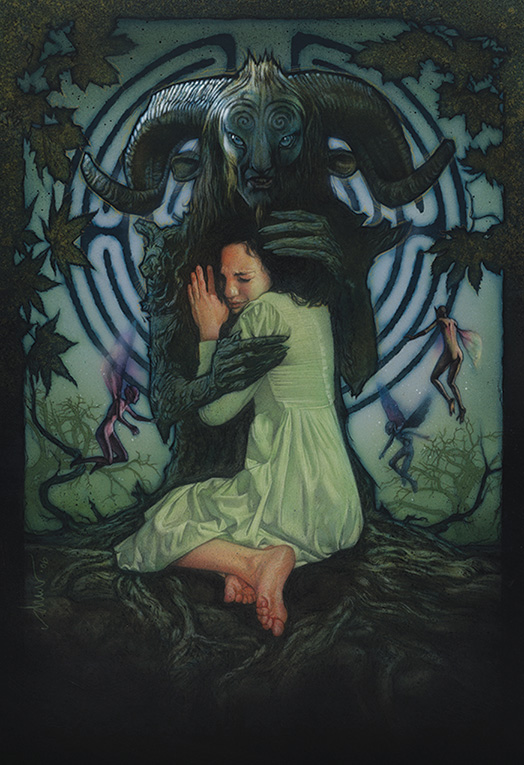
Unused Pan’s Labyrinth poster
DS: I completely concur with your thought. That’s how I feel, that’s how I could keep doing it but it changed from being that. I could tell stories about how I did paintings for Pan’s Labyrinth. I worked directly with my friend, the director and filmmaker and I made a painting that captured the movie. He said: ‘you’ve captured the whole spirit of the movie’ and yet the studios refused to use it. Even though the director had his power and his taste said I made him something nice. They just got used to the new way of doing things and they don’t even want art anymore. But I agree with what you said and many thousands of people around the world would echo your sentiments. But we’re not the people who run the studios.
TW: So the Pan’s Labyrinth piece was never used then? You did a finished painting that never saw the light of day?
DS: Yes. And the studio didn’t like one of the things I did for Guillermo on Hellboy. The studio said ‘we don’t want to use that’ so Guillermo printed it up and took it to Comic Con in New York and gave them away to all the fans. So the studio said ‘let’s give it a market test and see what people really think of this image’. Well, they got the highest rating they ever got on one of these market tests and yet they still refused to use it. At least, that’s the way it was told to me. So I just said: ‘What am I supposed to do? I accomplished exactly what I should with the poster and they still didn’t want it’. So I said: ‘There’s no reason for me to be here anymore. I’m beating a dead horse.’
TW: So you’re painting your own work. What subjects are you painting?
DS: Right now I’m painting a picture of my grandson and I just finished one of my wife. Whatever crosses my mind because they’re my focus now.
TW: Are you finding it quite liberating? Or does it feel a bit strange after all these years of working with art directors and movie people? Because now the only person who’s directing you is yourself?
DS: It’s strange because I think I’m harder to please than they were.
TW: You’re your own worst critic?
DS: It’s much more difficult than it was doing the other work. But that’s okay because if you go on my website you can see my illustrations as well as my paintings. Responses from people have been comments like: ‘I’ve loved your illustrations over the years but when I see your paintings I love them even more.’ So I’ve been feeling good recently. It feels nice after being kicked out of the movies.
TW: I’m sure you’re not the only person who’s left film after that sort of experience. There must been other artists who’ve had a similar experience…
DS: And what should be interesting to you is that it may have started with me but it’s happened all the way down the totem pole, in my view. I have a friend who’s a director and a writer in the industry and he’s made some of the best movies of all time. He goes into the studios with an idea now and they say to him: ‘We have to see your resume to see if you’re capable or not.’ They don’t even know who he is.
TW: That’s terrible.
DS: I know writers and directors who are having the same difficulties I’ve had but the industry and attitudes have changed. It’s not just me and when I talk to people in other industries, it’s happening there too. It’s happening everywhere. The world is changing. It’s not as sensitive or as friendly.
TW: It’s become a lot more corporate and cold.
DS: It’s losing its soul. So I felt it and a lot of my friends are feeling the same way.
TW: You did a ‘how-to’ DVD last year?
DS: Yes, in fact it wasn’t that long ago. It was about four months ago.
TW: What was the motivation behind that?
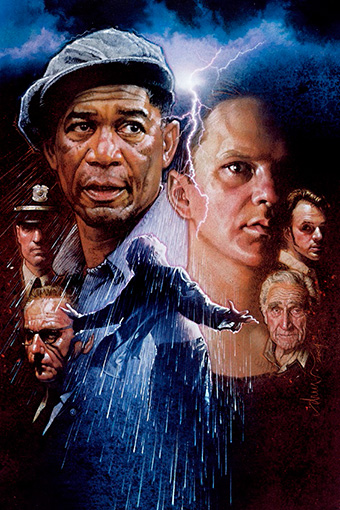
The Shawshank Redemption poster
DS: It was a number of things. Mostly because for years people had always asked me ‘How do you do that? How do you think about it? How do you accomplish that?’ I’ve explained it over the years at schools and in articles. But there was never really any record of me painting and explaining what I would do. When Guillermo had done the first Hellboy, he said ‘why don’t you film painting it and we’ll put it on the director’s cut DVD?’ But when the DVD came out, they didn’t use it. So I had this film and it just sat there. I had a friend who’d been out of work for a year and his wife had gotten cancer. He’s a film editor and producer and he said: ‘Why don’t we just put together the DVD?’, I said. ‘You can edit it and I’ll narrate it. I’ll do it for you and your wife, you can keep whatever comes of it’. So I was finally able to answer in real depth for all of those people who asked ‘how do you do that?’. I can actually show it to them now and I wanted to do it before I got so far from it that I forgot how I do it. So that was fun and I enjoyed it. So it’s there for all time to say that this is how these things used to be done and it became historical because it isn’t being done anymore.
TW: Because you don’t do that work anymore, it’s like a postscript to your career?
DS: Yes and now we’re just finishing up a book out of London, Titan Publishing. They wanted to redo my Oeuvre book but I said ‘What’s the point as that’s already been done?’ So we were talking about all the comps, preparatory work and candids I do. This book is taking some of the better- known movies and showing all those drawings and all those paintings I did in preparation for the finished paintings.
TW: When is that coming out?
DS: In July at Comic-Con and worldwide in September.
TW: Thanks for your time.
JOEL MEADOWS












You must be logged in to post a comment Login