

Comics News
Al Jaffee Explains How Mad Magazine Changed American Humour

Mad Veteran on How Mad Magazine Turned American Humour Jewish
♦Our friends over at forward.com have run an extensive interview with Mad veteran Al Jaffee on his career and Mad magazine so here is an excerpt of it for our visitors
As a kid, I was unaware that one reason Mad seemed so familiar was because most of the writers and cartoonists came from a demographic I knew well: New York, Jewish, left wing. Today, teens have a vast assortment of online and print choices for satiric takes on current events, but for us, the choice was basically limited to Mad and comic books. For an entire generation, Mad was one of the most central factors in shaping our understanding of the “adult” world.
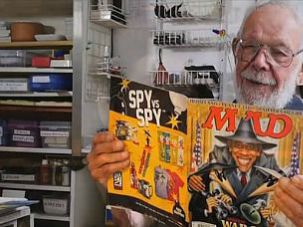
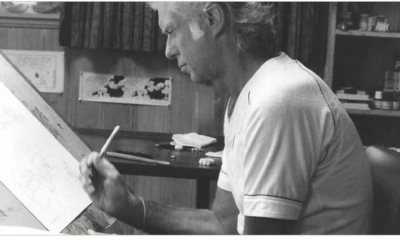
Jaffee is a sprightly 94-year-old with sparkling eyes, a deep voice and the energy of someone 20 years younger. He still wakes his wife in the middle of the night with fresh ideas for covers or cartoons, and spends his days creating new pieces for Mad. Jaffee, who started working at Mad in 1955 and has been drawing the Fold-Ins on the final page for the last 52 years, is the magazine’s longest-lasting and most important contributor. He has also created countless ridiculous inventions for things such as improved drink cans and cigarettes to help you stop smoking, as well as Mad’s “Snappy Answers to Stupid Questions.”
“So what is it you want to know?” Jaffee asked me as I stood next to his big draftsman’s table.
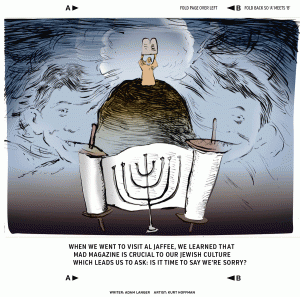 I explained that I was working on a book about Mad and Jewish culture, so my first question was the obvious one: Why was there so much Yiddish in Mad?
“Well, first of all, because I tend to think in Yiddish, and Yiddish conveys humor better than English.”
“You still think in Yiddish then?” I asked.
“It’s narishkeit, but I still do,” he said with a chuckle.
As a child, Jaffee lived for seven years in a shtetl in Lithuania. He was born in America, but his homesick mother took her four sons back to Eastern Europe for most of 1927 through 1933, and during that time, he lived much of his daily life in Yiddish. Yet, as he explained, upon returning to New York at 12, he switched back to English so his “intellectual Yiddish is only up to the age of 12.”
Jaffee explained to me that the two main architects of Mad during the first decade, the editor Harvey Kurtzman, and the artist (and his best friend) Willie Elder, had both grown up in New York families where their parents spoke and argued in Yiddish. For them, Yiddish was the inherently funny language that their parents would use to tell secrets and swear. While Jaffee was fluent in Yiddish, Kurtzman and Willie were not. According to Jaffee, Willie “didn’t know any Yiddish, and his parents would be arguing and all he would hear was a stream of funny words, and he would pick up the curse words his parents were throwing at each other in anger.” As a result, the Yiddish Kurtzman and Elder used during Mad’s first decade was based on finding the funniest-sounding words to evoke their parents’ humorous cut downs.
For example, the iconic Mad word furshlugginer was derived from the Yiddish word shlogan (to hit), while the meaning of the word potrzebie has been debated by Mad readers and academics for years. The word was first introduced in the Letters to the Editors section called Mad Mumblings in response to a query from a soldier (many if not most letters during the early 1950s were from men in the military ): “Please tell me what in the world ‘Furshlugginer’means. – Larry E. Lengle E.M.F.N – c/o F.P.O, New York, New York.” The answer from the editors to this was “It means the same as Potrzebie. –ed.”
The adamant refusal of the editors to explain the made-up word became a running joke. Today, Mad scholars theorize that potrzebie was in fact based on a Polish word that Kurtzman discovered on a jar of aspirin. According to Jaffee, though, this is not the case: “There was an expression in Lithuania when I was a kid — “putz-rebbe.” Harvey must have heard that. Putz is genitals and it is applied as an insult to the rebbe. It’s like saying, ‘Oh that stupid teacher’ or ‘putz-rebbe.’”
In fact, as Jaffee explained to me, much of the humor in Mad was deeply Jewish because it was based on satire created by a community that saw itself as not having much power and which used the jokes to take down those who “had it made,” i.e., rabbis, parents and, later, the rich and powerful. As he explained it, being a Jewish kid in the shtetl who was constantly hungry, “your only revenge is to expose and make fun of the frailties of the big shots and the ‘better-than-thou’ people. We made fun of our rabbis. Some of it was a bit raw and mean spirited, especially the comments about the personal habits of the rabbi when he went to the outhouse and defecated all over the board. This is the stuff that makes you feel equal [to] or better than they are. So going after the wealthy is such a release when you are barely getting by.”
Revisiting Mad as an adult, I was stunned to see the constant use of Yiddish, particularly during the first decade. In Mad’s first issue, there was a story entitled “Hoohah!” a transliterated Yiddish term for “a big to-do,” and the Yiddish/Hebrew term “ganef” (thief ) was employed in a satire of spy magazines. In nearly every issue of the first eight years of Mad, there was at least one Yiddish word, and in many cases more. Typically, the Yiddish words were used in mainstream settings, such as in the fourth issue of the magazine in a parody of Superman called “Superduperman.” Here, the supremely American iconic hero said the words “Shazoom? Vas ist das Shazoom?” For non-Yiddish speaking readers, the comedy was based on the archetypal American hero uttering strange Jewish intoned words. For the Yiddish-speaking reader, Clark Kent was not only hiding the fact that he was Superman but also that he was a Jew. It was a typical yet extraordinary moment of Mad’s writers suggesting that beneath the surface of even the most iconic American hero, there were Jewish roots, which of course there were.
Mad is famous for delivering pointed attacks on the powerful from a subversively left-wing perspective, and, according to Jaffee, this was because the first generation of Mad—Kurtzman, Elder and Jaffee himself — came from Jewish traditions. All the founders had grown up in Yiddish-speaking New York homes and became close friends at the High School of Music and Art. Raised in a world of Jewish humor and Borscht Belt schtick, this group of talented young men brought that background to Mad and in so doing made it the one of the most popular magazines in American history, reaching a pinnacle of 2 million circulation during the 1970s.
I asked Jaffee if he and the other writers, artists and editors considered their non-Jewish readers when they were using so much Yiddish, and he recalled that Kurtzman, the first editor, “wanted funny meaningless words. Meaningless to the general reading public, but not meaningless to someone who grew up in a Jewish household.” Overall, “Kurtzman’s philosophy was ‘why do I think it’s funny? If I think it’s funny, other people will too. Even if it is these throwaway words.’” For the readers who did not know the Yiddish words and jokes, Jaffee felt “the average reader in the country” wouldn’t have “made a connection between these strange words and the fact that a lot of people working for Mad were Jewish.” For them it would have been a jokey, funny, curse-like word. Yet over time, as non-Jewish readers learned the specific Yiddish language of Mad, even they began using Yiddish terms in their letters to the magazine.










You must be logged in to post a comment Login